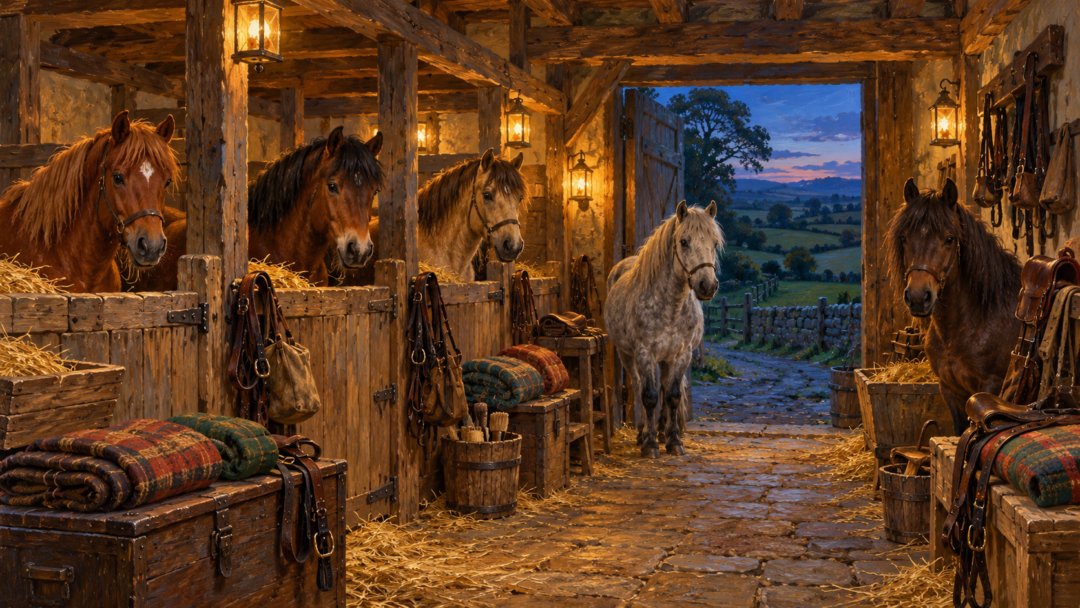
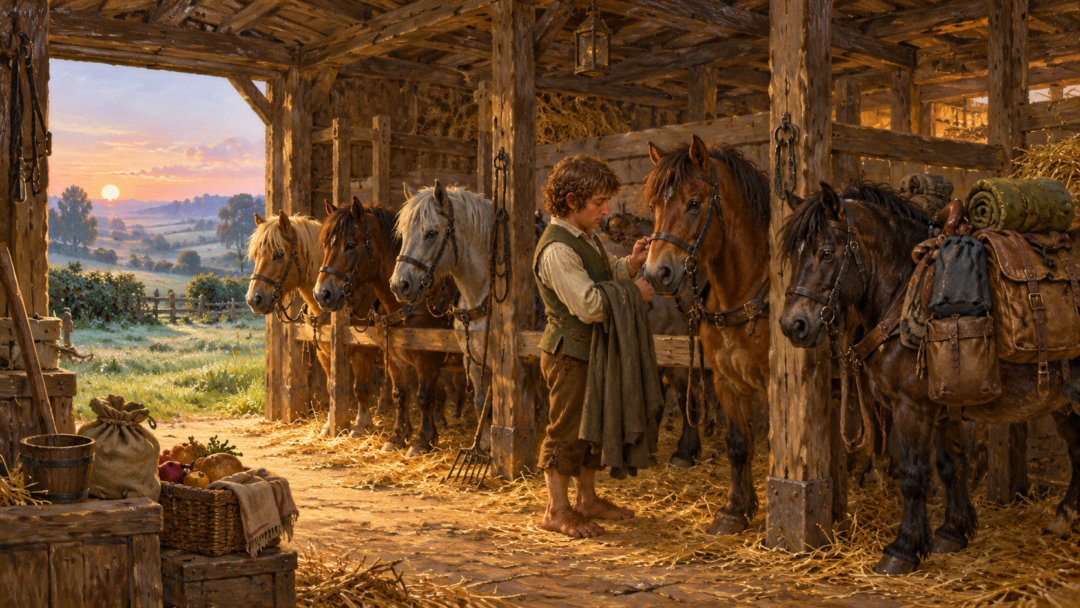
Five ponies are waiting in a stable across the fields. Their travelling equipment is packed, their supplies are ready, and nearly everything needed for departure has already been arranged. Frodo Baggins has not yet openly settled the practical details of his journey, but his friend Merry Brandybuck is prepared to leave within an hour.
That is the wonderfully revealing moment in The Fellowship of the Ring, in the chapter “A Conspiracy Unmasked.” Frodo believes he has been managing a difficult secret, while Merry has quietly been managing the horses—or, more accurately for hobbits, the ponies.
The difference matters. Frodo has been thinking about whether to leave, whom to trust, and what his departure might mean. Merry has been answering a more immediate question: what will everyone need when it is finally time to go?
His five ponies are not merely a charming example of hobbit efficiency. They show how thoroughly Frodo's friends have anticipated the practical consequences of a decision he has been reluctant to share.
The Stable Is Ready Before the Conversation Is Finished
The scene begins with an unmistakable contrast between words and preparations.
Frodo has just heard a travelling song that urges departure before daylight. Pippin wonders whether the words are meant literally. Frodo cannot yet give a definite answer.
He is considering the dangers of remaining in Buckland, the uncertainty surrounding Gandalf's absence, and the warning he received from Gildor not to delay. He also knows that leaving will require considerable preparation.
Merry already has an answer to that last problem.
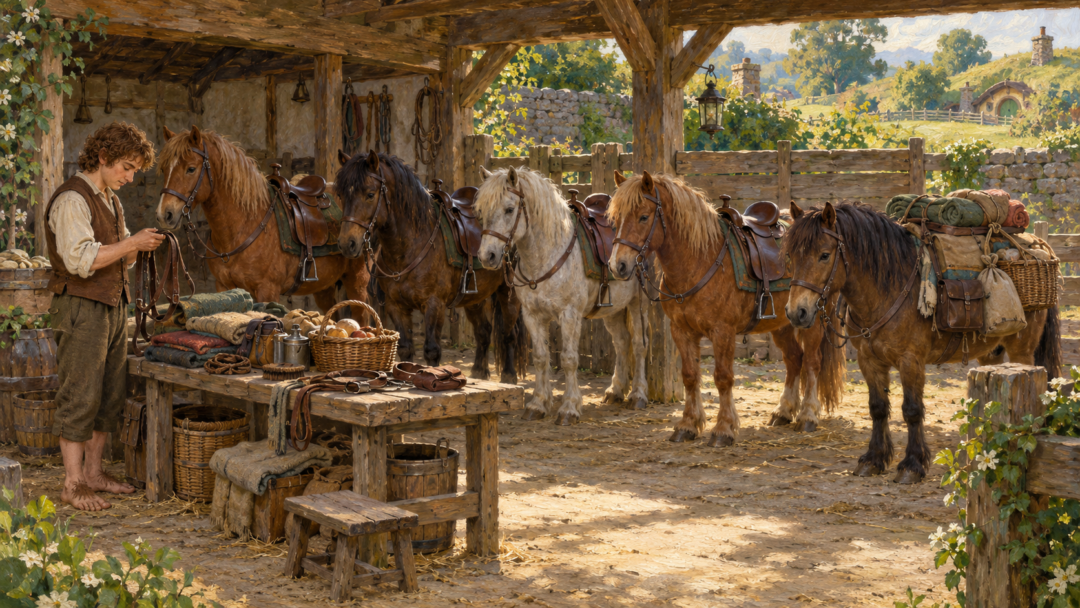
He explains that they could depart in an hour. Five ponies are waiting in a stable across the fields, while supplies and equipment have been packed. Only some additional clothing and perishable food remain to be dealt with.
It is a remarkably specific announcement. Merry does not claim that everything about the journey is settled. He reports what is ready, where it is, and what still needs attention.
That distinction gives the moment its practical appeal. A vague promise to help would leave Frodo wondering how much work remained. Merry supplies an inventory instead.
The stable is not a distant possibility or a plan for some later occasion. The ponies are physically waiting nearby. The travelling equipment has been assembled. The uncertainty of departure has been reduced to a manageable number of unfinished tasks.
Frodo still has decisions to make, but he no longer has to begin organizing the journey from nothing.
Why Five Ponies Make Sense for Four Travellers
The number five tells its own small story.
Four hobbits are to travel onward together: Frodo, Sam, Merry, and Pippin. Their arrangements include a fifth pony for baggage, rather than expecting every possession and provision to accompany its owner on a riding pony.
Four riding ponies provide transport for the companions. The baggage pony provides a separate means of carrying their supplies. It reflects the ordinary demands of travelling with clothing, provisions, and equipment, even when the travellers are small and accustomed to comparatively modest comforts.
Merry's preparation also goes beyond obtaining animals.
He has packed stores and tackle, meaning that the ponies are part of an organized travelling arrangement rather than five animals waiting without the necessary gear. A supply of food without a way to transport it would be an incomplete solution. So would a stable full of ponies without their equipment.
Perishable food is especially telling. Unlike durable provisions, it benefits from being gathered nearer departure. Merry's distinction between what is ready and what remains unfinished shows an understanding of the order in which preparations should happen.
None of this guarantees an easy journey. A baggage pony cannot choose a safe route, and packed provisions cannot remove uncertainty about what lies ahead.
But arrangements made in advance give the companions something useful: the ability to act on a decision without first undertaking an entire round of provisioning.
Crickhollow Is More Than an Empty Address
To understand why Merry has prepared so much, it helps to look at the house where the conversation takes place.
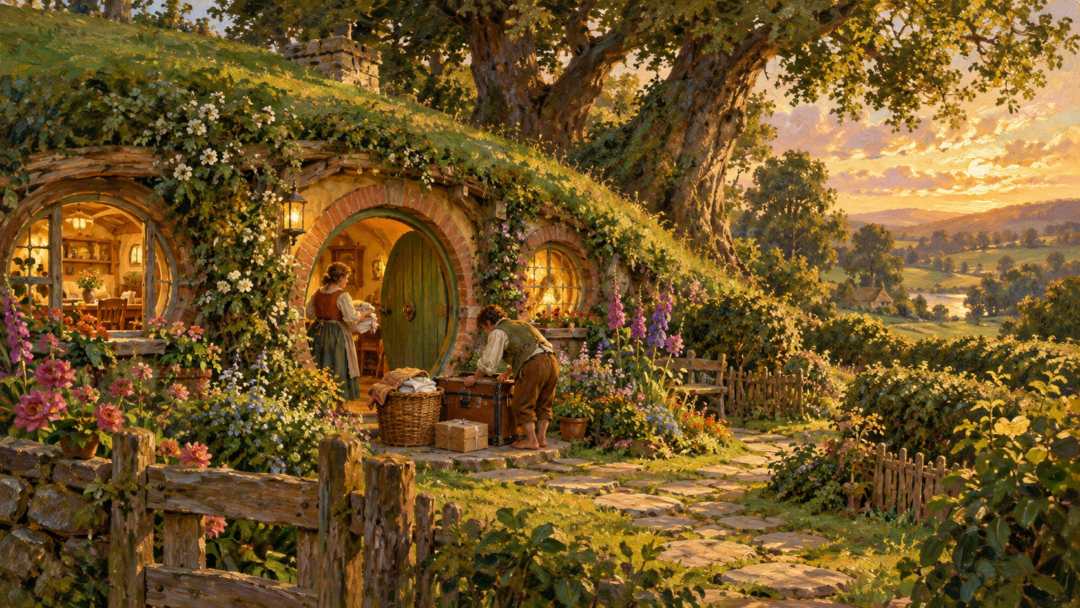
Crickhollow, in Buckland, is supposed to be Frodo's new home. His move from Hobbiton has provided an outwardly ordinary explanation for leaving Bag End behind.
A hobbit relocating to a house is familiar Shire business. Possessions must be transferred, rooms arranged, and friends enlisted to help. Such activity gives Frodo's departure the appearance of a change of residence rather than the beginning of a longer, concealed journey.
Merry has been involved in the arrangements surrounding that move.
The house therefore serves two purposes in the story. It is a real place where the companions can gather, eat, talk, and sleep under a roof. It also supports the appearance that Frodo has come to Buckland to live.
The distinction between the two purposes grows increasingly important as the conversation develops.
Crickhollow cannot remain a convincing destination if Frodo's departure immediately becomes public knowledge. Yet its apparent normality has already helped establish an ordinary explanation for his arrival.
Fredegar Bolger's part in the friends' conspiracy fits this arrangement. Unlike Frodo, Sam, Merry, and Pippin, he is not one of the four companions preparing to ride onward. His place is connected with keeping up the appearance that Frodo remains at his new home.
This is another reason not to mistake the five ponies for five departing riders.
Merry's practical work belongs to that larger effort. The stable and the house are not separate stories; both have been organized around Frodo's concealed intentions.
How Merry Knows What Frodo Has Not Told Him
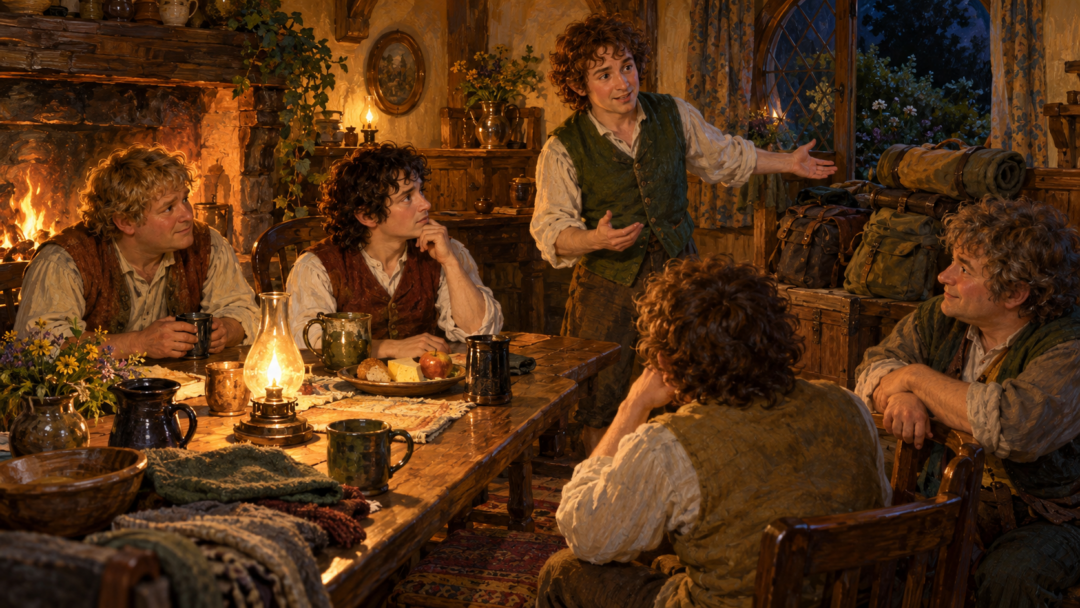
Frodo's surprise becomes more understandable when the friends reveal the extent of their knowledge.
He has been trying to keep his true plans hidden, even from people close to him. Yet the friends have noticed enough to understand that his departure from the Shire is not simply a permanent move to Buckland.
Their conspiracy is a conspiracy of assistance.
Merry, Pippin, Sam, and Fredegar have been sharing information and making arrangements because they understand that Frodo intends to go farther than his announced destination.
Sam has a particular connection to this knowledge, having heard things about Frodo's plans that Frodo did not expect to circulate among his friends. Merry is also no newcomer to the puzzle. His attention to Frodo's affairs predates the final conversation at Crickhollow.
The point is not that the friends have been told every detail of the road ahead. They have not.
Rather, they know enough to recognize that Frodo is preparing for something considerably more serious than settling into a comfortable house.
That knowledge explains Merry's readiness without requiring an invented private instruction from Frodo.
He has not waited for an official invitation to begin collecting supplies. Nor has he assumed that Frodo's public explanation tells the whole story.
By the time the truth is openly discussed, the practical arrangements have already caught up with the secret.
Frodo recognizes the efficiency of the operation. His friends have not merely uncovered his intentions; they have prepared to accompany him.
One Hour of Readiness Is Not the Departure Time
Merry's declaration that they could leave in an hour is easy to misunderstand.
It does not mean that the party actually rides away an hour later.
The conversation continues because an important question remains unresolved: whether Frodo should wait for Gandalf or depart without him.
Frodo is troubled by Gandalf's failure to appear. He also remembers Gildor's advice against waiting. Meanwhile, the possible arrival of the Black Riders makes delay increasingly difficult to contemplate.
Merry contributes information about Buckland's access arrangements. He discusses the North-gate, the gate-guards, and the possibility that riders asking for Mr. Baggins might eventually be admitted.
He also points out that Frodo's arrival at Crickhollow is widely known.
This information is relevant because a house that looks like an ordinary destination may also be a place where someone knows to search for its new occupant.
Frodo considers these circumstances and finally decides to leave the following morning, as soon as there is light.
His decision establishes the actual departure plan. Merry's earlier statement establishes only how quickly the group could be equipped to leave.
The distinction makes both characters' contributions clearer.
Merry has organized the material side of departure. Frodo must still decide when to go and which route to take.
Even a complete packing list cannot answer those questions.
Nor does Merry's hour-long estimate provide evidence for any precise amount of travelling time gained. The text gives the companions a state of preparedness, not a measurable advantage expressed in miles or minutes.
The useful result is simpler: preparations no longer dictate the decision.
The Comfort of Having the Small Things Settled
What makes the episode so enjoyable is its combination of serious decisions and recognizably domestic details.
There is a house for the night. There are clothes that still need packing. Fresh food must be gathered. The ponies are not standing conveniently at the door but waiting in a stable across the fields.
These are the concerns of people preparing for an actual journey, not merely announcing an adventure.
Merry has treated them accordingly.
Their commitment is not confined to conversation. It already exists in the shape of five waiting ponies and packed supplies.
The arrangement does not remove the uncertainties that trouble Frodo. The friends still have to agree on departure, and the journey still requires decisions no quantity of baggage can settle.
What Merry accomplishes is narrower, and therefore more convincing.
He makes sure that when Frodo is ready to decide, the ordinary business of setting out will not have to begin from scratch.
Five ponies are a modest number, but they carry a generous meaning. Four are for friends who have chosen to travel together; the fifth makes room for the things they will need.
Before Frodo can fully explain where he is going, Merry has already made sure they can bring their baggage.
That is the quiet satisfaction of this chapter's preparations: friendship becomes visible not through a grand declaration, but through an unexpectedly complete arrangement in a stable across the fields.
Sources & Notes
- Tolkien Gateway — A Conspiracy Unmasked. https://tolkiengateway.net/wiki/A_Conspiracy_Unmasked
- Tolkien Gateway — Crickhollow. https://tolkiengateway.net/wiki/Crickhollow
- Tolkien Gateway — Fredegar Bolger. https://tolkiengateway.net/wiki/Fredegar_Bolger
- Tolkien Gateway — Meriadoc Brandybuck. https://tolkiengateway.net/wiki/Meriadoc_Brandybuck
- The Encyclopedia of Arda — Crickhollow. https://www.encyclopedia-of-arda.com/c/crickhollow.html
Primary text: The Fellowship of the Ring, Book I, Chapter 5, “A Conspiracy Unmasked,” plus Book I Chapters 4 and 6 for the Crickhollow and Old Forest setting. These reference pages document the chapter synopsis, Crickhollow as Frodo's new house in Buckland, Merry's earlier provisioning of ponies and gear, and Fredegar “Fatty” Bolger's part in the friends' conspiracy. Tolkien Gateway records that the first printing gave the party six ponies and that the 50th Anniversary Edition corrected the number to five; this article follows the corrected text. The reading of the ponies as evidence of friendship's practical preparation is interpretation of that material, not a claim by the sources.