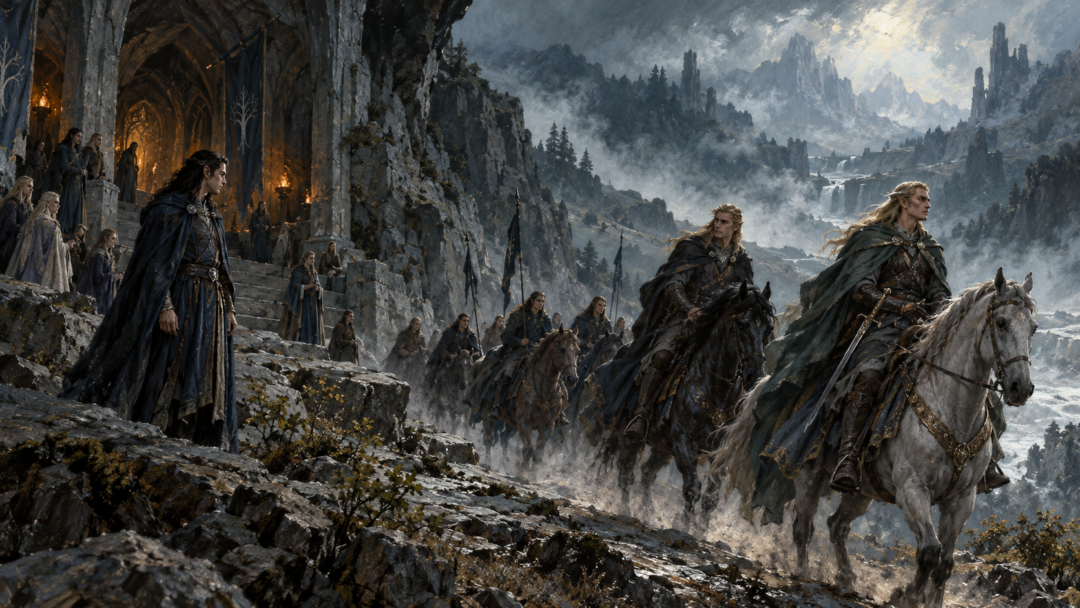
When Celegorm and Curufin are finally driven out of Nargothrond, they leave with something more damaging than a lost refuge. Their authority has collapsed. The people who had once listened to them now reject them, Orodreth banishes them, and even Curufin’s own son does not ride away at his side. Celebrimbor remains behind.
That small action carries unusual weight because of who his family is. In the Curufin-son conception of Celebrimbor’s life, he does not merely become geographically separated from his father. He repudiates Curufin’s deeds and refuses the automatic political solidarity that so often defines the House of Fëanor. But the break is specific. It is not the undoing of an oath Celebrimbor never swore, not a rejection of inherited craftsmanship, and not evidence that every other version of his ancestry belongs in the same biography.
Nargothrond turns Fëanorian prestige into a political crisis
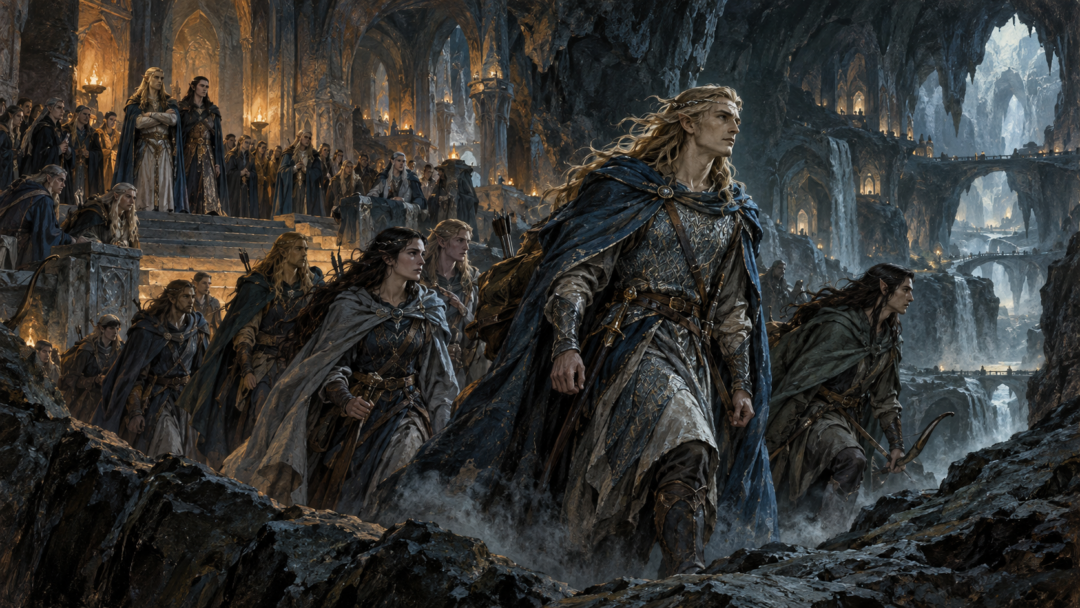
Curufin and Celegorm come to Nargothrond after the Dagor Bragollach has shattered their position in East Beleriand. They arrive as displaced princes of formidable lineage, received into the hidden realm of Finrod Felagund. That status matters. They are not obscure wanderers suddenly seizing a kingdom; they are sons of Fëanor, veteran lords with followers, reputation, and the burden of the Oath behind them. In Nargothrond, those assets become political leverage.
The crisis sharpens when Beren asks Finrod for help in the quest for a Silmaril. Finrod is bound by his promise to Barahir’s house. Celegorm and Curufin are bound by the Oath of Fëanor, which claims the Silmarils against anyone else who would possess them. Their opposition is therefore not a mere policy disagreement. The old oath enters the internal politics of another Elven realm and helps turn Beren’s request into a struggle over obedience, kingship, and fear.
Finrod chooses to keep faith with Beren even when his people will not follow him. He casts down his crown and leaves Nargothrond, with Orodreth assuming rule after his departure. Celegorm and Curufin remain, and their influence rises. The episode exposes one of the most dangerous forms Fëanorian politics can take: not simply marching beneath a family banner, but making the family’s oath and prestige decisive inside a community that is not theirs to command.
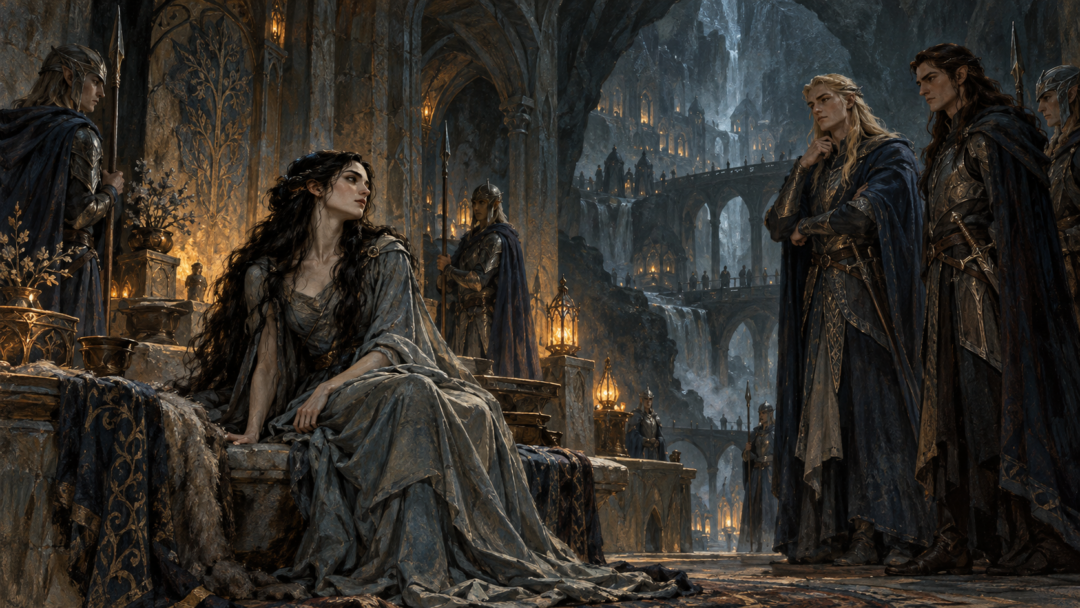
Their conduct toward Lúthien deepens the failure. After she reaches Nargothrond in search of Beren, the brothers detain her and conceal what they know of Beren and Finrod. Their plans are entangled with their own power and with Celegorm’s intended marriage to Lúthien. Whatever one makes of every motive in the episode, the narrative does not leave their actions morally neutral. Their position in Nargothrond depends increasingly on manipulation rather than the hospitality that first admitted them.
Then the balance reverses. Prisoners released from Tol-in-Gaurhoth return with news that exposes the brothers’ conduct, and opinion in Nargothrond turns against them. Orodreth, restored to authority, will not allow them to be killed in his halls, but he expels them. Celebrimbor’s choice belongs precisely here. The text gives us no private debate between father and son, public speech, or ceremonial renunciation. It gives something firmer than invented psychology: when Curufin and Celegorm leave, Celebrimbor repudiates his father’s deeds and stays.
Remaining behind breaks the expected chain of kinship
For a member of the House of Fëanor, staying is not a passive detail. The sons of Fëanor are repeatedly defined by collective obligation, shared campaigns, and the terrible persistence of their oath even when individual brothers differ in temperament. Curufin himself has acted in close partnership with Celegorm. When possession of a Silmaril is involved, the sons repeatedly act as a family whose sworn claim overrides other loyalties and political boundaries.
Celebrimbor interrupts that pattern. He does not defend Curufin because Curufin is his father. He does not treat exile from Nargothrond as a family command to depart. Most importantly, his response attaches moral consequence to deeds rather than blood. The point is not that he ceases to be Curufin’s son; the point is that being Curufin’s son does not settle where his allegiance must lie.
That is why “repudiation” should not be inflated into a complete political manifesto. We are not told that Celebrimbor condemned every earlier action of Fëanor’s house, rejected every relative, or formulated a new theory of Noldorin rule. We are told that these deeds of Curufin were enough for a break. The narrowness of the evidence makes the decision more useful, not less: it identifies a real boundary without pretending to know every belief behind it.
Nor does the record fill in what follows. Celebrimbor’s movements through the rest of the First Age are largely obscure in this conception. That silence matters. Remaining in Nargothrond at this moment is an attested act; a detailed life of resistance after it would be reconstruction. His First Age significance rests on the choice we actually have, not on adventures supplied to bridge the gap to Eregion.
He rejects Curufin’s deeds, not the inheritance of making
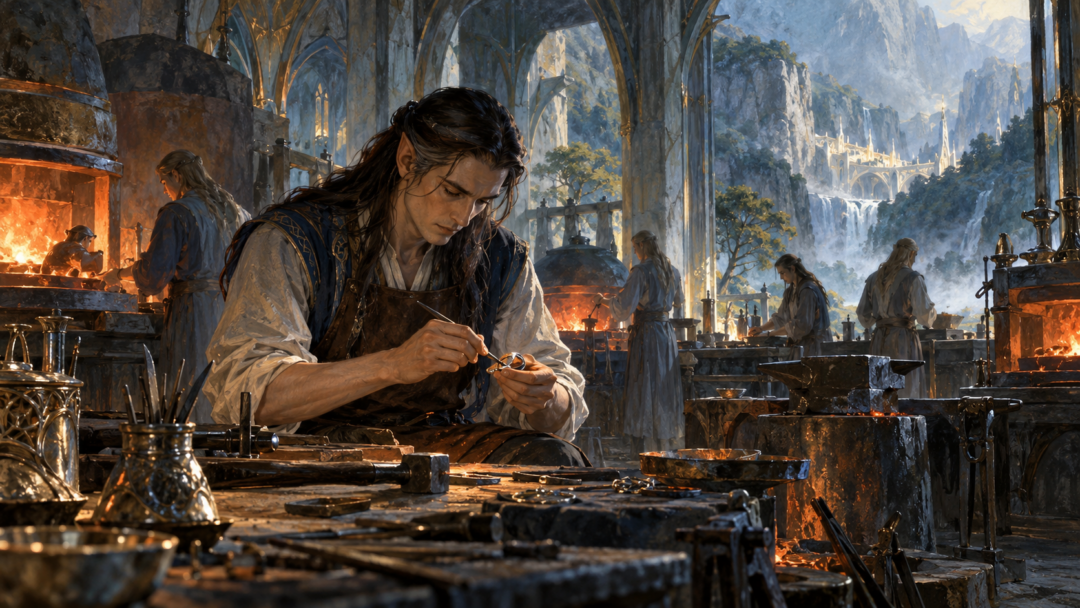
The separation is especially striking because Celebrimbor does not escape Fëanor’s legacy by becoming unlike his family in every respect. His later identity is inseparable from craft. As lord of Eregion and chief of the great jewel-smiths, he becomes the supreme Elven maker of his age, associated with works whose fame runs directly back toward Fëanor. The family resemblance that matters here is skill, not political obedience.
That distinction prevents a common mistake. Craft inheritance is not the same thing as oath inheritance. Curufin is one of the seven sons who swore the Oath of Fëanor. Celebrimbor did not swear it. There is therefore no oath for his repudiation at Nargothrond to dissolve, magically or legally. He is stepping away from his father’s conduct and company, not being released from a supernatural bond that never attached to him in the first place.
It also means there is no need to invent an apprenticeship drama to explain his later greatness. The tradition connects Celebrimbor to a family of extraordinary makers, and his father is himself renowned for skill. But the sources do not give us a scene in Curufin’s workshop in which techniques, tools, or secrets are handed down. The safe conclusion is simpler: Celebrimbor can inherit a craft tradition while refusing the politics practiced by the man from whom that tradition descends. He does not solve the danger of Fëanorian inheritance by abandoning making; he carries the creative inheritance forward into a new age. Nargothrond marks a political and moral separation without turning Celebrimbor into the opposite of his ancestors.
Celebrimbor’s other origins cannot be added as extra chapters
There is a further complication: “Celebrimbor” does not have one perfectly stable ancestry across every surviving conception. The Curufin-son version is the frame in which the Nargothrond repudiation makes sense. Other writings imagine him differently, and those alternatives are not missing episodes from the same life. In a version associated with Concerning Galadriel and Celeborn, Celebrimbor is an artificer of Gondolin who later becomes important in Eregion. That is already a different First Age foundation: the Nargothrond scene with Curufin cannot simply be inserted earlier or later when the background itself has changed.
A still later conception makes Celebrimbor one of the Teleri of Aman, a great silver-smith connected with Celeborn and drawn eventually toward Eregion and the mithril of Moria. Another late text, Of Dwarves and Men, instead presents him as a Sinda claiming descent from Daeron. These versions preserve recognizable features—craftsmanship, Eregion, relations with the Dwarves—but they alter the ancestry that gives the Nargothrond episode its force.
This is where publication history and in-world biography must be kept apart. A reader can compare the versions and learn something from the repeated effort to place Celebrimbor within different traditions of craft. But comparison is not harmonization. A Telerin silver-smith, a Gondolin artificer, a descendant of Daeron, and Curufin’s son cannot all be treated as successive identities in one seamless family tree.
The same caution applies to the Elessar traditions, where Celebrimbor is connected in some versions with the making of the green stone and with memories of Gondolin. Those stories are valuable for tracing how his character developed, but they do not supply secret evidence for what Curufin’s son did after Nargothrond. A variant can illuminate the history of the legendarium without becoming a missing chapter of another variant.
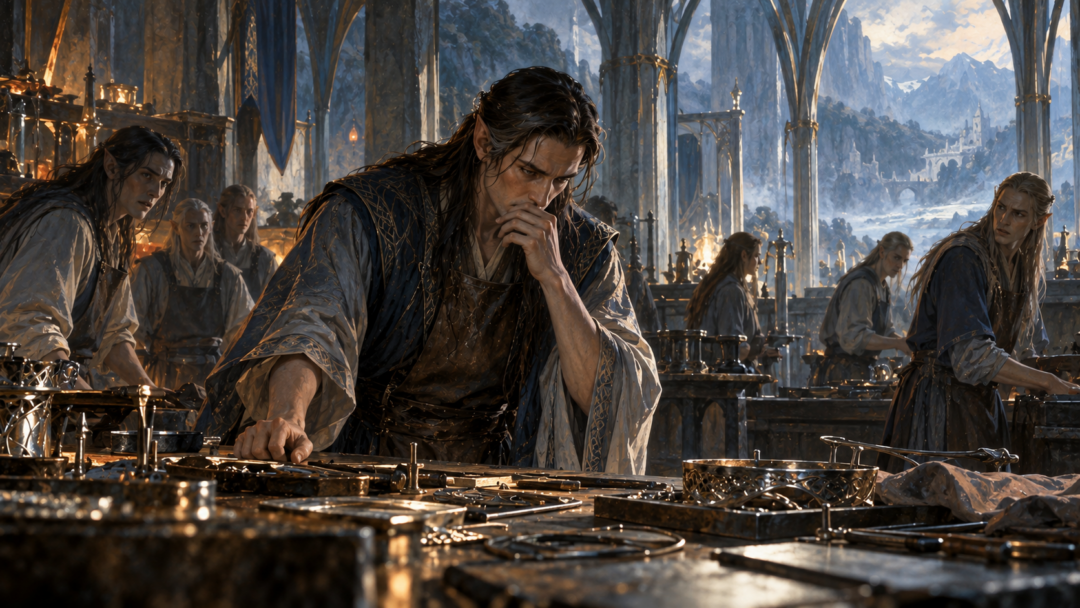
The break is real without making Celebrimbor morally invulnerable
Celebrimbor’s refusal to follow Curufin does not make him immune to later error. In the Second Age, the smiths of Eregion accept Sauron’s instruction while he is still hiding his true purpose, and Celebrimbor recognizes the trap only when the One Ring is forged. The son who once refused one disastrous alignment can still be deceived by another powerful figure. An earlier act of judgment is not a permanent shield against misjudgment.
That later failure does not cancel Nargothrond. Moral choices in Middle-earth are not retroactively erased because the chooser later errs. Celebrimbor saw enough in Curufin’s conduct to remain behind when kinship could have pulled him away, and the narrative records the break precisely because it was not automatic.
The cleanest image is therefore the simplest one: Curufin rides out of Nargothrond without his son. Celebrimbor keeps the name, the ancestry, and the dangerous gift for making, but not the obligation to follow. In a house so often driven by inherited loyalty, that refusal is small in scale and enormous in meaning.
Sources & Notes
- Tolkien Gateway — Celebrimbor: Nargothrond, craft inheritance, and alternative origins https://tolkiengateway.net/wiki/Celebrimbor
- Tolkien Gateway — Curufin: the Nargothrond power struggle and Celebrimbor's repudiation https://tolkiengateway.net/wiki/Curufin
- Silmarillion Writers' Guild — Celebrimbor, Part 2: textual history and Tolkien source references https://www.silmarillionwritersguild.org/reference/characterofthemonth/celebrimbor2.php
- The Encyclopedia of Arda — Celebrimbor: family, Nargothrond, and the Rings of Power https://www.encyclopedia-of-arda.com/c/celebrimbor.html
Primary narrative: The Silmarillion, 'Of Beren and Lúthien'. These references document Curufin's expulsion, Celebrimbor's refusal to follow him, his craft inheritance, and the alternative ancestry traditions. The political reading is interpretation; the differing origins are not combined into one biography.