
In Valinor, before the first sunrise of the familiar Silmarillion story, silver light gives way to gold. Telperion fades as Laurelin brightens; later their lights mingle again, and another cycle begins. It seems like the ideal clock for a world without ordinary days. Yet ask how long a Year of the Trees lasted, and two strikingly different answers appear: about 9.582 solar years, or 144.
Neither number is simply a bad multiplication. They come from different ways Tolkien constructed Valian time. In the Annals of Aman, a Valian hour corresponds to seven hours of our time, and a Valian year contains a thousand Valian days. In a later scheme, a Valian day itself equals a solar year, and larger units grow by twelves. The arithmetic works inside each account. The trouble starts when a conversion is treated as a permanent rule for every version of Arda’s history.
A clock made of silver and gold
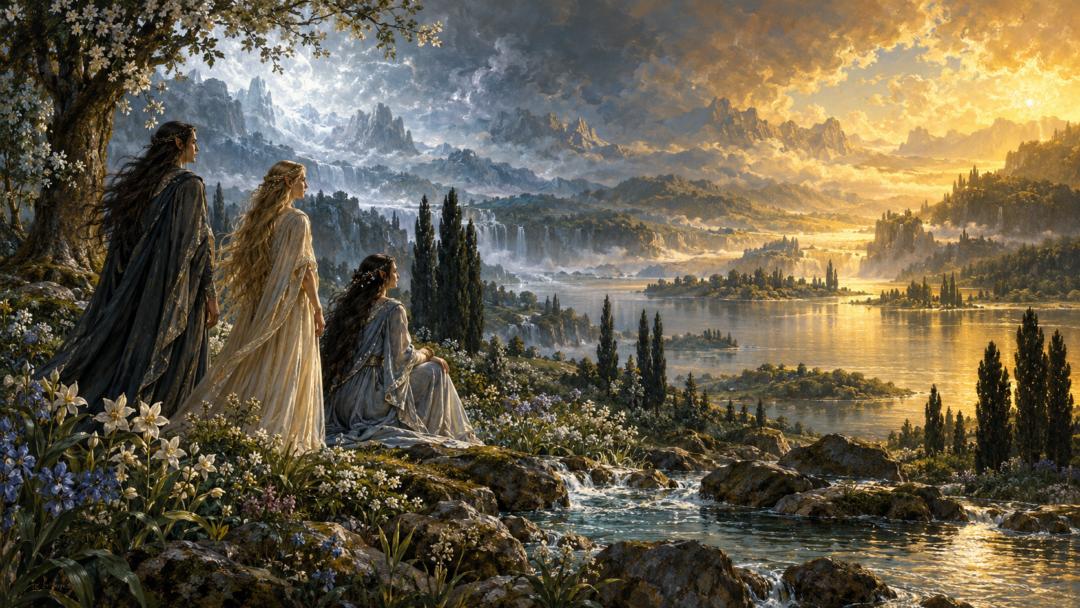
The Two Trees were not merely lamps lighting the Blessed Realm. Their waxing and waning offered a recurring pattern by which the Valar could reckon time. Telperion’s silver radiance and Laurelin’s golden light each rose to brilliance and diminished. At the transitions, both lights could be present together. This rhythm supplied something that Middle-earth, under its stars in this telling, did not possess in the same form: a repeating measure of light in Valinor.
The Annals of Aman, preserved in Morgoth’s Ring, describes a complete cycle of the Trees as a Valian day, divided into twelve hours. These are not twelve modern clock faces hanging beneath the branches. An hour here belongs to a specifically Valinorian reckoning, tied to the Trees’ changes rather than to the Sun crossing a sky. Calling it an “hour” makes the unit legible to readers; it does not establish that it lasts sixty of our minutes.
In this account, a thousand such days make a Valian year. The reckoning even connects the year with the Trees’ growth: after a thousand days they put forth another branch. This gives the larger unit a place in the imagined world, not just in a conversion chart. The Years of the Trees also names an era, while a Valian year is a unit used for spans within the chronology. Dating an event and deciding the duration of its measuring unit are related but separate tasks.
What the Annals of Aman lets us calculate
The widely repeated shorter conversion has a definite basis. In the commentary on the early Annals of Aman in Morgoth’s Ring, one hour of the Trees equals seven hours of our time. Twelve Tree-hours make one Valian day, giving 84 ordinary hours. Multiply by the thousand days in a Valian year, and the result is 84,000 ordinary hours. The factors follow the definitions of this particular reckoning.
At 24 hours per ordinary day, 84,000 hours equal 3,500 days. If the solar year is taken, for this calculation, as 365.25 ordinary days, the ratio is approximately 9.582 solar years to one Valian year. The familiar decimal is not an independently observed fact about the Trees. It is a result obtained from this textual scheme and a stated convention for expressing ordinary days as solar years.
The calculation is sound on those terms. Seven ordinary hours per Tree-hour is the supplied correspondence; twelve hours per day and a thousand days per year are the chosen divisions. A reader measuring an interval recorded in the Annals can use the resulting figure, provided the relevant dates belong to that chronology. Earlier forms of the mythology had placed a Valian year near ten solar years, with some variation. The more precise Annals formula belongs to that developing tradition, not automatically to every later revision.
When a Valian day became a solar year
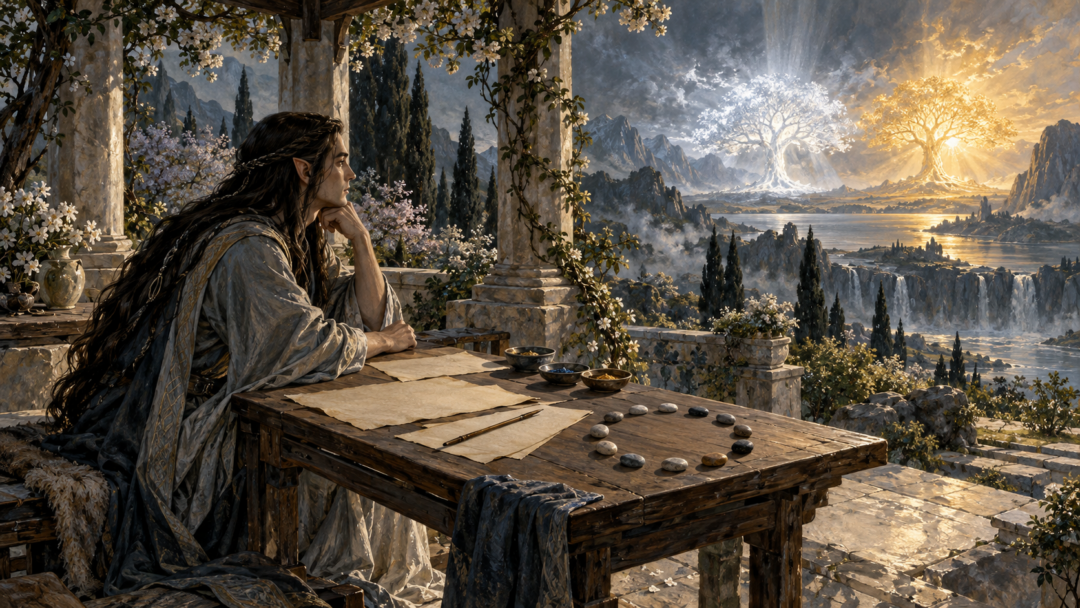
A different system appears in the late text “Valinorian Time-Divisions,” dated to around 1959 and published in The Nature of Middle-earth, Part One, section II. Here the foundational correspondence changes dramatically. One Valian day, or Tree-day, equals one löa, a year measured by the Sun. Instead of beginning with seven-hour segments and gathering a thousand days into a year, the reckoning begins with an entire solar year as its day-sized unit.
From there it proceeds by twelves. Twelve Valian days make a Valian month, equivalent to twelve solar years. Twelve of those months make a Valian year, equivalent to 144 solar years. That year is identified with a yén, the Elvish long-year. The Valian day is itself divided into twelve Valian hours and then into smaller units by successive twelves. Even “hour” has a different scale here, because it is one-twelfth of an entire solar year.
This is not a disagreement over whether a solar year contains 365 or 365.25 days. Nor is 144 a rounding of 9.582. Under the Annals arrangement, the Valian year comprises a thousand cycles of twelve Tree-hours. Under the later arrangement, it comprises twelve months of twelve days, each day equal to a solar year. The structure has changed. Although the 144-year yén also occurs in Elvish calendrical material associated with The Lord of the Rings, its existence does not turn every older Valian year into a yén. The later text makes that identification; the Annals uses another definition.
A numbered event is not a portable measuring stick
Chronologies tempt us to forget the difference between an event’s position and the size of the units used to date it. The Annals of Aman places the awakening of the Elves at Cuiviénen within the numbered Years of the Trees. Later discussions of Elvish generations, journeys and ageing developed under changed assumptions about Valian time. The event remains recognizable, but that does not mean every date and interval surrounding it survived unchanged.
Suppose someone takes a column of dates from the Annals, leaves the numbers untouched, then replaces the roughly 9.582-year unit with the later 144-year unit. The multiplication is easy; the historical claim is harder to defend. It assumes that the later construction endorses each earlier event’s placement, its relationship to neighbouring events and the time allowed between them. Shared terminology alone cannot establish that. A chronology is more than numbers waiting for a new multiplier.
Nor should every landmark be treated as the same boundary. The first flowering of the Trees, their Darkening, the flight of the Noldor and the first rising of the Sun mark different moments. The published Silmarillion makes their sequence vivid, while the Annals organizes early history into numbered entries. Anyone calculating “how long before the Sun” must identify a start and an end. A table that combines dates from one manuscript with the unit from another might contain correct arithmetic while creating a chronology that neither manuscript presents.
The Sun itself changes the setting
In the familiar account, Valinor enjoys the Trees’ light while Middle-earth lies largely beneath the stars. After Melkor and Ungoliant destroy the Trees, their last flower and fruit are used in the making of the Moon and Sun. On this telling, the Years of the Trees genuinely precede the first rising of the Sun. “Before the Sun” is part of the story’s order of events, not simply a label for a numerical interval.
Some later writings explore a Round World conception in which the Sun already exists from early in Arda’s history. The Trees’ radiance is understood differently, as preserving unmarred sunlight, and the darkness over Middle-earth has another explanation. The later “Valinorian Time-Divisions” likewise works from a world with a primeval Sun and Moon. These are alternative conceptions, not consecutive chapters in which the Sun both existed from the beginning and was subsequently created for the first time.
That change does not, by itself, choose a conversion formula. It changes the context in which a solar year can be used. Such a year may underlie the measure of time even where the Trees govern the experience of light in Aman. Trying to splice the Round World premise into the familiar creation of the Sun turns a genuine textual difference into a contradiction of our own making. The same caution applies when moving dates across the two systems of Valian reckoning.

Reading a conversion without being misled
The best test of a conversion has three parts. Which textual scheme supplies the unit? Which named interval, with which beginning and ending, is being measured? And what arithmetic convention turns its days or years into modern terms? These questions do not make every number doubtful. They let a number do precisely the work its underlying account supports, without asking it to repair the entire history of Arda.
For the Annals, one may say that a Valian year contains 84,000 ordinary hours, or approximately 9.582 solar years using a 365.25-day solar year. For the later Valinorian divisions, one may say that a Valian year equals 144 löar. Neither statement, alone, establishes the total elapsed time of every event set within the Years of the Trees. A claim about that whole span still needs dates from the same construction as the chosen unit.
Beneath Telperion and Laurelin, the mingled light marks the turning of a day without settling how many later sunrises that day represents. The silver and gold remain wonderfully definite in the story. The modern number depends on which telling has given them their measure. A reader can follow that light through the ages without pretending that every version made it strike the same hour.
Sources & Notes
- https://tolkiengateway.net/wiki/Valian_Years — Tolkien Gateway, Valian Years: compares the Annals of Aman reckoning in Morgoth’s Ring with the later Valinorian Time-Divisions in The Nature of Middle-earth, Part One, II.
- https://tolkiengateway.net/wiki/Y%C3%A9n — Tolkien Gateway, yén: the 144-year Elvish long-year, with references to The Lord of the Rings, Appendix D, and its distinction from the older Annals reckoning.
- https://tolkiengateway.net/wiki/Round_World_version_of_the_legendarium — Tolkien Gateway, Round World version of the legendarium: alternative cosmology in which the Sun precedes the Two Trees; references include Morgoth’s Ring, Myths Transformed.
- https://www.encyclopedia-of-arda.com/o/openinghour.php — The Encyclopedia of Arda, Opening Hour: Telperion’s first flowering and the twelve-hour cycle of the Trees in the familiar pre-Sun chronology.
These references distinguish the Annals of Aman reckoning from the later Valinorian time-divisions and the Elvish yén. Chronological conversions depend on the textual scheme; the Round World conception is an alternative, not a continuation of the familiar creation of the Sun.