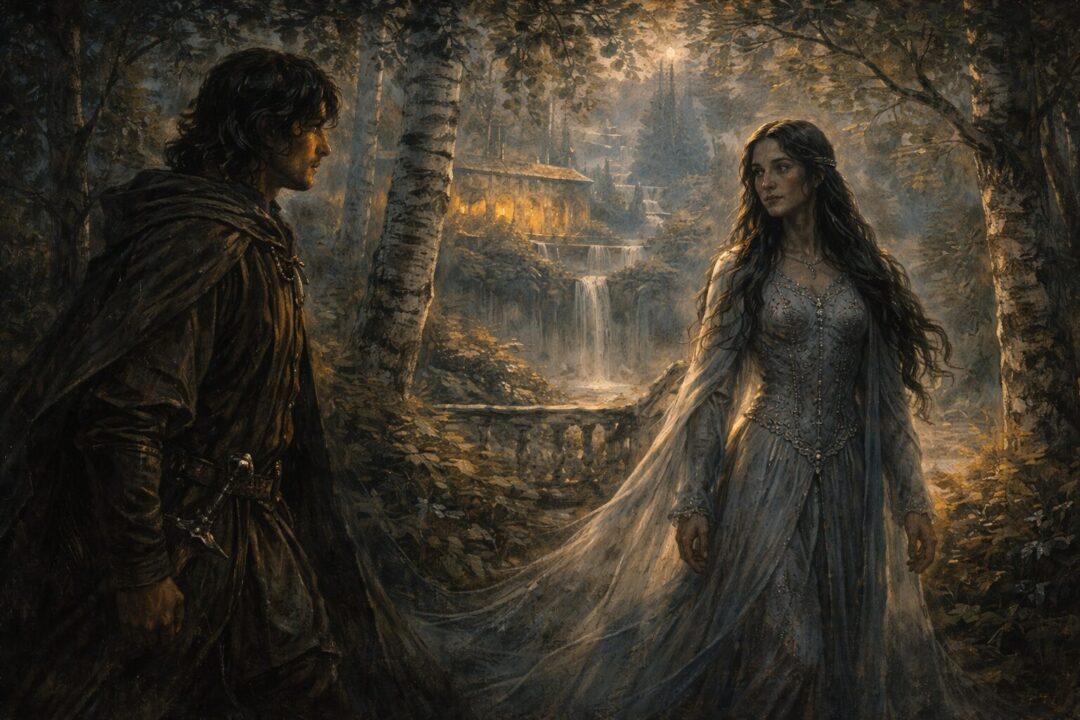
At first glance, the question sounds almost like a trap.
Aragorn is a Man.
Arwen is an Elf-maiden.
Their love story is one of the most famous in Middle-earth.
So when readers discover that Aragorn descends from Elros, while Arwen is the daughter of Elrond, the immediate reaction is often the same:
Wait. Does that mean they are related?
The answer is yes.
But the more important answer is: not in the way most people mean.
The texts do support a blood relationship between them. Aragorn comes from the line of Elros, and Elros was the twin brother of Elrond. Arwen, meanwhile, is Elrond’s daughter. So the two belong to branches of the same ancient family. That much is real, and it is not hidden. The tradition of fostering the Heirs of Isildur in Rivendell is explicitly tied to their kinship with Elrond.
And yet the story does not treat their marriage as a problem of near relation.
It treats it as the reunion of something that had long been divided.
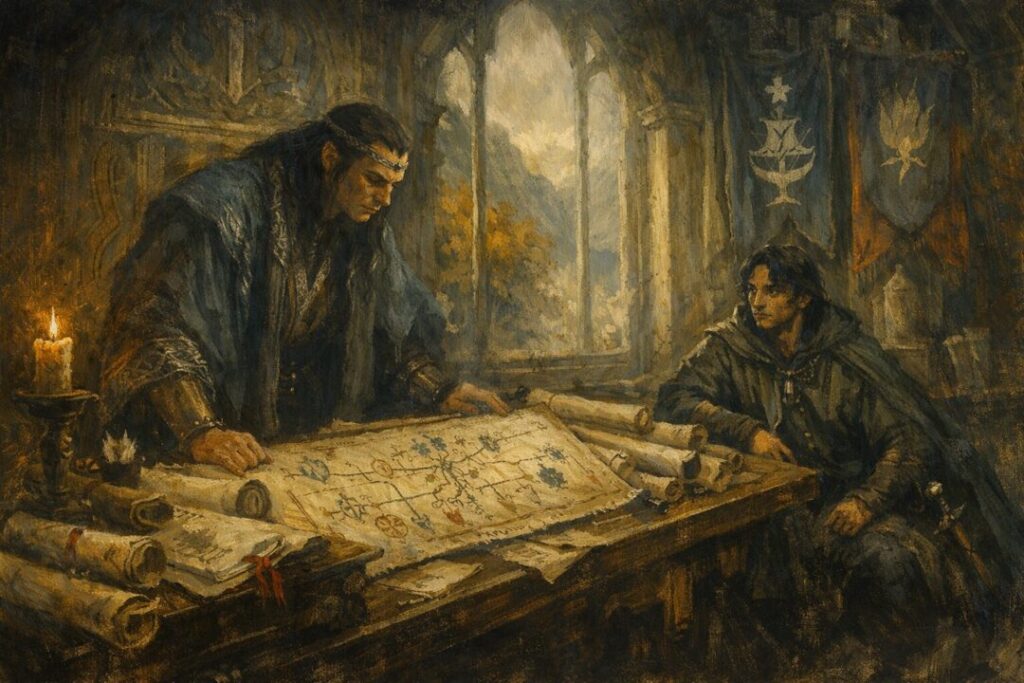
The Blood Connection Is Real
The easiest way to see the connection is to begin with Elrond and Elros.
They were brothers: the sons of Eärendil and Elwing, and among the Half-elven they received the choice of kindred. Elrond chose to remain with the Eldar. Elros chose the fate of Men and became the first king of Númenor. From Elros came the Númenórean royal line, then the Lords of Andúnië, then Elendil and Isildur, and much later Aragorn.
Arwen stands on the other side of that split.
She is Elrond’s daughter, and so she belongs to the branch that remained Elven. That means Aragorn and Arwen are indeed connected by descent from the same family line, though through two branches separated for thousands of years.
This is why Rivendell matters so much to the line of Isildur.
The heirs of that house are sheltered there “because of the kinship of their blood with Elrond himself,” as the tradition is summarized in lore references drawn from Appendix A. Aragorn is not a random stranger raised in Elrond’s house. He is fostered there as one of a line already bound to Elrond by ancestry.
So if the question is simply whether Aragorn and Arwen are related by blood, the answer is yes.
But that still does not tell us what kind of relation the text is asking us to notice.
Not Close Cousins in Any Ordinary Sense
This is where modern instincts can mislead the reading.
When people ask whether Aragorn and Arwen are cousins, they often imagine a close family relation: something near, recent, socially immediate.
That is not what the legendarium presents.
Aragorn is separated from Elros by a vast dynastic history stretching back through Númenor, the Faithful, Elendil, Isildur, the kings of Arnor, and the Chieftains of the Dúnedain. Arwen, by contrast, is only one generation removed from Elrond. The common family link is ancient. It matters genealogically, but it is extremely distant in practical human terms. That is why reputable lore summaries describe Arwen as a very distant cousin of Aragorn rather than implying any close familial bond.
The texts themselves are notably restrained here.
They do not pause to label the marriage as troubling.
They do not frame it as forbidden kinship.
They do not even emphasize the cousin idea at all.
Instead, they keep drawing attention to something else.
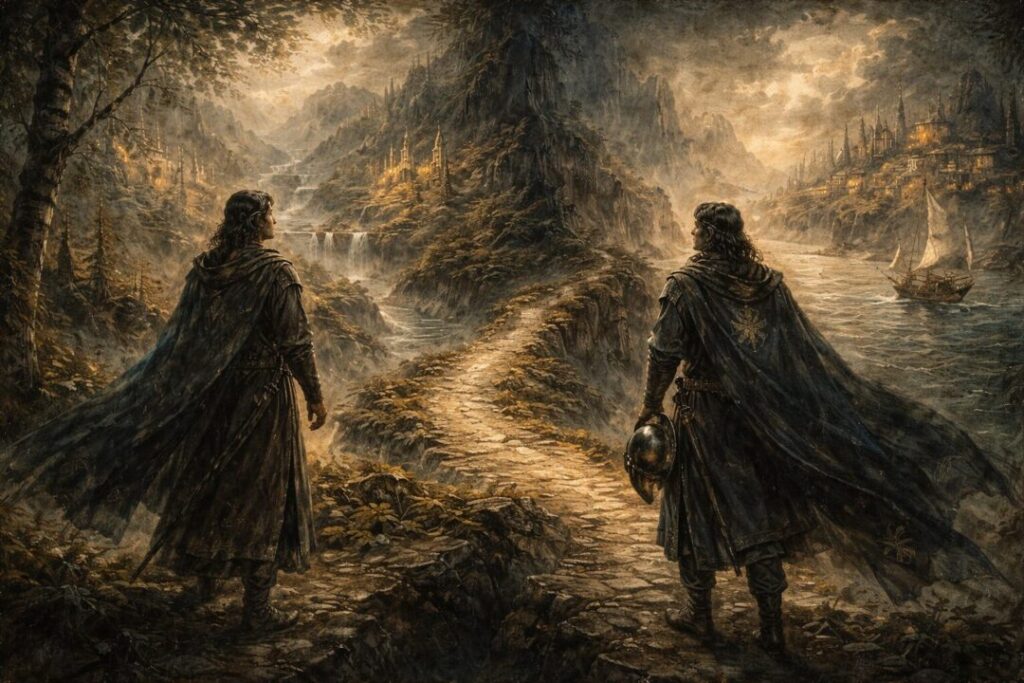
The Important Phrase: The Long-Sundered Branches
The clearest line comes in Appendix A, in the famous summary of the unions of Elves and Men.
Aragorn and Arwen are counted as the third great union of the Eldar and the Edain, after Beren and Lúthien, and Tuor and Idril. Then comes the crucial statement: by their union, the long-separated branches of the Half-elven were brought together again.
That wording changes the whole emphasis.
The story is not asking the reader to stare at a family tree in discomfort.
It is asking the reader to recognize a healing of an ancient division.
Elrond and Elros had once stood at the point where one bloodline divided into two destinies: one choosing the life of the Eldar, the other the fate of Men. Ages later, Aragorn and Arwen bring those two lines back together. Their marriage is presented as historical closure, not genealogical scandal.
That is why the union is placed in such exalted company.
It is not merely romantic.
It is not merely political.
It is not merely dynastic.
It reaches back into the deepest story of the Half-elven.
Why Elrond’s Role Matters
Elrond’s position sharpens this even more.
He is not only Arwen’s father. He is also the living witness to the original division, because Elros was his own brother. He has watched the line of Elros pass through age after age, thinning, waning, nearly lost, and finally arriving in Aragorn. He has also raised the heirs of Isildur in his own house, preserving that line until the right time.
That gives extra weight to his reluctance.
When he tells Aragorn that Arwen will not marry him unless he becomes king of both Gondor and Arnor, the issue is not that Aragorn is too closely related to her. The issue is cost, destiny, and loss. If Arwen chooses Aragorn, she must also choose the fate of Men and the sorrow that comes with it. One way or another, Elrond will lose her.
So even within the family itself, the emotional problem is not cousinship.
It is mortality.
It is the ending of the Elder Days.
It is the fact that this union can only happen through renunciation.
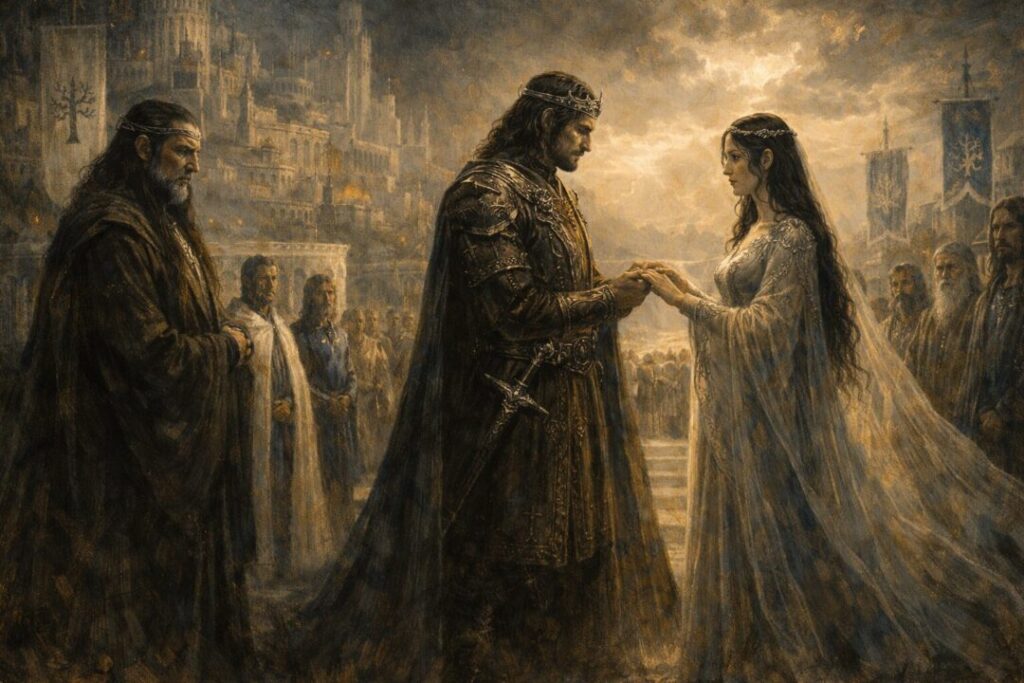
Aragorn Is Not Half-elven in the Same Immediate Sense
Another confusion often appears beside this question.
If Aragorn descends from Elros, does that make Aragorn effectively half-elven?
Not in the immediate sense that Elrond, Elros, or Arwen are.
Aragorn belongs to the House of Elros through a remote line of descent. The Númenórean kings and their heirs carried that ancestry, but by Aragorn’s time it is an ancient inheritance, not a fresh crossing of kinds. The text honors that lineage and explicitly links Aragorn’s royal house to Elros, yet Aragorn is still counted among Men, not among the Half-elven who stood under the original Choice.
This distinction matters because it explains the tone of the story.
Aragorn is a mortal man of high lineage.
Arwen is one of the Half-elven through Elrond’s line and must choose mortality if she will remain with him.
So although their ancestry converges in the distant past, their lived condition in the story is not symmetrical.
That asymmetry is part of what makes their union echo Beren and Lúthien rather than simply resemble an internal marriage within one people.
Why the Story Wants You to Notice This
The question “Are Aragorn and Arwen cousins?” is technically fair.
But it can also be too small for what the text is doing.
Yes, they are related.
Yes, the relation is real enough that the Heirs of Isildur are sheltered in Rivendell partly because of their blood kinship with Elrond.
Yes, Aragorn descends from Elros while Arwen is Elrond’s daughter.
But the legendarium does not shine a light on this in order to make their love story awkward. It does so in order to make it larger.
Their marriage closes a circle opened in the First Age and divided by choice.
From Eärendil and Elwing came Elrond and Elros.
From Elrond came Arwen.
From Elros came the kings of Númenor, then the line of Isildur, then Aragorn.
When Aragorn and Arwen are finally joined, the old severed branches meet again.
That is the point the text keeps steering toward.
So Are They Cousins?
If the word is used loosely enough, yes.
They are kin.
They share remote common ancestry.
Arwen is descended from Elrond, Aragorn from Elros, and Elrond and Elros were brothers.
But if the word is meant to suggest a close familial relationship in the ordinary sense, then it gives the wrong impression.
The texts present them as extremely distant kin, joined across immense stretches of history. More importantly, they present the marriage not as a family oddity, but as the reunion of two ancient lines of the Half-elven at the turning of the Age.
That is why the question never quite lands where people expect.
Because the answer is not really a quiet “yes.”
It is more like this:
Yes, they are related.
And that is precisely why their union means so much.
Sources & Notes
- J.R.R. Tolkien, The Silmarillion, “Of the Voyage of Eärendil and the War of Wrath”: identifies Elrond and Elros as the sons of Eärendil and Elwing and explains the Choice of the Half-elven.
- J.R.R. Tolkien, The Lord of the Rings, Appendix A, “The Númenórean Kings”: traces the descent from Elros Tar-Minyatur through Númenor, Elendil, Isildur, and the northern line toward Aragorn.
- J.R.R. Tolkien, The Lord of the Rings, Appendix A, “The Tale of Aragorn and Arwen”: names Arwen as Elrond’s daughter and presents her marriage to Aragorn as the third union of Elves and Men.
- J.R.R. Tolkien, The Lord of the Rings, Appendix A, “The North-kingdom and the Dúnedain”: notes the fostering of Isildur’s heirs in Rivendell because of their blood-kinship with Elrond.