Most people think Elves in Middle-earth are naturally good.
That is understandable.
In The Lord of the Rings, the Elves we meet most closely are figures of wisdom, sorrow, beauty, and resistance. Elrond preserves memory in Rivendell. Galadriel stands against Sauron from Lórien. Legolas becomes one of the Nine Walkers and remains faithful through fear, darkness, and war.
To a reader moving only through the Third Age, Elves can seem almost morally elevated by nature.
But the deeper history of Middle-earth gives a more complicated answer.
Elves are not evil by design. They are not a race of hidden villains. They are not equivalent to Orcs, servants of Sauron, or creatures bred for malice.
Yet they are not morally perfect.
They can be proud.
They can be possessive.
They can be cruel.
They can betray.
They can kill.
And some of the worst tragedies in the history of Arda are caused not by monsters from the darkness, but by Elves who should have known better.
Elves Are Not Angels
The first mistake is treating Elves as if they are flawless spiritual beings.
They are not.
Elves are among the Children of Ilúvatar. They are bound to the world in a different way from Men, and their lives are far longer, but they still have wills. They can choose. They can love rightly or wrongly. They can resist evil, but they can also become entangled in it.
Their beauty does not remove moral danger.
In fact, the oldest stories often show that the Elves’ greatest strengths can become the source of their ruin. Their memory is deep, but so is their grief. Their craft is great, but so is their attachment to what they make. Their loyalty can be noble, but it can also become destructive when bound to pride or revenge.
This is why the question “Are there bad Elves?” needs care.
There are no Elves who are simply presented as a whole people of evil.
But there are individual Elves who do terrible things.
And the most important examples begin long before the War of the Ring.
Fëanor: The Fall of Brilliance
The clearest answer is Fëanor.
Fëanor is not introduced as a petty villain. That would be too simple. He is one of the greatest of the Noldor, a maker of extraordinary skill, and the creator of the Silmarils. His greatness is real.
That is what makes his fall so dangerous.
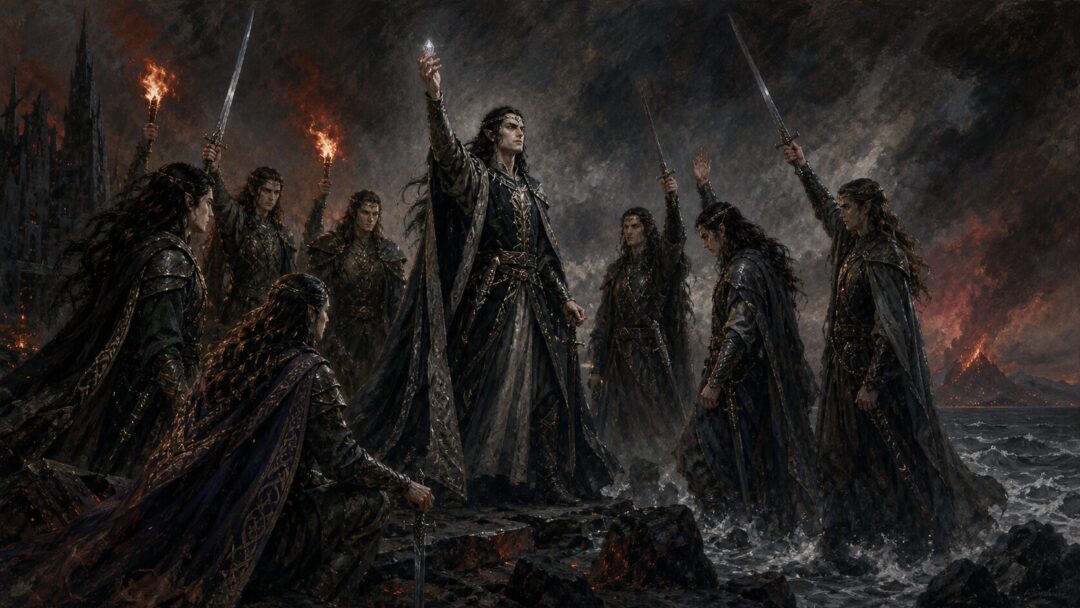
After the Darkening of Valinor, the murder of his father Finwë, and the theft of the Silmarils by Morgoth, Fëanor’s grief becomes inseparable from pride and possession. He does not merely mourn what has been lost. He binds himself, and his sons, to a terrible oath.
That oath is one of the most disastrous acts in the Elder Days.
It drives Fëanor and his sons to pursue the Silmarils against anyone who withholds them. The horror is not only that they oppose Morgoth. Opposing Morgoth would be just. The horror is that their oath does not stop at the Enemy.
It turns against other Elves.
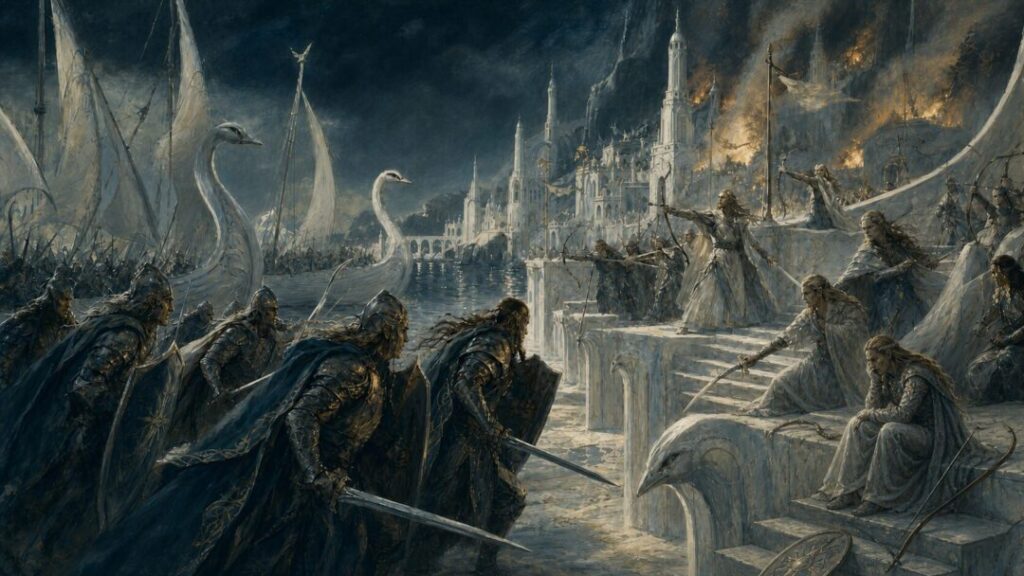
At Alqualondë, Fëanor and his followers seize the ships of the Teleri. The result is the first Kinslaying: Elf killing Elf. This is one of the great moral ruptures in Elvish history.
That alone answers the question.
Yes, an Elf can do evil.
Not because he is ugly, corrupted in body, or born wicked.
But because pride and grief can twist even greatness into violence.
The Sons of Fëanor: When an Oath Becomes a Prison
Fëanor’s sons are just as important.
The Oath does not die with Fëanor. It continues to bind his house, and its consequences spread through the First Age like a wound that will not close.
The Sons of Fëanor are not all identical. Some are shown with moments of nobility, pity, regret, or restraint. Maedhros, especially, is more tragic than simple. Maglor too is not presented as a flat villain.
But the Oath remains.
And because of it, the sons of Fëanor are drawn again and again into violence over the Silmarils. The later attacks on Doriath and the Havens of Sirion belong to this pattern: not random cruelty, but oath-driven ruin.
That distinction matters.
Their evil is not mindless. It is worse in another way. It is chosen, justified, repeated, and excused by a vow they refuse to break.
This is one of Middle-earth’s most frightening moral ideas:
An oath made in the name of justice can become a chain dragging people into injustice.
The sons of Fëanor are “bad Elves” not because they lack all good, but because they allow one consuming purpose to overrule mercy, kinship, and wisdom.
Eöl: Darkness Is Not Always the Enemy’s Shadow
Another major example is Eöl, often called the Dark Elf.
That title can be misleading.
“Dark Elf” does not simply mean “evil Elf.” In the older language of the legendarium, it can refer to Elves who never saw the light of the Two Trees in Valinor. So Eöl’s title should not be read as proof of wickedness by itself.
His actions are the issue.
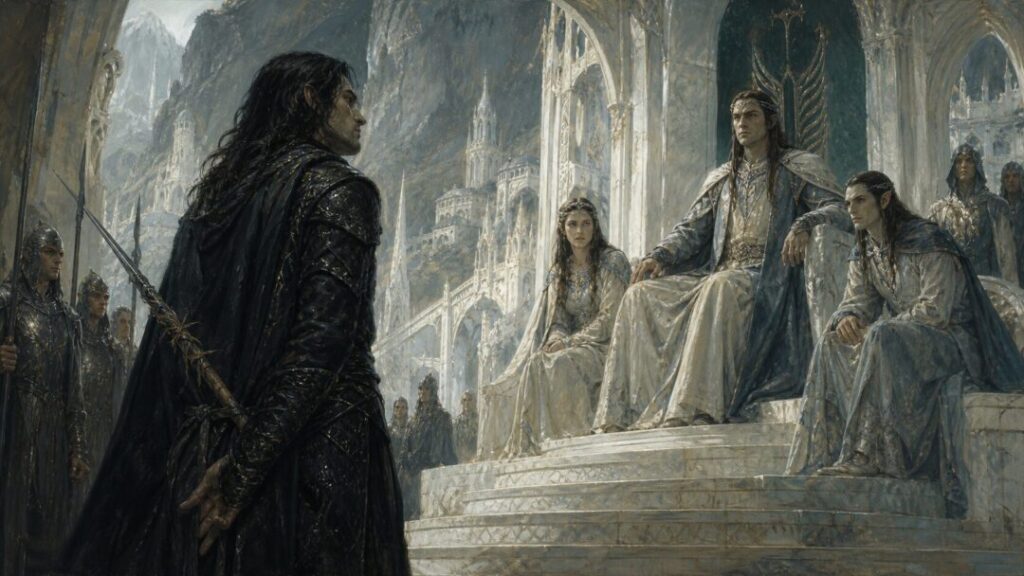
Eöl dwells in Nan Elmoth, apart from many of the great Elvish realms. His story becomes bound to Aredhel, sister of Turgon of Gondolin, and their son Maeglin.
The published story is careful in places and uncomfortable in others. It does not present the household of Eöl as healthy or free. Aredhel eventually leaves with Maeglin and returns to Gondolin. Eöl follows them.
When brought before Turgon, Eöl refuses the judgment laid upon him. He chooses death rather than remain in Gondolin, and he attempts to kill Maeglin with a poisoned javelin. The weapon strikes Aredhel instead, and she dies.
Here the evil is smaller in scale than Fëanor’s wars, but more intimate.
It is not an oath shaking kingdoms.
It is possessiveness.
Control.
Refusal to release another person.
A violent claim over wife and son.
Eöl is not important because he commands armies.
He is important because Middle-earth recognizes that evil can live in a hidden house as surely as on a battlefield.
Maeglin: The Betrayal of Gondolin
Maeglin, son of Eöl and Aredhel, is perhaps the most infamous Elvish betrayer.
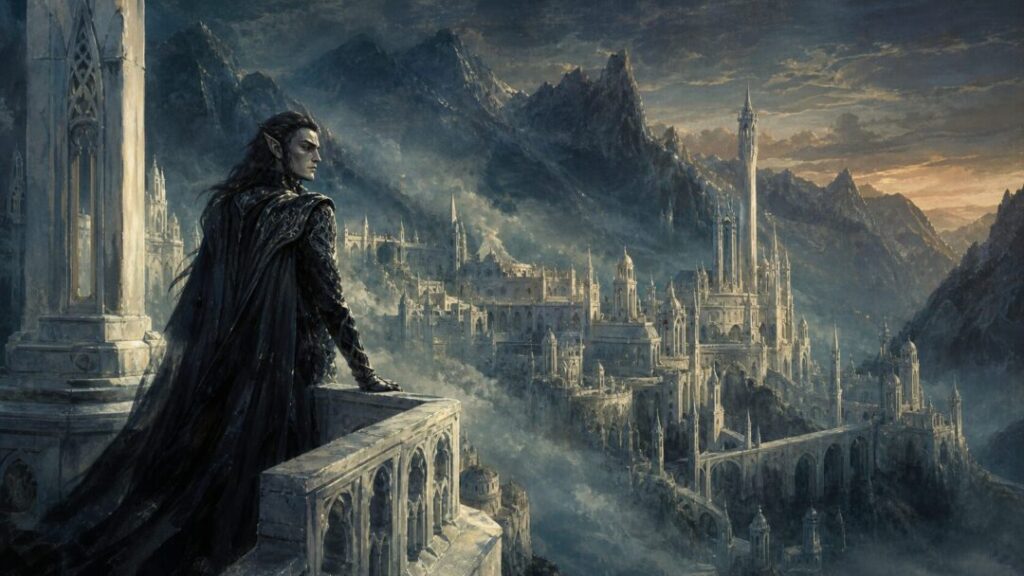
His story is tragic from the beginning. He grows up in Nan Elmoth, comes to Gondolin, and rises high in Turgon’s hidden city. He is skilled, strong, and valued.
But Maeglin also desires Idril, Turgon’s daughter. The text makes clear that this desire is hopeless and forbidden. It is not returned, and it becomes part of the darkness within him.
When Maeglin is captured by Morgoth, he reveals the location of Gondolin. The hidden city, preserved for so long, is doomed.
This does not mean Maeglin was born evil. The story is more disturbing than that. He has gifts. He has status. He has a place among his people.
Yet desire and fear make him vulnerable. Morgoth does not need to create wickedness out of nothing. He finds what is already twisted and uses it.
Maeglin’s betrayal leads to the Fall of Gondolin, one of the great catastrophes of the First Age.
So yes, there are bad Elves.
And one of them opens the way to destroy one of the fairest hidden cities ever built.
Saeros and the Smaller Cruelties
Not every bad Elf causes the fall of a kingdom.
Some reveal a different kind of failure.
Saeros of Doriath is not on the same level as Fëanor, Eöl, or Maeglin. It would be too strong to place him among the greatest evildoers of Elvish history. But his treatment of Túrin shows that Elves can be cruel, contemptuous, and unjust on a personal level.
Saeros insults Túrin and provokes him. Later, he attacks Túrin, and the conflict ends with Saeros dying as he flees.
The episode matters because it breaks the simplified picture of Elves as automatically gentle or fair-minded. Doriath is a great Elvish realm, protected by Melian and ruled by Thingol. Yet even there, pride and scorn can live.
This is not cosmic evil.
It is the ordinary ugliness of contempt.
And Middle-earth does not pretend Elves are immune to it.
What About The Lord of the Rings Itself?
In The Lord of the Rings, there are no major “evil Elf” characters in the same way there are evil Men, Orcs, Ringwraiths, or corrupted wizards.
But the possibility remains present.
The clearest moment is Galadriel’s temptation.
When Frodo offers her the One Ring, Galadriel does not laugh it away as if she were incapable of corruption. She imagines what she could become with it. The scene matters because it shows that even one of the greatest Elves remaining in Middle-earth can be tested.
She passes the test.
But the test is real.
That is the point.
Elves are not safe because they are Elves. They are safe only when they choose wisdom, humility, and renunciation over domination.
Galadriel’s greatness is not that she cannot fall.
It is that she refuses to.
Are Elves Ever Purely Evil?
This is where the answer becomes more precise.
The legendarium does not usually present Elves as purely evil beings. Even the worst Elves are not treated as a separate evil species. They are moral agents who fall through choices, desires, vows, fears, and pride.
Fëanor is brilliant before he is disastrous.
Maedhros can be noble and still be oath-bound.
Maglor can commit terrible acts and still end in sorrow.
Eöl is not evil because of his title, but because of what he does.
Maeglin is tragic, but his betrayal remains real.
This complexity is essential.
Middle-earth is not saying that beauty is false, or that wisdom is meaningless, or that Elves are secretly no better than anyone else.
It is saying something sharper:
No created people are beyond moral danger.
The fairest voice can speak a terrible oath.
The greatest craft can become possession.
The deepest love can turn into control.
The longest memory can preserve bitterness as well as wisdom.
The Real Answer
So, are there any bad Elves in Middle-earth?
Yes.
Fëanor and his sons commit grave evils in pursuit of the Silmarils. Eöl kills Aredhel while attempting to kill his own son. Maeglin betrays Gondolin to Morgoth. Other Elves, like Saeros, show cruelty on a smaller but still meaningful scale.
But the deeper answer is not simply that “some Elves are bad.”
The deeper answer is that Elves are free.
They are capable of holiness, beauty, endurance, sacrifice, and wisdom. But they are also capable of pride, violence, jealousy, and betrayal.
That is why their falls matter so much.
When Orcs do evil, the story often presents it as expected within the darkness that shaped them. When Sauron does evil, it is the work of a will already bent toward domination.
But when Elves do evil, the tragedy cuts differently.
Because Elves know beauty.
They remember light.
They understand loss.
They can perceive, perhaps more deeply than Men, the value of what they are destroying.
And still, some of them destroy it.
That is what makes the bad Elves of Middle-earth so haunting.
They are not proof that Elves are secretly evil.
They are proof that even the highest gifts can be ruined when they are turned inward, guarded too fiercely, or loved more than mercy.
The danger was never that Elves were monsters.
The danger was that they were great enough to do terrible things beautifully, and wise enough to justify them until it was too late.
Sources & Notes
- J.R.R. Tolkien, The Silmarillion, "Of the Flight of the Noldor" — Fëanor’s oath and the Kinslaying at Alqualondë show Elves committing grave evil through pride and possession.
- J.R.R. Tolkien, The Silmarillion, "Of the Ruin of Doriath" and "Of the Voyage of Eärendil and the War of Wrath" — the sons of Fëanor continue the oath-driven violence against Doriath and the Havens of Sirion.
- J.R.R. Tolkien, The Silmarillion, "Of Maeglin" — Eöl’s possessiveness, pursuit of Aredhel and Maeglin, and the poisoned javelin that kills Aredhel.
- J.R.R. Tolkien, The Silmarillion, "Of Tuor and the Fall of Gondolin" — Maeglin betrays Gondolin after capture by Morgoth, turning personal desire and fear into catastrophe.
- J.R.R. Tolkien, The Children of Húrin, "Túrin in Doriath" — Saeros’s contempt and violence toward Túrin show a smaller, personal form of Elvish cruelty.
- J.R.R. Tolkien, The Lord of the Rings, Book II, Chapter 7, "The Mirror of Galadriel" — Galadriel’s temptation by the Ring shows that even the greatest Elves are not beyond moral danger.