In the Chamber of Mazarbul, deep beneath the Misty Mountains, the Fellowship discovers a battered record of the Dwarves who once lived in Moria. Gandalf struggles through its damaged pages while the silence around Balin's tomb grows threatening. It is one of the novel's most memorable encounters with a book inside a book—and a fitting place to begin a question about what might be missing from the pages we own.
There is no officially expanded narrative edition of The Lord of the Rings established by the available publishing records, comparable to an extended cut of a film. That is a conclusion about the documented editions, not a claim to have checked every printing in every language. What readers can find is more intriguing than a simple yes or no: revised texts, editions enriched with original artwork, once-omitted visual material, and companion books that explain how Middle-earth took shape. Some contain more material. They do not necessarily contain more story.
Revised text does not mean extra chapters
Correcting a novel is different from lengthening its narrative. The Lord of the Rings reached readers in the 1950s, but publication did not freeze every spelling, punctuation mark, or arrangement of the text forever. Errors can enter during typesetting, survive reprinting, or appear when a publisher resets a book for a new format. Restoring an intended reading matters, even if Frodo still takes the same road.
Wayne G. Hammond and Christina Scull have closely studied these differences. In a comparison published in January 2026, they examined numerous editions and variations, including editions made from different typesettings. Their account traces the textual basis of the group to a revision prepared for the 2004–5 fiftieth-anniversary edition, undertaken with Christopher Tolkien's advice and consent. The work concerns published wording, not newly discovered scenes.
The details show why the distinction matters. In their corrections and addenda, Hammond and Scull discuss a passage where an extra adjective entered during a later resetting, as well as discrepancies in the Ring inscription and the placement of chronological entries in the appendices. They affect prose, invented lettering, and the navigability of Middle-earth's history. For close readers, correcting them can make the book more faithful to its underlying textual evidence without changing the adventure's boundaries.
Nor does a newer publication date guarantee the cleanest reading. A fresh typesetting can fix some problems and introduce others; different printings may carry different corrections. Hammond and Scull identify particular editions they favor for textual accuracy, including certain deluxe, author-illustrated, and collector's formats. Their judgments concern examined copies, not every later printing with a similar cover. If textual precision is your priority, the editorial history matters more than the phrase special edition.
The author-illustrated book offers a different kind of expansion
A reader browsing the 2021 HarperCollins edition illustrated by the author might reasonably wonder whether this is the elusive extended book. Its publisher's description emphasizes a complete, corrected and newly reset text printed in red and black, alongside Tolkien's own drawings, sketches, and maps. It includes removable fold-out maps by Christopher Tolkien. It offers a different experience from an ordinary paperback without claiming a longer plot.
The artwork is not merely later decoration. As Hammond and Scull explain in an essay published by the Tolkien Estate, the author made sketches and finished drawings while working through the geography and architecture of his story. Subjects include Moria, Lothlórien, and Barad-dûr. Seeing such material can reveal aspects of how a place was imagined visually. It remains important, however, to distinguish artwork made during composition from prose that was omitted from publication.
The remarkable case of the Book of Mazarbul
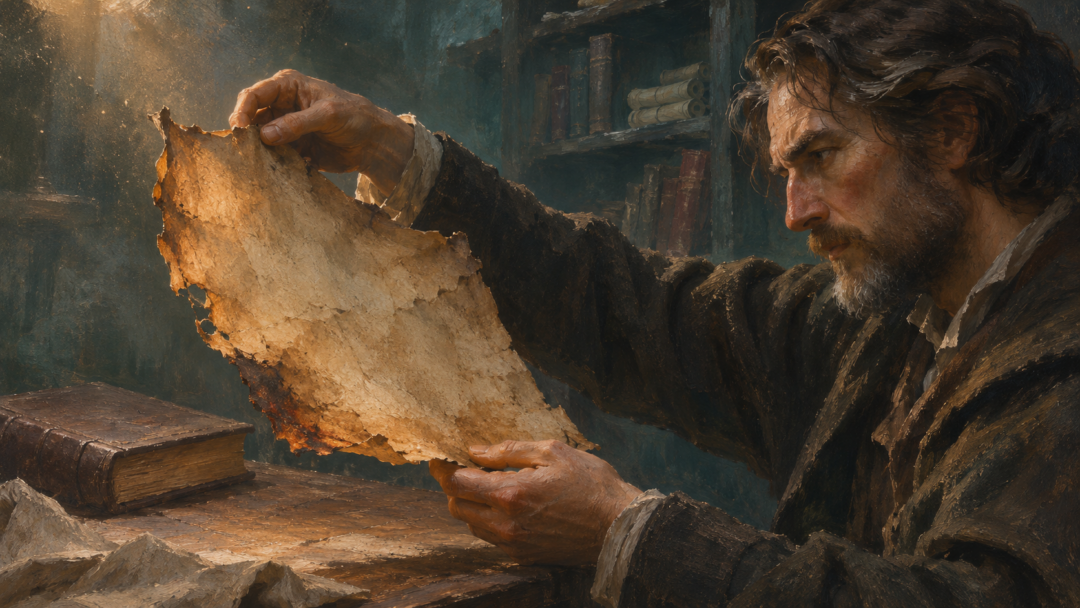
The clearest example of genuinely delayed material takes us back to Balin's tomb. In the story, the ruined Book of Mazarbul preserves a fragmentary account of the Dwarves' fate in Moria. The reader learns about it through the action and Gandalf's efforts to decipher it. But Tolkien also fashioned manuscript-like pages representing that fictional object. He carefully lettered them and distressed the paper, tearing and burning its edges to make the pages look as though they had survived the catastrophe described in the novel.
These were not merely hypothetical illustrations imagined by later publishers. The Tolkien Estate explains that reproduction costs prevented the facsimiles from appearing in the original publication. Postwar paper and production expenses already complicated the release of such a long work. The material survived outside the printed novel until HarperCollins included it in the 2004 fiftieth-anniversary edition. Here, at last, is a literal example of something created for the book's presentation arriving in readers' hands much later.
Yet its effect is visual, not narrative. The facsimiles let you look at an artifact that the characters handle, with the wear and broken writing conveying damage in a way ordinary typeset prose cannot. They do not supply a fresh escape from Moria, another conversation at Balin's tomb, or a replacement account of the Fellowship's journey. Instead, they bring the frame of the story closer to its reader: for a moment, the object described in the fiction seems almost to rest on the same desk as the novel itself.
Why the same novel appears in different numbers of volumes
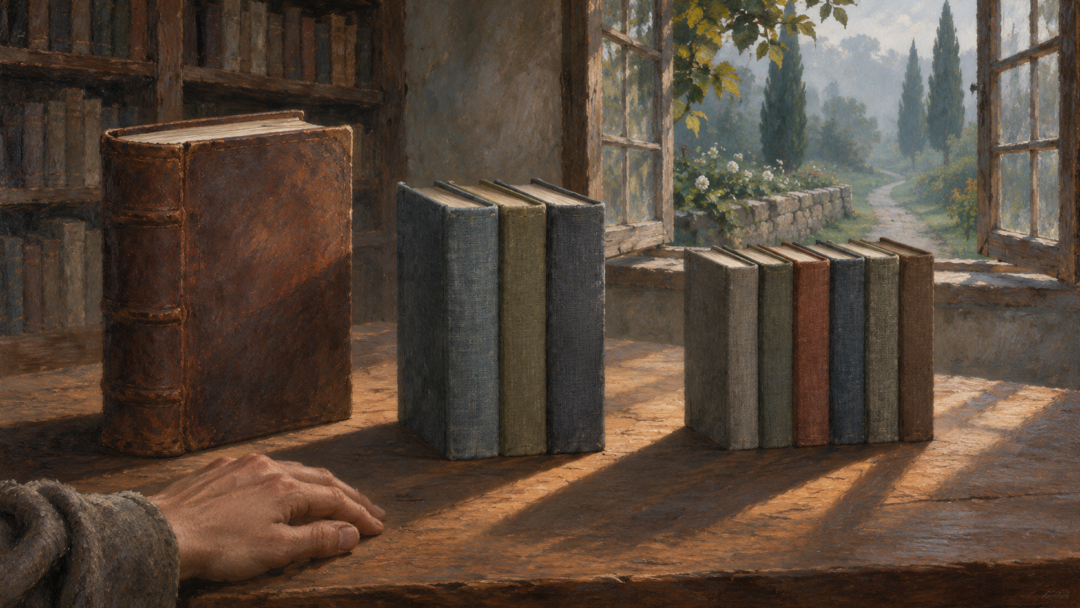
Another source of confusion is sitting on library shelves. The Lord of the Rings is frequently sold as The Fellowship of the Ring, The Two Towers, and The Return of the King. It was published in those parts in 1954–55, partly because of the practical difficulty of producing such a large book. That history encourages people to call it a trilogy, but the work itself is a continuous novel organized internally into six books, with appendices following the main narrative.
Bibliographic records at TolkienBooks.net also document one-volume editions and a seven-volume arrangement. The latter uses names such as The Ring Sets Out and The Ring Goes South, corresponding to divisions within the familiar work; the appendices occupy their own volume in the catalogued set. Different titles and extra spines might suggest a bigger story. The catalog establishes packaging, not an enlarged journey.
The appendices deserve particular attention here because they are already part of the published work, not a secret reward unlocked by choosing an expensive edition. They provide royal histories, family trees, chronology, calendars, and information about languages and writing. A first-time reader may reach the ending at the Grey Havens without exploring all of them, then later discover how much historical depth has been waiting behind the story. That can feel like finding an extension, but it is a change in the reader's route through the book, not proof of a newly lengthened text.
Companion books and early drafts are not extended editions
For readers who actually want more words about The Lord of the Rings, the most productive path may lead beyond editions of the novel. Hammond and Scull's The Lord of the Rings: A Reader's Companion offers detailed annotations on textual changes, names, sources, invented history, and interpretation. The Tolkien Estate's reference bibliography makes one practical fact clear: the companion omits the novel's text. It is designed to accompany a copy of the story, not replace it with a longer telling.
The writing history opens a different door. In The History of Middle-earth, edited by Christopher Tolkien, books including The Return of the Shadow and The Treason of Isengard trace stages in the development of the narrative. Early ideas could be strikingly unlike the published version: the hobbit who would become Frodo passed through the name Bingo, while the mysterious figure who became Strider was once conceived differently. These drafts show roads the story might have taken. They document composition, not additional canonical adventures.
One further label can mislead an enthusiastic searcher. The Tolkien Estate lists a Smith of Wootton Major: Extended Edition, edited by Verlyn Flieger, containing background writings and early material relating to that separate tale. Its existence shows that the term Extended Edition really does appear in Tolkien publishing. It does not identify an equivalent product for The Lord of the Rings. Titles must be matched to their works before a promising search result becomes an answer.
Choosing the edition that gives you what you want
For a first reading or rereading, choose a comfortable, reputable corrected text. You do not need a collectible binding to follow the complete quest, and a handsome cover alone says little about the accuracy of a particular printing. Readers especially concerned with textual details can consult Hammond and Scull's edition comparisons and corrigenda rather than assuming the most recent or costly version is automatically best.
If the attraction is visual immersion, the 2021 author-illustrated edition is a strong example of what a richer presentation can offer. If you are fascinated by the physical imagination behind the book, look for editions containing the Mazarbul facsimiles and check the stated contents of the specific printing. For deeper questions about names, chronology, revisions, and discarded possibilities, pair the novel with a reader's companion or the relevant volumes of its writing history. Those choices answer different curiosities, and none needs to masquerade as an extended cut.
In Moria, the damaged record matters because a scrap of the past has survived long enough to be read. The publication history of The Lord of the Rings has its own quieter version of that discovery: corrected lines, recovered images, and notes that illuminate the making of Middle-earth. The road to Mount Doom does not grow longer. Our view of the world around it can grow deeper.
Sources & Notes
This article is based on close reading and interpretation of Tolkien's published works and related source material where relevant.