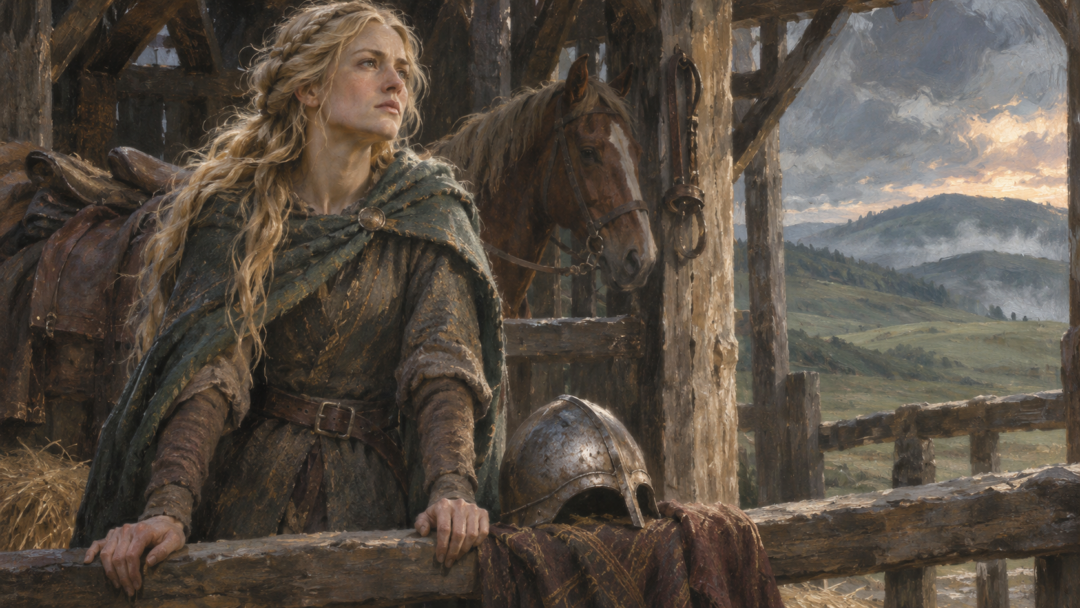
On the road out of Dunharrow, Merry Brandybuck notices a young Rider with grey eyes and a face that seems almost without hope. Later, that same Rider offers to carry him into battle, giving only the name Dernhelm. By the time a helmet falls away on the Pelennor Fields, the mysterious horseman has become someone we already know: Éowyn, niece of King Théoden.
So is this a plot twist? In the straightforward sense, yes: the story conceals a character's identity and discloses it at a carefully dramatic moment. But whether Tolkien meant the answer to astonish readers is harder to establish. An adult paying attention to Éowyn's earlier story could plausibly work it out. Another could arrive at the battlefield genuinely surprised. The difference is not necessarily how carefully either person reads, but which parts of a crowded, urgent story command their attention.
Why Éowyn would become Dernhelm
Long before the Rohirrim ride to Gondor, Éowyn has reasons to resent being left behind. She is no stranger to horses or weapons: she has learned to ride and wield a sword. Yet much of her life at Meduseld has been spent tending her uncle during the years when his strength and judgment decline. Her service matters, but it does not give her the deeds of valor she longs for, and the shadow of Gríma Wormtongue makes her confinement more bitter.
When Théoden recovers and Rohan goes to war, the opportunities she wants remain closed. Éomer rides among the warriors, while Éowyn shoulders responsibilities away from the fighting. At Dunharrow, she asks Aragorn to take her on the Paths of the Dead, but he refuses. She fears a life in which duty means waiting while others act, perhaps never being allowed to choose her own danger.
The king's instructions at the muster make the conflict immediate. Théoden intends to ride to Minas Tirith and leaves Éowyn to govern his people in his absence. This is a serious charge, not an idle task devised to humiliate her. Still, it places the very person most desperate to ride on the side of those who must remain. If she joins the army, she cannot simply announce herself without exposing her defiance of the king's command.
Dernhelm solves that practical problem. Under a warrior's name and helmet, Éowyn can travel without announcing that Théoden's niece has defied him. The alias also expresses her situation: she is capable of taking part in Rohan's martial world but believes she must hide to enter it. The disguise does not create her courage; it makes action possible.
What Merry misses, and what a reader might see
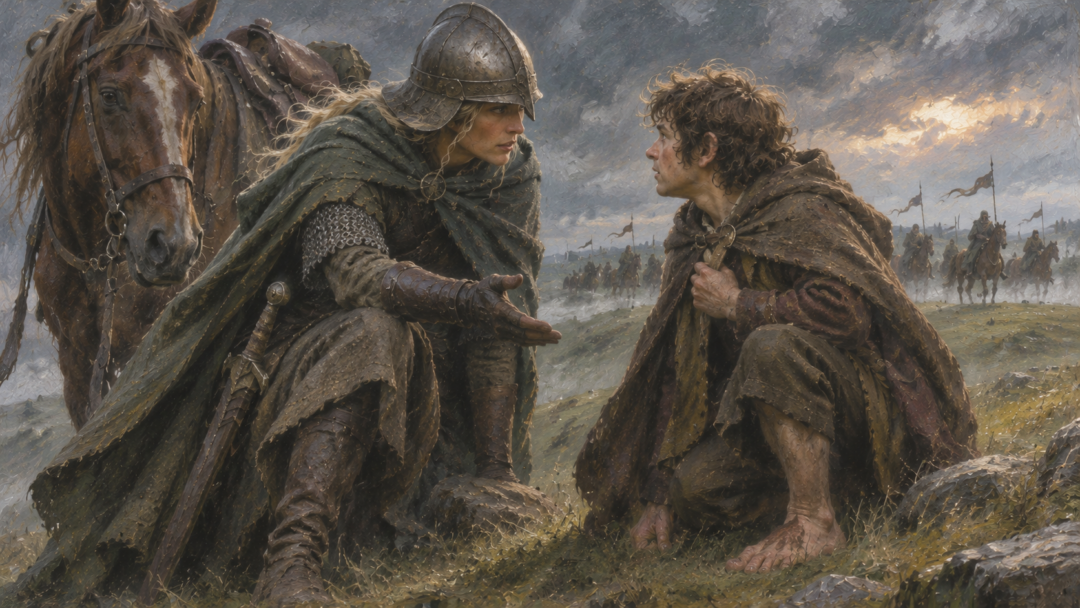
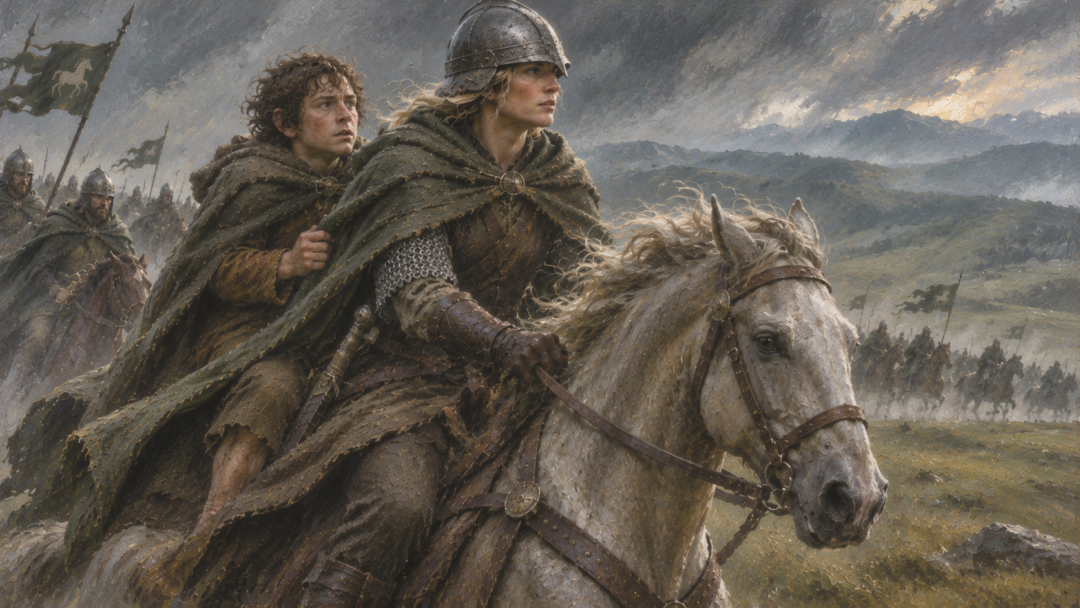
Merry is also told to stay behind. Théoden has accepted his service as a swordthain, but he will not take a small hobbit into a distant battle on a pony unsuited to the journey. Merry feels dismissed and ashamed, especially when his friends are already caught up in the war. Then an unfamiliar Rider approaches and quietly offers him a place on a horse. They depart together on Windfola, with Merry concealed beneath the Rider's cloak.
The invitation suggests a particular identity. This stranger understands exclusion and is willing to break the arrangement keeping Merry from the fight. Such sympathy makes sense coming from Éowyn, who has also been ordered to remain behind. It is not proof: another soldier could certainly pity Merry. But a reader acquainted with her frustration has a candidate ready to hand.
There are smaller details as well. Merry initially takes Dernhelm for a young man, slighter than many of the other Riders, and notices those striking grey eyes. What unsettles him most is the expression of someone riding toward death without much hope of returning. The portrait fits Éowyn's state of mind far better than it fits an uncomplicated adventure. A reader who remembers her disappointment and despair may find the combination of slight build, secrecy, and sorrow increasingly recognizable.
Merry is not conducting a mystery investigation. He has just been denied the journey he wants, and the Rider offers an escape. The land darkens under Mordor's shadow, while military orders and the prospect of death crowd his thoughts. Dernhelm is hardly a talkative companion during the ride. Merry's failure to recognize Éowyn is understandable even if a reader suspects her almost at once.
Readers have the advantage of knowing Éowyn as a person with a history and an unresolved desire. Merry knows her too, but his experience is narrower and more frightened. We can connect scenes separated by chapters while he concentrates on staying with the Riders. Still, noticing a pattern is not certainty, and missing one does not mean missing the point of the scene.
The battlefield gives the revelation its force
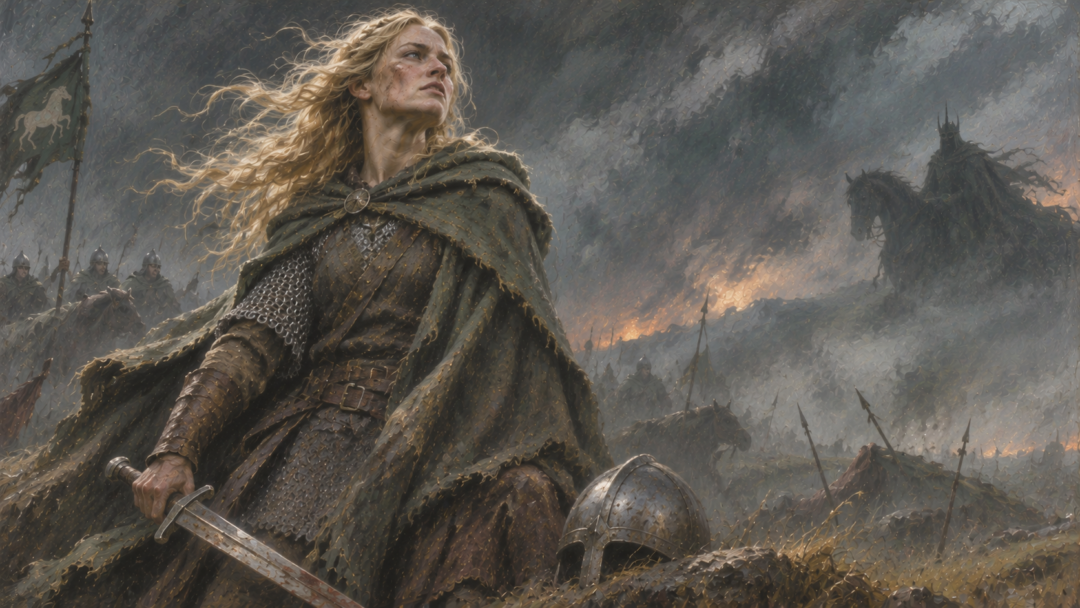
The disguise lasts through the ride, but on the Pelennor Fields secrecy becomes almost irrelevant beside the danger. Théoden leads his people in a great charge, only to fall when his horse Snowmane crashes down beneath him. The Witch-king arrives on his dreadful winged mount, and fear drives others away. Merry is overwhelmed. The Rider who brought him to this place stands between the Lord of the Nazgûl and the fallen king.
The disclosure happens here, not during a quiet conversation at camp. Éowyn is facing an enemy whose presence has broken the courage of seasoned fighters. When the Witch-king boasts that no living man can hinder him, she answers by identifying herself as a woman, Éomund's daughter. The hidden name becomes an open declaration at the moment of greatest risk.
For anyone who guessed Dernhelm's identity earlier, that statement loses none of its challenge. In fact, anticipation may sharpen it. The reader knows what it has cost Éowyn to reach the battlefield, and now watches her abandon the protection of anonymity before a terrifying foe. She is no longer asking Aragorn or Théoden for a place beside the warriors. She has taken that place, and her words make the decision visible to everyone within the scene.
The scene does not make her fearless or a simple emblem of triumph. When her helmet falls, Merry sees her pale hair and the tears on her face alongside her resolve. The despair he glimpsed at Dunharrow has accompanied her into battle. Her bravery is more unsettling than a cheerful victory over expectations: she stands firm while carrying wounds that began long before the Witch-king appeared. Her willingness to face death is courageous, but the despair behind it is not the same as hope.
Nor is the confrontation hers alone. Éowyn kills the winged creature, but the Witch-king breaks her shield and arm. Merry, now recognizing Dernhelm, finds the courage to strike the enemy from behind; Éowyn delivers the decisive blow. The two people told not to ride become essential to the battle's outcome. Merry's recognition also changes his response from helpless fear to an attempt to save her. Both emerge wounded and need care in the Houses of Healing, beyond the immediate victory.
A twist does not have to fool everybody
A plot twist can mean a revelation that overturns what nearly everyone believed. By that standard, Dernhelm may seem guessable. Yet fiction can conceal an identity for the sake of timing, letting some readers anticipate it while others remain uncertain. The payoff comes when a suspected truth changes events. A disguised ally stepping forward in danger is dramatic even if the mask never seemed particularly convincing.
We should also distinguish a constructed effect from a provable intention. The novel gives us a hidden identity and an emphatic disclosure. Tolkien Gateway, Thain's Book, and the Encyclopedia of Arda, all secondary reference works, confirm the basic events. They cannot establish whether Tolkien expected most adults to be deceived or considered surprise the scene's main purpose.
There is no representative adult reader. Someone attuned to character motivation may suspect Éowyn as soon as the stranger appears. Someone absorbed in the march toward disaster may overlook a Rider's size or eyes. On rereading, the disguise may seem painfully transparent, particularly in the hopeless expression Merry notices. These are plausible experiences, not evidence of how most adults reacted.
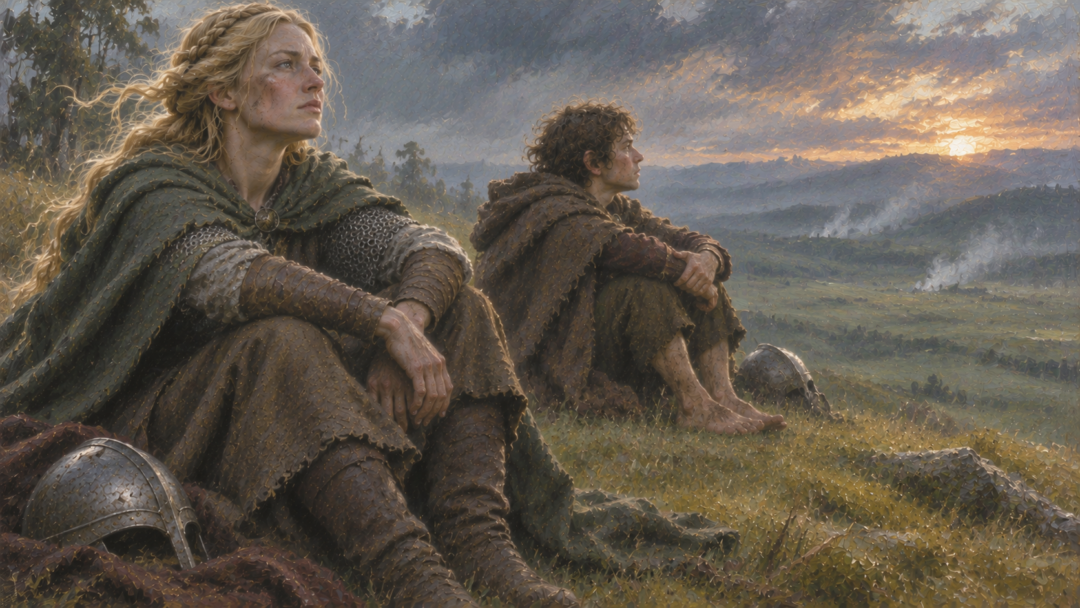
Why adaptations change the question
The 2003 film of The Return of the King makes a revealingly different choice. It omits the name Dernhelm, and Merry recognizes Éowyn by her voice when she helps him join the ride. Her presence in the army is therefore not sustained as the same identity puzzle. Suspense shifts toward what will happen once they reach the battle. That says something about the film's presentation, not the book's intended difficulty.
The 1981 radio dramatization keeps the name Dernhelm and uses a visor to obscure the Rider's face. On radio, voices and dialogue must do work that costume and framing perform on screen, so the alias offers another route to concealment. These adaptations show that recognition can be handled differently while retaining the confrontation. Neither establishes what Tolkien privately expected readers to guess.
What stays with us is the moment on the Pelennor when a hidden Rider refuses to remain hidden. An adult might have known all along who sat in Windfola's saddle; another might discover it only as the helmet falls. Either way, the scene asks us to see Éowyn not as a clever answer to a riddle, but as a person who finally speaks her own name where she had been forbidden to stand.
Sources & Notes
This article is based on close reading and interpretation of Tolkien's published works and related source material where relevant.