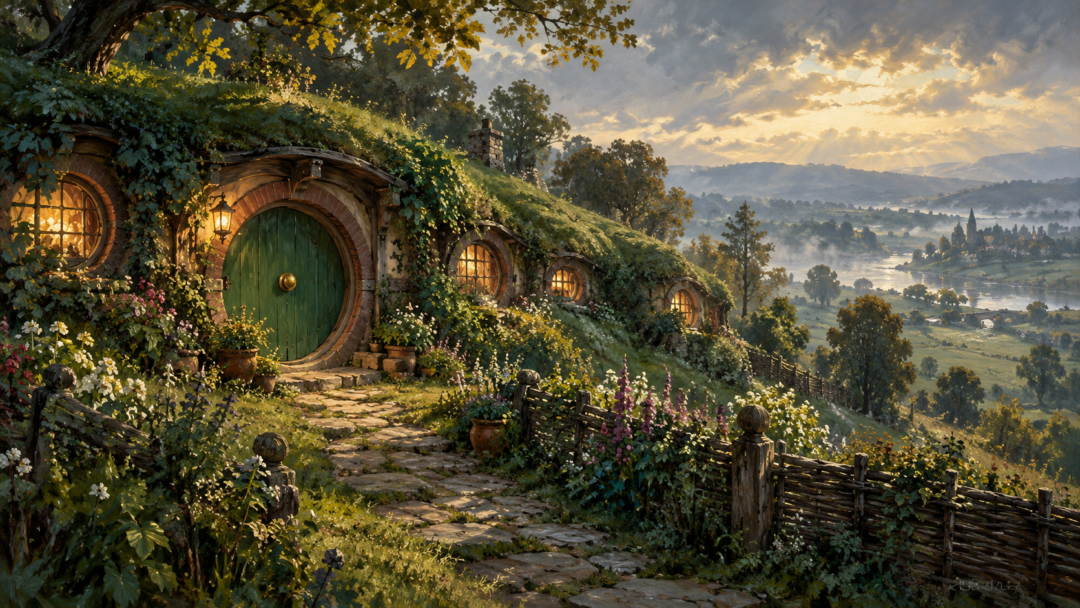
Before Bilbo Baggins ever discovered a magic ring, encountered a dragon, or returned from the Lonely Mountain, he already possessed something remarkable: Bag End.
Its round green door, polished furniture, well-stocked pantries, and comfortable rooms made it one of the most memorable homes in Middle-earth. But its importance was not simply that it contained more rooms than an ordinary Hobbit-hole.
Bag End was a carefully constructed family home, occupying a distinctive place on Hobbiton Hill. It had been built by Bilbo’s father, Bungo Baggins, for his wife, Belladonna Took, and its comforts reflected an established family position long before Bilbo’s adventures.
That distinction matters. Bag End did not become prestigious because Bilbo returned with treasure. It was already an exceptional residence when Gandalf arrived at its door.
And the strongest evidence lies not in the treasure Bilbo eventually acquired, but in the house itself.
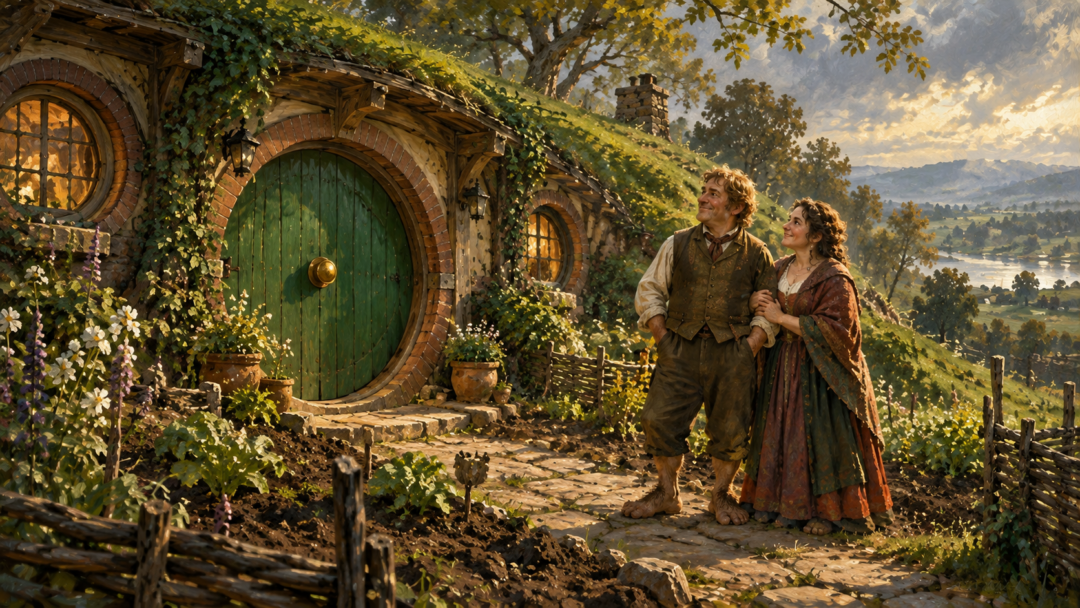
Bag End Was Exceptional Before Bilbo’s Adventure
The opening chapter of The Hobbit introduces Bag End through its physical comforts.
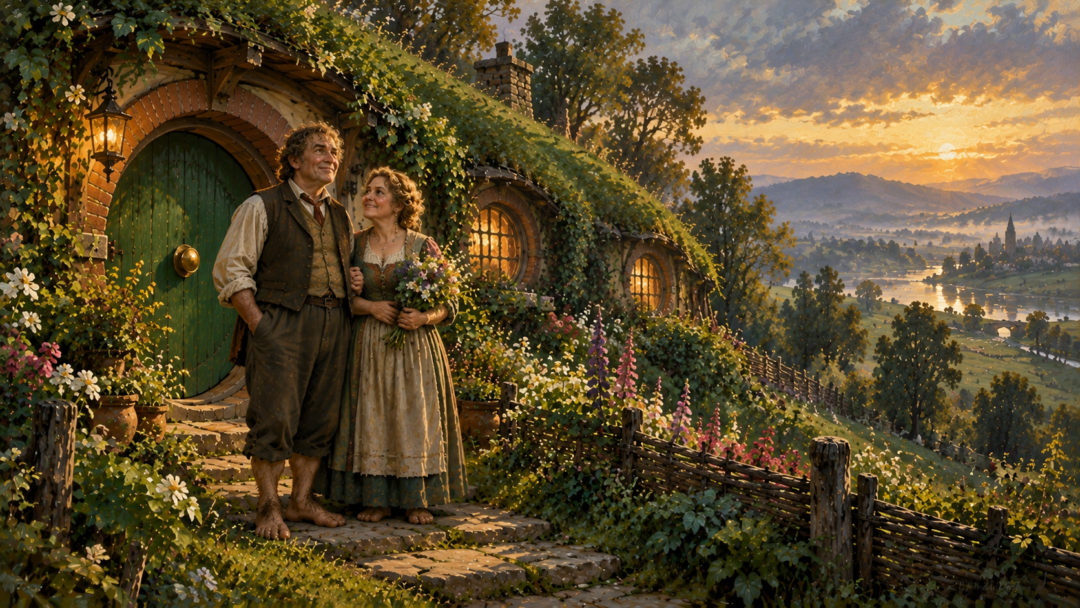
It was a Hobbit-hole, but not the damp, uncomfortable burrow an unfamiliar reader might imagine. Its entrance was a perfectly round door, painted green, with a shining brass knob at its centre.
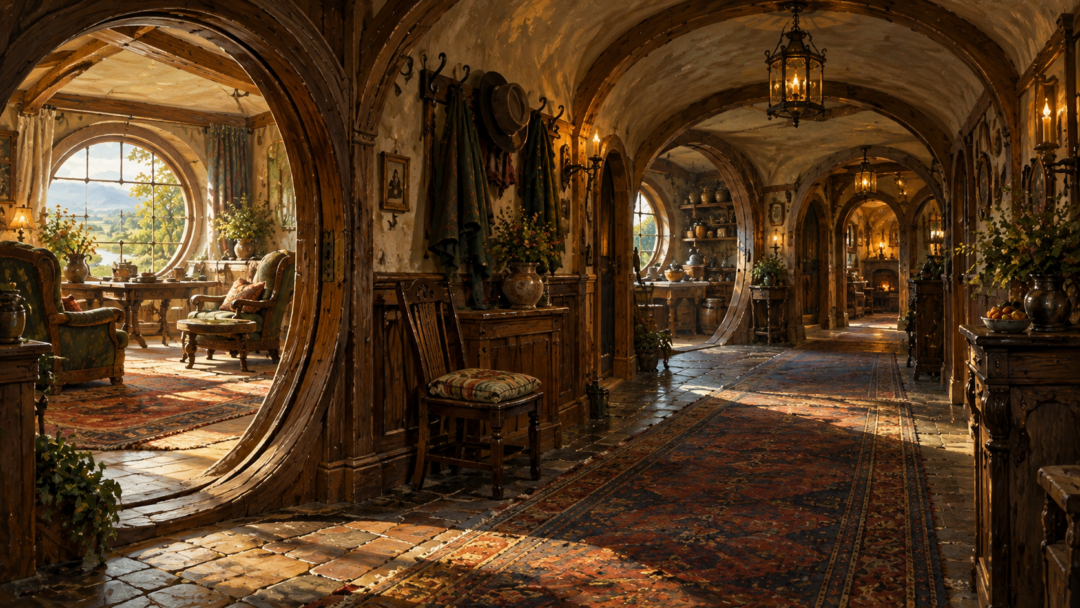
Inside was a tunnel-shaped hall, furnished and finished with considerable care. Its walls were panelled, its floor tiled and carpeted, and its furniture polished.
The hallway led to numerous rooms, including bedrooms, bathrooms, kitchens, dining rooms, cellars, wardrobes, and pantries.
These details establish something important about Bilbo’s circumstances.
He lived in a home designed for comfort, storage, hospitality, and everyday convenience. The house was not merely large enough to shelter its occupant. It was arranged to make domestic life pleasant.
The Hobbit also presents the Baggins family as respectable and comfortably situated. Their reputation rested partly on their predictable habits and their reluctance to become involved in adventures.
Bag End therefore represents an established way of life rather than a fortune suddenly acquired.
Its significance exists before the first Dwarf appears at Bilbo’s door.
Bungo Baggins Built More Than an Ordinary Hobbit-Hole
The origins of Bag End explain why its status cannot be reduced to Bilbo’s personal wealth.
Bilbo’s father, Bungo Baggins, built the luxurious residence for Belladonna Took after their marriage. The Hobbit explicitly notes that Belladonna’s money contributed to its construction.
This is a crucial detail.
Bag End was not simply an old dwelling that Bilbo happened to occupy. Its familiar form was the result of an earlier generation’s decision to establish a particularly comfortable household.
Bungo was responsible for its construction, while Belladonna contributed financially.
Their marriage also united two notable Hobbit families.
The Bagginses were associated with respectability and conventional behaviour. Belladonna, meanwhile, was one of the three daughters of the Old Took, a prominent figure in the Shire.
The Took family carried a somewhat different reputation, including stories of unusual behaviour and occasional adventures.
Bilbo inherited both sides of this family background.
Bag End itself, however, expresses the settled and domestic side of that inheritance.
It is reasonable to read its construction as evidence of the resources available to Bungo and Belladonna, but the texts do not provide a building budget, the size of their combined fortunes, or any formal ranking of wealthy Hobbit households.
What they do establish is sufficient: Bag End was deliberately built as an unusually luxurious home, with contributions from both sides of Bilbo’s immediate family.
Its standing preceded Bilbo’s ownership.
The Design Reveals What Luxury Meant to Hobbits
One of Bag End’s most revealing features is its arrangement.
All its rooms were on a single level, opening from the main passage. Yet their positions were not equally desirable.
The best rooms were on the left as one entered, because they possessed deep-set round windows overlooking the garden and the meadows beyond, descending toward the Water.
That architectural distinction is easy to overlook.
A home excavated into a hill cannot provide the same natural light and outward views from every room. The position of the windows therefore mattered.
Bag End’s finest rooms enjoyed the advantages of the hillside setting, while the remaining spaces provided the practical facilities needed for a well-appointed household.
Its luxury was not simply a matter of having numerous chambers.
It came from how those chambers were furnished, connected, and positioned.
The panelled hallway, carpets, polished chairs, wardrobes, and extensive storage reinforced the same impression.
This was a residence designed around domestic ease.
Even its many pegs for hats and coats suggest a household equipped to receive visitors, although their presence alone does not establish how frequently guests arrived.
The overall effect is unmistakable: Bag End’s comfort was built into its architecture.
It did not depend upon displaying treasure.
The Hill Was Part of Bag End’s Identity
Bag End also possessed a distinctive geographical identity.
It stood in the Hill above Hobbiton, overlooking the surrounding countryside. Its windows connected the interior to the garden, meadows, and the Water below.
The house and its location are difficult to separate.
A visitor approaching Bag End was not merely entering another room excavated into the earth. They were approaching a recognizable residence occupying a particular position in the landscape.
The garden was especially important.
In The Lord of the Rings, the Gamgee family is closely associated with its care. Hamfast Gamgee, known as the Gaffer, worked as Bilbo’s gardener, and Samwise later followed in that occupation.
The garden was therefore not an incidental decorative feature. It formed part of the household’s continuing life.
Bag End’s identity included its door, interior, garden, and position on the Hill.
That does not justify imagining enormous Baggins estates extending across Hobbiton.
The texts do not establish such holdings, nor do they describe Bilbo collecting rents from a large property portfolio.
The evidence supports a narrower, more meaningful conclusion.
Bag End was a substantial and desirable residence with an identifiable garden and hillside setting. Its status came partly from possessing and maintaining that particular property.
Its prestige was rooted in place, not merely in the number of rooms beneath the Hill.
Why the Sackville-Bagginses Wanted Bag End
The strongest demonstration of Bag End’s desirability may be the behaviour of Bilbo’s relatives.
In The Hobbit, when Bilbo returns from his journey, he discovers that he has been presumed dead and that his belongings are being auctioned.
The Sackville-Bagginses are particularly disappointed by his unexpected return.
Their interest in Bag End continues into The Lord of the Rings.
Otho and Lobelia Sackville-Baggins had long hoped to acquire the property. Bilbo’s adoption of Frodo as his heir frustrated those expectations.
This family dispute reveals how important the house was independently of its owner’s adventures.
The Sackville-Bagginses wanted Bag End as a residence and inheritance.
The story does not establish that they were pursuing a hidden treasure chamber or some extraordinary commercial income attached to the Hill.
Their desire concerns possession of the house itself.
That makes the inheritance conflict especially revealing.
Bag End was a property worth waiting for, arguing over, and attempting to secure through family succession.
The house carried value because it was already established, comfortable, and desirable.
Bilbo’s later adventures added notoriety to his household, but they did not create the property’s underlying appeal.
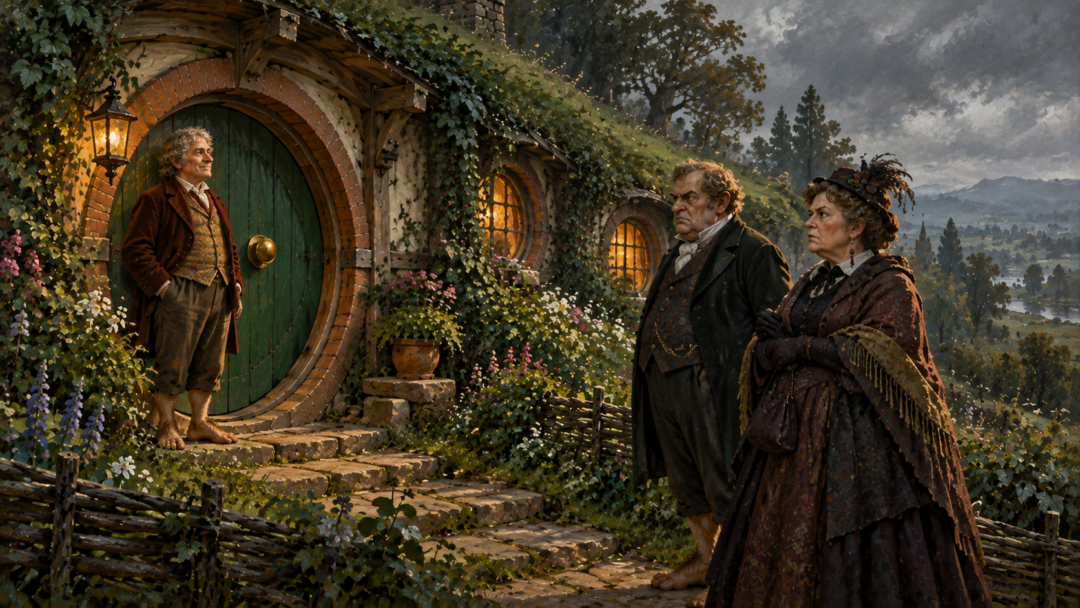
Frodo’s Inheritance Shows That Bag End Was a Family Asset
When Bilbo departed after his famous birthday celebration, Frodo inherited Bag End.
This transition is important because it separates the house from Bilbo’s individual personality.
Bilbo had become an unusual figure in Hobbiton. His long life, strange friendships, and earlier disappearance made him a subject of considerable curiosity.
Yet Bag End remained a recognizable family residence.
Frodo’s inheritance continued its connection with the Baggins family, even though Frodo was not Bilbo’s son.
Later, when Frodo prepared to leave the Shire, he sold Bag End to Lobelia Sackville-Baggins.
The sale provided a plausible explanation for his departure and allowed him to conceal his more dangerous purpose.
It also demonstrated that Bag End could pass out of the immediate household through an ordinary property transaction.
The precise financial terms are not given, so there is no reliable basis for assigning the house a monetary value.
Nevertheless, its importance to the Sackville-Bagginses remains clear.
Lobelia finally obtained the residence her family had coveted.
The emotional force of that development depends upon Bag End’s longstanding identity as a desirable family home.
It is not simply a building that happens to contain Bilbo’s possessions.
It is a place whose ownership matters.
The Scouring of the Shire Reveals What Could Be Lost
Bag End’s importance becomes even clearer during the Scouring of the Shire.
Under Lotho Sackville-Baggins and later Saruman, Hobbiton undergoes destructive changes.
The familiar landscape is damaged, trees are felled, and Bag End itself becomes associated with the intruders who have imposed their will upon the Shire.
Saruman eventually occupies the house.
This is a striking reversal.
The home originally designed for comfort and peaceful domestic life becomes the dwelling of a figure consumed by domination and bitterness.
The contrast gives Bag End’s physical character a deeper meaning.
Its gardens, rooms, and established setting represent a kind of life that Saruman’s methods have violated.
After the Shire is liberated, Bag End is restored and Frodo returns to live there.
Its recovery belongs to the wider healing of Hobbiton.
The house is not important because it possesses magical defences or political authority. Its importance comes from the ordinary life it was built to sustain.
That ordinary life proves worth protecting.
From Bungo and Belladonna to Samwise Gamgee
Bag End’s final major change of ownership completes its remarkable history.
When Frodo leaves Middle-earth, he passes Bag End to Samwise Gamgee.
This is more than the transfer of a comfortable dwelling.
Sam had grown up in Bagshot Row beneath the Hill, and his family had worked in Bag End’s garden.
He understood the place through labour, loyalty, and daily familiarity.
By inheriting Bag End, Sam becomes its master rather than its gardener.
The change is especially meaningful because the house had originally been established by Bungo Baggins and Belladonna Took as a luxurious family residence.
Across the story, its ownership moves from Bilbo to Frodo and finally to Sam.
Its meaning expands with each generation.
For Bungo and Belladonna, it was a home they established together.
For Bilbo, it was the comfortable world he repeatedly left behind and returned to.
For Frodo, it was part of the Shire he struggled to save.
For Sam, it became a home for the family life that followed the War of the Ring.
The same property could carry different meanings without losing its identity.
Bag End’s True Prestige Was Built Before the Treasure Arrived
Bag End is often remembered through Bilbo’s adventures, but its original importance is much older.
Its distinction came from a combination of features: Bungo’s construction, Belladonna’s financial contribution, its comfortable arrangement, its carefully positioned rooms, its garden, and its recognizable place on Hobbiton Hill.
The later inheritance disputes confirm that it was a desirable possession in its own right.
None of this requires imagining vast estates, secret revenues, or an exact ranking among the Shire’s richest households.
Nor does it mean size was irrelevant. Bag End certainly contained many rooms, and its spaciousness contributed to its luxury.
But room count alone cannot explain why the house matters.
Bag End was a family home created with care, maintained across generations, and rooted in a particular landscape.
Long before Bilbo returned with anything from the Lonely Mountain, the green door already opened onto a life of exceptional comfort.
And perhaps that is why Bag End remains so powerful in the story.
The treasure came later.
The home was already worth returning to.
Sources & Notes
- Tolkien Gateway — Bag End. https://tolkiengateway.net/wiki/Bag_End
- Tolkien Gateway — Bungo Baggins. https://tolkiengateway.net/wiki/Bungo_Baggins
- Tolkien Gateway — Belladonna Took. https://tolkiengateway.net/wiki/Belladonna_Took
Primary text: The Hobbit, “An Unexpected Party,” and The Fellowship of the Ring, “A Long-expected Party.” These references document the house, its builder, and family financing. The assessment of status is interpretation; the text supplies no building budget or formal wealth ranking.