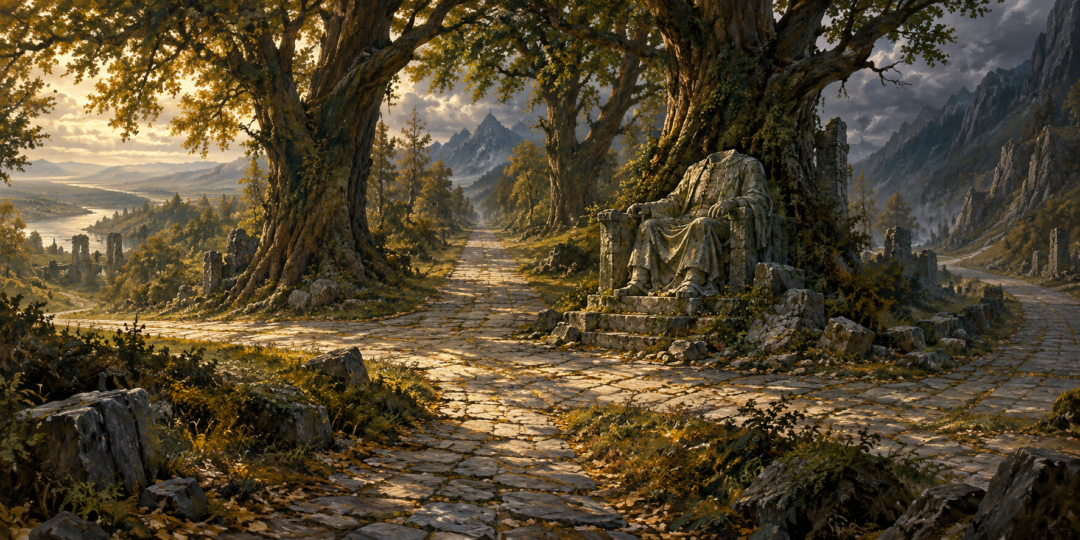
At the Cross-roads in Ithilien, Frodo and Sam discover something more revealing than an abandoned road. Four ancient routes meet beneath the trees, and beside them sits the broken statue of a king whose kingdom has lost control of the surrounding land.
The roads still lead where they always led. But the political world that gave them their meaning has changed almost beyond recognition.
One road reaches north toward the Black Gate of Mordor. Another continues south toward the distant lands beyond Gondor. A third runs west toward Osgiliath and the Anduin. The fourth turns east into the valley of Minas Morgul, once the Gondorian city of Minas Ithil.
That eastern road reveals the deepest contradiction. It was once a connection between important places belonging to Gondor. By the end of the Third Age, it leads into a stronghold of the Enemy.
The Cross-roads therefore preserve an extraordinary piece of Middle-earth’s history: a road network that survived the collapse of the territorial order it once served.
The Four Roads That Reveal an Older Geography
In The Two Towers, the chapter “Journey to the Cross-roads” brings Frodo, Sam, and Gollum to the meeting of two ancient roads.
The first runs broadly north and south through Ithilien, between the Mountains of Shadow and the Anduin.
Its northern course approaches the Morannon, the Black Gate of Mordor. Southward, the road continues through Ithilien toward the lands beyond the Poros.
The second road crosses it from west to east.
Westward lies Osgiliath, the ancient capital of Gondor, standing upon the Anduin. Eastward lies the valley containing Minas Morgul.
The geography matters because these are not merely four convenient directions.
They connect several different parts of Gondor’s historical world: its river settlements, its eastern fortified territory, its northern approaches to Mordor, and its southern connections.
The junction occupies a position where these routes naturally intersect.
Yet its importance is not simply geographical.
By the time Frodo reaches it, the road toward Minas Morgul has become dangerous, Osgiliath is ruined and contested, and Ithilien itself is no longer securely held by Gondor.
The roads remain connected even though the places they connect no longer belong to the same political order.
A Road Built When Gondor Was Stronger
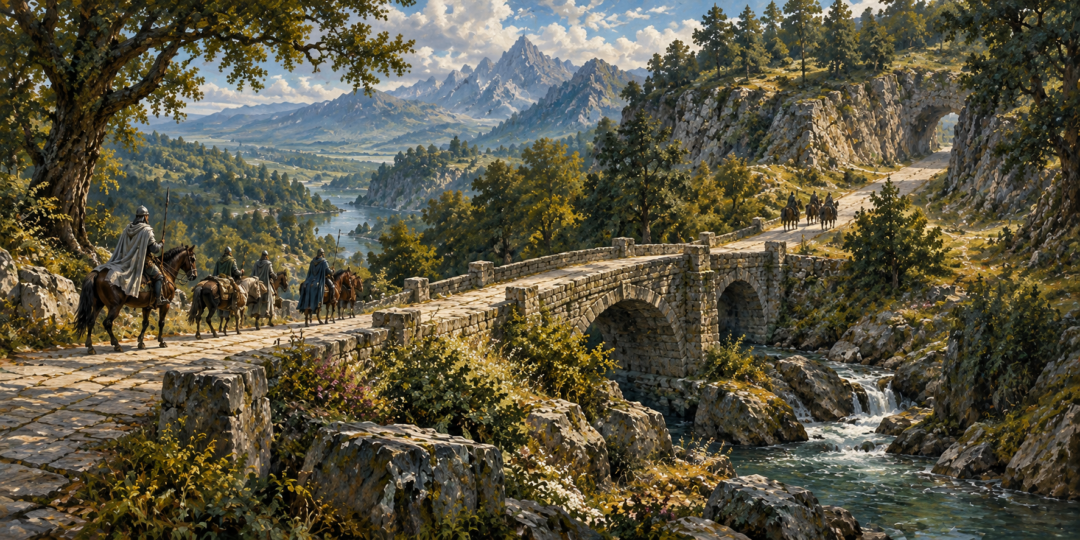
Earlier in their journey, Frodo and Sam encounter the ancient north-south road through Ithilien.
The narrative describes a road laid out long ago, with stretches running straight through difficult country. Where necessary, its makers cut through hillsides or carried the route across streams on stone bridges.
These details distinguish it from a temporary track worn into the earth by passing travelers.
The precise date of its original construction is not supplied, and the text does not establish a complete history of its development.
Nevertheless, its surviving features belong naturally to the long history of Gondor and the works of the Men of Westernesse.
In the earlier Third Age, Gondor was considerably more powerful than the realm defended by Denethor during the War of the Ring.
Its kings exercised authority over extensive territories, maintained fortified positions, and fought campaigns far beyond the immediate surroundings of Minas Tirith.
The north-south route connected regions separated by considerable distances, while the east-west route linked Osgiliath with Minas Ithil.
It would be too much to reconstruct an exact system of road administration, patrol schedules, or commercial traffic from these descriptions.
The surviving evidence supports a simpler conclusion.
Gondor once possessed the territorial reach and organizational capacity associated with maintaining important connections across this region.
By Frodo’s time, much of that reach had disappeared.
Why the Road to Minas Ithil Matters Most
The eastern branch of the Cross-roads offers the clearest evidence of historical change.
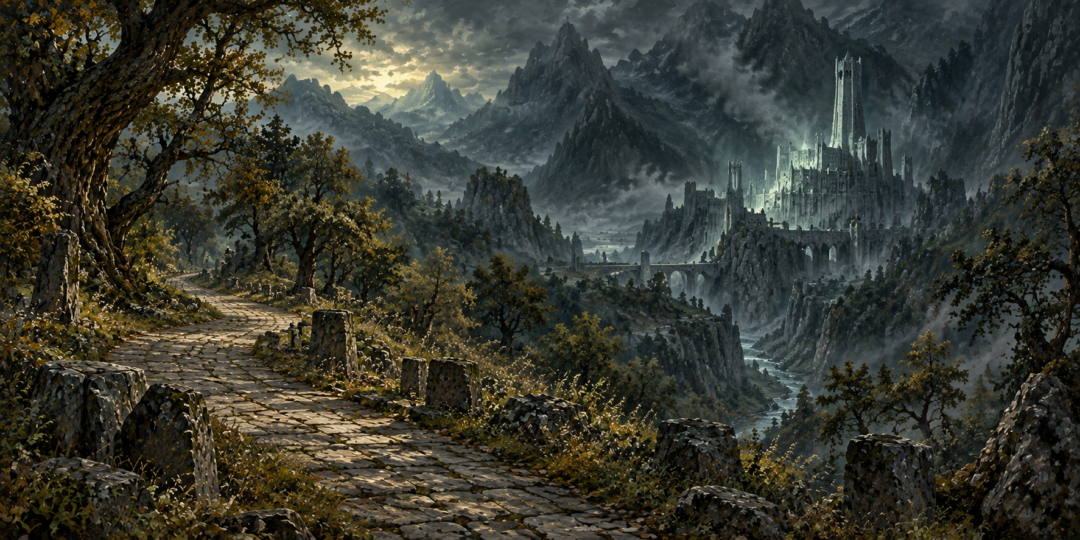
In the late Third Age, it is the road toward Minas Morgul, the dreadful city inhabited by the servants of Sauron.
But Minas Morgul was not originally an enemy fortress.
It began as Minas Ithil, the Tower of the Moon.
According to the history preserved in The Lord of the Rings, Isildur established Minas Ithil in the mountains bordering Mordor, while Anárion established Minas Anor farther west.
Osgiliath stood between them as the chief city of the southern kingdom.
This arrangement belonged to the foundation of Gondor after the downfall of Númenor.
The eastern city was therefore not an isolated outpost belonging to a foreign power.
It was part of Gondor’s original political geography.
The road running from Osgiliath toward Minas Ithil connected two places that belonged to the same kingdom.
Its course reflects a world in which the eastern approach to Mordor was guarded by Gondorian strength.
The route did not need to be moved when the city changed hands.
The destination remained in the same valley.
What changed was the power occupying it.
A road that had connected Gondor’s own possessions now led directly toward one of its most dangerous enemies.
The Fall of Minas Ithil Changed the Meaning of the Junction
The transformation of Minas Ithil was neither sudden nor accidental.
After the defeat of Sauron at the end of the Second Age, Gondor maintained defenses intended to watch the land of Mordor.
But its strength declined over the centuries.
Civil conflict, plague, warfare, and pressure from hostile powers weakened the kingdom.
One particularly important turning point came when the Nazgûl returned to Mordor.
In Third Age 2000, they besieged Minas Ithil.
The city fell in 2002.
Its capture gave the Enemy control of a stronghold that had once formed part of Gondor’s eastern defense.
Minas Ithil became Minas Morgul.
The loss was more than the destruction or occupation of a single city.
It fundamentally altered the strategic geography of Ithilien.
The eastern road from Osgiliath now led toward an enemy-held fortress.
The western approach remained associated with Gondor, but the route between the two no longer joined friendly centers of authority.
Over time, the presence of Minas Morgul contributed to the growing insecurity of Ithilien.
The region became increasingly difficult for Gondor to inhabit and defend.
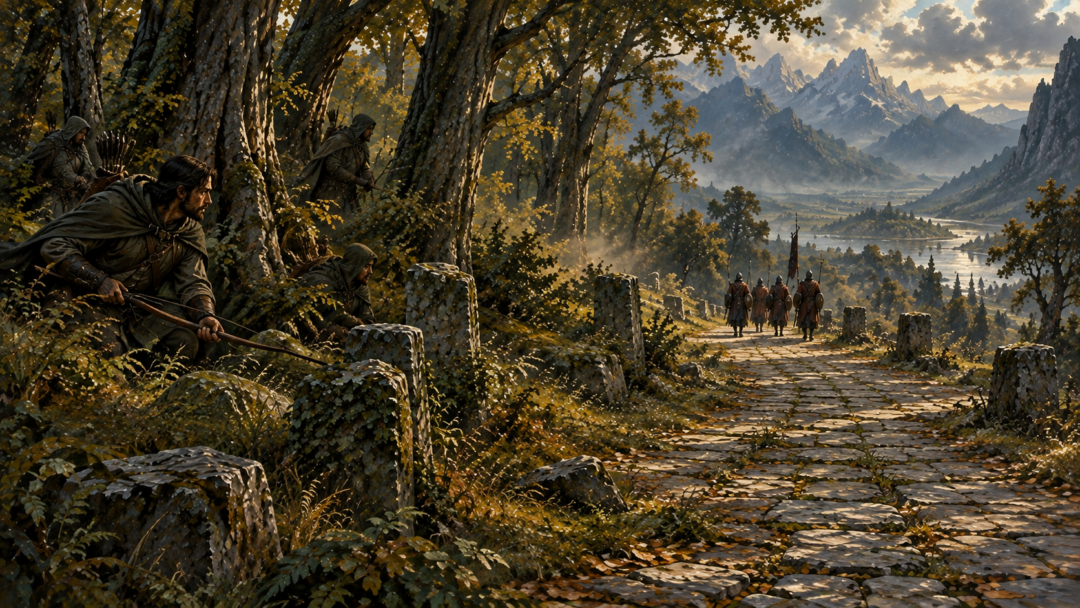
By the War of the Ring, Gondor still sent Rangers into Ithilien, including the company commanded by Faramir.
Yet their hidden operations were evidence of a contested land, not the ordinary administration of a secure province.
The Cross-roads stood within that changed landscape.
Its eastern branch had become a reminder of territory that Gondor had once possessed and could no longer command.
The Northern Road and the Problem of Mordor
The northern road presents a different historical irony.
It runs toward the Morannon, the great entrance to Mordor.
To Frodo and Sam, the Black Gate represents an almost insurmountable barrier.
Yet Gondor’s earlier relationship with Mordor was very different.
After the War of the Last Alliance, the victorious powers had reason to prevent the return of evil to that land.
Gondor maintained fortifications and watchfulness along Mordor’s approaches.
The Towers of the Teeth, later occupied by Sauron’s servants, belonged originally to this defensive history.
This does not prove that every stretch of the northern road was constructed for a particular military purpose.
Nor does it establish exactly how the route was administered throughout the Third Age.
What it does show is that the road’s northern destination had not always represented an unconquerable enemy frontier.
In Gondor’s stronger days, the approaches to Mordor were places its soldiers could watch and defend.
By the end of the Third Age, that relationship had been reversed.
Sauron’s power dominated the Black Gate, while Gondor struggled to preserve its remaining territory west of the Anduin.
The Southern Road Reveals Gondor’s Wider Connections
The southern continuation of the road is equally important, although its significance is easier to overlook.
The route runs through southern Ithilien toward the Crossings of Poros.
Beyond that river lay the region historically known as South Gondor or Harondor, and farther south the lands of Harad.
The published maps of Middle-earth show the continuation of this wider southern connection, including the Harad Road.
This should not be mistaken for proof that Gondor permanently controlled every region reached by the road.
Roads can cross political boundaries, and the extent of Gondor’s authority changed repeatedly.
Harondor itself became disputed territory between Gondor and its southern enemies.
Nevertheless, the road demonstrates that Ithilien was not merely a narrow strip of land facing Mordor.
It also formed part of a much larger north-south geographical corridor.
During Gondor’s more powerful centuries, its interests and influence extended far beyond the immediate region around Minas Tirith.
By the War of the Ring, however, the same general corridor could serve the movement of forces hostile to Gondor.
Frodo and Sam witness Southrons traveling northward, while Faramir’s Rangers operate against enemies moving through Ithilien.
A route associated with an older world of Gondorian reach now passes through territory where Gondor’s defenders must conceal themselves.
The Broken King Beside the Roads
At the Cross-roads, the most powerful symbol of Gondor’s lost authority is not the road itself.
It is the ruined statue beside it.
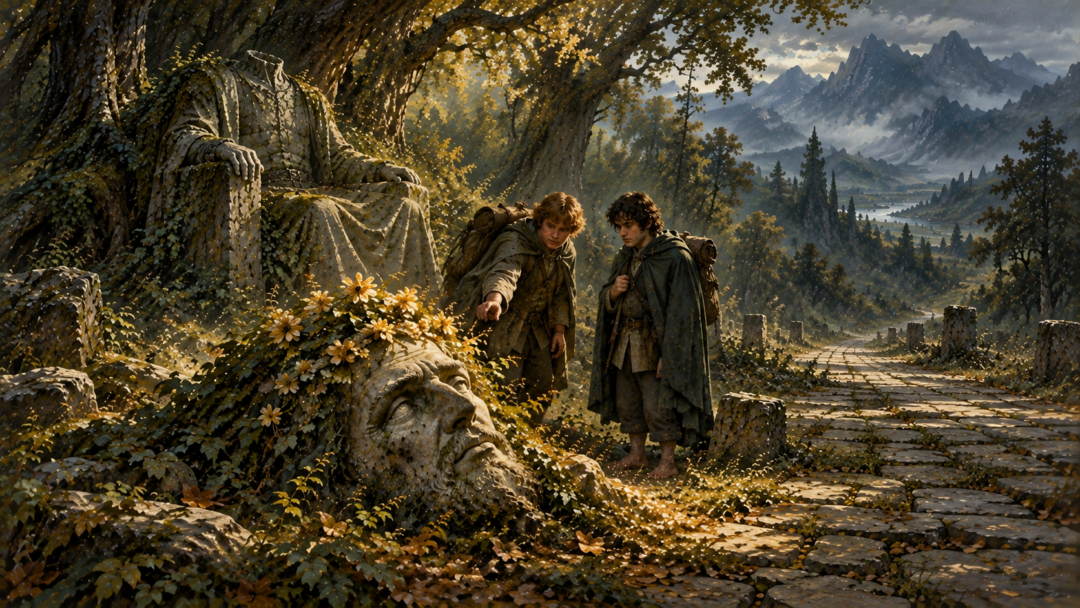
Frodo and Sam see the remains of a seated king, an ancient monument damaged and defaced by the servants of the Enemy.
Its head has been broken away.
In its place, the destroyers have set a rough stone bearing the sign of the Red Eye.
The old king’s likeness has been dishonored, and the emblem of the new power has been imposed upon it.
Yet the statue also reveals something that the road network alone cannot.
The Cross-roads were once a place where royal authority was visibly commemorated.
The identity of the represented king is not established in the narrative.
It would therefore be misleading to identify the figure confidently as Isildur, Anárion, or any particular ruler.
What matters is the monument’s association with the kings of the older realm.
The roads continue to point toward Gondor’s former possessions, while the broken statue shows what has happened to the authority once associated with them.
Stone roads and royal stonework have endured.
Political control has not.
The Crown of Flowers and the Meaning of Survival
The statue’s story does not end with its desecration.
Frodo sees the severed head lying nearby.
Although battered and weathered, it retains something of its former dignity.
Flowers have grown around it, and their arrangement gives the appearance of a renewed crown.
Frodo draws Sam’s attention to the sight.
For a brief moment, the ruined king appears crowned again.
The Enemy has damaged the monument and attempted to replace its meaning with a symbol of domination.
Yet the natural world has produced an image that contradicts that act of humiliation.
The moment does not mean that Gondor has already been restored.
Nor does it guarantee that every lost territory will return to its former rulers.
Its immediate significance is moral and symbolic.
The Enemy’s defacement has not succeeded in making the king’s image wholly meaningless.
This is especially powerful because the discovery occurs at a road junction whose geography already preserves the memory of an earlier Gondor.
The surviving roads record the extent of an old political world.
The fallen king records its humiliation.
The flowers suggest that humiliation need not be the final meaning of its history.
Why the Cross-roads Matter to Gondor’s Decline
Gondor’s decline is often understood through the loss of great cities, the weakening of its royal line, and the long struggle against Mordor.
The Cross-roads offer a quieter way to understand the same history.
They show that the kingdom’s physical geography could outlast its political strength.
Osgiliath remained beside the Anduin, though much of its former greatness had vanished.
Minas Ithil remained in its mountain valley, though it had become Minas Morgul.
The road toward the Morannon still followed the northern approaches to Mordor, though the Black Gate was now controlled by Sauron.
The southern road still connected Ithilien with more distant lands, though Gondor no longer possessed its former security or reach.
These changes did not erase the network.
Instead, they transformed what traveling along it meant.
The same route could belong to different historical realities without moving from its original course.
That is the distinctive importance of the Cross-roads.
They are a surviving arrangement of connections from a time when Gondor’s power extended farther and its eastern defenses stood in different hands.
The roads reveal a kingdom whose historical footprint had become larger than the territory it could still govern.
A Kingdom Remembered by Its Roads
When Frodo and Sam leave the Cross-roads, they continue toward the terrible valley of Minas Morgul.
For them, the junction is a moment of danger, uncertainty, and brief encouragement.
For the history of Gondor, it is something more.
It is a place where the geography of the past remains visible beneath the political divisions of the present.
The roads still point toward the places that mattered to the older kingdom.
But those places have been ruined, contested, abandoned, or captured.
Beside the junction, a broken king sits beneath the trees, while his fallen head receives a crown that no conqueror intended.
Together, the roads and the statue express the same historical truth from different directions.
A realm may lose command of its territory long before the material traces of its greatness disappear.
The Cross-roads in Ithilien preserve the shape of a Gondor that no longer exists.
And that is why this small junction tells such a large story: the roads remember a kingdom whose borders have retreated, whose cities have fallen, and whose former authority survives most clearly in the things it left behind.
Sources & Notes
- Tolkien Gateway — Cross-roads. https://tolkiengateway.net/wiki/Cross-roads
- Tolkien Gateway — Harad Road. https://tolkiengateway.net/wiki/Harad_Road
- Tolkien Gateway — Minas Morgul. https://tolkiengateway.net/wiki/Minas_Morgul
Primary text: The Two Towers, “Of Herbs and Stewed Rabbit” and “Journey to the Cross-Roads”; The Return of the King, “The Black Gate Opens,” and Appendix A. The references establish the roads and the change from Minas Ithil to Minas Morgul. Administrative and political implications are interpretation.