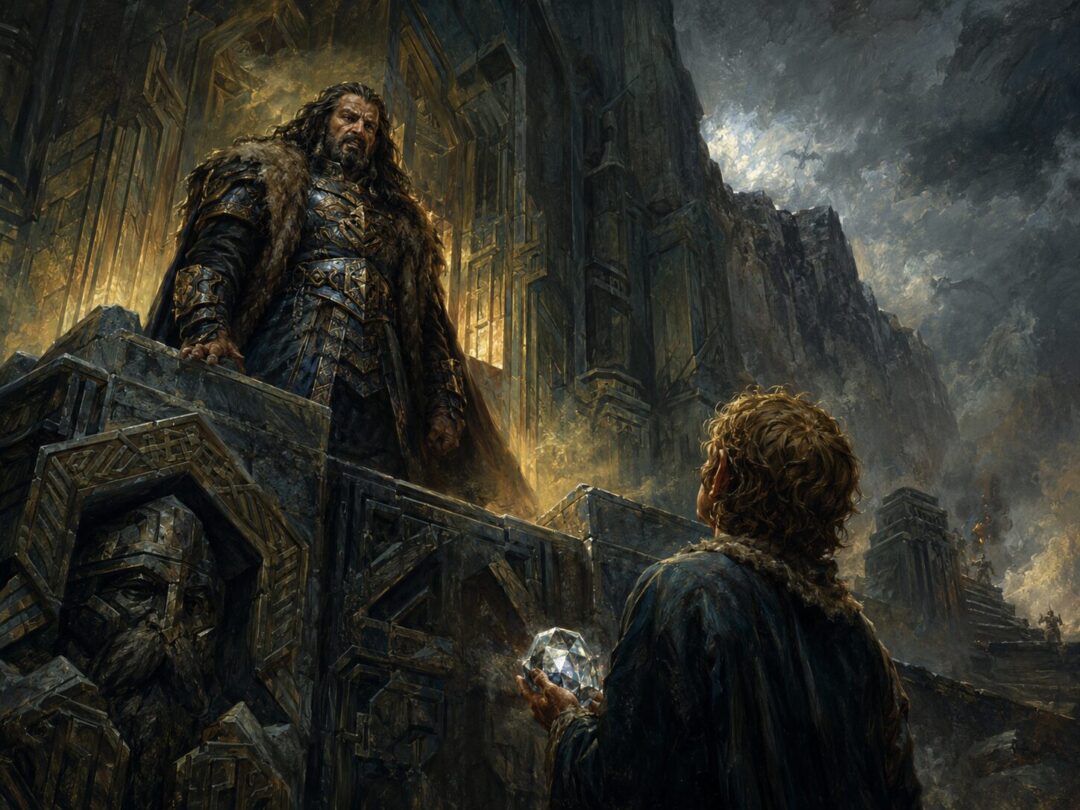
The Arkenstone looks, at first, like the perfect treasure-object: beautiful, ancient, royal, and almost impossible to separate from Thorin Oakenshield’s claim to the Lonely Mountain.
But in The Hobbit, the stone becomes something far more dangerous than a jewel. It becomes the test of whether friendship must obey loyalty even when loyalty is leading toward ruin.
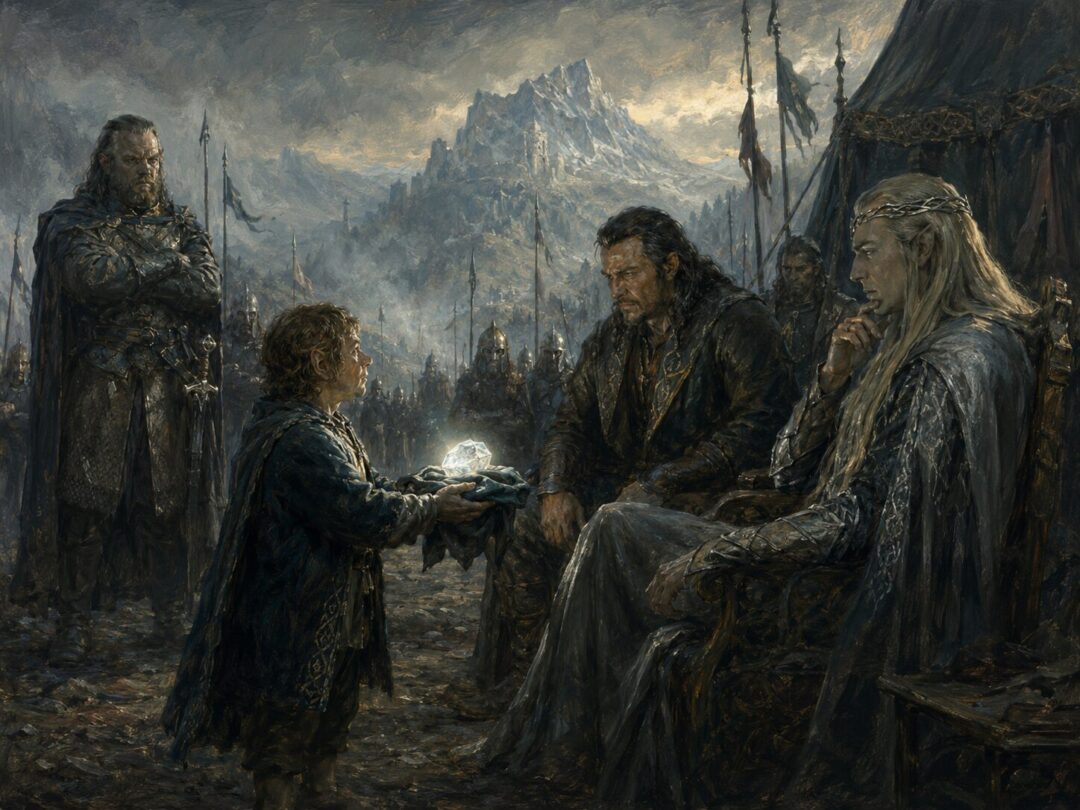
Bilbo Baggins does betray Thorin in one plain sense. He secretly takes the Arkenstone, keeps silent when Thorin searches for it, and later gives it to Bard and the Elvenking so they can use it in bargaining against him. He acts behind Thorin’s back, against Thorin’s wishes, and in a way Thorin experiences as treachery.
Yet that is exactly why the moment matters.
Bilbo’s choice is not brave because it is clean. It is brave because it is morally costly. He does not defeat a dragon. He does not win a battle. He does something more difficult for a hobbit who has come to love his companions: he chooses the possibility of peace over the comfort of being approved by his own side.
The Arkenstone Was Not Just Another Treasure
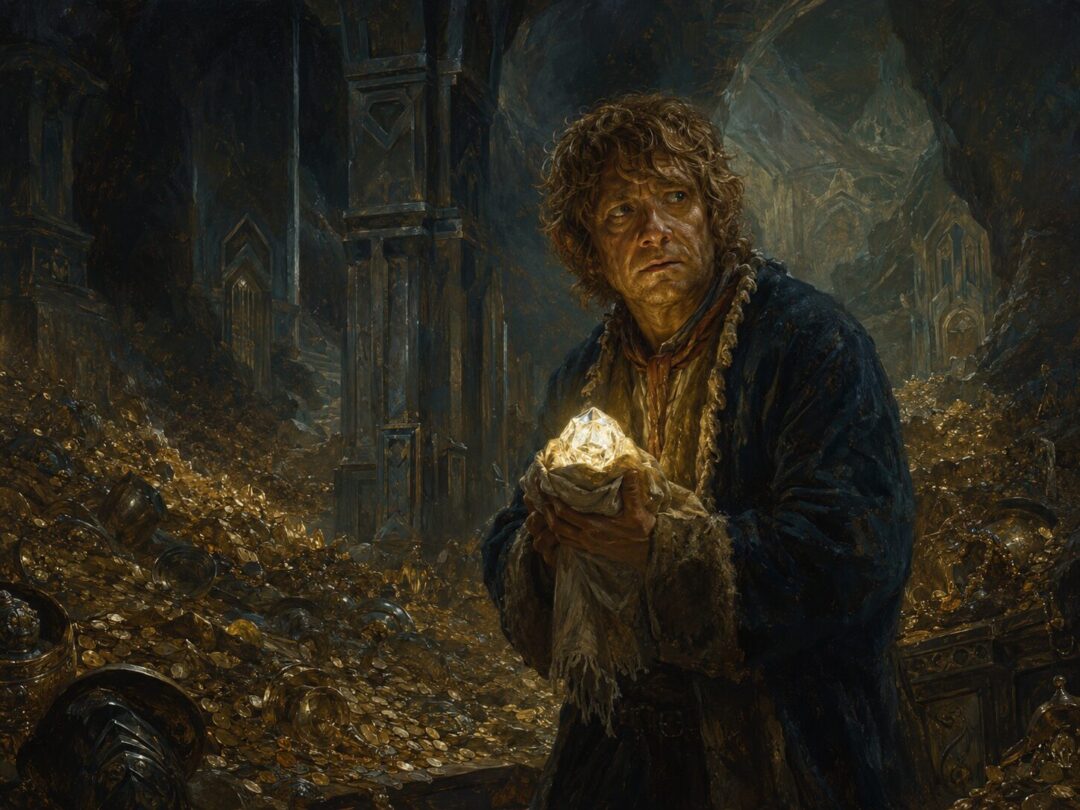
By the time Bilbo finds the Arkenstone inside the Lonely Mountain, he has already done more than anyone expected of him. He has faced trolls, goblins, spiders, imprisonment, and Smaug himself. He has also become far more than a hired burglar.
Yet the Arkenstone tempts him in a different way.
It is not merely valuable. The Dwarves remember it as the Heart of the Mountain, the great jewel of Thráin, found beneath Erebor and shaped by Dwarven craft. Thorin’s desire for it is deeply tied to memory, kingship, inheritance, and the restoration of his people’s lost glory.
That is what makes Bilbo’s silence so tense. When he first takes the Arkenstone, he does not immediately give it to Thorin. The text allows room to judge him. He claims it inwardly as part of his promised share, but he also understands that Thorin would see the stone differently from any other treasure.
This is not a simple case of Bilbo holding a random gem. He has taken the very object Thorin values above all others.
That fact makes his later decision morally dangerous. Bilbo cannot pretend that the Arkenstone means little. He knows it means almost everything to Thorin. And still, when the siege hardens and battle becomes likely, he decides that the stone must be used to break Thorin’s refusal.
Thorin’s Claim Was Real, But It Was Not the Only Claim
One reason this episode is so powerful is that Thorin is not simply wrong in every way.
The treasure under the Mountain belonged to his people before Smaug took it. The Dwarves suffered exile, dispossession, and humiliation. Thorin’s longing to reclaim Erebor is not greed from the beginning; it is bound to memory, identity, and justice.
But after Smaug’s death, other claims appear.
The Lake-men have suffered the destruction of their town after helping Thorin’s company. Bard has slain the dragon. The people of Esgaroth need aid. The Elvenking also comes with force, though the moral weight of his claim is more complicated than Bard’s. The situation is no longer only about recovering what Smaug stole from the Dwarves.
The treasure has become the center of a political and moral crisis.
Thorin’s error is not that he remembers the wrong done to his house. His error is that, under the pressure of treasure and kingship, he begins to treat every other claim as an insult. He speaks from within a fortress of injury. He sees demand where Bilbo sees negotiation, enemies where Bilbo sees starving survivors, and surrender where Bilbo sees compromise.
That is the overlooked tragedy: Thorin has won the Mountain, but he is in danger of losing the nobility that made the quest meaningful.
Bilbo Sees the War Before It Happens
Bilbo’s greatness in this moment is not military courage. It is moral imagination.
He sees what the proud leaders around him refuse to fully face: Dwarves, Men, and Elves are about to fight over treasure while greater evils still exist in the world. The goblins and wargs have not vanished. The wider darkness of Middle-earth has not ended. Yet the free peoples stand at the edge of killing one another over gold.
Bilbo is not a king. He has no army. He is not the strongest, oldest, or wisest person present. But he has a clear view precisely because he is not possessed by the old claims in the same way.
He respects Thorin. He has travelled with him, depended on him, and seen his courage. But Bilbo is also still enough of a hobbit to be shocked by the idea that treasure should be worth a war.
That ordinary hobbit-sense becomes extraordinary. In Tolkien’s world, smallness often exposes the madness of the great. Bilbo’s lack of heroic grandeur allows him to ask the question kings and warriors avoid: what is this victory worth if it ends in needless bloodshed?
The Betrayal Was Real
It is tempting to soften Bilbo’s action too much and say he did not really betray Thorin. But the story becomes weaker if we remove the sting.
From Thorin’s perspective, Bilbo has done something unforgivable. He has concealed the Arkenstone, left the Mountain in secret, and given the enemy their strongest bargaining tool. When Bard reveals the stone, Thorin’s rage is terrible because the wound is personal. It is not merely political. Bilbo, the companion Thorin had come to value, has sided against him.
The fact that Bilbo means well does not erase the betrayal.
That is why the act has moral weight. Bilbo is not choosing between obvious good and obvious evil. He is choosing between two obligations: loyalty to Thorin and responsibility to prevent a disastrous conflict. He cannot satisfy both. To serve peace, he must wound a friend.
This is one of the most adult moral moments in The Hobbit. Earlier adventures often reward cleverness immediately. Here, cleverness brings disgrace. Bilbo does the right thing and is cursed for it.
That is much closer to real moral courage than simple heroics.
Why Bilbo Could Act When Others Could Not
Gandalf is present in the larger affair, and Bard and the Elvenking have their own roles, but Bilbo’s action is unique because he crosses the line from inside Thorin’s company.
He is not an outside negotiator. He is not an enemy. He is one of the companions.
That gives his act power, but it also makes it painful. Bilbo can carry the Arkenstone out because he is trusted enough to be inside the Mountain. His betrayal is only possible because friendship has already existed.
He also acts without the certainty that things will end well. He cannot know that the Battle of Five Armies will be interrupted by the arrival of goblins and wargs. He cannot know that Thorin will later repent before death. He cannot know that history will remember him kindly.
At the moment of decision, Bilbo has only judgment.
That matters. Moral bravery is often portrayed as certainty, but Bilbo’s choice is made under uncertainty. He risks being hated by Thorin, rejected by the Dwarves, distrusted by Bard and the Elvenking, and possibly killed if Thorin’s fury goes unchecked.
He acts anyway.
The Ring Makes the Scene More Uncomfortable
Bilbo’s use of the Ring adds another shadow to the episode.
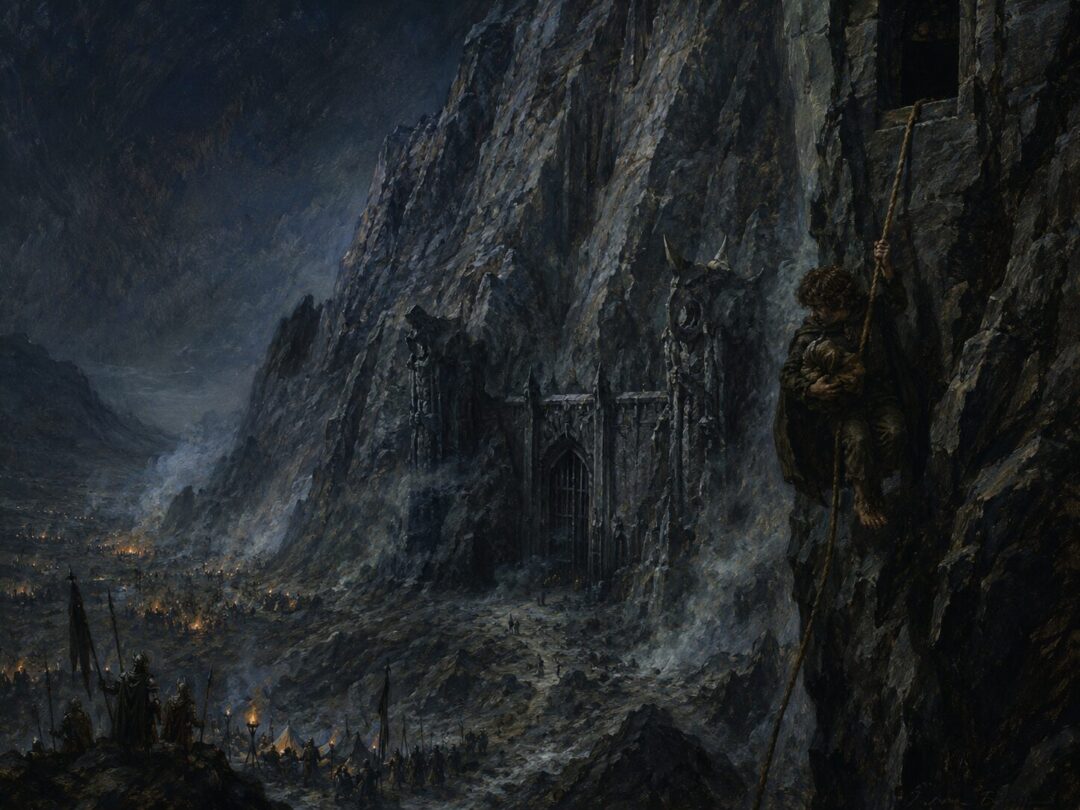
In The Hobbit, the Ring is not yet explained with the full terror it receives in The Lord of the Rings. But within the story itself, it already gives Bilbo the ability to move unseen, escape danger, and shape events secretly. His night journey with the Arkenstone depends on invisibility and deception.
That does not make his decision evil. The text presents his motive as peace-making, not domination. But it does make the scene morally complicated. Bilbo uses secrecy against his companions in order to prevent something worse.
This is important because Tolkien’s world rarely treats hidden power as harmless. Even good intentions can become dangerous when joined to concealment and manipulation. Bilbo’s choice is brave, but it is not innocent.
The difference is that Bilbo does not use hidden power to gain control over others for himself. He uses the one thing he has to force negotiation where pride has blocked it. He gives up leverage rather than hoarding it. He parts with the Arkenstone instead of using it to enrich himself.
In that sense, his action quietly resists the very corruption surrounding the treasure.
Thorin’s Anger Proves Bilbo’s Courage
The scene at the gate shows the full cost of Bilbo’s decision.
When the Arkenstone is revealed, Thorin’s fury turns on Bilbo. The king under the Mountain, who once depended on the hobbit, now sees him as a traitor. Bilbo does not respond like a warrior seeking glory. He does not boast. He does not try to overpower Thorin. He stands exposed before the consequences of what he has done.
That exposure is the point.
Many characters in Middle-earth are brave when facing enemies. Bilbo is brave when facing the hatred of someone he does not hate back.
That is a rarer form of courage. He is not trying to destroy Thorin. He is trying to save him from the moral disaster of his own obsession. Whether Bilbo fully understands it in those terms is debatable, but the effect is clear: he refuses to let friendship become obedience to madness.
A lesser loyalty would have stayed silent.
Bilbo’s loyalty becomes disobedience.
Thorin’s Deathbed Words Do Not Erase the Wrong, But They Reveal the Truth
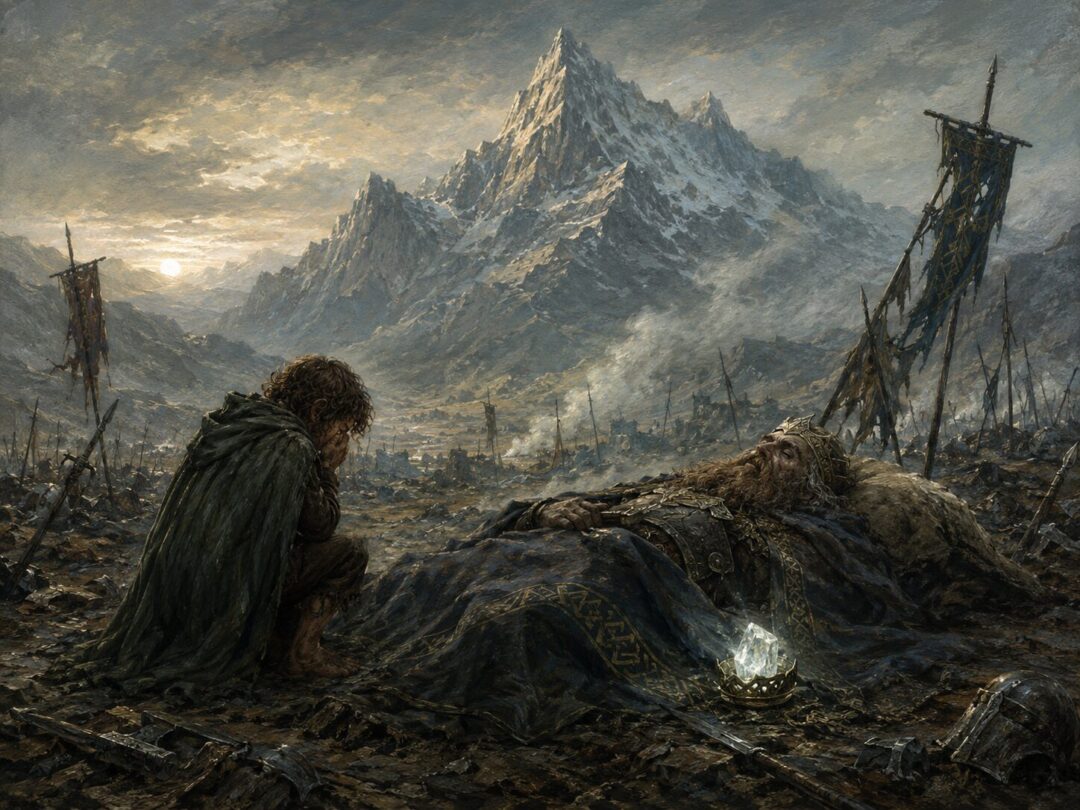
After the Battle of Five Armies, Thorin’s final reconciliation with Bilbo is one of the most moving moments in The Hobbit. Thorin recognizes, too late, that there are things of greater worth than gold. His farewell does not undo his rage, nor does it make the earlier conflict painless. But it reveals that Bilbo had seen something true.
The tragedy is that Thorin learns it only at the edge of death.
This is why Bilbo’s betrayal should not be read as a clever trick that simply “worked.” It did not prevent the Battle of Five Armies, because the arrival of goblins and wargs transformed the crisis. It did not immediately heal Thorin. It did not spare everyone.
But it did place a moral challenge before Thorin. It forced the question that treasure had buried: what kind of king will he be?
Thorin’s final repentance suggests that Bilbo’s act belongs on the side of mercy, not malice.
The Bravery of Refusing the Story Everyone Else Is Telling
Everyone around the Mountain is trapped in a story.
Thorin is trapped in the story of inheritance and insult. Bard is trapped in the story of survival and rightful compensation. The Elvenking is trapped, at least partly, in the politics of power and treasure. The Dwarves of the Iron Hills are arriving into a story of kinship and defense.
Bilbo alone seems able to step outside the heroic script.
He does not ask who can win. He asks how the killing might be avoided.
That is why his action feels so modern and so ancient at once. He recognizes that being “on the right side” does not excuse every act of escalation. He understands that loyalty to a leader is not the same as loyalty to the good. And he sees that peace sometimes requires betraying the expectations of your own camp.
This is not cowardice. Cowardice would have hidden in the Mountain and hoped the great people solved the problem.
Bilbo climbs down into the dark and acts.
Bilbo’s Greatest Victory Was Over Belonging
By the end of the quest, Bilbo has gained treasure, reputation, and experience. But his deepest transformation is not that he becomes more adventurous. It is that he becomes morally independent.
At the beginning, he is pushed and pulled by stronger personalities: Gandalf’s plan, the Dwarves’ skepticism, Thorin’s authority, the dangers of the road. By the Arkenstone episode, he is no longer merely reacting. He makes a decision that no one has ordered him to make.
And it costs him belonging.
That is why the word “betrayal” cannot simply be dismissed. Bilbo betrays Thorin’s command, Thorin’s desire, and the immediate solidarity of the company. But he does so because a higher loyalty has appeared: loyalty to life, peace, and the hope that Thorin can still be more than the treasure’s prisoner.
His bravest moral choice is not brave because it is perfect.
It is brave because it is lonely.
Bilbo stands between greed and war with no weapon worthy of a saga, only a stolen jewel, a guilty conscience, and the stubborn decency of a hobbit who knows that gold is a terrible reason for friends to become monsters.
Sources & Notes
- J.R.R. Tolkien, The Hobbit, “Not at Home” — Bilbo finds the Arkenstone, understands its unique value to Thorin, and keeps it as part of his share.
- J.R.R. Tolkien, The Hobbit, “The Gathering of the Clouds” — Bard’s claim, the Lake-men’s need, and Thorin’s hardening position create the moral crisis around the treasure.
- J.R.R. Tolkien, The Hobbit, “A Thief in the Night” — Bilbo carries the Arkenstone to Bard and the Elvenking as a bargaining piece meant to avert war.
- J.R.R. Tolkien, The Hobbit, “The Clouds Burst” — Thorin’s fury at Bilbo, Dáin’s arrival, and the sudden goblin threat show both the cost and the limits of Bilbo’s intervention.
- J.R.R. Tolkien, The Hobbit, “The Return Journey” — Thorin’s deathbed reconciliation with Bilbo frames the episode against the greater worth of mercy, food, cheer, and song over hoarded gold.