1. The ending that repentance might have changed
Had Sméagol’s repentance survived Cirith Ungol, would the Quest have lost the very instrument through which it ultimately succeeded? If Frodo could not relinquish the One Ring at the Sammath Naur, and Gollum remained loyal, what could have brought about Sauron’s downfall?
The difficulty rests upon an assumption Tolkien did not share: that Gollum’s moral regeneration would necessarily extinguish his desire for the Ring. Repentance could transform his relationship with Frodo without liberating him from the object that had governed his existence for centuries.
Tolkien considered substantially this alternative in Letter 246, written in September 1963 in response to Eileen Elgar. His proposed resolution retained Gollum’s seizure of the Ring but transformed its destruction. Instead of perishing through an accidental fall while celebrating his recovery of the Precious, a partially regenerated Sméagol might have chosen to perish with it for Frodo’s sake.
This is neither an abandoned episode belonging to the published narrative nor an authoritative account of an alternative history of Middle-earth. It is Tolkien’s retrospective speculation about different moral circumstances, providing a firmer foundation for answering the question than conjecture about Eru physically pushing someone into the fire.
2. Frodo’s inability was not a failure of devotion
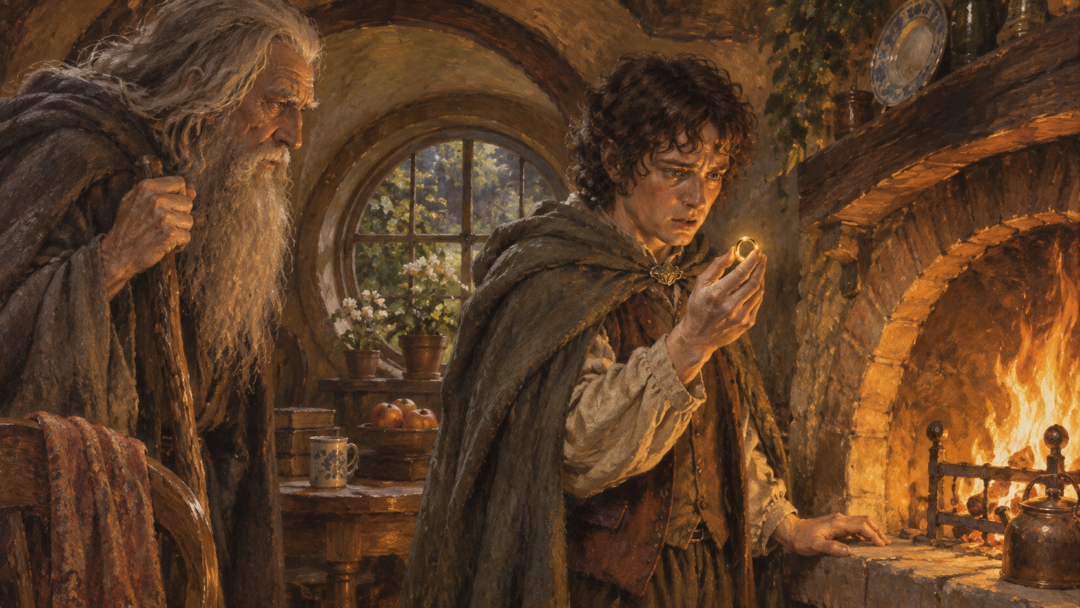
Any alternative ending must acknowledge the severity of Frodo’s predicament. In The Fellowship of the Ring, Book I, Chapter 2, ‘The Shadow of the Past’, Frodo attempts to throw the Ring into his hearth but finds himself returning it to his pocket. This occurs before the journey has exhausted him and far from the place of the Ring’s forging.
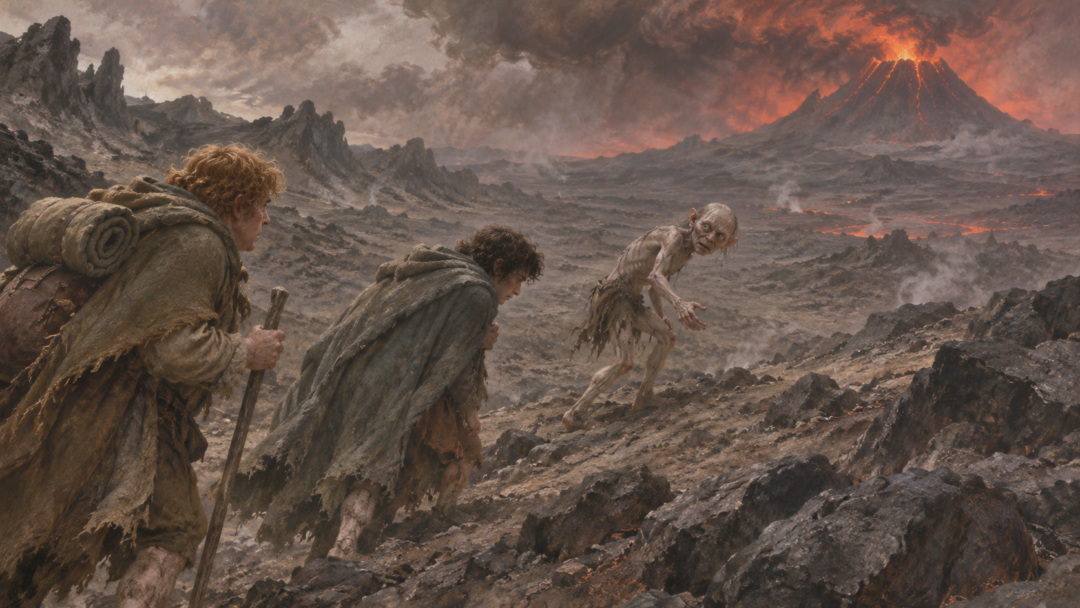
At the Sammath Naur, Frodo has endured wounds, imprisonment, hunger, thirst and the increasing burden of possession. His final declaration of ownership in The Return of the King, Book VI, Chapter 3, ‘Mount Doom’, follows this prolonged ordeal.
Tolkien defends Frodo in Letters 191 and 246. The latter explains that the Ring’s pressure at the decisive moment exceeded the resistance reasonably expected from someone in Frodo’s condition. Failure to accomplish an objective is distinguished from culpable moral failure.
A repentant Sméagol could not automatically solve this problem through encouragement. Frodo understands the stakes, accepts the personal cost and demonstrates exceptional endurance. What fails is his capacity to translate his original intention into action.
Avoiding the betrayal at Shelob’s lair might have considerably improved Frodo’s physical and psychological condition. Tolkien does not, however, calculate how much strength Frodo would have retained or suggest that a less arduous journey would necessarily enable voluntary surrender. His alternative concentrates instead upon Gollum. Assistance could alleviate the burden without removing its supernatural character.
3. What Sméagol’s repentance would actually mean
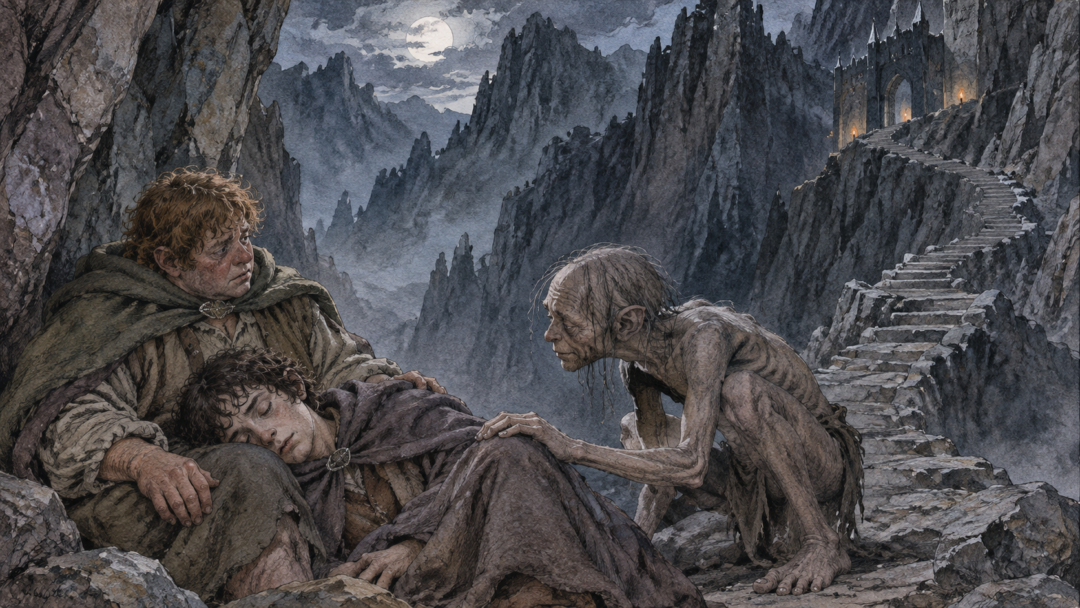
The decisive opportunity appears in The Two Towers, Book IV, Chapter 8, ‘The Stairs of Cirith Ungol’. Finding Frodo and Sam asleep, Gollum undergoes a change of expression, and his tentative gesture towards Frodo reveals the vulnerable, hobbit-like creature beneath his corruption.
Sam awakens and interprets the scene through his established distrust, destroying the fragile opportunity for reconciliation. Tolkien identifies this encounter in Letter 246 as especially tragic and connects its outcome with the subsequent betrayal involving Shelob.
Repentance, however, must not be confused with reversing the Ring’s effects. In Book IV, Chapter 2, ‘The Passage of the Marshes’, Gollum’s internal debate reveals affection for Frodo alongside his determination to recover the Precious. Both impulses can be genuine without being ultimately reconcilable.
The Ring’s influence predates Gollum’s attachment to Frodo by centuries. ‘The Shadow of the Past’ establishes his murder of Déagol and prolonged possession of the Ring. The Hobbit, Chapter 5, ‘Riddles in the Dark’, shows how thoroughly his underground existence has become associated with it.
Tolkien nowhere establishes that moral regeneration immediately cancels the effects of prolonged Ring-bearing. Bilbo’s lingering desire to see the Ring in The Return of the King, Book VI, Chapter 6, ‘Many Partings’, illustrates the durability of such attachment.
If complete repentance means absolute freedom from every temptation associated with the Ring, the question exceeds Tolkien’s proposed alternative. If it means sincere remorse, renewed affection and a determination to serve Frodo faithfully, Letter 246 addresses precisely the resulting conflict.
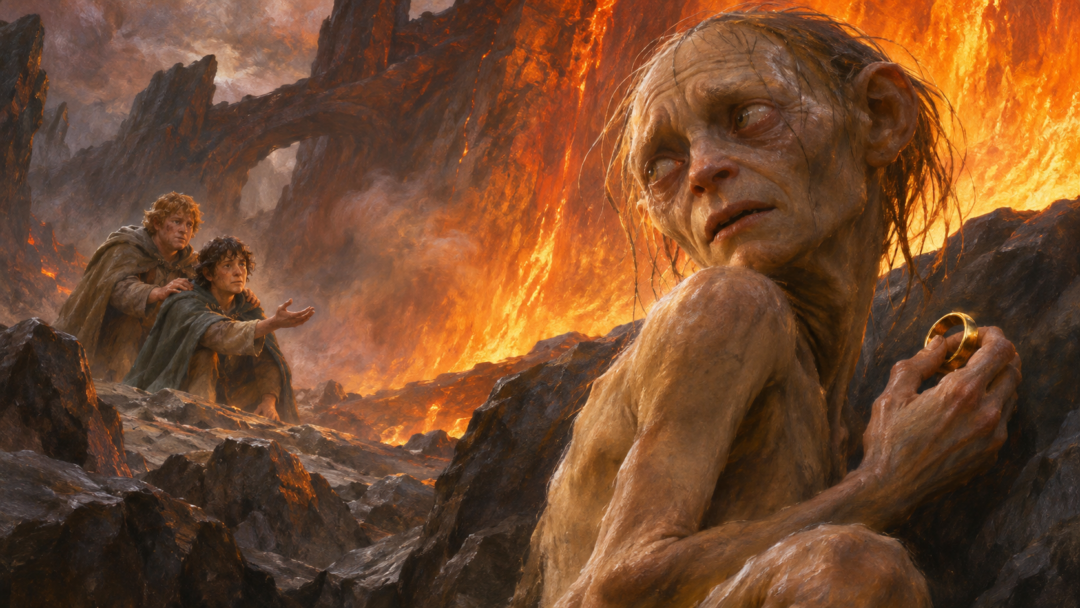
4. Why a repentant Gollum would probably still seize the Ring
Tolkien refuses to equate moral improvement with invulnerability. In Letter 246, he envisages Gollum’s affection growing during the remaining journey while the Ring retains its supremacy over his possessive desire. Eventually, Gollum would recover it through theft or force.
This would not make his repentance meaningless: the decisive temptation would still exceed the strength of his recovering will. The distinction resembles Tolkien’s treatment of Frodo, despite their profoundly different moral histories. Frodo’s claim at Mount Doom does not retrospectively invalidate his sacrifices; Sméagol’s seizure need not expose his earlier affection as fraudulent.
The proposed seizure also differs from the actual betrayal at Cirith Ungol, which involves deliberately delivering Frodo and Sam into mortal danger through a previously conceived plan. Tolkien’s alternative allows affection to develop sincerely until possessiveness produces a catastrophic contradiction.
The letter neither specifies the precise location of this seizure nor describes Frodo and Sam’s reactions. It does not establish that Frodo would necessarily lose his finger. Importing every physical detail of the published climax would therefore be unwarranted.
What survives is the transfer of possession; what changes is the moral condition of the creature acquiring it. Gollum’s recovered affection would introduce a competing purpose into his moment of victory.
5. The paradox of keeping the Ring while destroying it
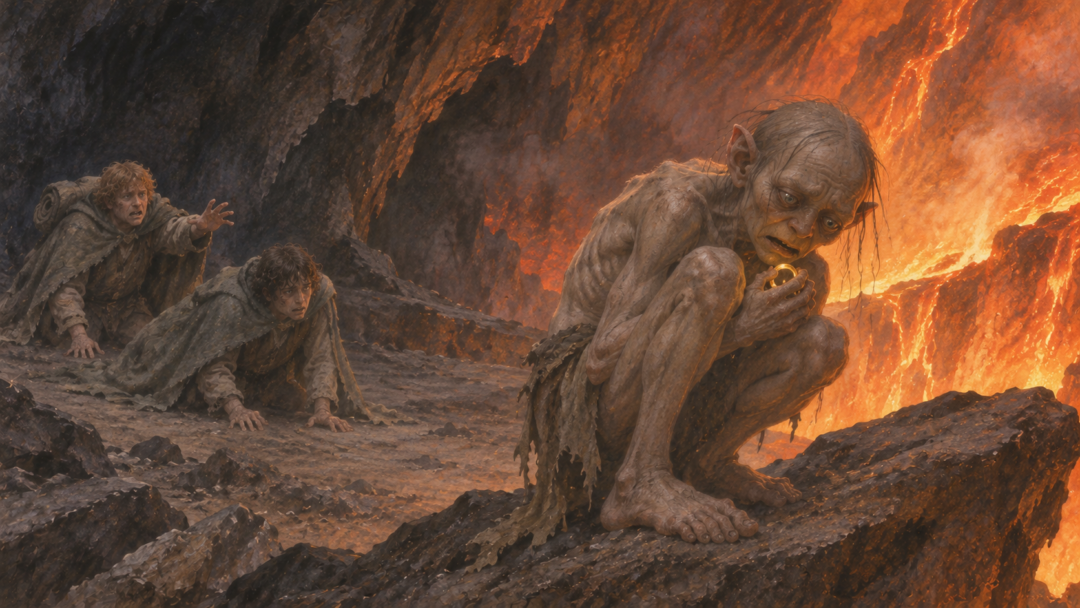
The most remarkable element of Letter 246 is Tolkien’s suggestion that Gollum, having recovered the Ring, might deliberately enter the fire with it.
Sméagol would not suddenly become capable of treating the Ring as an unwanted possession. Rather, moral recovery might produce a clearer understanding of his predicament after regaining it. He could recognize Sauron’s evil, the impossibility of successfully employing the Ring against him, and the hopelessness of preserving it indefinitely from its maker.
Destroying himself together with the Ring could unite otherwise irreconcilable desires. Gollum would deny Sauron the Precious without surrendering ownership to another person, simultaneously accomplishing the objective for which Frodo had suffered.
This is the interpretive key: renouncing possession and accepting destruction while retaining possession are psychologically distinguishable acts, although both result in the Ring’s annihilation. Tolkien’s speculation depends upon this distinction. The desire for possession remains powerful, but need not operate exclusively towards prolonged survival once Gollum recognizes that survival cannot preserve his ownership.
Affection for Frodo supplies a positive motive beyond opposition to Sauron. Without it, the Ring’s destruction would offer Gollum little that he consciously values. With it, the same act could become a final service to someone he loves.
This would represent an imperfect victory over corruption, not its disappearance. Tolkien’s proposal remains conjectural, but answers the central objection without requiring a suspension of the Ring’s established power.
6. Would Eru have needed to intervene differently?
The providential character of the actual ending has stronger textual support than the popular image of an invisible divine hand physically dislodging Gollum.
In Letter 192, written in July 1956, Tolkien explains Frodo’s achievement through the exhaustion of his available strength and his arrival at the appointed place. He attributes the event’s completion to a power beyond Frodo, identifying the history’s ultimate author as someone other than himself. Letter 246 similarly places Frodo’s endurance and earlier mercy within a providential framework.
These comments accord with Gandalf’s observations in ‘The Shadow of the Past’, where Bilbo’s acquisition of the Ring and Frodo’s inheritance possess significance beyond the intentions of the Ring and its maker. They also accord with the metaphysical framework of the Ainulindalë in The Silmarillion, in which the designs of rebellious created beings cannot ultimately escape Ilúvatar’s greater purpose.
None of these passages establishes direct physical intervention as the mechanism of Gollum’s fall; the narrative describes his loss of footing. Nor do they establish that every conceivable alternative history must reach the same outcome.
Tolkien’s proposed scenario therefore requires no additional miracle. Providence could operate through Sméagol’s recovering affection and final decision, just as it operates through earlier mercy, moral weakness and unintended consequences in the published ending.
If the counterfactual stipulates that Gollum never takes the Ring under any circumstances, another means would be necessary. Tolkien gives no definitive account of what Eru would arrange. Divine capacity is not evidence for a particular unrecorded divine action.
7. Could Frodo or Sam have supplied another solution?
Letter 246 also considers what might have happened had Gollum not immediately attacked Frodo following his claim to the Ring. Tolkien suggests that Frodo himself might have recognized the impossibility of retaining it against Sauron and faced the necessity of entering the fire with it.
This again distinguishes relinquishing the Ring from perishing while possessing it. Tolkien does not guarantee Frodo’s success. His subsequent discussion of the Ringwraiths and Sauron establishes that failure remained possible as the opportunity for destruction began to close.
Sam offers another conceivable instrument, but with weaker textual support. His brief Ring-bearing in The Return of the King, Book VI, Chapter 1, ‘The Tower of Cirith Ungol’, demonstrates both susceptibility to temptation and exceptional resistance to its promises through humility and affection.
This does not establish that Sam could willingly destroy the Ring at the Sammath Naur. His earlier relinquishment cannot be treated as an equivalent test. Nor does Tolkien identify an alternative in which Sam forcibly destroys the Ring or sacrifices Frodo to complete the Quest.
Such possibilities remain reader-generated conjectures. Tolkien’s proposals concerning Gollum and Frodo deserve greater weight because they explicitly address the psychological and supernatural conditions of the climax. The evidence supports alternative possibilities, not a guarantee that someone else could succeed whenever the appointed bearer failed.
8. Repentance would change the victory, not make it impossible
The published ending contains a pattern of warning and fulfilment. Gollum’s oath in ‘The Taming of Sméagol’, Frodo’s warning at the Forbidden Pool, and the pronouncement during their confrontation on Mount Doom connect betrayal, possession and destruction. The precise metaphysical mechanism remains open to interpretation; the narrative identifies no single explicit supernatural cause for the fall.
A repentant Gollum might still have fulfilled the terrible association between recovering the Precious and perishing with it, but the inward meaning of his fate would have changed radically.
In the published story, Gollum accomplishes the Quest without intending its success. In Tolkien’s imagined alternative, he might accomplish it through an intention emerging from his renewed capacity for love, notwithstanding his continuing enslavement to possession.
This difference makes the opportunity at Cirith Ungol genuinely tragic. Treating Gollum’s betrayal as indispensable would diminish the significance of his moral choices and imply that repentance necessarily condemned Middle-earth. Tolkien’s speculation refuses that conclusion.
Frodo’s pity need not have produced salvation only by preserving a future traitor. It might have preserved someone capable of a final, costly act of loyalty. The Ring’s destruction could have remained the providential completion of Frodo’s exhausted endeavour while becoming something the actual ending denies Gollum: a conscious contribution to the good of another.
Sources & Notes
This article is based on close reading and interpretation of Tolkien's published works and related source material where relevant.