1. The distinction Tolkien’s readers must make
The destruction of Orcs is a recurring consequence of victory in Tolkien’s legendarium. Their armies are broken, their strongholds emptied, and their surviving companies driven into remote places. Yet Tolkien’s narratives raise a difficult question: are any victims of such destruction explicitly identified as Orc civilians?
The answer requires more precision than either an accusation of genocide or a blanket defence of Orc killing allows. Tolkien supplies abundant examples of Orc soldiers dying in battle, but no unambiguous narrative scene in which the protagonists deliberately kill identified Orc women or children. That absence does not establish that every Orc who died throughout Middle-earth’s history was an active combatant.
Some of the most troubling passages concern the destruction of entire Orc communities rather than encounters between armed opponents. Other texts acknowledge Orc reproduction, contemplate surrender, and distinguish fighting Orcs from treating them with indiscriminate cruelty.
Tolkien predominantly depicts Orcs through their military functions, leaving their domestic existence largely outside the narrative. The ethical implications of that omission must be distinguished from events the author actually describes.
2. Orc women and children: existence is not evidence of death
Tolkien’s writings provide considerably more evidence for Orc reproduction than for their domestic arrangements.
In The Silmarillion, in ‘Of the Coming of the Elves and the Captivity of Melkor’, Tolkien states that Orcs reproduced in the manner of the Children of Ilúvatar. Whatever difficulties surround their ultimate origins, this account distinguishes their subsequent multiplication from their original corruption by Morgoth.
The Hobbit supplies a concrete genealogical example in Bolg, the son of Azog. Appendix A of The Lord of the Rings records Azog’s death at Azanulbizar, while The Hobbit records Bolg’s leadership of the northern goblins at the Battle of Five Armies. Orc parentage is therefore an established element of Middle-earth’s recorded history.
Tolkien addressed Orc women explicitly in a letter to Mrs Munby dated 21 October 1963, extracts from which were subsequently published in Sotheby’s auction catalogues. He acknowledged their necessary existence, explaining their narrative absence through the stories’ predominant concern with Orcs as soldiers.
This does not tell us how Orc children were raised, whether settlements contained segregated domestic quarters, how responsibilities were distributed between the sexes, or whether every adult Orc was subject to compulsory military service.
Reproduction makes a population containing immature Orcs a reasonable inference. It does not demonstrate that they were present during any particular destruction of an Orc stronghold, much less that Elves, Men or Dwarves knowingly killed them.
3. The Hobbit and The Lord of the Rings: overwhelmingly military deaths
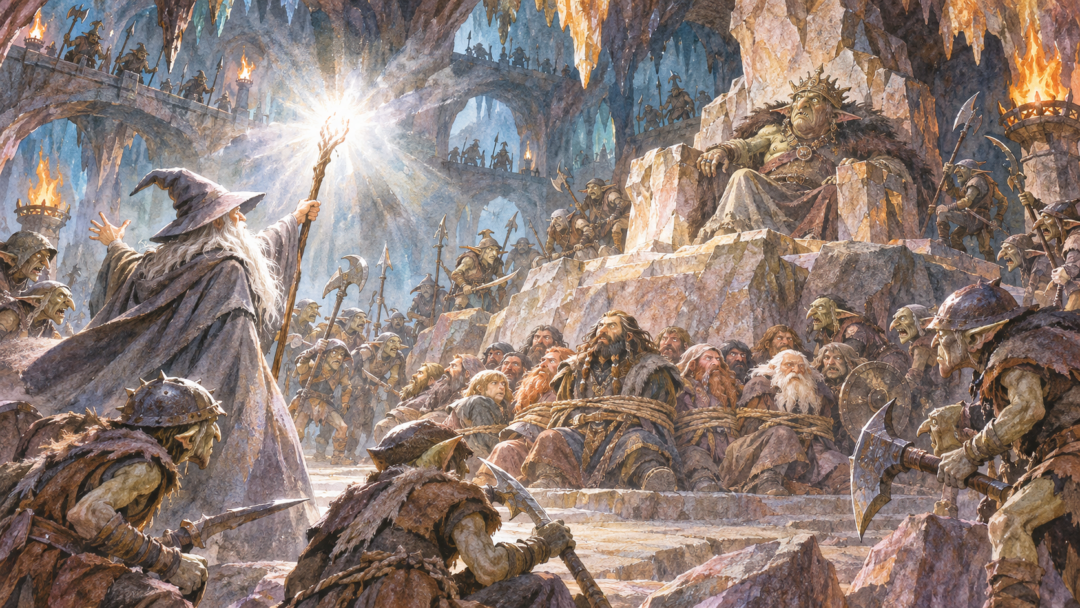
The principal Orc encounters in The Hobbit involve immediate physical danger. In ‘Over Hill and Under Hill’, goblins capture Thorin’s company and take them before the Great Goblin. Gandalf kills their ruler during the rescue, and further goblins die during the company’s escape.
These goblins are captors, guards, pursuers and their commanding authority, not an identified civilian household. Their underground location no more establishes civilian status than the subterranean setting of Moria does for its attacking Orcs.
The Battle of Five Armies provides clearer evidence. In ‘The Clouds Burst’ and ‘The Return Journey’, the goblin host confronts the assembled forces at Erebor. Tolkien’s account of the northern goblins’ enormous losses specifically concerns their warriors. Extending that description to their entire reproductive population exceeds the text.
The Lord of the Rings preserves this military emphasis. The Orcs in ‘The Bridge of Khazad-dûm’ attack the Fellowship. The companies destroyed by Éomer’s riders, whose fate is examined in ‘The Riders of Rohan’ and ‘The Uruk-hai’, are armed raiders carrying prisoners. The Orcs counted by Gimli and Legolas at Helm’s Deep belong to Saruman’s attacking army.
Gondor’s defenders likewise confront military forces at the Pelennor Fields and the Morannon. None of these episodes identifies an Orc child or civilian woman among the dead. This military focus explains the absence of Orc families from both novels without establishing that such families cannot exist beyond the protagonists’ experiences.
4. The War of the Dwarves and Orcs: the strongest ambiguous case
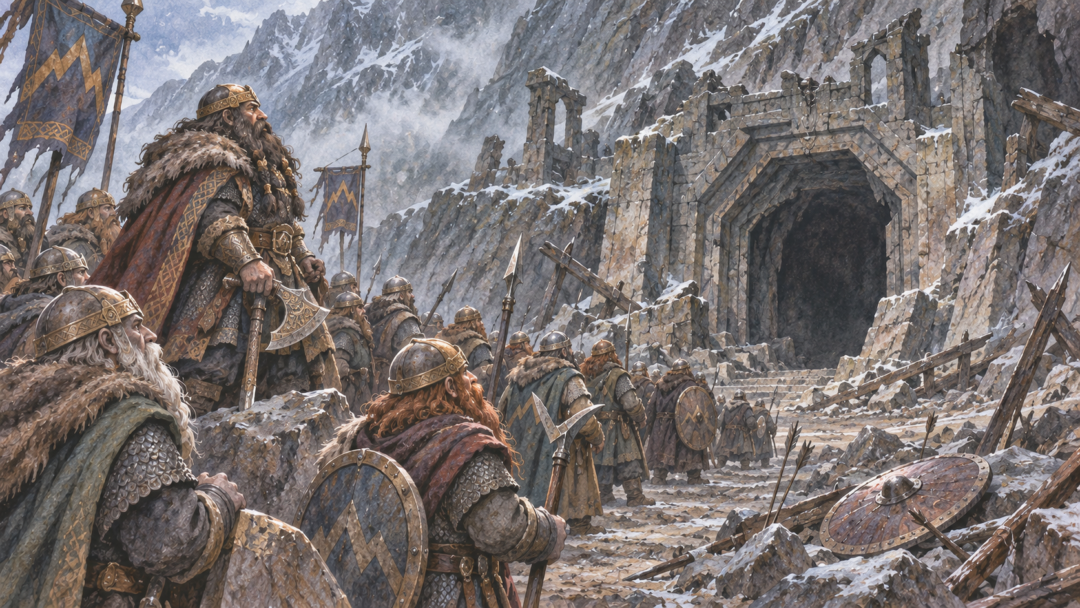
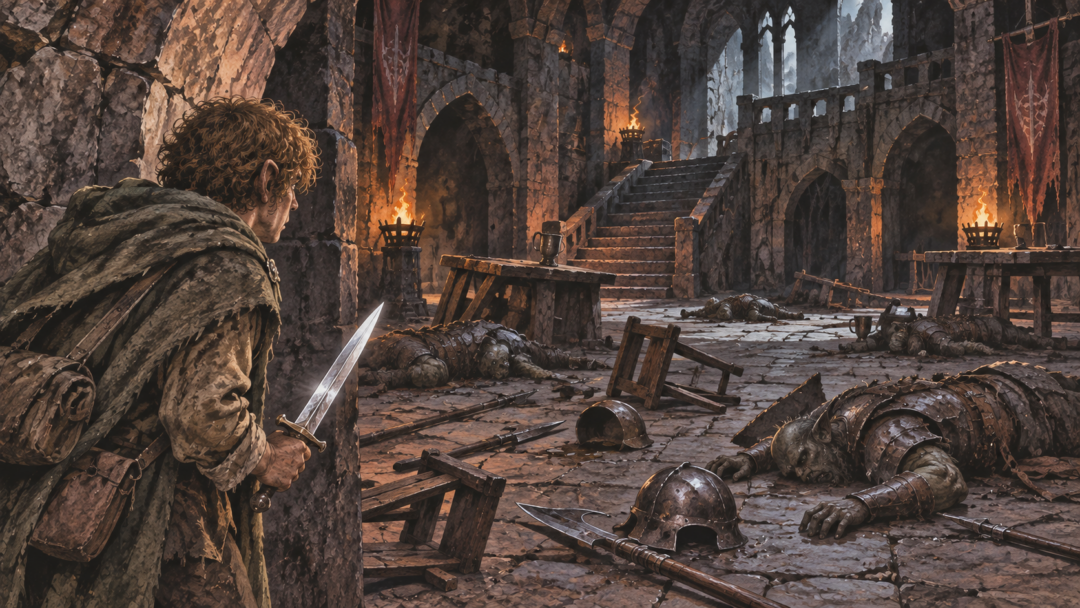
The strongest challenge to a purely battlefield interpretation appears in Appendix A of The Lord of the Rings, in ‘Durin’s Folk’. The War of the Dwarves and Orcs begins as vengeance for Azog’s murder and humiliation of Thrór, but extends far beyond pursuing the individual responsible.
The Dwarves attack and sack Orc strongholds throughout the Misty Mountains, from Gundabad to the Gladden. The prolonged, exceptionally bitter conflict culminates in the Battle of Azanulbizar in Third Age 2799.
The earlier stages concern the destruction of occupied settlements rather than merely encounters with armies in the open. Given Orc reproduction, these strongholds might have contained dependants or others who took no part in fighting.
Tolkien, however, does not describe their inhabitants sufficiently to establish this. He reports neither the discovery of Orc children, the killing of Orc women, nor orders to destroy the reproductive population. Sacking a stronghold establishes its violent defeat, not the identity or circumstances of every victim.
Conversely, Appendix A does not guarantee that the Dwarves restricted their attacks to armed defenders. There is no account of civilian evacuation, protection or survival. Categorically excluding civilian casualties therefore requires assumptions, just as asserting deliberate massacres does.
The collective vengeance deserves ethical scrutiny because the campaign extends beyond Azog himself. Nevertheless, the text cannot sustain a definitive reconstruction of how non-combatants were treated. This is the strongest opportunity for inferring civilian deaths, not an explicit example of them.
5. Extermination language and the clearing of Orc settlements
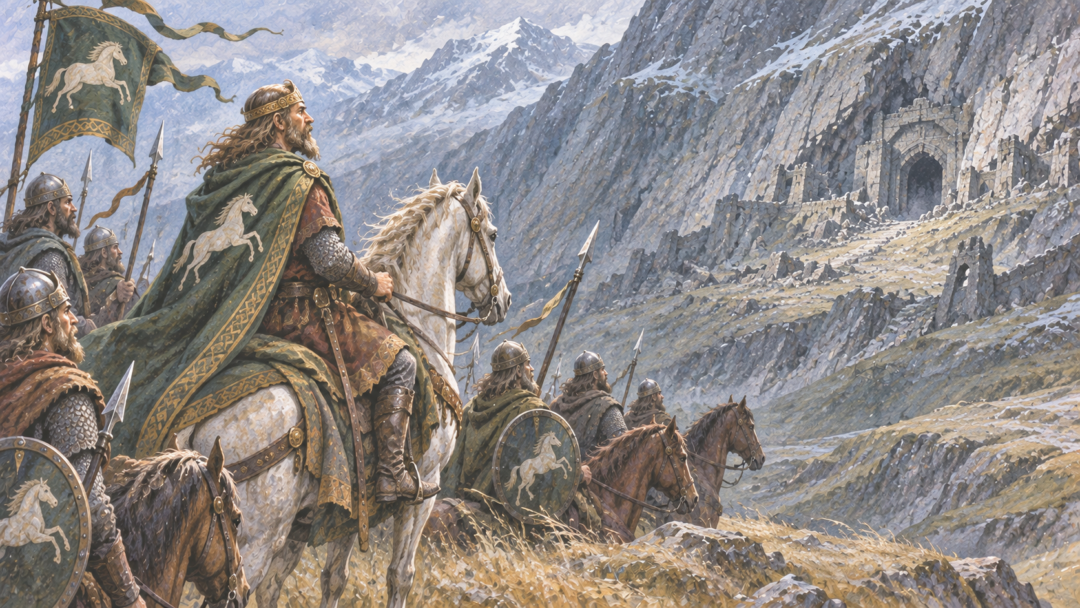
A similar difficulty arises in Appendix A’s account of Folca, king of Rohan. He refuses ordinary hunting until the Orcs have been removed from his kingdom. The destruction of Rohan’s final Orc stronghold precedes his fatal hunt for the great boar of Everholt.
Folca’s objective extends beyond repelling an invading company: he intends to eliminate the Orc presence within a defined territory. Nevertheless, Tolkien does not specify whether the stronghold shelters civilians, describe the fate of each inhabitant, or establish whether escapees survived elsewhere. The distinction between destroying a hostile settlement and destroying every member of a people remains unresolved.
Earlier history presents comparable limitations. In The Silmarillion, ‘Of the Voyage of Eärendil and the War of Wrath’, Morgoth’s defeat brings enormous destruction upon his Orc forces, with survivors escaping into distant regions. The account concerns the overthrow of his power and does not enumerate civilian victims.
Even the more detailed military narrative in Unfinished Tales, ‘The Disaster of the Gladden Fields’, identifies Orcs through their participation in the attack on Isildur’s company. Their defeat in the initial fighting supplies no evidence about inhabitants of nearby Orc settlements.
Broad historical summaries cannot establish the individual circumstances of every casualty. Where Tolkien describes the destruction of an Orc population or its regional presence without further qualification, non-combatant casualties can neither be responsibly excluded nor presented as established fact.
6. Not every Orc killing is a battlefield killing
The opposition between civilian deaths and soldiers killed in battle overlooks a third category: Orcs killed outside conventional engagements, including victims of other Orcs.
In The Two Towers, ‘The Uruk-hai’, disputes between the companies carrying Merry and Pippin culminate in lethal violence. These deaths result from internal antagonism and struggles over authority rather than combat against the Free Peoples.
In The Return of the King, ‘The Tower of Cirith Ungol’, Sam discovers the consequences of the garrison’s quarrel over Frodo’s possessions. The Orcs have largely destroyed one another. Their military affiliation is clear, but their deaths do not result from ordinary warfare between opposing armies.
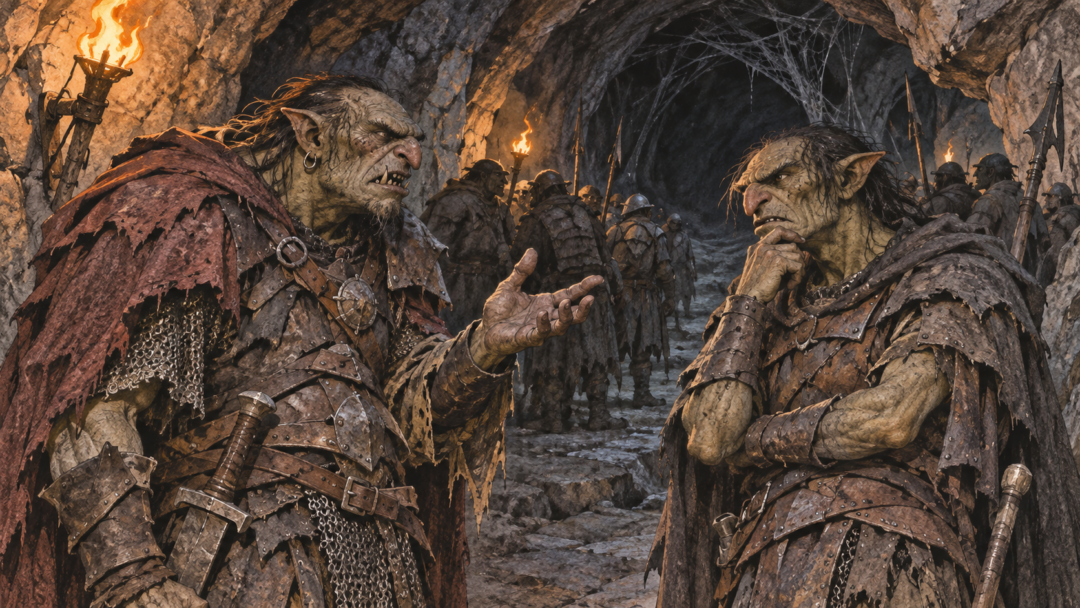
The Mordor chapters also complicate the assumption that every Orc willingly identifies with Sauron’s military enterprise. In The Two Towers, ‘The Choices of Master Samwise’, Shagrat and Gorbag discuss escaping their service and establishing an independent arrangement. Their imagined future involves predation rather than peaceful domestic life, but reveals interests distinct from those of their master.
These episodes do not establish civilian casualties. They demonstrate that military affiliation, personal motivation and the circumstances of death are separate questions. An Orc can belong to an army and die without fighting its enemies. The proposition that every recorded Orc death occurs in battle is demonstrably false.
7. Tolkien’s moral law and the limits of genocide framing
The clearest authorial evidence against indiscriminate Orc killing appears in Morgoth’s Ring, volume X of The History of Middle-earth, in the ‘Myths Transformed’ material concerning Orcs.
In one late discussion, Tolkien insists that Orcs remain subject to the moral law despite their corruption. He rejects torture of captives and requires mercy for those who surrender and request it. Crucially, he acknowledges that the conduct prescribed by the Wise was not invariably observed during war.
Tolkien thus distinguishes ethical standards from the historical behaviour of those nominally aligned with good. Participation in a righteous struggle does not make every conceivable action against an Orc morally permissible.
Letter 153, addressed to Peter Hastings in September 1954, illuminates the underlying theological difficulty. Tolkien wrestles with beings apparently corrupted beyond ordinary redemption while resisting their classification as creatures possessing an absolutely evil nature. His proposals concerning Orc origins remained unsettled, as the alternative accounts collected in Morgoth’s Ring demonstrate.
These writings neither establish that civilian massacres occurred nor show that instructions concerning captives were universally followed. They undermine the argument that Orc ancestry alone removes an individual from moral consideration.
Genocide is a modern analytical category rather than Tolkien’s description of these campaigns. Applying it to the legendarium requires distinguishing the defeat of hostile military forces from an intention to destroy a people as such. Civilian deaths are neither the sole possible evidence of such an intention nor sufficient by themselves to establish it.
The Dwarven campaign and Folca’s clearing of Rohan deserve examination under this distinction. Their objectives and collective language invite questions about the intended scope of destruction, but neither account provides sufficient detail about the treatment of the wider Orc population to establish an unqualified accusation of genocide.
Equally, Tolkien’s moral restrictions undermine any hypothetical justification for killing every Orc regardless of conduct, age or willingness to surrender.
8. What the surviving evidence actually establishes
Tolkien establishes Orc reproduction, individual parentage and the existence of women. He describes warriors being killed, campaigns destroying settlements, violence within Orc society, and moral restrictions upon the treatment of defeated Orcs.
What the principal published narratives and relevant supplementary writings do not supply is an unequivocal account of the Free Peoples deliberately killing identified Orc civilian women or children.
The destruction of the Misty Mountain strongholds and Rohan’s final Orc-hold leaves civilian casualties possible. Claiming they certainly occurred supplies details the historian of Middle-earth has withheld. Claiming they certainly did not mistakes the limitations of his account for comprehensive knowledge.
Tolkien’s recorded Orc casualties are predominantly military, but his narratives do not establish the complete absence of civilian casualties. His moral writings, moreover, deny readers an unrestricted ethical justification for extermination.
The Orc child is absent from Tolkien’s battle narratives. That absence limits what we can claim about those battles; it does not prove that such a child never existed or could never have suffered their consequences.
Sources & Notes
This article is based on close reading and interpretation of Tolkien's published works and related source material where relevant.