It’s easy to say Frodo trusted Gollum.
It’s also easy to say he didn’t.
Both answers can sound convincing, because the story gives you scenes that support either reading: Frodo’s gentleness, Frodo’s warnings, Frodo’s use of Gollum as a guide, Frodo’s moments of harsh command.
But the text doesn’t present Frodo’s approach as a single settled posture.
It changes.
And the change matters, because it’s one of the clearest places where you can watch the Ring’s pressure reshaping a good intention into something sharper.
The question, then, is not only “Did Frodo trust him?”
It’s what kind of trust we mean—and what Frodo is actually trying to accomplish.
The first truth: Frodo does not meet Gollum as an equal
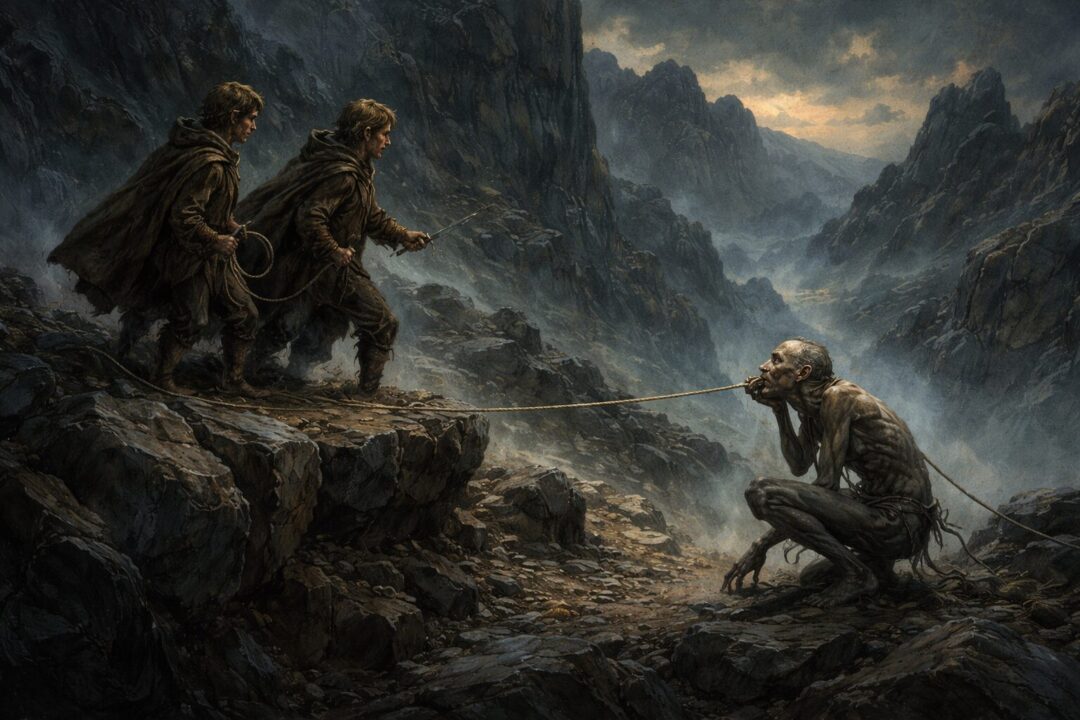
When Frodo and Sam first “take” Gollum in the Emyn Muil, the situation is not friendly.
Gollum has been following them. He attacks. He is subdued. He is bound.
Whatever Frodo feels, he begins with control, because he has to. They are two hobbits alone on the edge of Mordor. Gollum is dangerous, unpredictable, and desperate.
This is the first place the “strategy” reading has real weight.
Frodo’s immediate problem is practical: they need a way forward, and they need to survive the night. Gollum is both a threat and—potentially—the only creature nearby who knows paths that might lead them toward Mordor.
So Frodo acts like someone handling a living hazard.
He restrains him, and he demands a promise.
Even the form of the promise matters. Frodo does not simply accept any soothing words. He presses Gollum toward an oath, and when Gollum reaches instinctively for the Ring—his “Precious”—Frodo is not naïve about what that implies.
He cautions him about the nature of such an oath: that the thing Gollum calls on is treacherous, and that words can be twisted.
That is not blind trust.
It is a decision to bind Gollum as tightly as possible—morally, psychologically, and (when needed) physically—because the Ring has already taught Frodo how slippery promises can become.
In other words: Frodo’s mercy begins inside a frame of management.
The second truth: Frodo’s mercy is not pretend
And yet, if it were only strategy, the story wouldn’t keep showing you something else: Frodo’s willingness to treat Gollum as a person rather than a pest.
Sam wants simpler categories—enemy or ally, threat or friend. Frodo does not.
Again and again he tries to handle Gollum without needless cruelty, even when Gollum is repulsive, even when he lies, even when he whines, even when he is plainly thinking about the Ring.
This is not softness for its own sake. Frodo’s compassion has a specific shape: he refuses to turn Gollum into a thing.
That matters in Tolkien’s world, because one of the great moral dangers is precisely that habit—renaming a person into a “creature,” a “vermin,” a “thing,” and then treating them accordingly.
Frodo does not do that.
He calls him by the name that still points toward personhood: Sméagol.
That choice isn’t proof of trust. But it is proof of moral intent. Frodo is trying to keep open the possibility that Sméagol can be reached, even if Gollum cannot.

The Forbidden Pool: the moment Frodo “betrays” him to save him
If you want the clearest example of why this question is difficult, you go to Ithilien.
Gollum is caught in the Forbidden Pool beneath Henneth Annûn, within Faramir’s hidden realm. The local law is death for trespassers. Frodo understands that if Gollum stays hidden in the water, the Men will shoot him—or take him and kill him.
So Frodo makes a choice that is both merciful and ruthless.
He calls to Gollum and draws him out—so that he can be seized.
To Gollum, this can only look like treachery: the master calling him into a trap.
And the narrative itself acknowledges how it would seem, while also framing it as the only way Frodo can save him.
This is a key point for “strategy from the start” readers: Frodo is willing to do something that damages the relationship if it prevents immediate death.
But it’s also a key point for the opposite reading: Frodo does this not to get rid of Gollum, but to keep him alive.
Strategy alone doesn’t require that.
In Ithilien, Frodo’s stance looks like this:
- He does not trust Gollum to act wisely.
- He does not treat Gollum as disposable.
- He is willing to be misunderstood by Gollum if that misunderstanding is the price of survival.
That is not friendship.
But it is not mere exploitation either.
It is a grim, protective kind of stewardship—the kind you adopt when you believe someone is dangerous and wounded at the same time.
The Stairs of Cirith Ungol: why Frodo’s approach almost matters
Then the story shows you something rare.
On the Stairs of Cirith Ungol, Frodo and Sam speak about Gollum again, and Frodo insists that whatever else Gollum is, he is no friend of Orcs, and so may still be a reliable guide.
That line can be read as cold calculation: he hates Orcs, so he’ll lead us.
But the chapter doesn’t stop there.
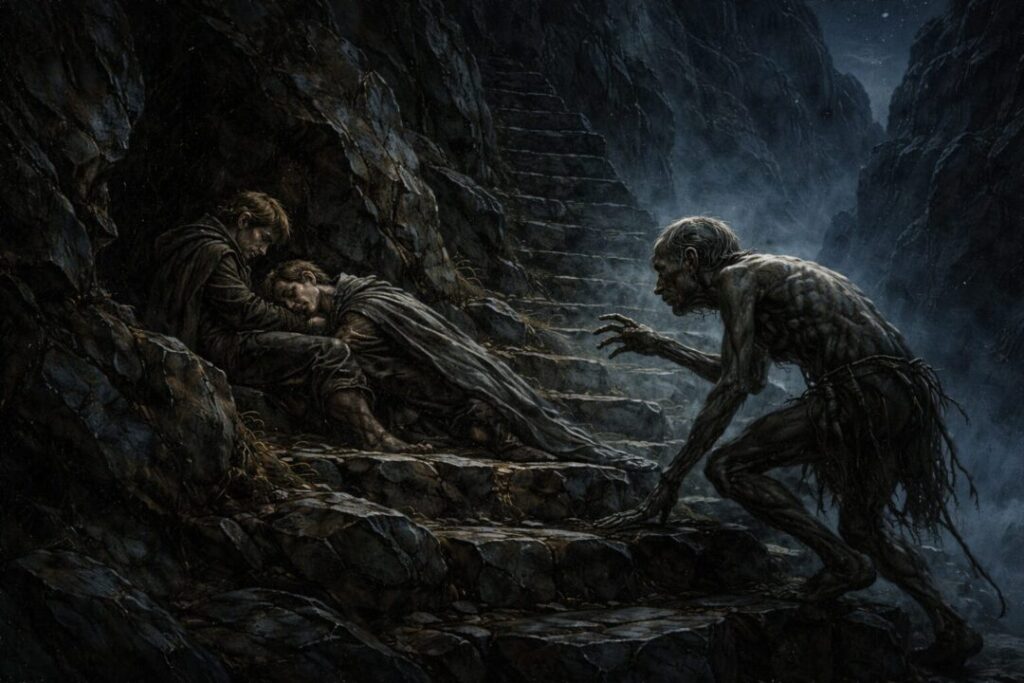
Gollum returns and finds the hobbits asleep in an almost childlike peace—Frodo’s head in Sam’s lap—and for a moment he wavers. The Tolkien Gateway summary captures that pivot directly: Gollum considers repentance, but the moment collapses when Sam wakes and treats him harshly.
You do not need to romanticize Gollum to see what the scene is doing.
The story briefly opens a door.
And crucially: that door is only believable because Frodo has not treated Gollum as nothing but a chained animal. Frodo’s repeated insistence on restraint and mercy is part of what makes Gollum’s wavering conceivable.
This is the strongest evidence that Frodo’s mercy is not merely a tactic.
If it were only performance, the story would not linger on the cost of its failure.
So did Frodo “trust” him?
Not in the simple sense.
Frodo does not trust Gollum the way you trust Sam—quietly, without calculation, with your safety in his hands.
Frodo’s trust, when it exists, is conditional and shaped by necessity:
- He trusts Gollum’s knowledge of paths more than he trusts any other option available.
- He trusts Gollum’s fear of the Ring’s power and oaths enough to try binding him by them.
- He trusts—more cautiously—that the hatred between Gollum and Orcs makes open betrayal less likely in certain moments.
But Frodo also behaves as if he believes something else:
That there is still a fragment of Sméagol who can respond to being treated as a person.
That belief is not “trust” in the sense of reliability.
It is trust in moral possibility.
And Tolkien’s narrative repeatedly treats that kind of trust as meaningful, even when it fails.
The final turn: Mount Doom and the voice of command
By the time Frodo reaches the Sammath Naur, his relationship to power has changed.
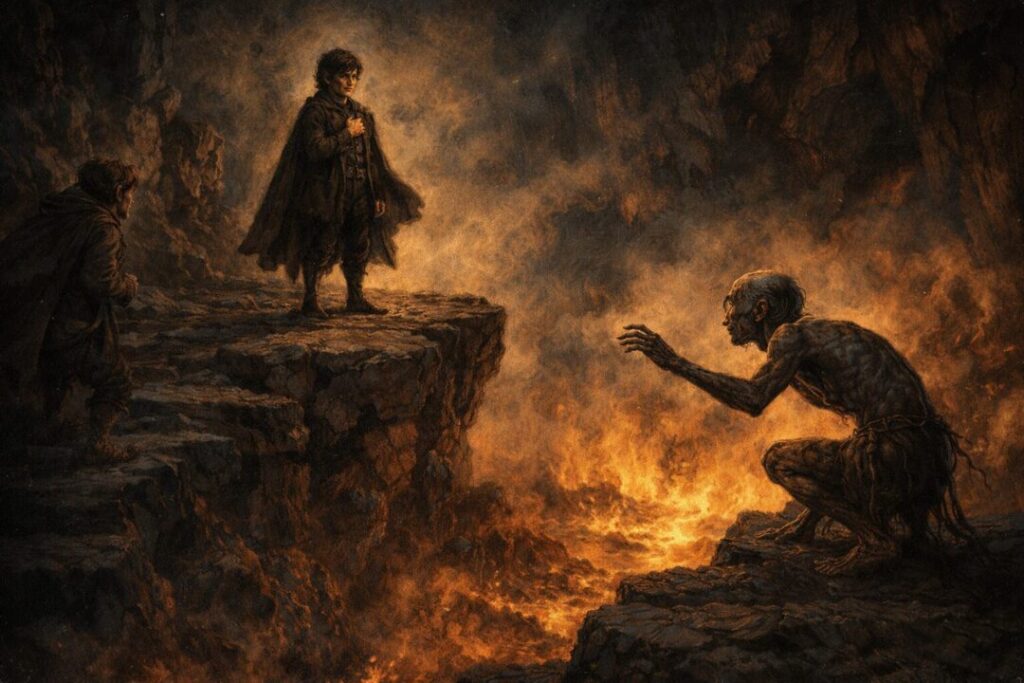
Near the Cracks of Doom, the text depicts Frodo in a moment of terrible authority—Sam perceives him as almost transfigured, and a commanding voice issues a warning to Gollum: that if he ever touches Frodo again, he will be cast into the Fire of Doom.
Whether you read that voice as Frodo, the Ring working through Frodo, or Frodo under the Ring’s domination, the effect is the same:
The “trust” phase is over.
What remains is binding, command, and doom.
And if you look back, you can see the progression:
- Control and necessity in the Emyn Muil.
- Protective management in Ithilien—even at the cost of being misunderstood.
- A narrow chance on the Stairs, made possible by Frodo’s earlier restraint.
- Authority without softness at the end.
So was it strategy from the start?
Partly, yes—because it had to be.
But the texts also show Frodo attempting something morally real: to treat a ruined creature as still responsible, still addressable, still not beyond the reach of pity.
That attempt is not a loophole in the plot.
It’s one of the story’s central pressures: in a world where evil corrupts by ownership, the hardest mercy is the mercy that refuses to turn a person into a tool—even when you must rely on them to survive.
And the tragedy is not simply that Gollum betrays them.
It’s that for a moment, the story lets you glimpse what might have happened if that fragile trust—Frodo’s trust in possibility—had been met with gentleness instead of scorn.
That is why this question never has a clean answer.
Because Frodo’s mercy is both a strategy for survival… and a last defense of his own humanity.