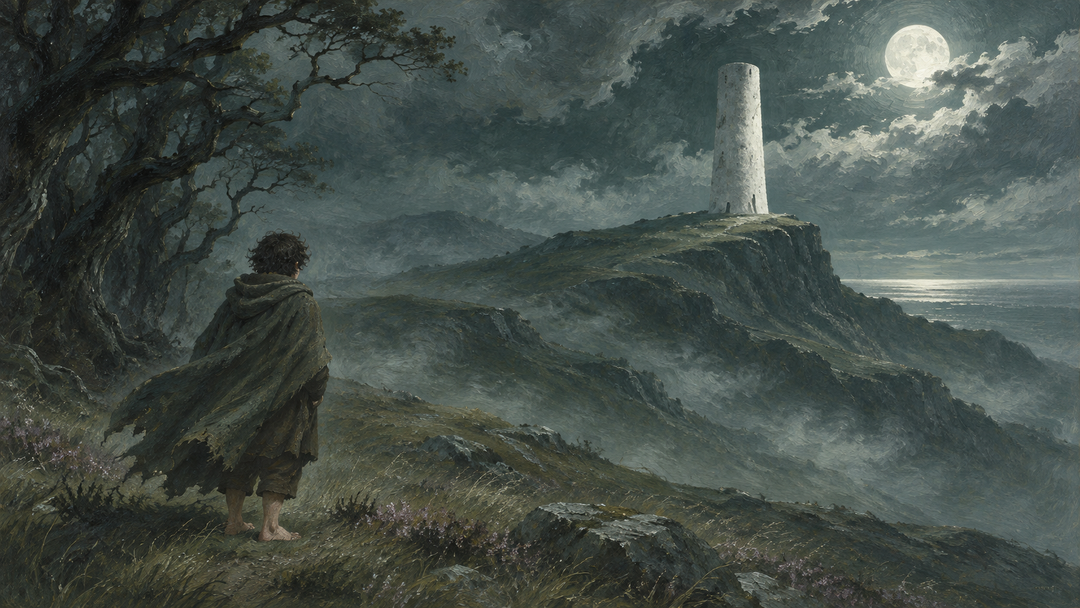
On the night of 25 September 3018, Frodo Baggins falls asleep at Crickhollow and dreams of a solitary white tower above a distant sea. He wants to climb it, but the dream ends before he reaches the summit. The scene, near the end of “A Conspiracy Unmasked” in The Fellowship of the Ring, is real enough in the book. Identifying the building as the Tower of Avallónë, however, goes beyond what Tolkien actually says.
The strongest geographical identification is Elostirion, the westernmost of the three Elf-towers on the Tower Hills beyond the Shire. The Tower of Avallónë stands elsewhere, across the Sea in the Undying Lands. The two are linked by a Seeing-stone, which makes the question more interesting than a simple case of mistaken names. Frodo’s dream may anticipate his eventual passage into the West, but it never identifies the tower he sees.
What Frodo Actually Dreams at Crickhollow
Crickhollow is Frodo’s temporary house in Buckland, east of the Brandywine. By the time he goes to bed, his friends have disclosed that they know more about his departure than he expected. Merry, Pippin and Sam will accompany him, while Fredegar Bolger stays behind as a decoy. Black Riders are searching for Frodo. The company plans to enter the Old Forest the following morning rather than follow an exposed road.
Frodo’s dream begins with an uncomfortable perspective. He seems to look from a high window over a dense stretch of tangled trees. Something moves and snuffles among their roots, and he fears it will find him. Then the sound changes. What first resembles wind in leaves becomes the distant noise of the Sea, which has troubled his earlier dreams although he has never heard it while awake.
In the next moment the trees vanish. Frodo stands on a dark heath, notices salt in the air and sees a tall white tower on a high ridge. He longs to climb it to look at the Sea. As he struggles uphill, a sudden brightness and thunder interrupt the experience. The narrative provides no name, inscription, inhabitant or recognisable harbour by which to locate the tower.
That sequence matters. Frodo does not look out across the Sea from the tower; he only hopes to do so. Nor does he describe an island, an Elvish city or the shores of the Blessed Realm. A claim that he directly sees Avallónë has to supply information absent from the scene. The tower is part of a dream, not a documented journey or a report from an identified viewpoint.
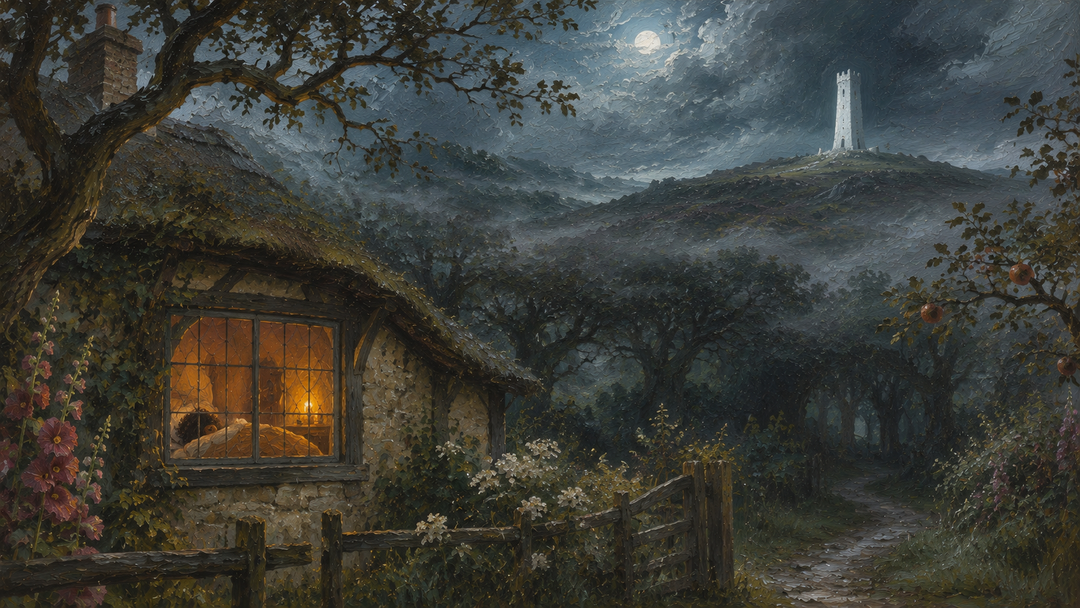
The first half of the dream also complicates any purely prophetic reading. The snuffling creatures recall the immediate danger from the Riders, while the threatening forest anticipates the terrain the hobbits will enter at dawn. Its change into an open coastal landscape could represent an escape from pursuit, a longing for freedom or some knowledge reaching Frodo through dreams. Tolkien does not settle which explanation is correct.
Elostirion, Avallónë and the Seeing-stone
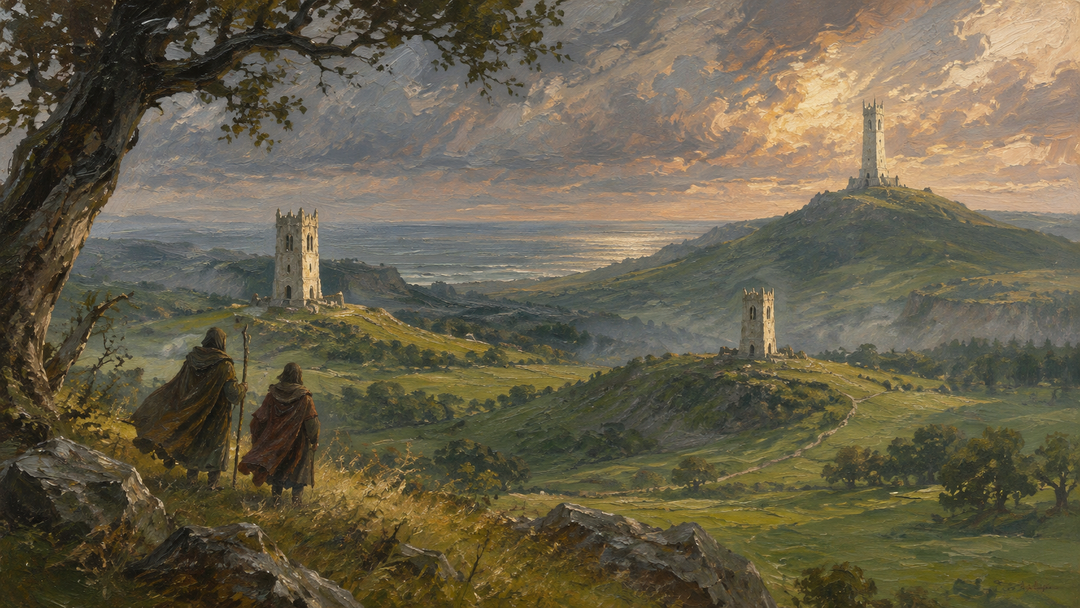
The clearest clue appears before the adventure begins. In the Prologue to The Lord of the Rings, Tolkien describes three ancient Elf-towers on hills beyond the Shire’s western borders. The tallest stands furthest away, separated from the others on its own mound. Westfarthing hobbits maintain that someone at its top could see the Sea, although no hobbit is known to have climbed it.
This tradition corresponds closely to Frodo’s dream: a solitary tower, elevated ground and the desire to see the Sea from above. The tallest tower is called Elostirion. It stands in Emyn Beraid, the Tower Hills, west of the Far Downs on the route towards the Grey Havens. Its location makes it a much stronger candidate than a building on an island outside the ordinary world.
The match is suggestive rather than exact. Frodo dreams of a dark heath and a ridge; the Prologue places Elostirion on a green mound. Dreams need not reproduce a landscape faithfully, but the difference is another reason not to treat the identification as explicitly confirmed. Moreover, the hobbits’ belief about seeing the Sea is presented as local tradition, not as a report by someone who accomplished the climb.
The Tower of Avallónë has a separate history. It stands at the Elvish haven of Avallónë on Tol Eressëa, the island associated with the Undying Lands. In the account of Númenor in The Silmarillion, its tower is a distant sign of the West, visible in earlier ages to exceptionally keen observers looking from Númenor. Mariners approaching the Blessed Realm could recognise it before reaching those shores.
That is not the geography of Third Age Buckland. After Númenor’s downfall, Aman and Tol Eressëa were removed from the ordinary circles of the world. A hobbit could not see Avallónë with unaided eyes from a Shire hill, though a dream might cross boundaries that normal sight cannot.
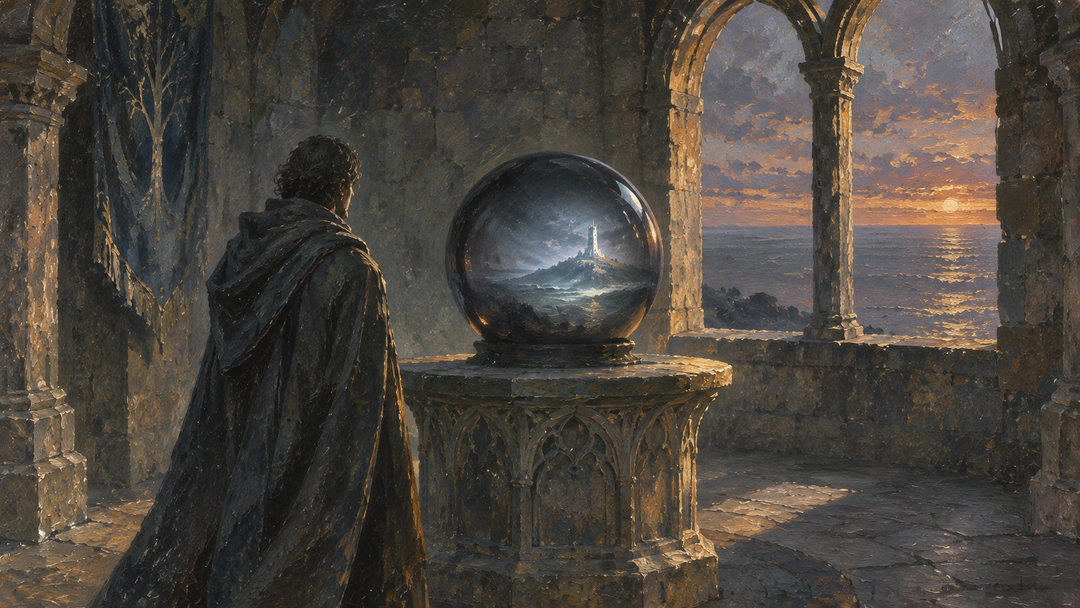
There is, nevertheless, a real connection between the towers. Gil-galad had the Elf-towers raised for Elendil, who escaped the destruction of Númenor. Elostirion housed one of the palantíri, the Seeing-stones carried to Middle-earth by the Faithful. Unlike the other stones, this one looked westwards towards Tol Eressëa rather than communicating with the stones elsewhere in Middle-earth.
The account called “Of the Rings of Power and the Third Age” in The Silmarillion says that Elendil used Elostirion when he yearned for the lost West. Through its stone he could sometimes glimpse the distant Tower of Avallónë, where the Master-stone was kept. Unfinished Tales, particularly its discussion of the palantíri, gives further context for the western stone’s unusual orientation.
Consequently, the two names should not be treated as interchangeable. Elostirion is the tower from which someone might seek a western view; Avallónë is the distant tower that Elendil might see through the stone within it. Frodo approaches a tower to look out from it, a pattern closer to Elostirion. He neither enters it nor uses a palantír, so no vision directly connects him to Avallónë.
What Tolkien’s Earlier Drafts Reveal
The manuscript history provides an unusually concrete explanation for the image. Christopher Tolkien examines the episode in The Treason of Isengard, part of The History of Middle-earth. During the development of the story, Gandalf’s unexplained absence had a different cause: Black Riders besieged him in a western tower. Frodo was to witness something of his escape in a dream.
In an early version set at the Prancing Pony in Bree, Frodo sees a white tower on a lonely height, with the Sea audible in the distance. Riders stand watch outside, then depart, allowing a grey-cloaked figure on a white horse to emerge. This was an episode about Gandalf, not a disclosed vision of Avallónë. Christopher Tolkien identifies its western setting with the Elf-towers beyond the Shire.
Tolkien reconsidered the timing and moved this dream back to Crickhollow, combining it with the existing vision of tangled trees and creatures below a window. Later he changed the explanation for Gandalf’s absence: Saruman had imprisoned him at Orthanc in Isengard, rather than the Riders holding him at a western Elf-tower. Much of the dream’s original action was therefore removed.
What survived was the white tower, Frodo’s desire to climb and see the Sea, and the interruption by light and thunder. Christopher Tolkien specifically notes that the surviving tower belongs to a narrative element which preceded the eventual account of Orthanc. That drafting history does not mean the finished dream depicts Orthanc: its setting, colour and maritime associations differ from Saruman’s black inland tower.
The thunder has an equally revealing history. In the Bree draft, Frodo wakes when Trotter, the early name for Strider, opens the shutters with a loud noise and lets morning light into the room. When Tolkien removed and relocated the surrounding action, the sudden ending survived. There is no need to invent a storm at Avallónë, a message from the Valar or a magical intervention to explain it.
Later Dreams and the Meaning of the West
Frodo dreams of another tower during his first night in Tom Bombadil’s house. This time he sees an aged figure high upon a stone pinnacle and an eagle arriving to carry him away. The scene corresponds to Gandalf’s rescue from Orthanc by Gwaihir. It is separate from the Crickhollow dream, even though both involve towers and events beyond Frodo’s waking knowledge.
On his following night with Bombadil, Frodo experiences a different vision. He hears singing and perceives a grey veil opening onto a distant green country beneath a swift sunrise. The episode is not described as a sight of Avallónë’s tower. It is important because the novel itself returns explicitly to this vision at the end, giving readers a firmer textual connection than the conjectural identification of the white tower.
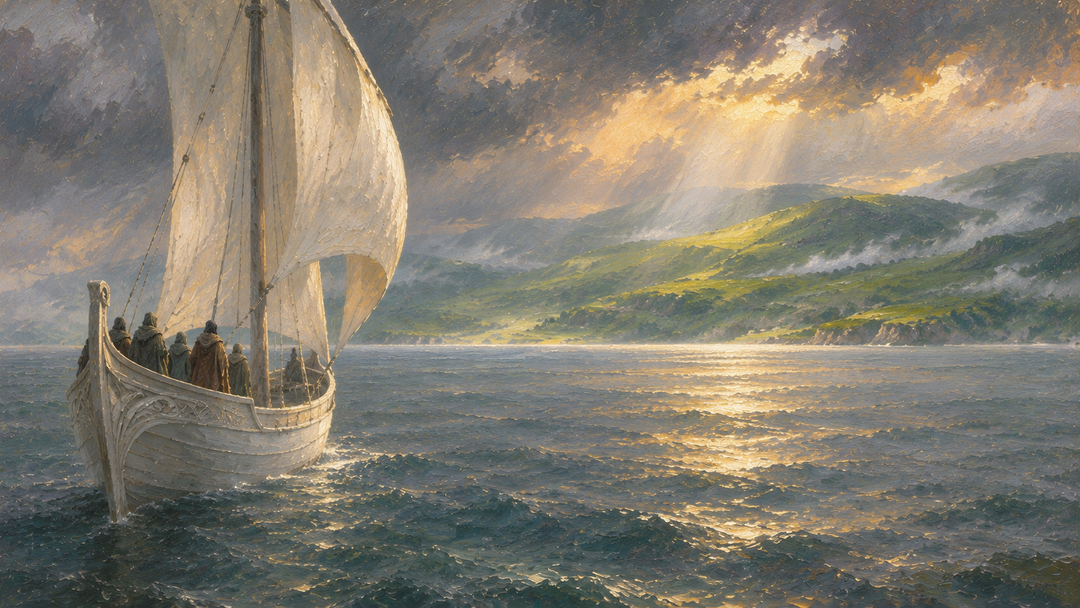
At the end of The Return of the King, Frodo travels west with Bilbo, Gandalf, Elrond and Galadriel towards the Grey Havens. Their route passes the country of the western towers. Frodo eventually boards the White Ship and leaves Middle-earth. When the vessel approaches the West, the narration deliberately recalls the dream in Bombadil’s house: the barrier of rain opens, revealing bright shores and a green country.
That explicit return makes the Bombadil vision a clear foreshadowing of Frodo’s departure. The Crickhollow dream, by contrast, is never retrospectively labelled a vision of either Elostirion or Avallónë. It can still foreshadow the same journey indirectly: Frodo’s wish to reach a western vantage point anticipates his movement beyond the familiar limits of the Shire and, eventually, across the Sea.
There is a particularly poignant contrast with the Prologue. Most hobbits regard the Sea with dread, and none is known to have climbed the tower said to overlook it. Frodo is already drawn towards that view while asleep. Yet his eventual westward voyage is not a simple fulfilment of a holiday wish. He leaves after suffering wounds that do not fully heal in the Shire. The dream’s longing gains weight from the cost of his journey.
The film adaptations must be kept separate. Peter Jackson’s The Fellowship of the Ring does not dramatise Frodo’s Crickhollow dream. His The Return of the King instead adapts the imagery of the distant green country into Gandalf’s conversation with Pippin about death. That cinematic reassignment cannot identify the tower in Tolkien’s book.
Fan speculation may read the white tower as an early summons towards the Undying Lands, or imagine Frodo receiving an unrecognised glimpse of Avallónë itself. Both readings are possible as symbolism. A stricter reading says that the dream shows an unnamed tower most plausibly resembling Elostirion, while the Avallónë connection exists through the western palantír and the story’s eventual destination. Tolkien does not provide enough information to turn the stronger possibility into certainty.
So did Frodo see the Tower of Avallónë at Crickhollow? The published story does not say that he did. He saw a white tower he wanted to climb, and the best-supported identification is the Elf-tower of Elostirion. Avallónë belongs to the larger meaning of that westward image, but recognising the difference between a tower seen in a dream and a tower that might be seen from it preserves both the textual evidence and the mystery Tolkien left intact.
Sources & Notes
- Tolkien Gateway — A Conspiracy Unmasked — https://tolkiengateway.net/wiki/A_Conspiracy_Unmasked
- The Encyclopedia of Arda — Elostirion — https://www.encyclopedia-of-arda.com/e/elostirion.php
- The Encyclopedia of Arda — Avallónë — https://www.encyclopedia-of-arda.com/a/avallone.php
- Tolkien Gateway — The Treason of Isengard — https://tolkiengateway.net/wiki/The_Treason_of_Isengard
Primary reading: The Fellowship of the Ring, A Conspiracy Unmasked and the Prologue; The Silmarillion, Of the Rings of Power and the Third Age; The Treason of Isengard. Frodo's tower is unnamed in the finished dream. Elostirion is a supported identification, while Avallónë is a distinct western tower linked through a palantír.