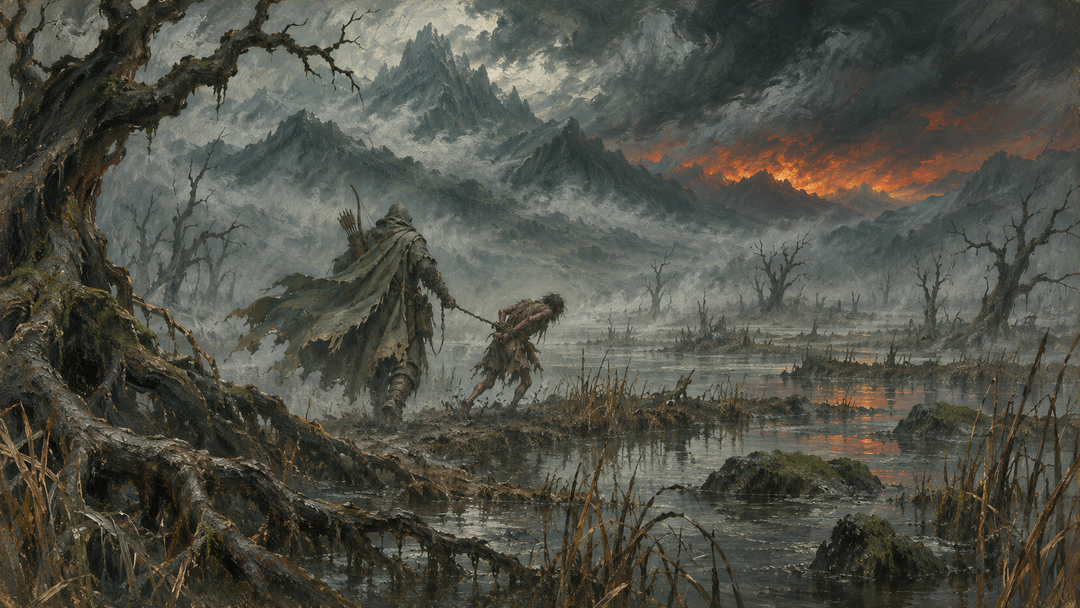
In the year 3017 of the Third Age, Aragorn caught Gollum in the Dead Marshes and marched him north to the Elvenking’s realm in Mirkwood. The prisoner was questioned by Gandalf, held by the Elves and eventually escaped. All of that happens before Frodo leaves the Shire. The hunt’s result is known before the film begins.
That is the obvious problem facing The Lord of the Rings: The Hunt for Gollum: not that Gollum lacks a story, but that the central pursuit has a known ending and its most important consequences have already appeared in another story. The drama must lie in what the hunters discover, what Gollum chooses and why keeping him alive matters.
The project is real, rather than a fan proposal. Warner Bros has scheduled a December 2027 release, with Andy Serkis directing and returning as Gollum, and Peter Jackson among the producers. The announced cast includes Jamie Dornan as Aragorn and Ian McKellen as Gandalf. Those facts do not establish the screenplay’s precise events.
The hunt already has an ending
The broad chronology is clear. In Appendix B of The Lord of the Rings, Gandalf begins seeking news of Gollum after Bilbo’s farewell party in 3001. He enlists Aragorn, and the two renew their search intermittently from 3009. Gollum travels into Mordor, falls into Sauron’s hands and is subsequently released. Aragorn captures him in 3017 and delivers him to Thranduil’s Elves. He escapes in 3018, months before Frodo reaches Rivendell.
This is not a conventional mystery about whether the quarry will be found. Readers know that Aragorn succeeds, that Gandalf learns something crucial and that the Elves ultimately fail to keep their prisoner. Nor can the film kill Gollum or prevent him from following the Fellowship without creating an alternative continuity. Gollum survives until the destruction of the Ring in 3019, where his intervention proves decisive.
The books also supply strikingly little continuous action for a feature-length pursuit. In the chapter ‘The Shadow of the Past’ in The Fellowship of the Ring, Gandalf explains his investigation retrospectively. At the Council of Elrond, Aragorn describes the capture and Legolas reports the escape. Appendix B fixes the sequence. These are narrative anchors, not a complete screenplay.
A further complication lies in Unfinished Tales, published after Tolkien’s death under Christopher Tolkien’s editorship. Its material on the hunt for the Ring adds information about Sauron’s calculations and movements across Middle-earth. Some associated chronological material places Gollum’s capture in 3018 rather than the 3017 of the published appendix. Some precise dates repeated by fans combine different textual stages. Not every day is an uncontested final decision by Tolkien.
That leaves a choice for an adaptation. It can respect the established outcome while inventing incidents inside the gaps, or it can revise the chronology more freely to match Jackson’s films. Neither approach supplies a previously untold, fully documented Tolkien narrative. The title promises a hunt; Tolkien mainly gave its background, resolution and implications.
Why Gollum cannot simply be the villain
Gollum is valuable to a storyteller because he frustrates ordinary moral categories. Before becoming the creature Bilbo meets beneath the Misty Mountains, he is Sméagol, a member of a people related to hobbits living near the Anduin. When his relative Déagol finds the Ring, Sméagol murders him to take it. He makes a terrible choice, but centuries under the Ring’s influence deform his body and mind.
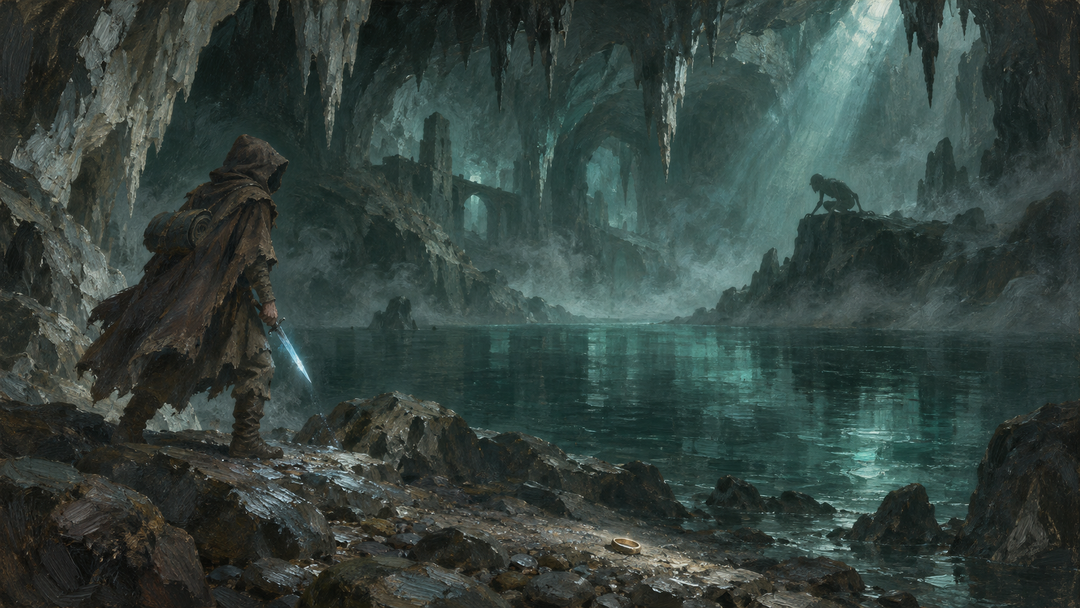
The revised ‘Riddles in the Dark’ chapter of The Hobbit is essential here. In its original 1937 form, Gollum intends to offer the Ring as a prize in the riddle contest and, unable to find it, helps Bilbo leave. Tolkien later changed the episode as the Ring’s significance developed. In the familiar revised version, Gollum wants to use the Ring to kill Bilbo, who instead escapes invisibly. Tolkien incorporated the older account into the fictional history as Bilbo’s misleading version. This is a textual revision, not two events in Middle-earth.
Bilbo’s choice to spare Gollum is what matters beyond the riddle game. Gandalf later insists that pity, not a confident prediction of usefulness, justifies the decision. When Frodo wishes Gollum had died, Gandalf challenges the ease with which people assign death to those who deserve it. The supposedly expendable creature eventually makes possible what Frodo cannot achieve alone.
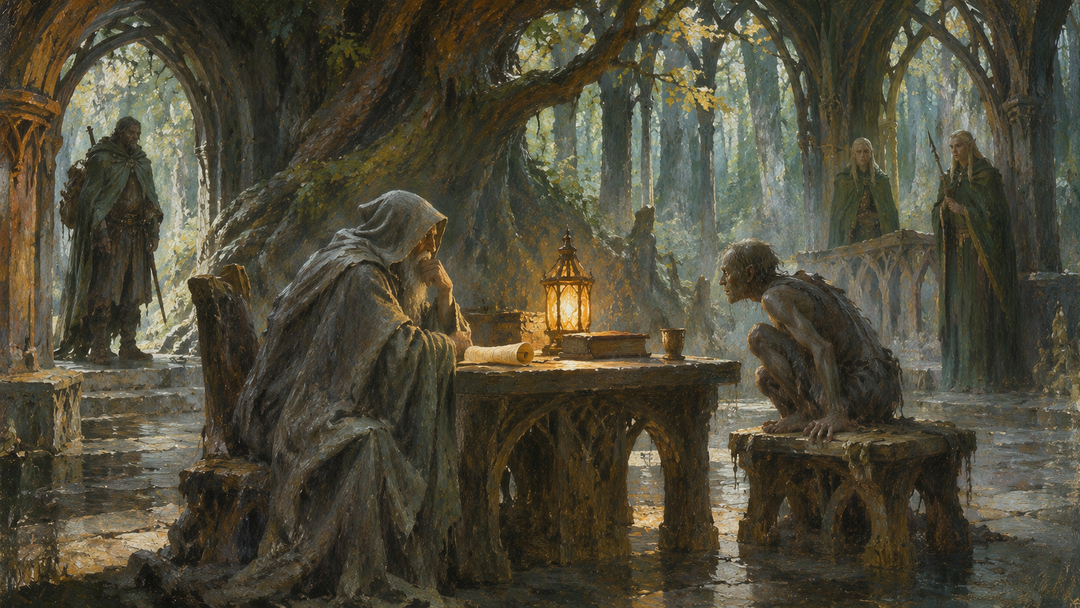
This creates a particularly awkward situation for a film about Aragorn’s pursuit. The audience may understand why Gandalf wants information, but the obvious tactical response to a dangerous servant of the Ring could seem to be killing or permanently confining him. Tolkien rejects that narrow calculation. Aragorn undertakes a miserable and hazardous journey to bring Gollum in alive. Gandalf questions him rather than treating his past crimes as grounds for execution. The Elves later show him kindness despite knowing he is dangerous.
Kindness does not make Gollum harmless. During the events leading to Frodo’s journey, he has already supplied Sauron with the names Baggins and Shire, even if his knowledge of the Shire’s location is limited. Unfinished Tales describes Sauron releasing him partly in the hope that his obsessive search would lead spies towards the Ring. His malice serves the enemy, though he is no obedient agent.
A worthwhile adaptation should preserve this instability. If Gollum is merely a monster stalking villages, the chase becomes morally simple and loses its Tolkienian point. If he is presented solely as an abused victim, Déagol’s murder and his continuing threats disappear from view. The more productive question is how an intelligent, cruel, frightened and pitiable person behaves when both Sauron and his pursuers want something from him.
Book chronology and film continuity are different
Jackson’s The Fellowship of the Ring moves rapidly from Bilbo’s departure to Gandalf’s discovery of the Ring’s identity and Frodo’s flight. The novel allows seventeen years between Bilbo’s party in 3001 and Frodo’s departure in 3018. The interval contains Gandalf’s research and his hunt with Aragorn. The film leaves less visible room for intermittent searching.
The earlier trilogy does establish some essential facts: Gollum once possessed the Ring, Sauron tortured him, and Gandalf recognises the danger of the information he revealed. It does not show Aragorn’s capture of Gollum and the journey to Thranduil. Filling that omission need not contradict the films. What matters is whether the new story is presented as fitting into their compressed timeline or as recovering the longer chronology of the books.
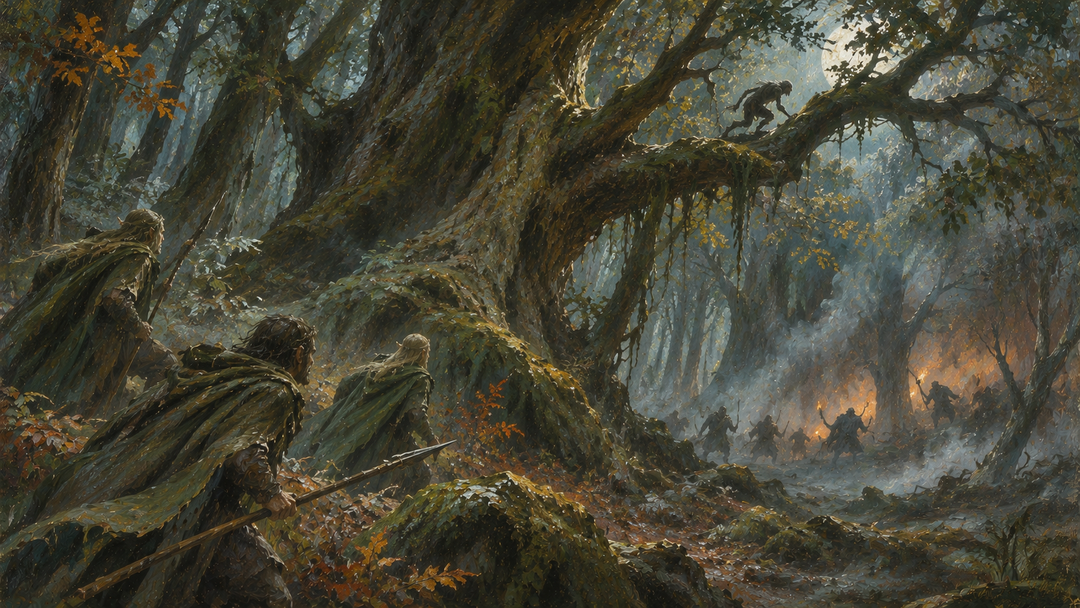
There are other differences that cannot be waved away. In the novel, Legolas arrives at the Council of Elrond bearing news of Gollum’s escape. An Orc attack allows Gollum to disappear while climbing a tree under Elven guard. Legolas reports the failure with embarrassment. The incident illustrates both compassion and the terrible practical risks of exercising it. It is more than a convenient jailbreak.
The books do not resolve every detail about how much Gollum knew of the Orcs’ plan or how far he cooperated. Suspicion is reasonable, certainty is not. A film might depict a conspiracy, a chance escape or an uneasy arrangement with enemy agents. Such scenes would be interpretations of an incomplete record, not straightforward visualisations of a passage Tolkien wrote.
Recasting also raises a different, less fundamental concern. Aragorn is already an established screen character, and a new performer must suggest the same person at an earlier point in the story. Dornan’s casting makes that a practical challenge, not a chronological contradiction. As a long-lived Dúnadan, Aragorn is older than his appearance suggests.
Likewise, the return of familiar actors does not prove that the film will reproduce their earlier characters’ exact screen histories. Framing scenes, memories and rearranged events remain possibilities, but unless formally described they are fan speculation. Participation is confirmed; how the screenplay connects events is not.
The real suspense is moral, not logistical
A known ending is not fatal to a prequel. Tragedy rarely requires an unknown ending. Suspense can come from the cost of a decision, the changing relationship between pursuer and prisoner, or the audience’s knowledge that an apparently sensible choice will produce terrible consequences. For this film, the journey north offers precisely that kind of tension.
Aragorn knows how to survive in hostile country, but a prisoner who lies, struggles and seeks escape changes the demands of his task. Tolkien gives the capture’s location and the eventual destination, along with Aragorn’s account of the ordeal. A screenplay can build on those difficulties, while inventing its ambushes, allies or dialogue. Invention is not necessarily bad adaptation; calling it Tolkien’s canon is.
Gandalf’s investigation provides another source of tension. He is trying to establish how Bilbo’s ring fits into the history of the One Ring, not simply to collect a villain for interrogation. The account of Isildur, preserved in Gondor, matters alongside what Gollum can tell him. The stakes are intellectual and strategic as well as physical.
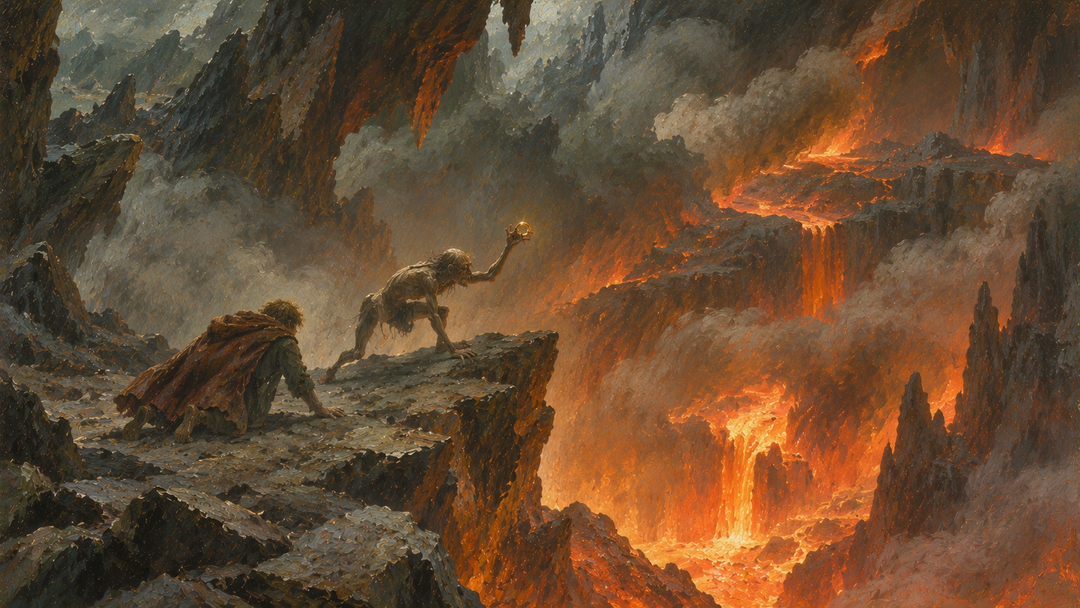
The most important consequence reaches beyond the hunt itself. At Mount Doom, Frodo claims the Ring rather than destroying it. Gollum attacks him, regains it and falls into the fire. His actions are driven by possession, not by a clearly stated intention to save Middle-earth. The Ring is destroyed nonetheless. Bilbo and Frodo could not foresee that consequence of their mercy.
It would be a mistake, however, to argue that Gollum therefore had to remain evil or that every act of compassion was merely a device for bringing him to the Cracks of Doom. In The Two Towers, he nearly responds to Frodo’s kindness before Sam’s suspicion interrupts the moment on the stairs of Cirith Ungol. Tolkien later discussed the possibility of Gollum’s repentance and imagined a different outcome in correspondence. That was a counterfactual reflection, not a replacement ending inserted into the novel.
There is room here for a film to show flashes of the person Sméagol used to be without making a promise the later story cannot keep. It can show Gandalf and Aragorn assuming responsibility for an enemy. Neither needs to know that mercy will eventually help save the world. Indeed, their decision is more meaningful because they cannot know.
The danger is that a modern prequel could mistake scale for significance. Adding battles, familiar faces and elaborate journeys might supply spectacle, but none answers why this particular episode deserves its own film. Its distinctive material is imprisonment without cruelty and a creature no one can entirely dismiss.
So the obvious problem is real, though it is not an unfixable plot hole: the hunt’s result is settled, and its subject cannot be removed from the story that follows. The answer is to stop treating Gollum’s capture as the surprise. What matters is why Aragorn brings him back alive, why Gandalf insists on understanding him, why the Elves take pity on him and how those choices expose the limits of foresight. A film that makes those questions dramatic could add something worthwhile to Middle-earth without pretending Tolkien left a missing adventure novel waiting to be filmed.
Sources & Notes
- Tolkien Gateway — Gollum — https://tolkiengateway.net/wiki/Gollum
- Tolkien Gateway — The Hunt for the Ring — https://tolkiengateway.net/wiki/The_Hunt_for_the_Ring
- Tolkien Gateway — The Council of Elrond — https://tolkiengateway.net/wiki/The_Council_of_Elrond
- Variety — The Hunt for Gollum casting announcement, April 15, 2026 — https://au.variety.com/2026/film/news/lord-of-the-rings-hunt-for-gollum-jamie-dornan-aragorn-2-35352/
- Ian McKellen — The Hunt for Gollum: official project page — https://mckellen.com/wp3/index.php/the-hunt-for-gollum/
Primary reading: The Fellowship of the Ring, The Shadow of the Past and The Council of Elrond; The Lord of the Rings, Appendix B; Unfinished Tales, The Hunt for the Ring. These document the capture, questioning and escape, with variant chronology. The official McKellen page and Variety's April 15, 2026 casting report document the announced film and December 17, 2027 release. Its narrative success remains interpretation.