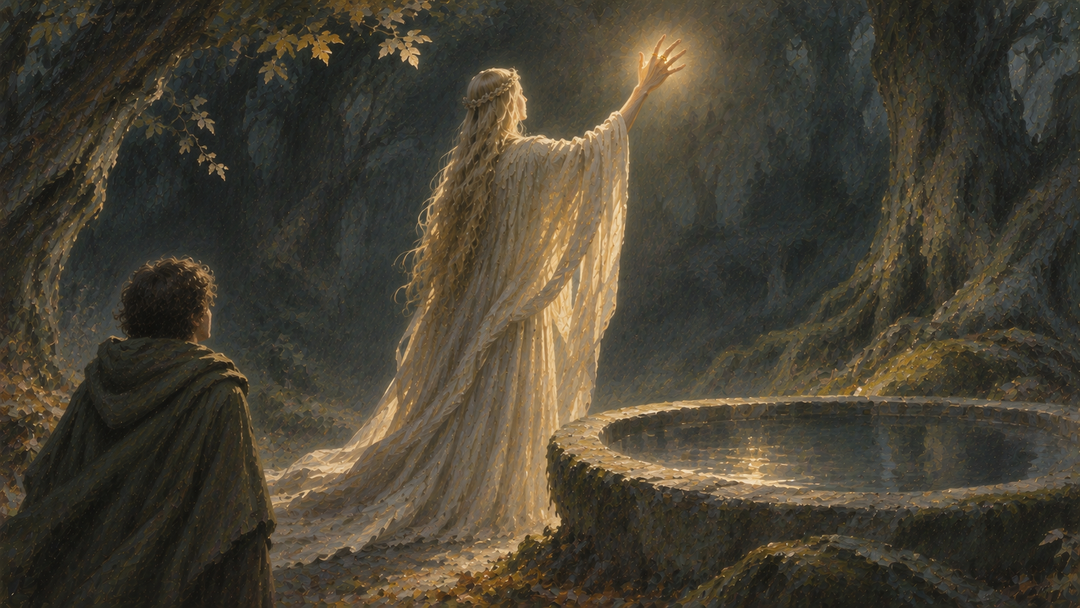
When Frodo offers Galadriel the One Ring in Lothlórien, she raises her hand and light pours from the Elven ring she already wears. The darkness around her makes her seem overwhelmingly tall and frightening. Moments later, she lowers her hand, laughs and looks like herself again. This is the passage behind one of the most recognisable effects in Peter Jackson’s The Lord of the Rings: The Fellowship of the Ring.
But Tolkien never calls the vision Galadriel’s “dark form”, nor does he establish a second, monstrous body that she can summon for combat. The book presents a moment of temptation: a glimpse of the ruler she might become if she accepted the One Ring. The films turn that moment into a more visibly supernatural transformation, then reuse similar imagery in a different situation during The Hobbit: The Battle of the Five Armies. Their magical mechanics belong to the adaptations.
What Frodo actually sees at the Mirror
The crucial scene occurs in “The Mirror of Galadriel”, a chapter of The Fellowship of the Ring. Galadriel takes Frodo and Sam to a basin of water that can show events distant in place or time, including possible futures. Its visions are difficult to interpret, not reliable instructions or predictions.
Frodo’s experience is already unsettling before he offers her the Ring. He sees images connected with the Shire, the wider struggle and finally Sauron’s searching Eye. After the vision fades, he becomes aware of a ring on Galadriel’s finger: Nenya, one of the Three Rings held by the Elves. Frodo’s position as bearer of the One allows him to perceive what others cannot.
Galadriel explains that her own desires are not untouched by the Ring. For years she has considered what she could accomplish with it. Frodo’s offer is especially dangerous because she would not need to seize it from a guest by force. Trust makes the offer appear generous rather than dangerous.
She then speaks as a queen who would replace Sauron. Her imagined rule would be radiant, not a copy of his grim kingdom. She promises a beauty so imposing that love would become inseparable from terror. The famous conclusion, “All shall love me and despair!”, makes the contradiction plain: her subjects might admire her, but they would have no real freedom before her power.
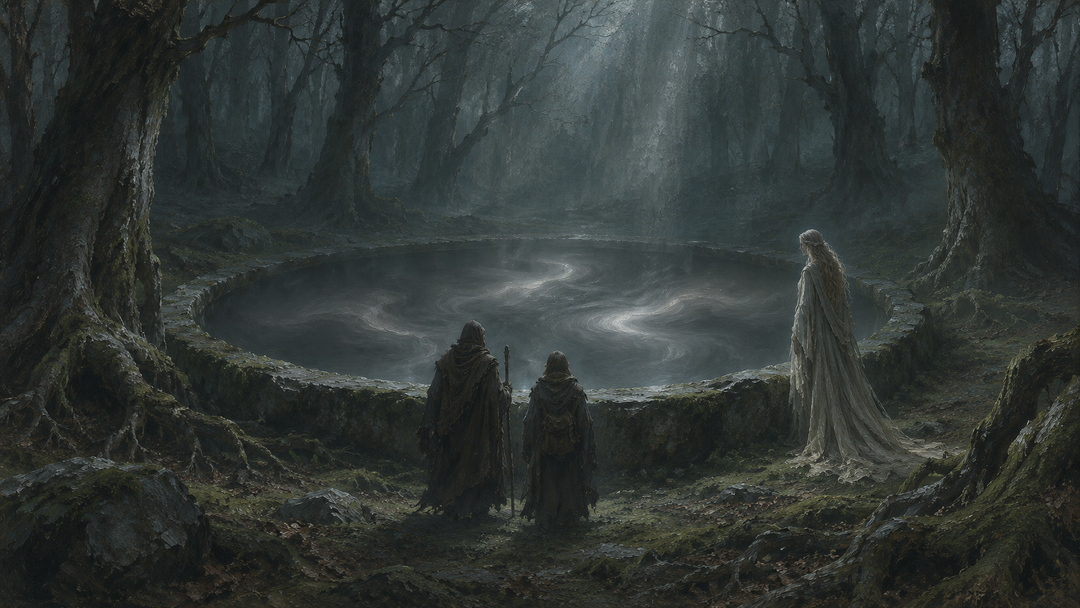
The narration describes light issuing from the ring on her hand and illuminating Galadriel while leaving everything else dark. To Frodo she appears “seeming now tall beyond measurement”, with an unbearable splendour. This describes an experience, not a shape-changing spell. Tolkien does not say that her skin turns green, that her voice becomes demonic or that she assumes a named magical form.
Nor does the book settle whether Frodo witnesses an outward physical change, a vision shaped by his heightened awareness, or some combination. The narration describes her apparent size rather than certifying a physical change. The safest reading is that Tolkien deliberately makes spiritual power visible without specifying a repeatable spell.
When Galadriel declines the offer, the threatening impression vanishes. Her decision matters more than the spectacle: she accepts the loss of her realm’s preserved beauty rather than purchase its survival through the power to command others. She refuses to become a tyrant.
Why taking the Ring would make her dangerous
Galadriel’s imagined kingship is not merely a warning that any powerful object might make her angry. The One Ring was made by Sauron to dominate the bearers of the other Rings and to extend his will over Middle-earth. It does not become harmless when a person with good intentions takes possession. It promises desirable ends through coercive power.
Galadriel has a particularly strong reason to find that promise attractive. She protects Lothlórien, a place where the passing years seem held at bay. Nenya is associated with the preservation of such Elven beauty and resistance to decay. Yet the Three remain bound to the fate of the One. If Sauron recovers it, their keepers face exposure and danger; if it is destroyed, the power sustaining their works will fade. Galadriel cannot keep everything she loves without accepting a cost.
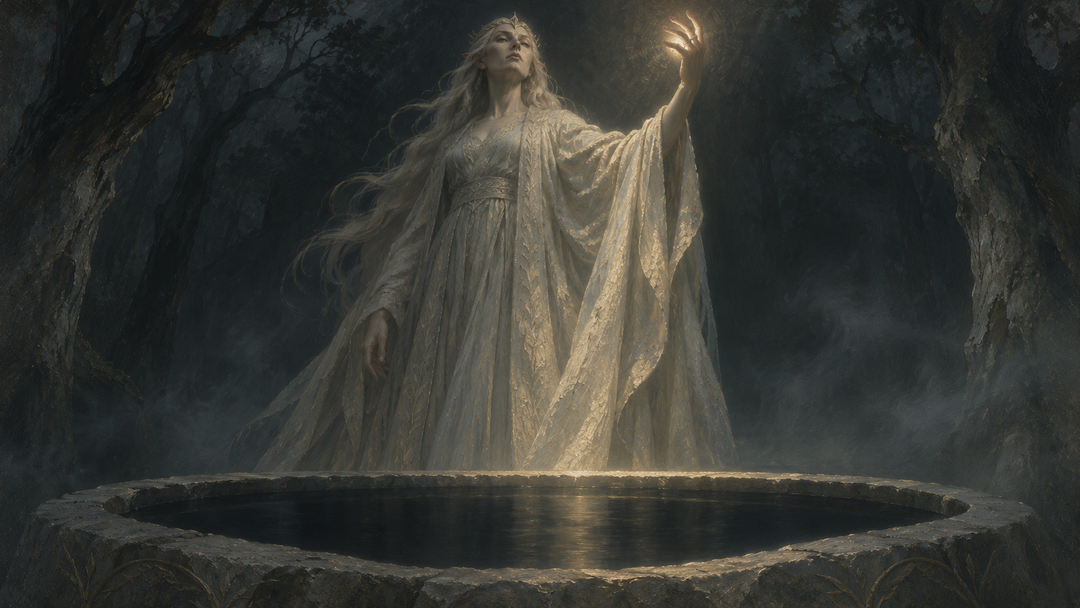
Frodo’s offer therefore tests more than greed. With the One, she might hope to secure her people, overcome Sauron and reshape the world according to her wisdom. These aims are understandable. But everyone else would then live under her will.
Tolkien addressed this possibility in a 1963 draft letter to Eileen Elgar, usually identified as Letter 246. He cautioned that the Ring fills minds with fantasies of supreme power. If Galadriel or Elrond tried to wield it against Sauron, he envisaged them building empires, armies and subordinate commanders. He described no magical transformation or duel.
The letter also distinguishes her confidence from certainty. Galadriel could imagine supplanting Sauron; that does not prove she could master the Ring in a direct contest with its maker. Tolkien treated a confrontation between Sauron and Gandalf as a different, exceptional possibility, and even there the Ring’s continuing power would corrupt the result. The Ring-queen is a moral and political danger, not a combat character with fixed abilities.
This distinction also explains why her frightening appearance is not evidence that she has briefly turned evil. She articulates the temptation before rejecting it. Her words and appearance show Frodo what claiming it would mean. The imagined future is real as a possibility within the story, but it is not an event that actually happens in the book’s history.
Her earlier ambitions complicate the picture
Galadriel’s response carries weight because Tolkien did not write her as a character without pride or ambition. In the wider history of the Elves, she belongs to the Noldor who left the Blessed Realm for Middle-earth during the rebellion associated with Fëanor. She distrusted Fëanor and did not take his terrible oath, but she also desired freedom to act and rule outside the authority she had known.
The Silmarillion, published after Tolkien’s death, places her within the great movement of the Noldor into exile. Her story is not identical to that of the leaders who carried out the first Kinslaying. Other writings make her opposition to Fëanor especially clear, including accounts in which she defends her mother’s kin at Alqualondë. Ambition did not mean endorsing his crimes.
In Unfinished Tales, Christopher Tolkien presents material concerning Galadriel and Celeborn while openly acknowledging that his father’s accounts were difficult to reconcile. Galadriel’s route to Middle-earth, Celeborn’s origins and the nature of her exile changed across drafts. In one strand, her pride helps explain why she refuses permission or pardon to return West after Morgoth’s defeat. In very late revisions, Tolkien considered a history that separated her more decisively from the rebellion.
There is no single tidy biography hiding behind these variations. It would be misleading to take one late note as proof that every earlier version was simply mistaken, or to claim that Galadriel was always written as either innocent or power-hungry. The published Lord of the Rings gives readers a definite action at the Mirror: she faces the Ring’s offer and refuses it. The larger history supplies possible reasons why that refusal means so much to her.
In a 1971 letter, Tolkien described Galadriel as a penitent and linked her ultimate pardon to her resistance to the Ring. That account fits the story of a proud exile learning to relinquish power. It is important evidence of his thinking, although his continuing revisions mean it should not be treated as a complete resolution of every conflicting detail in the posthumous material.
Even without those background writings, the choice is clear in the novel. She can try to preserve her world by ruling over others, or she can allow change and loss while remaining herself. Her acceptance is summed up in the words, “I will diminish, and go into the West, and remain Galadriel.” Refusal preserves her identity rather than proving weakness.
How the films change the meaning of the image
Jackson’s The Fellowship of the Ring preserves the basic dramatic situation. Frodo offers the Ring, Galadriel voices the prospect of becoming a terrifying queen, and she then rejects it. To convey the internal danger immediately, the film gives Cate Blanchett’s Galadriel an altered voice, an imposing presence and harsh, shifting greenish light. The effect makes Frodo’s fear immediate.
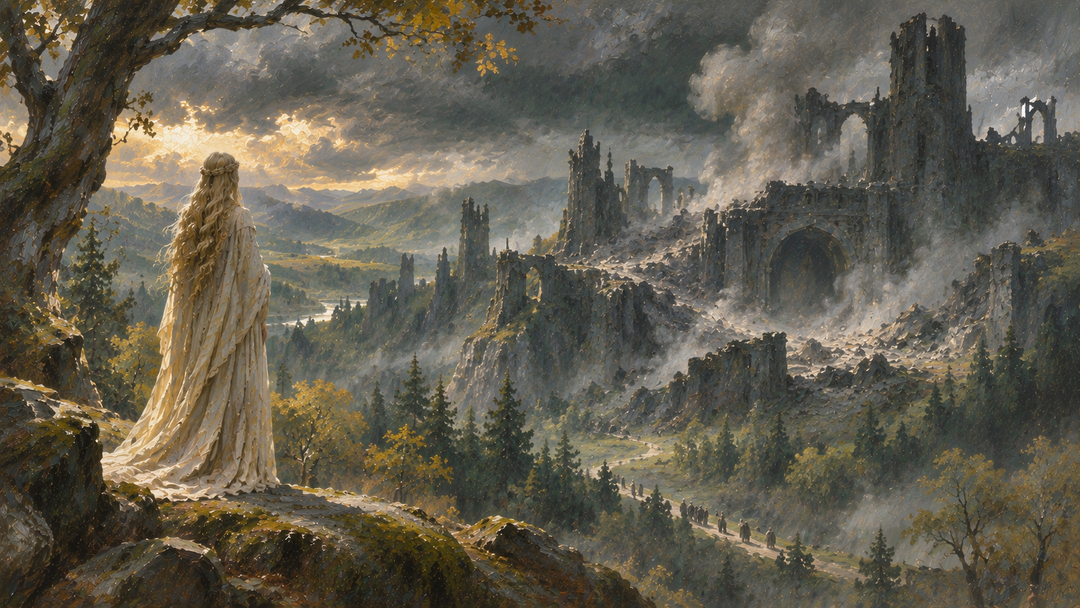
That is a defensible adaptation choice, but it changes the emphasis. On the page, the frightening vision is inseparable from Galadriel’s extraordinary beauty and the brightness surrounding her. She specifically imagines a queen who would not resemble Sauron’s darkness. On screen, the distortion can look like a temporary possession or a reveal of an otherwise hidden villainous identity. Tolkien’s text requires neither reading.
The difference becomes larger in The Hobbit: The Battle of the Five Armies. At Dol Guldur, the film shows Galadriel confronting Sauron with the White Council and displaying a shadowy, formidable appearance while driving him away. Because the visual language resembles her earlier temptation scene, viewers can reasonably infer that she has activated a special combat form. No such rule exists in the books.
The Hobbit mentions the Necromancer and Gandalf’s involvement in the business of the White Council, but it does not stage Galadriel’s confrontation with Sauron. The broader chronology in The Lord of the Rings records that the Council drove Sauron from Dol Guldur in 2941, the year of Bilbo’s adventure. Tolkien does not give a detailed account of Galadriel fighting him there, becoming shadow-clad or using Nenya as an offensive weapon.
There is a separate event that sometimes gets mixed into this discussion. During the War of the Ring, Lothlórien withstands attacks from Dol Guldur. After the One Ring is destroyed in 3019, Celeborn leads forces against the fortress, and Galadriel brings down its walls and exposes its pits. That feat is part of the written history. It happens decades after the White Council’s earlier action, however, and after Sauron’s downfall. It cannot be used as evidence that she performed the film’s earlier duel.
Fans sometimes speculate that the screen transformation reveals Galadriel’s true power, that Nenya grants a dark battle mode, or that she briefly channels the same future self imagined beside the Mirror. These are interpretations of the films, not established facts about Tolkien’s magic. The writings do not spell out exactly how she destroys Dol Guldur, either, so they offer no basis for reconstructing a particular spell or appearance.
What survives across both versions is the central tension: Galadriel possesses immense power, but the most important use of her judgement is deciding what not to do with it. Tolkien gives readers one disturbing glimpse of a Ring-queen and then closes that path. The films give the glimpse a memorable visual shape, and later make something similar useful in battle. Her so-called dark form exists in the novel as a warning about a choice she rejects, not as a second identity she can switch on.
Sources & Notes
- Tolkien Gateway — The Mirror of Galadriel — https://tolkiengateway.net/wiki/The_Mirror_of_Galadriel
- Tolkien Gateway — Galadriel — https://tolkiengateway.net/wiki/Galadriel
- The Encyclopedia of Arda — Nenya — https://www.encyclopedia-of-arda.com/n/nenya.php
Primary reading: The Fellowship of the Ring, The Mirror of Galadriel; Tolkien's Letter 246; The Lord of the Rings, Appendix B. Distinguish Galadriel's temptation and refusal from the films' visual transformations and their invented Dol Guldur combat sequence. No repeatable dark combat form is established by the books.