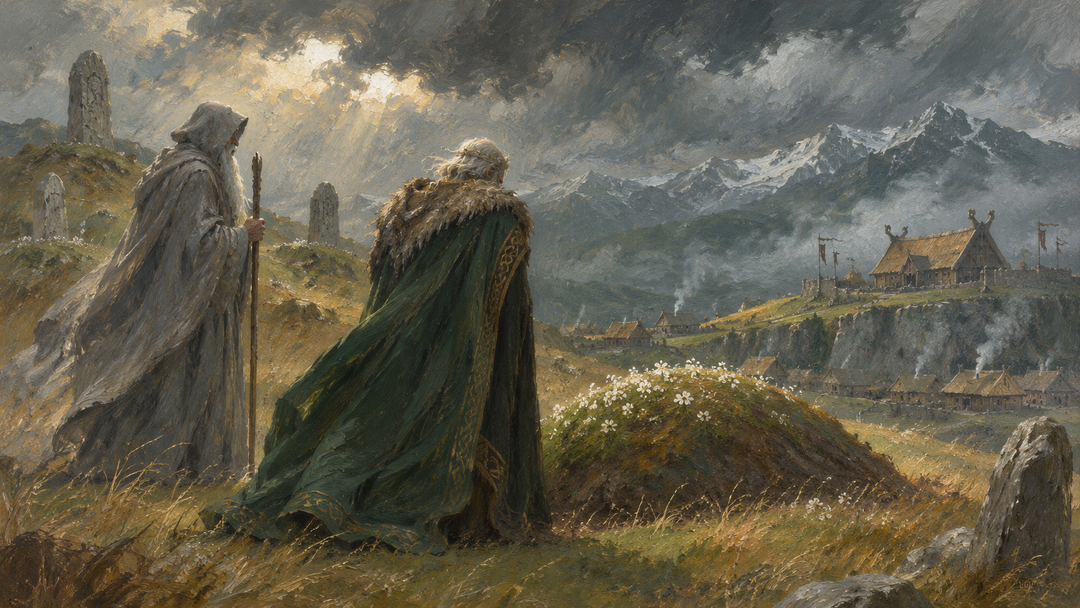
After Théoden is freed from Saruman’s influence in Peter Jackson’s The Two Towers, he asks for his son. Théodred has died from wounds sustained fighting Saruman’s forces, and the king finds himself standing beside his grave at Edoras. Gandalf tries to console him. The moment raises a genuine question about Tolkien’s world: can a wizard know where a dead Man’s spirit goes?
There is no clear evidence that Gandalf knowingly lies. His words belong to the film, not to a conversation in Tolkien’s novel, and they can be understood as a compassionate expression of Rohirric belief rather than an exact description of the afterlife. Tolkien’s wider mythology makes a literal reading difficult to prove, but it does not establish that Gandalf’s reassurance is false.
What Gandalf actually says in the film
In the 2002 film, Théoden blames himself for having survived while his son has died. Gandalf first tells him that Théodred’s death was not his doing. When Théoden says that no parent should have to bury a child, Gandalf replies that Théodred was strong in life and that his spirit will find its way to the halls of Théoden’s fathers. He then offers a brief farewell in the language used for Rohan on screen.
The wording matters. Gandalf does not claim to have seen Théodred arrive at a named supernatural destination. Nor does he describe a judgement or an established route for the dead. The image of ancestral halls evokes a family reunion and the old royal household. It meets Théoden’s grief on terms that a king of Rohan can recognise.
The setting reinforces that choice. Théoden notices simbelmynë, the white flower associated with his ancestors’ burial mounds, now growing beside his son’s grave. His fear is not only personal loss but the apparent end of his house. Gandalf answers with continuity: Théodred has not become meaningless or cut off from his people simply because his life ended early.
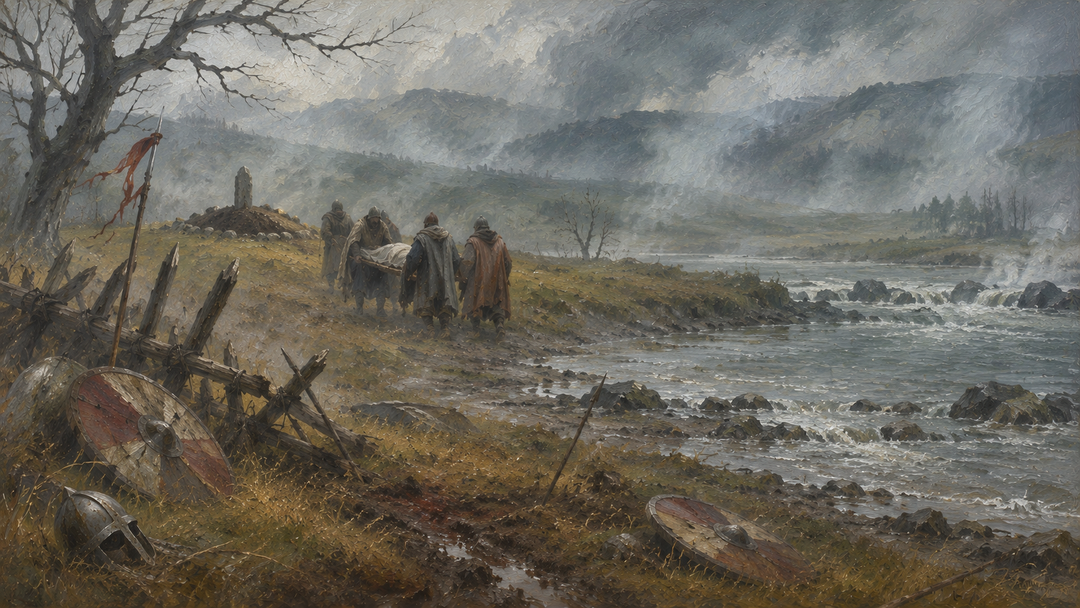
This is an adaptation-specific scene. In Tolkien’s The Two Towers, Théodred falls defending the Fords of Isen and is buried there, rather than being brought to Edoras for the funeral shown in the film. The book does not contain this graveside exchange between Gandalf and Théoden. Treating the line as a direct statement by Tolkien about the fate of Men therefore gives it more authority than it possesses.
What Tolkien establishes about death
Théodred is a Man, and Tolkien gives Men a fundamentally different destiny from Elves. In the account of the world’s beginning in The Silmarillion, Elves are bound to the life of the world. When their bodies are slain, their spirits are summoned to the halls of Mandos in the West, where they may eventually be restored to embodied life. Men, by contrast, are mortal in a deeper sense: after death, they depart from the world itself.
This departure is called the Gift of Ilúvatar, the creator. The term does not suggest that dying is painless or that those left behind should welcome bereavement. Tolkien describes death as something darkened by Morgoth’s influence and deeply feared by human beings. The gift lies in the possibility of a destiny beyond the limits that bind the immortal Elves to Arda.
The ultimate destination of Men’s spirits is deliberately unknown. Even the Valar, the great powers who govern the world under Ilúvatar, do not possess a complete account of what awaits them. A firm assertion that every dead Man spends eternity in a familiar hall somewhere in Valinor would conflict with that uncertainty. Neither the royal mounds of Rohan nor the halls of Mandos should simply be identified with an ordinary human heaven.
There is an important qualification. Tolkien’s writings allow that the spirits of Men may come to Mandos for a time before leaving the world. Beren’s spirit, for example, waits there in the story of Beren and Lúthien. But a temporary stay is not the same as the final destiny of Men, and Beren’s extraordinary story cannot establish a general rule about Théodred’s fate.
The Dwarves offer another tempting but misleading parallel. As Thorin dies in The Hobbit, he expects to wait beside his fathers until the world is renewed. The Silmarillion describes a Dwarven belief that their maker, Aulë, has separate halls for them in Mandos. That resemblance to Gandalf’s film language is striking, but Dwarves are not Men, and their traditions cannot be transferred to Rohan without evidence.
Tolkien continued exploring these differences in writings published after his death. In the discussion between the Elf Finrod and the mortal woman Andreth, included in Morgoth’s Ring, the characters argue about whether mortality is part of humanity’s original nature and what hope could lie beyond it. Their disagreement is significant: Tolkien did not reduce human death to a simple map of a known destination. Much of the conversation concerns trust and possibility where proof is unavailable.
Nor do Middle-earth’s ghosts settle the issue. The Dead Men summoned by Aragorn remain bound by an unfulfilled oath; the Nazgûl have been unnaturally prolonged and enslaved through their Rings. These are exceptional states associated with a broken promise or dark power, not evidence that ordinary Rohirrim live indefinitely as wandering spirits. Nothing says Théodred shares either condition.
The halls of the fathers in Rohan’s tradition
Although Gandalf’s graveside speech is not in the book, its central image has a close counterpart in Tolkien’s own writing. As Théoden dies after the charge of the Rohirrim on the Pelennor Fields in The Return of the King, he speaks of going to his fathers and of no longer feeling ashamed in their mighty company. The king imagines his death in relation to those who ruled and fought before him.
This is stronger evidence for how Théoden himself understands death than the invented film exchange. It shows that meeting one’s ancestors, or at least being judged worthy of their company, is language natural to him. It does not prove that he knows their precise location. A dying character can voice a deeply held hope without providing the narrator’s authoritative report of the supernatural world.
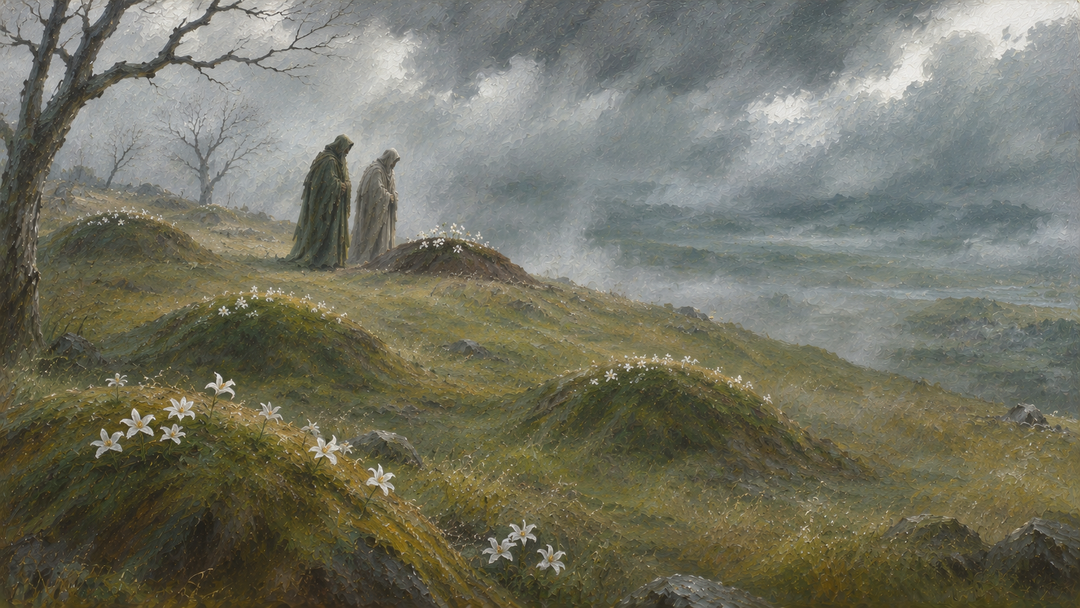
Rohan’s culture gives the expression additional weight. The kings are honoured in burial mounds near Edoras, and simbelmynë grows on their graves. The mounds preserve names and lineage in a society where memory of ancestors is bound up with honour and kingship. The long succession of rulers matters because Théoden measures himself against it; his failure or success has meaning beyond his own lifetime.
The Rohirrim also preserve their history in songs about riders, battles and loss. Such poetry asks what survives when warriors and kingdoms pass away. An ancestral hall is therefore more than a decorative fantasy setting. It gathers together the people’s ideas of belonging, remembered deeds and the hope of reunion. Gandalf’s words would resonate even if nobody present could describe the mechanics of life after death.
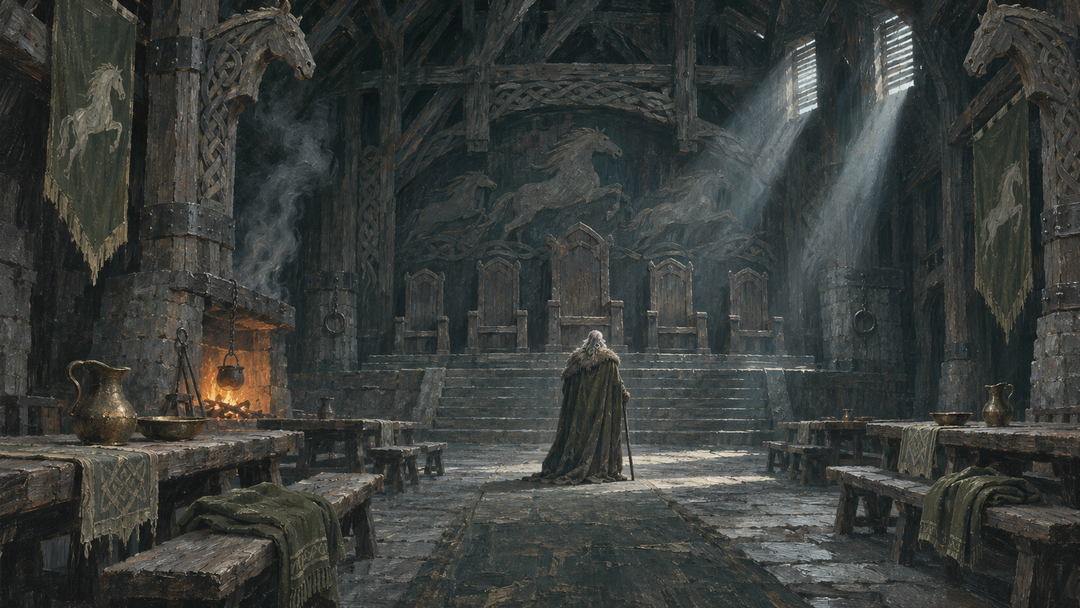
There is a distinction between an ancestor’s tomb and an ancestor’s spirit. The burial mounds are visible signs of remembrance, not shown to be inhabited by the dead. Equally, an expression about joining one’s fathers need not assert that their souls occupy a physical building. In ordinary language, people can speak of the dead being reunited without claiming knowledge of the architecture of the next world.
The film makes this connection particularly clear by placing Théodred’s grave among the royal tombs. The change from the book’s burial at the Fords of Isen creates a visual link between son, father and forebears. Gandalf’s speech then translates that visible family history into a consoling hope. It is effective cinema, but the alteration must not be used to reconstruct what Tolkien wrote about Théodred’s funeral.
When the film trilogy later has Théoden speak of going to his fathers, it echoes Gandalf’s language without proving that any reunion occurs.
Is reassurance the same as a white lie?
A white lie requires more than an uncertain statement intended to comfort someone. The speaker must say something he believes to be untrue, usually to spare another person’s feelings. The films never show Gandalf deciding that Théodred cannot join his ancestors and then pretending otherwise. The novels and Tolkien’s other writings supply no such private knowledge or intention. Calling the remark a deliberate deception therefore goes beyond the evidence.
Gandalf is nevertheless no ordinary mourner. In Tolkien’s mythology he is one of the Maiar, a spiritual being sent to Middle-earth in the form of an aged wizard. He has knowledge of matters far beyond Théoden’s experience. After defeating the Balrog, Gandalf himself dies and is returned to complete his task. Tolkien’s letters make clear that this death and return are not merely a trick or a brief fainting spell.
Yet none of this makes Gandalf omniscient. His extraordinary experience does not establish that he has inspected the final destiny of mortal souls or followed Théodred after death. The fact that Gandalf has crossed the boundary of death under exceptional circumstances cannot answer what happens to all Men. Any claim that he knows the precise location of Théodred’s spirit remains speculation.
There are several defensible readings of the speech. Gandalf could be deliberately speaking within the traditions of Rohan, expressing a hope rather than giving a lecture about the Gift of Ilúvatar. He could believe that human beings will ultimately be reunited beyond the world, without knowing where or how. Or the filmmakers could simply be drawing on a familiar heroic image of the honoured dead together with their ancestors.
These readings are interpretations, not facts supplied by a narrator. A further fan theory is that Gandalf knows the promise is literally false but chooses kindness over accuracy. That is possible as an imagined account of his motives, but nothing in the film confirms it. It also assumes the very thing Tolkien keeps hidden: that no reunion of mortal family members can occur beyond Arda.
The alternative counterfactual is worth separating from the story. If Gandalf meant that Théodred would remain forever in the physical halls of Mandos alongside the spirits of earlier kings, his assertion would be difficult to reconcile with the normal departure of Men from the world. But the film never names Mandos. It also never specifies forever, or says that these halls lie anywhere within Arda. The contradiction arises only after extra details are added to his words.
It matters, too, that Gandalf praises Théodred’s strength rather than claiming that military courage earns admission to a particular afterlife. Tolkien does not set out a rule by which brave Rohirrim reach paradise and less successful warriors are excluded. Read as a guarantee of reward for valour, the line would import a system not established in the books. Read as recognition of the dead man’s character, it fits the scene without requiring such a system.
The most convincing answer is therefore no, not demonstrably. Gandalf offers Théoden a culturally intelligible hope at the moment when the king needs it most. Tolkien’s account of human mortality prevents us from treating that hope as verified knowledge, but its mystery also prevents us from declaring it a known falsehood. The statement is consolation expressed with confidence, not evidence of a secret lie.
Sources & Notes
- Tolkien Gateway — Théodred — https://tolkiengateway.net/wiki/Th%C3%A9odred
- The Encyclopedia of Arda — Gift of Men — https://www.encyclopedia-of-arda.com/g/giftofmen.php
- The Encyclopedia of Arda — Halls of Mandos — https://www.encyclopedia-of-arda.com/h/hallsofmandos.php
The graveside exchange belongs to Jackson's The Two Towers. Compare the book's Théoden at the Pelennor Fields, the differing fates of Elves and Men in The Silmarillion, and the discussion of mortal hope in Morgoth's Ring. An ancestral reunion is not a mapped, verified destination for Théodred.