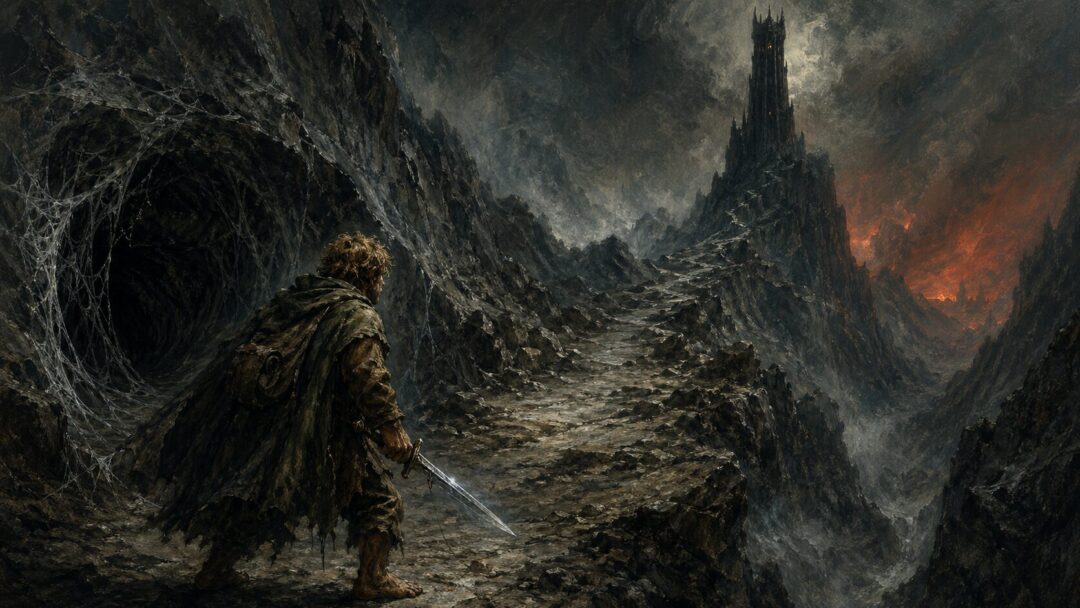
The end of The Two Towers is one of the cruelest cliffhangers in The Lord of the Rings.
Frodo has been stung by Shelob. Sam has fought the spider off in a desperate struggle. Believing his master dead, he has made the almost unbearable decision to take the Ring and continue the Quest alone.
For a few terrible moments, Sam becomes the last hope of Middle-earth.
And then everything changes.
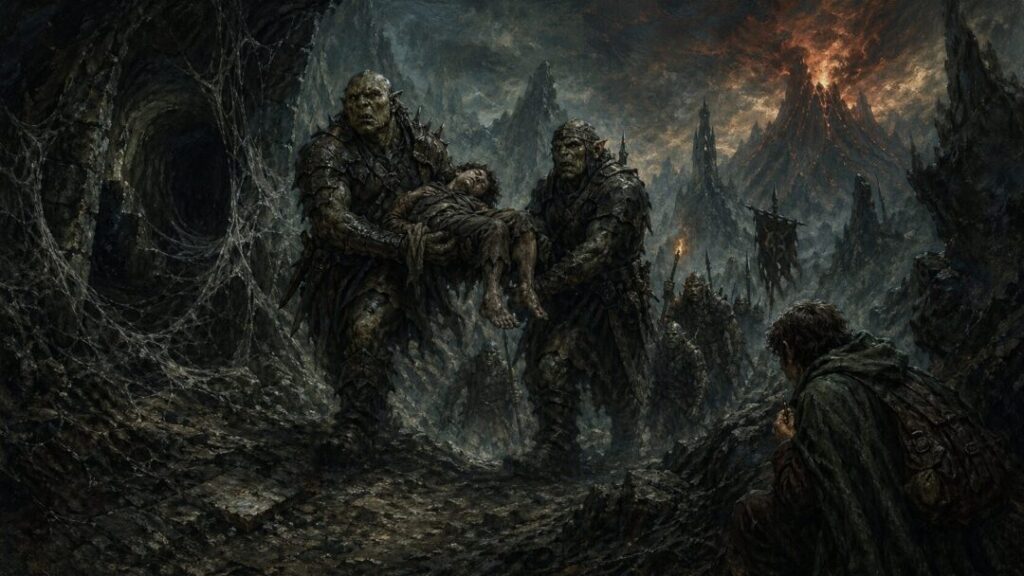
He overhears Orcs speaking over Frodo’s body. They do not treat Frodo as dead. They know what Shelob has done. They know her poison does not kill at once. Frodo is alive.
That revelation breaks open the entire scene.
Sam no longer stands beside a dead master. He stands behind a living prisoner being carried into enemy hands.
And the question becomes unavoidable:
Was Sam really about to attack the Orcs?
At first, the idea seems almost absurd. Sam is alone. He is a Hobbit, not a trained captain or warrior. He has just survived Gollum, Shelob, grief, terror, and the burden of the Ring. Ahead of him are armed Orcs moving toward a fortified tower on the edge of Mordor.
But Sam runs after them anyway.
The key is that the text does not present this as a carefully formed battle plan.
It presents it as something simpler, more desperate, and more revealing.
Sam is not thinking like a soldier.
He is thinking like Sam.
The Moment Sam Learns Frodo Is Alive
Before the Orcs arrive, Sam believes Frodo is dead.
That belief matters because it forces him into the hardest choice of his life. He cannot stay beside Frodo forever. He cannot bury him. He cannot carry him. And he cannot let the Ring fall into the hands of the Enemy.
So Sam takes the Ring.
This is not ambition. It is not temptation in the ordinary sense. Sam does not want mastery, kingdoms, command, or glory. He takes the Ring because he believes the Quest will fail unless someone carries it onward.
That makes the next moment even more devastating.
When Shagrat and Gorbag’s Orcs find Frodo, Sam learns the truth. Frodo is not dead. Shelob’s victims can appear lifeless while still being alive. The Orcs intend to take him away.
Everything Sam has just decided is overturned.
The Quest is still real.
But Frodo is alive.
And for Sam, that changes the order of the world.
Sam Does Not Have a Strategy
The important point is this: the scene never shows Sam calmly devising a rescue operation.
He does not count the Orcs. He does not choose the best place to strike. He does not wait for a better chance. He does not think through the defenses of Cirith Ungol.
He follows because Frodo is being taken.
That is not the same as having a plan.
The text strongly suggests that Sam is acting from desperate love and shock, not tactical judgment. He has just passed through grief and into sudden hope. In that state, the only thing clear to him is that he must not lose Frodo again.
This is why the question “Did Sam plan to attack the Orcs?” needs a careful answer.
If by “plan” we mean a thought-out assault, then no. There is no sign of that.
If by “plan” we mean “Was Sam ready to fight them if he could reach Frodo?” then the answer is much closer to yes.
Sam has Sting. He has the Ring. He has already faced Shelob, something far more terrible than ordinary Orcs. And now that he knows Frodo is alive, it is hard to imagine him willingly doing nothing.
But his action is not strategy.
It is loyalty in motion.
Why He Does Not Attack Immediately
There is another detail that matters.
Sam is not standing openly in front of the Orcs challenging them to battle. He is following them.
This distinction is important.
The Ring allows him to remain unseen, and while wearing it he can understand the Orcs’ speech. That is how he learns what has happened to Frodo and where they are taking him.
So Sam’s first action is not to leap out swinging.
He listens. He follows. He tries to keep up.
This does not make him cowardly. It makes the scene more believable. Sam may be overwhelmed, but he is not mindless. He understands enough to know that the Orcs have Frodo and that charging too soon might lose everything.
Still, the pace of the scene gives him little room for calculation. The Orcs are moving. Frodo is being carried away. The tunnel, the pass, and the road to the tower are all part of a hostile landscape.
Sam’s delay is not a polished rescue plan.
It is the delay of someone trying to reach the right moment while fear and urgency close around him.
The Gate Changes Everything
The real answer to the question lies at the gate of Cirith Ungol.
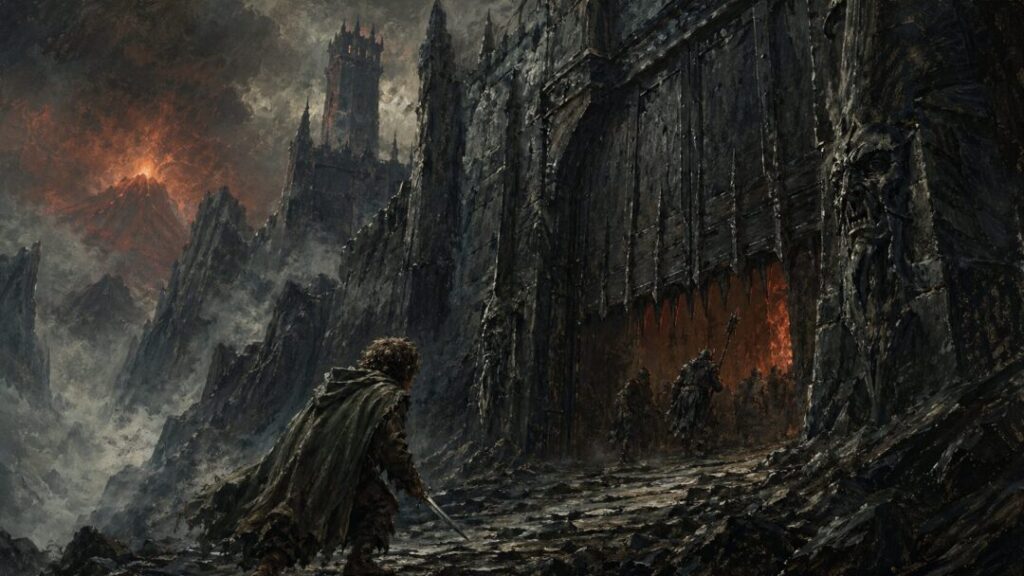
Sam follows the Orcs as they carry Frodo toward the tower. He is close enough to hear, close enough to understand, close enough to hope.
But not close enough to save him.
The Orcs get inside first.
The gate closes.
That is the blow that ends Book Four.
Sam is not defeated in battle. He is not disarmed. He is not captured. He is simply shut out.
This matters because it means the text never gives Sam the chance to carry out whatever desperate rescue he might have attempted. The question remains suspended. Would he have attacked? Would he have waited? Would the Ring have changed his choices if the gate had not closed?
The story does not answer by showing a fight.
It answers by showing Sam’s helplessness.
He has survived Shelob. He has taken the Ring. He has learned Frodo lives. He has run after him with everything he has left.
And still the door shuts.
That is why the ending is so painful.
The scene is not about whether Sam could defeat the Orcs.
It is about the one moment when even Sam’s courage is not enough to bridge the distance.
Why This Is Not a Warrior’s Scene
Sam’s heroism is often misunderstood because it does not look like the heroism of Aragorn, Boromir, Éomer, or Faramir.
Those characters belong naturally to the world of weapons, commands, battles, and public courage.
Sam does not.
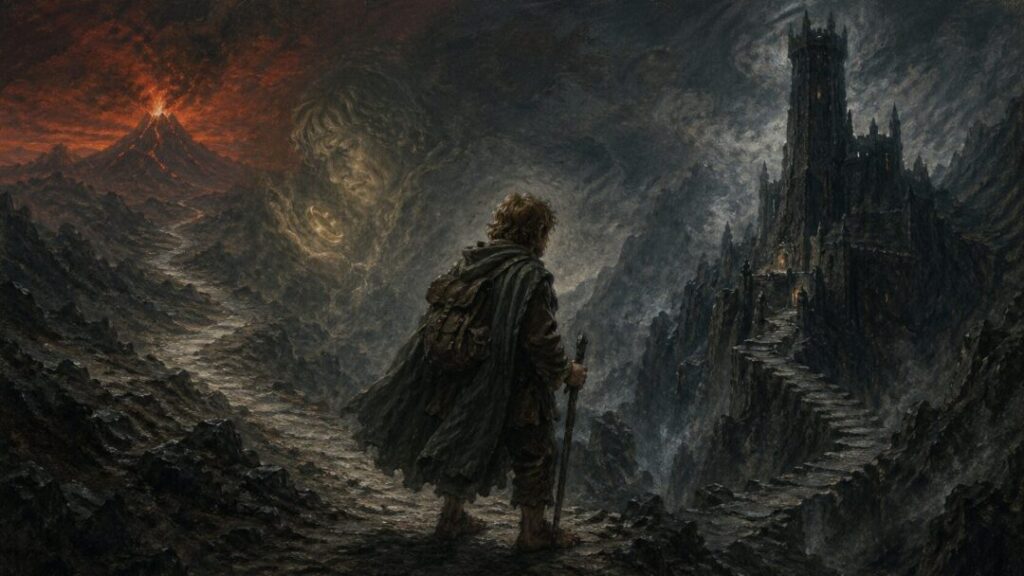
He is a gardener from the Shire. His bravery is domestic before it is martial. He loves things that grow. He thinks in terms of food, rest, home, and care. Even his deepest dream under temptation is not to become a Dark Lord in the usual sense, but to turn Mordor into a garden.
That is why his pursuit of the Orcs is so powerful.
Sam is not suddenly transformed into a great warrior. He does not become someone else.
He remains Sam.
And because he remains Sam, Frodo matters to him more urgently than the odds.
This is one of the quiet patterns of The Lord of the Rings: the greatest acts are often not performed by those who believe themselves mighty. They are performed by those who cannot abandon what they love.
Sam does not need to think he can win.
He only needs to know that Frodo is alive.
The Ring Is Present, But Not the Center
Another part of the scene is easy to miss.
Sam has the Ring.
That makes the situation dangerous in more than one way. The Ring is not a neutral tool. Even when used for concealment, it draws the bearer deeper into peril. It also exposes the bearer more directly to the pressure of Mordor and the will that rules there.
Yet in this moment, Sam’s focus is not domination. He is not thinking about using the Ring to become powerful enough to defeat the Orcs. He is not imagining himself as a lord of rescue and vengeance.
His mind goes to Frodo.
That does not mean the Ring is harmless to him. No one who bears it is simply untouched. But Sam’s brief possession of it reveals the quality of his heart. His temptation is shaped by his own nature, and his nature is rooted in service, gardens, and loyalty rather than conquest.
This is why the end of The Two Towers is so tense.
Sam holds the most dangerous object in Middle-earth, but the thing driving him forward is not hunger for power.
It is love.
Did Sam Mean to Fight?
So did Sam really intend to attack the Orcs?
The safest answer is this:
Sam did not have a formed plan to attack the Orcs in Shelob’s Lair or at the gate of Cirith Ungol. The text does not show him preparing a deliberate assault.
But once he learns Frodo is alive, he is clearly trying to reach him. And given Sam’s actions before and after this moment, it is reasonable to say that he would have fought if fighting became the only way to rescue Frodo.
That distinction matters.
A plan belongs to the mind.
Sam’s movement belongs first to the heart.
He is not acting because he has found a path to victory. He is acting because in his moral universe, leaving Frodo behind is impossible.
That is why the moment feels both reckless and right.
By ordinary logic, Sam has no chance.
By the deeper logic of the story, he is doing exactly what he must.
The Rescue Comes Later — But Not as Expected
The actual rescue does not happen at the end of The Two Towers.
It comes in The Return of the King, and even then it does not unfold as a grand assault by Sam against a full tower of Orcs.
Instead, the Orcs of Cirith Ungol turn on one another. Shagrat and Gorbag’s factions quarrel over Frodo’s belongings, including the mithril coat. The violence inside the tower clears the way in a manner Sam could not have planned.
This is important because it prevents the story from becoming a simple fantasy of one small hero defeating an entire fortress by force.
Sam does show courage inside the tower. He does use Sting. He does face danger. But the situation has changed by then. The Orcs have already destroyed much of their own strength through greed, suspicion, and rivalry.
That is very fitting for Mordor.
Evil is dangerous, but it is also self-dividing. Its servants cooperate under fear, not love. When pressure rises, they turn on each other.
Sam survives not because he becomes stronger than Mordor in worldly terms, but because Mordor’s own nature helps open the way.
Why the Ending Works So Well
The end of The Two Towers works because it refuses to give immediate relief.
Sam does everything his heart tells him to do.
He chooses the Quest when he believes Frodo is dead.
He turns back toward Frodo when he learns Frodo is alive.
He follows the Orcs into the shadow.
He reaches the gate.
And then he loses him anyway.
For a reader, this is devastating. For Sam, it is almost unbearable.
But it also prepares us for the next part of the story. Sam’s courage is not the courage of someone who always succeeds. It is the courage of someone who keeps going after failure, grief, and terror have already done their worst.
That is what makes him essential.
Not because he has a perfect plan.
Not because he is fearless.
Not because he can overpower the servants of Mordor.
But because he cannot stop loving Frodo.
The Real Meaning of Sam’s Pursuit
The question of whether Sam planned to attack the Orcs has a simple surface answer and a deeper emotional answer.
On the surface, no: Sam does not have a clear, tactical plan. The text gives us no organized scheme, no calculated ambush, no carefully chosen attack.
But beneath that, yes: Sam is moving toward confrontation if confrontation is what it takes.
He is not following as a witness.
He is following as a servant, friend, and guardian whose master has been taken alive.
That is the heart of the scene.
Sam’s greatness is not that he knows what to do.
It is that he goes anyway.
The gate of Cirith Ungol closes before he can act, leaving him outside in darkness with the Ring and his grief. But the closed gate does not end his loyalty. It only delays it.
And that may be the real answer.
Sam did not plan an attack.
He planned nothing.
He simply followed Frodo into the dark.
And for Samwise Gamgee, that was always the beginning of courage.
Sources & Notes
- J.R.R. Tolkien, The Lord of the Rings, Book IV, Chapter 9, “Shelob’s Lair” — Sam’s fight with Shelob and use of Sting establish the desperate courage immediately behind the pursuit of the Orcs.
- J.R.R. Tolkien, The Lord of the Rings, Book IV, Chapter 10, “The Choices of Master Samwise” — the core scene: Sam takes the Ring, overhears Shagrat and Gorbag, learns Frodo is alive, follows the Orcs, and is shut out by the gate of Cirith Ungol.
- J.R.R. Tolkien, The Lord of the Rings, Book VI, Chapter 1, “The Tower of Cirith Ungol” — Sam’s later rescue of Frodo shows him entering the tower after the Orcs’ quarrel has changed the odds, not defeating a full garrison by planned assault.
- J.R.R. Tolkien, The Lord of the Rings, Book VI, Chapter 1, “The Tower of Cirith Ungol” — Sam’s brief Ring-temptation as “Samwise the Strong” is shaped by gardening and protection rather than a desire for domination.
- J.R.R. Tolkien, The Letters of J.R.R. Tolkien, Letter 246 — Tolkien’s comments on Frodo, Sam, pity, and the Ring help frame Sam’s loyalty and brief Ring-bearing as moral pressure rather than simple battle strategy.