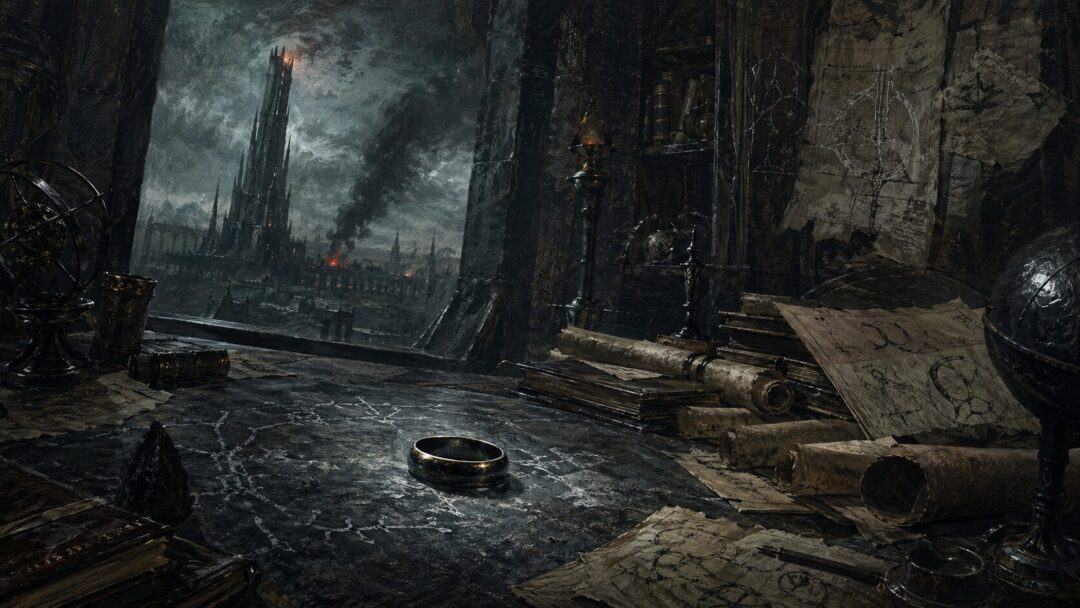
It is mentioned clearly enough that readers are meant to notice it.
And then it disappears.
There is no scene in which it is taken from him. No explanation of its powers. No warning about its danger. No note in the early Fourth Age telling us where it ended up, who found it, or whether it was destroyed.
For a story so deeply concerned with rings, that silence feels almost suspicious.
After all, Saruman was not merely a traitor with an army. He was the head of the White Council. He had long studied the lore of the Rings. He searched for knowledge of their making. And when Gandalf came to Orthanc, Saruman revealed himself not only as a rebel against his order, but as something far more disturbing.
He called himself “Saruman Ring-maker.”
So what happened to that ring after his fall?
The honest answer is simple:
The texts never tell us.
But that does not make the question meaningless. In fact, the silence around Saruman’s ring may be one of the clearest windows into what Saruman had become.
Saruman Did Have a Ring
The first thing to establish is that Saruman’s ring is not a fan invention.
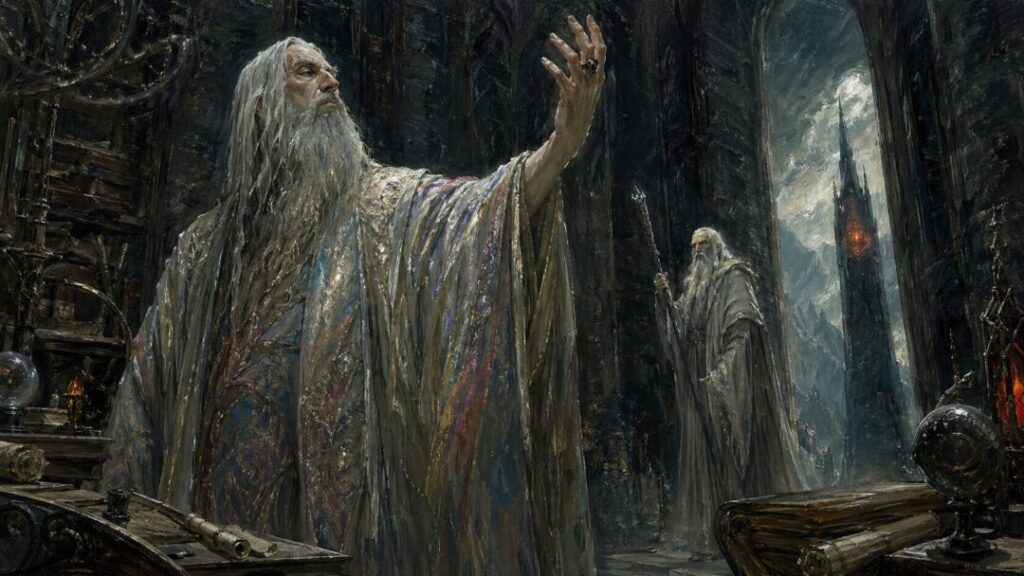
When Gandalf recounts his meeting with Saruman at the Council of Elrond, he says that Saruman wore a ring on his finger. Saruman then gives himself a new title: “Saruman Ring-maker.”
That is the central evidence.
The text does not pause to explain the ring. Gandalf does not test it. Elrond does not discuss it. No one at the Council says, “What became of this ring?” or “How dangerous is it?”
But the detail is still there.
Saruman wants Gandalf to see what he has become. His new robe of many colours, his altered title, and his ring all belong to the same moment. He is no longer content to be Saruman the White, chief of the order sent to oppose Sauron. He is remaking himself.
And the ring is part of that self-remaking.
It is not merely jewelry. It is a declaration.
Saruman has studied the arts of power for so long that he now wants to stand among the makers of rings.
It Was Not One of the Great Rings
This is where caution matters.
Saruman’s ring is never identified as one of the Rings of Power.
It is not one of the Three, which were held by Elrond, Galadriel, and Gandalf by the end of the Third Age. It is not one of the Seven given to the Dwarves. It is not one of the Nine held by the Nazgûl under Sauron’s domination.
Nor is it the One.
Saruman’s ring belongs to a different category: something he apparently made or claimed to have made in imitation of the ancient ring-lore.
That distinction is crucial.
The great Rings were bound up with the history of Sauron, the Elven-smiths of Eregion, and the domination of Middle-earth. Saruman came much later. His knowledge was deep, but he was not one of the original makers in Eregion, and the text never suggests that he recovered the full craft of the great Rings.
So when people imagine Saruman’s ring as a hidden equal to the One Ring, that goes far beyond what the story says.
The safer reading is that Saruman made a lesser ring, or at least a ring made in imitation of the greater works he had studied.
It may have had some power.
It may have had very little.
The texts do not say.
Why Saruman Would Make a Ring
The ring matters less because of what it can do, and more because of what it reveals.
Saruman’s tragedy is not that he loved Sauron.
He did not.
Saruman wanted to rival Sauron. He wanted to understand him, use him, survive him, and eventually replace him. His alliance with Mordor was never humble obedience. It was calculation.
That is why the title “Ring-maker” is so revealing.
Saruman does not merely want to possess power. He wants to be recognized as a maker of power.
In Middle-earth, making is never morally neutral when it becomes bound to domination. The greatest works can be beautiful, but they can also become traps when the maker pours too much desire for control into them.
Saruman’s ring appears at the exact point where his wisdom has curdled into imitation.
He has studied Sauron so deeply that he begins to resemble him.
He builds armies.
He destroys trees.
He corrupts language.
He desires the One Ring.
And finally, he places a ring on his own hand.
This is not proof that his ring was mighty.
It is proof that Saruman wanted to be the kind of being who could make such a thing.
Why the Ring Disappears from the Story
After the Council of Elrond, Saruman’s ring is not meaningfully discussed again.
This absence is important.
When the story returns to Saruman, the focus is not on the ring. It is on his voice, his pride, his ruined authority, and his inability to repent. At Isengard, he is already diminished. Gandalf breaks his staff and casts him from the order. Saruman still has cunning and malice, but the grand image he created at Orthanc has cracked.
By the time he reaches the Shire, the collapse is almost complete.
He is no longer a lord in a tower. He is “Sharkey,” a petty tyrant poisoning a small land out of spite. His power has narrowed from world-strategy to revenge. He cannot rule Middle-earth, so he wounds the Shire.
That decline tells us something about the ring.
If Saruman’s ring had been a major surviving power, the narrative gives no sign of it. It does not save him. It does not preserve his rule. It does not prevent Gandalf from overthrowing his authority. It does not prevent his humiliation in the Shire. It does not protect him from Wormtongue.
Whatever it was, it was not enough.
And perhaps it was never meant to be.
Saruman’s Death Leaves No Clear Fate for the Ring
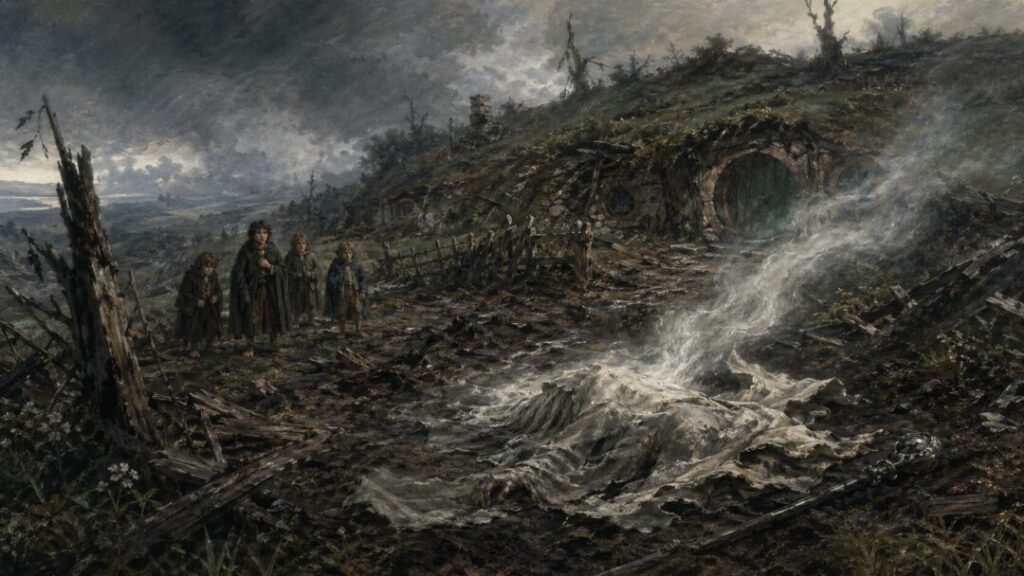
Saruman dies in the Shire, killed by Wormtongue after Frodo offers him mercy.
The scene is one of the most haunting endings in the book. A grey mist rises from Saruman’s body, seems to look toward the West, and is then blown away by a cold wind. His body is left behind, suddenly withered and exposed in its ruin.
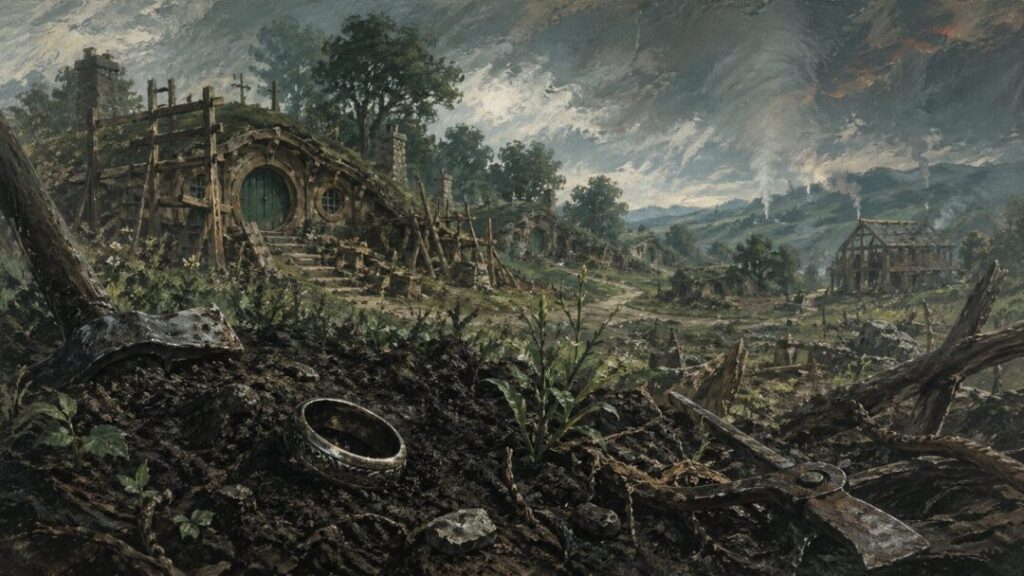
But the ring is not mentioned.
That is the key point.
The text does not say that it vanished with him. It does not say that it melted. It does not say that Frodo took it, or Sam buried it, or the Hobbits destroyed it. It does not say that Gandalf returned to deal with it. It does not say that it remained a peril in the Fourth Age.
So any definite answer would be invention.
The most we can say is this:
Saruman’s ring was last associated with him before his final ruin, and no canon text gives it a later history.
It may have remained among his physical possessions. It may have been lost, discarded, buried, or destroyed during the clean-up of the Shire. But these are possibilities, not stated facts.
The story refuses to give the ring a dramatic afterlife.
And that refusal matters.
Was It Destroyed When the One Ring Was Destroyed?
This is a tempting explanation, but it has to be handled carefully.
The destruction of the One Ring ended Sauron’s power and caused the Three Rings to lose their power. The age of the great Elven Rings passed away. Their keepers departed over the Sea, and the older kind of preservation and enchantment faded from Middle-earth.
But Saruman’s ring is not clearly placed within that system.
If Saruman’s ring depended on the same ring-lore that was ultimately bound to Sauron’s craft, then it may have been rendered useless or hollow after the One was destroyed. That is a reasonable interpretation.
But it is not directly stated.
The text never tells us what power Saruman’s ring had, whether it was linked to the One, or whether it survived the fall of Sauron with any virtue remaining.
So the safest phrasing is this:
If Saruman’s ring had any power derived from the same corrupt tradition of domination, the destruction of the One and the fall of Sauron would make it spiritually and historically irrelevant. But the exact mechanism is never explained.
It is not treated as a remaining threat.
That absence is probably more important than any theory.
The Ring as a Symbol of Failed Imitation
Saruman’s ring may not be important because it was powerful.
It may be important because it was pathetic.
Not pathetic in the sense of silly, but in the older, tragic sense: a sign of a great mind reduced by pride.
Saruman begins as the chief of the Wise. He is learned, persuasive, and formidable. He is entrusted with real authority. He understands more about the Enemy’s devices than almost anyone in Middle-earth.
But knowledge does not save him.
The more he studies domination, the more he desires it. The more he understands Sauron’s methods, the more he believes he can safely use them. And the more he imitates the Dark Lord, the smaller he becomes.
That is the bitter irony.
Sauron made the One Ring as an instrument of rule. Saruman makes, or claims to make, a ring as part of his attempt to become a new power. But instead of becoming another Dark Lord, he ends as a spiteful wreck in the Shire, unable even to master the servant he has abused.
His ring does not crown him.
It exposes him.
Why No One Seems to Care About It
One of the strongest clues about Saruman’s ring is how little attention the Wise give it afterward.
Gandalf is deeply concerned with the One Ring. Elrond understands the danger of the Rings of Power. Galadriel knows what it would mean to claim ruling power. The entire War of the Ring turns on the fate of Sauron’s Ring.
Yet Saruman’s ring receives no such treatment.
That suggests that, whatever it was, it did not belong to the same order of peril.
It was not a second One Ring.
It was not a hidden master-ring.
It was not the seed of a new Dark Lord in the Fourth Age.
If it had been, the silence would be almost impossible to explain.
Instead, the ring seems to belong to Saruman’s personal fall. It is part of his costume of self-exaltation, part of the false identity he creates when he rejects the role he was given.
Once Saruman is broken, the ring no longer has a story to carry.
The Fourth Age Has No Place for Saruman’s Ring
The Fourth Age begins after Sauron’s defeat and the passing of the Ring-bearers. It is the age of Men, of the restored kingship, of the fading of the Elves, and of a world becoming more ordinary.
Saruman’s ring does not belong to that future.
Not because we are told it was ceremonially destroyed.
But because the entire meaning of the age moves away from it.
The great contests of ring-lore are over. The One has perished. The Three have lost their power. Sauron is gone. The keepers depart. The old devices of preservation and domination pass into memory.
A lesser ring made by Saruman, if it physically survived at all, would be a relic without a role.
A failed imitation from a failed imitator.
That may be why the story gives it no ending.
It does not deserve one.
The Most Lore-Accurate Answer
So what happened to Saruman’s ring in the Fourth Age?
The most accurate answer is:
We do not know.
The texts never state its fate.
But we can say what did not happen.
It is never named as one of the great Rings. It is never shown to survive as a danger. It is never claimed by any ruler. It never becomes the center of another conflict. No canonical account follows it into the Fourth Age.
The most conservative interpretation is that Saruman’s ring either lost whatever significance it had after his fall, remained among his abandoned possessions, or disappeared in the aftermath of his death and the restoration of the Shire.
Anything more specific would be speculation.
But the deeper answer is that Saruman’s ring was never meant to become another great mystery-object.
It was meant to show what Saruman had become.
A wizard sent to oppose domination had begun to imitate the maker of the chief instrument of domination. A guardian of wisdom had become a craftsman of self-deception. A being who should have resisted the Ring’s logic tried to enter that logic on his own terms.
And in the end, his ring did not matter.
That is the punishment hidden inside the silence.
Saruman wanted to become a maker of power remembered alongside the great powers of the world.
Instead, his ring vanishes from memory almost as soon as he does.
Not every ring in Middle-earth becomes legend.
Some are only the shape pride leaves behind.
Sources & Notes
- J.R.R. Tolkien, The Lord of the Rings, Book II, Chapter 2, “The Council of Elrond” — Gandalf reports Saruman’s ring, his title “Saruman Ring-maker,” and his self-recasting as Saruman of Many Colours.
- J.R.R. Tolkien, The Silmarillion, “Of the Rings of Power and the Third Age” — outlines the making of the Rings of Power, the Three, Seven, Nine, and the One, giving the proper scale for what Saruman’s later imitation is not shown to equal.
- J.R.R. Tolkien, The Lord of the Rings, Book III, Chapter 10, “The Voice of Saruman” — Saruman’s authority is broken at Orthanc, with the narrative emphasizing his voice, pride, and diminished power rather than any surviving ring-device.
- J.R.R. Tolkien, The Lord of the Rings, Book VI, Chapter 8, “The Scouring of the Shire” — Saruman’s final degradation as Sharkey and his death are described without any stated fate or renewed importance for his ring.
- J.R.R. Tolkien, The Lord of the Rings, Book VI, Chapter 6, “Many Partings” — Galadriel says the power of the Three has ended after the One’s destruction, supporting the article’s caution about the passing of ring-lore without assigning Saruman’s ring a canon mechanism.