Most people think Sméagol became Gollum because of the Ring.
And in one sense, that is true.
The Ring stretched his life, poisoned his mind, drove him into secrecy, and consumed almost everything that had once been natural in him. By the time Bilbo meets him under the Misty Mountains, there is barely a recognizable person left. There is hunger, suspicion, riddling, memory, and a voice that speaks to itself in the dark.
But the more uncomfortable question comes earlier.
Before the caves.
Before the centuries of loneliness.
Before “my precious” became the center of his existence.
What kind of person was Sméagol before he ever possessed the Ring?
Because the story does not begin with Gollum finding the Ring in a tunnel.
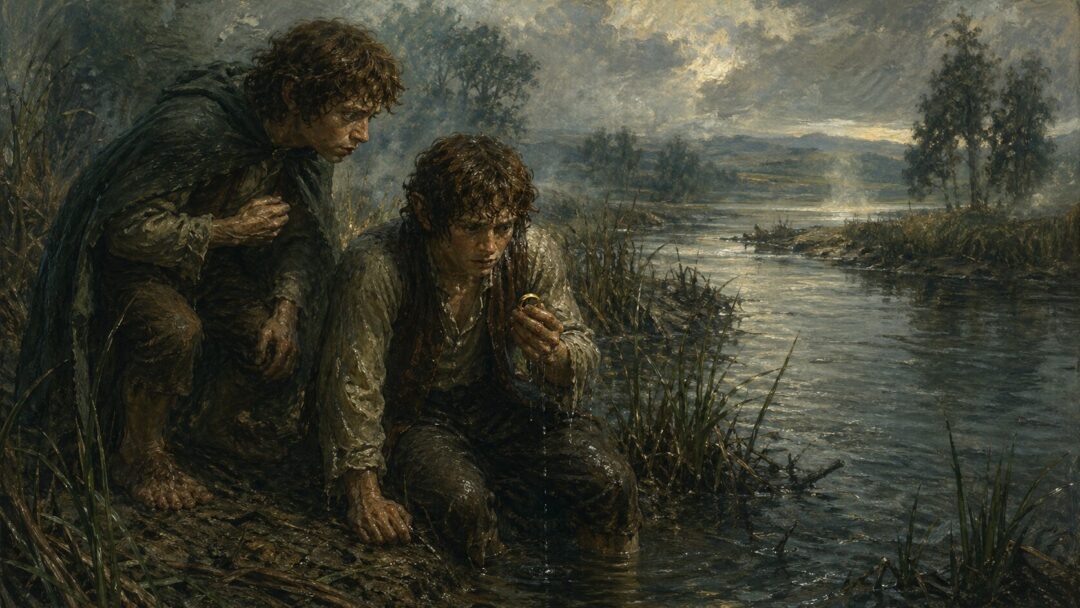
It begins beside the Gladden Fields, with two small river-folk going out together. Déagol is pulled into the water by a great fish. Beneath the surface, he finds a golden ring. He brings it up. Sméagol sees it.
And almost immediately, he wants it.
That moment is brief, but it changes the entire moral shape of his story.
The Ring Did Not Choose Sméagol First
One of the most important details is also one of the easiest to forget:
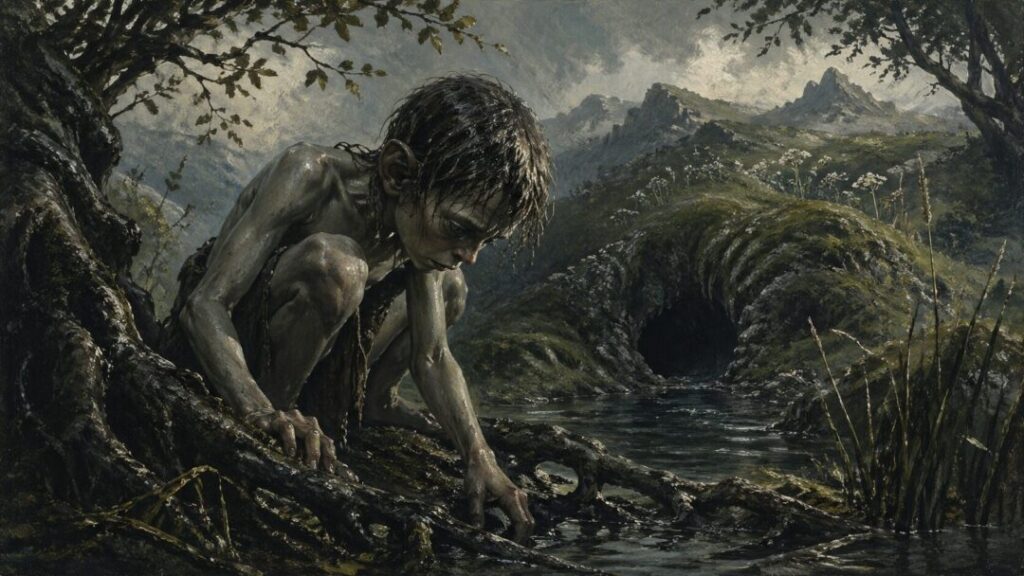
Sméagol did not find the Ring.
Déagol did.
That matters because it means Sméagol’s first relationship to the Ring is not discovery. It is desire.
He sees something beautiful in another person’s hand and wants it for himself. When Déagol refuses to give it to him, Sméagol claims it should be his because it is his birthday. Déagol answers that he has already given Sméagol a gift, more than he could afford.
Then Sméagol kills him.
The text does not describe a long temptation. It does not show years of corruption before that act. It does not give us a scene in which the Ring slowly educates Sméagol into evil.
The murder comes at the beginning.
That does not mean the Ring had no influence. The One Ring is not an ordinary object. It was made by Sauron, and its nature is bound up with domination, possession, and the bending of wills. It is entirely reasonable to understand its presence as immediately dangerous.
But the text is still careful.
Sméagol is not shown as a helpless innocent who accidentally becomes evil. He sees. He wants. He demands. He kills.
And that makes the question much harder.
Gandalf’s Account Is Not Simple
Gandalf does not describe Sméagol as a monster from birth.
This is important.
When Frodo hears Gollum’s story, he reacts with horror and disgust. Gandalf’s answer is not to excuse Sméagol, but neither is it to flatten him into simple villainy. Gandalf treats the story as tragic. He even says it might have happened to others, including some hobbits he has known.
That line should stop us from being too quick.
If Gandalf thought Sméagol was uniquely evil from the beginning, the warning would be simple: some creatures are just bad, and the Ring found one of them.
But that is not the warning he gives.
Instead, Gandalf’s account suggests something more disturbing. Sméagol was not some vast dark lord in miniature. He was one of a small river-dwelling people related to hobbits. He had ordinary beginnings. He had family. He had a grandmother. He had a community.
And yet something in him answered the Ring very quickly.
That is where the tragedy lives.
Not in the idea that Sméagol was secretly a monster all along, but in the possibility that the Ring found a weakness that was already there and pulled it open.
The Downward-Looking Mind
The most revealing description of Sméagol before the Ring is not that he was violent.
It is that he was curious.
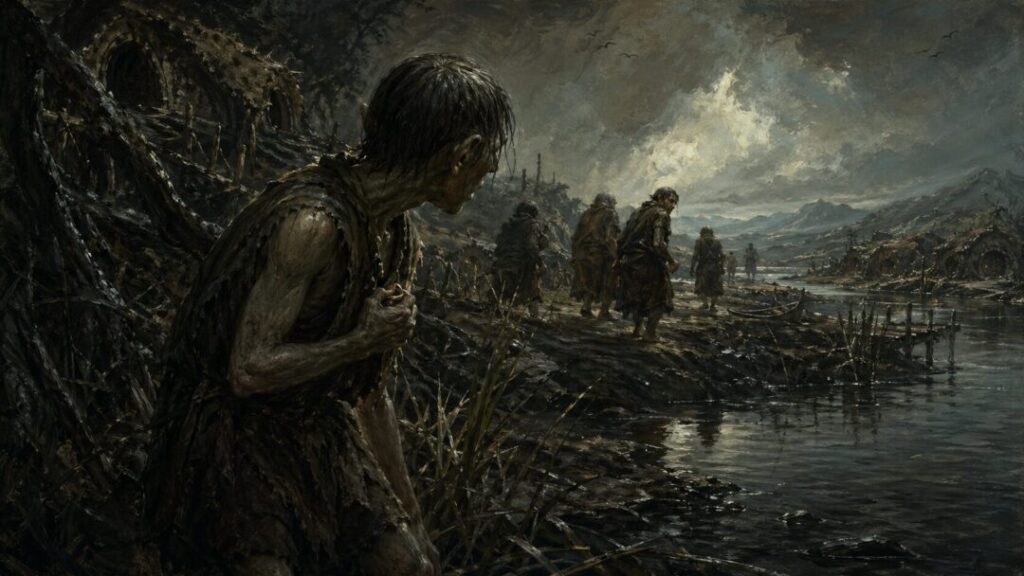
Gandalf says Sméagol was the most inquisitive and curious-minded of his family. He was interested in roots and beginnings. He dived into pools. He burrowed under trees and plants. He tunneled into green mounds. His head and his eyes were downward.
This is not presented as evil by itself.
Curiosity can be good. Wanting to know how things began can be noble. In Middle-earth, memory and ancient knowledge often matter deeply.
But Sméagol’s curiosity has a particular direction.
It does not look upward.
It does not delight in flowers opening in the air.
It does not look toward hilltops or leaves.
It looks down.
That detail is not proof that Sméagol was corrupt before the Ring. The text never says that directly. But it does create a pattern. Sméagol is drawn to hidden things, buried things, secret things, things under the surface.
And when the Ring comes into his life, that instinct becomes monstrous.
He uses invisibility to spy. He discovers secrets. He puts knowledge to crooked and malicious uses. He becomes hated by his own people. Eventually, even his grandmother drives him away.
The Ring did not have to invent his downward-looking nature.
It only had to weaponize it.
The Murder Cannot Be Ignored
Still, there is one fact that no careful reading can soften too much:
Sméagol murdered Déagol.
Not after five hundred years.
Not after long exile.
Not after he had become the creature Bilbo meets in the dark.
At the very beginning.
This is why it is fair to say that something was already wrong in Sméagol before the Ring fully transformed him. Not because he was doomed from birth. Not because he was incapable of pity or change. But because the first test we see him face reveals an immediate willingness to possess by violence.
That matters morally.
Other characters are tempted by the Ring, too. Bilbo lies about it at first and becomes possessive of it, but he does not murder for it. Frodo bears it under terrible pressure and is wounded by it, but he begins with pity. Sam briefly bears it and experiences visions of power, but he gives it back. Boromir falls to temptation, but his desire is tied to defending Gondor, and he repents before his death.
Sméagol’s first response is different.
He does not want the Ring to save anyone.
He does not want it because he understands its power.
He does not even know what it is.
He wants it because it is beautiful and because another person has it.
That is a small desire in one sense.
But in another sense, it is the exact kind of desire the Ring exists to magnify.
The Ring Amplifies What It Finds
The One Ring does not tempt everyone in exactly the same way.
That is one of the most important things to understand about it.
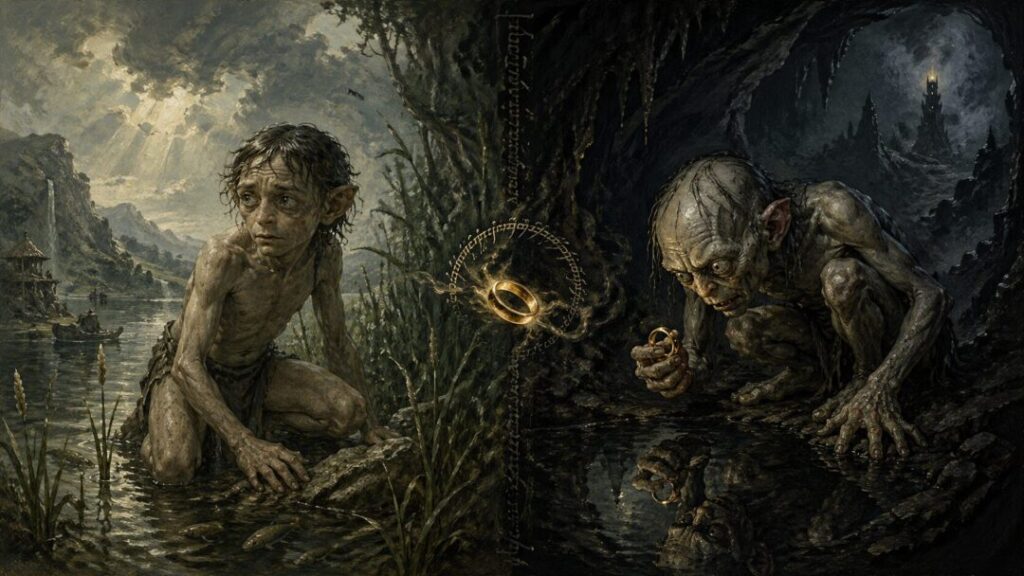
It does not offer the same dream to every bearer. It works through the bearer’s own desires, fears, wounds, and ambitions. It can turn pity into possessiveness, courage into domination, duty into tyranny, and secrecy into isolation.
This is why Sméagol’s case is so disturbing.
The Ring finds in him a desire to possess, a fascination with hidden things, and a readiness to put himself before another. Once he has it, those tendencies grow. He becomes secretive. He becomes malicious. He becomes isolated. He is driven away from his people and eventually disappears beneath the mountains.
But the seed is visible before the full corruption.
Again, this must be phrased carefully. The text does not say Sméagol was insane before the Ring. It does not say he was born wicked. It does not say he would certainly have become Gollum without it.
The safer reading is this:
Sméagol had weaknesses that made the Ring’s work horribly swift.
That is different from saying the Ring did nothing.
The Ring did almost everything.
But it did not begin with nothing.
Was Sméagol Responsible?
This is the hardest part of the question.
If the Ring is powerful enough to overwhelm even the wise, how responsible can Sméagol be for what happened?
The answer is not simple, because Middle-earth rarely treats evil as either pure choice or pure compulsion. The Ring exerts pressure. It corrupts. It enslaves. After long possession, its power can become nearly impossible to resist.
But Sméagol’s murder of Déagol happens at the threshold.
He is not yet the long-tormented creature under the mountains. He is not yet centuries deep in addiction, isolation, and self-division. He is faced with a desire, and he acts on it.
That does not remove the Ring’s influence.
But it does preserve his moral responsibility.
This is why Gandalf can both pity Gollum and speak honestly about the evil he has done. Pity does not mean pretending the murder was not murder. It means refusing to believe that even such a ruined creature exists outside the reach of mercy.
That balance is essential.
Sméagol is guilty.
Gollum is pitiable.
Both are true.
Frodo Sees What Others Miss
Frodo’s view of Gollum changes over the course of the story.
At first, he speaks harshly of him. He cannot understand why Bilbo did not kill him when he had the chance. Gandalf warns him not to be too eager to deal out death in judgment, because even the wise cannot see all ends.
Later, when Frodo himself bears the Ring, he begins to understand Gollum differently.
Not because Gollum becomes innocent.
But because Frodo learns what the Ring does from the inside.
This is one of the deepest parallels in the story. Frodo does not excuse Gollum’s treachery, but he recognizes the torment of a creature enslaved to the Ring. He sees that Gollum is not merely a villain outside himself. He is also a warning.
A possible future.
That makes Sméagol’s beginning even more important.
If Gollum were simply born evil, he would be easy to dismiss. But if he began as something closer to a hobbit, with recognizable weaknesses and ordinary desires twisted beyond recognition, then his story becomes far more frightening.
Because the distance between Sméagol and everyone else is not infinite.
It is moral.
It is spiritual.
But it is not unimaginable.
So Was Sméagol Already “Messed Up”?
The fairest answer is:
Yes, but only if we say it carefully.
Sméagol was not Gollum before the Ring. He was not already the cave-creature Bilbo finds. He was not already centuries-old, divided in mind, physically altered, and enslaved to “the Precious.”
But the text gives us enough to say that he was not an untouched innocent either.
His curiosity already bent downward.
His desire for the Ring became possessive almost at once.
His first decisive act was murder.
And after gaining the Ring, he used it in ways that matched those existing tendencies: secrecy, spying, hidden knowledge, and malice.
So the Ring did not simply ruin a pure soul.
It found a crooked place and widened it.
That is the tragedy of Sméagol.
He is not frightening because he was always a monster. He is frightening because the monster has a beginning we can recognize: envy, wanting, secrecy, resentment, the refusal to let another person keep what we desire.
The Ring turned those things into a nightmare.
But it did not have to invent them.
Why This Matters
Sméagol’s story is not just a backstory for Gollum.
It is one of the clearest warnings in the entire War of the Ring.
Evil does not always begin with armies, towers, or dark crowns. Sometimes it begins with a small demand:
Give me that.
It is mine.
I want it.
Sméagol’s fall begins in a moment that feels almost childish. A birthday claim. A beautiful object. A refusal. A sudden act of violence.
But from that small beginning comes centuries of darkness.
That is why his story matters.
The Ring is terrifying because it corrupts.
Sméagol is terrifying because he shows how quickly corruption can find something to use.
And yet even then, he is not treated as beyond pity.
That may be the final discomfort of his story.
Sméagol was responsible for terrible evil. He was damaged before the Ring, and far more damaged after it. But he was never reduced to a simple lesson in wickedness. His life remains tragic because some part of him was still remembered, still named, still visible beneath the ruin.
Gollum is what the Ring made.
Sméagol is what gave it something to work with.
And somewhere between those two names lies one of the saddest warnings in Middle-earth.
Sources & Notes
- J.R.R. Tolkien, The Lord of the Rings, Book I, Chapter 2, “The Shadow of the Past” — Gandalf’s account gives the core evidence: Déagol finds the Ring, Sméagol demands it as a birthday present, murders him, and hides the body.
- J.R.R. Tolkien, The Lord of the Rings, Book I, Chapter 2, “The Shadow of the Past” — describes Sméagol’s pre-Ring curiosity as turned toward roots, beginnings, pools, tunnels, and things underground, supporting the article’s “downward-looking” reading.
- J.R.R. Tolkien, The Hobbit, Chapter 5, “Riddles in the Dark” — Bilbo’s encounter with Gollum shows what centuries of Ring-possession, secrecy, hunger, and isolation have made of Sméagol.
- J.R.R. Tolkien, The Lord of the Rings, Book IV, Chapter 1, “The Taming of Sméagol” — Frodo’s treatment of Gollum after bearing the Ring himself supports the article’s balance of guilt, pity, and enslavement.
- J.R.R. Tolkien, The Letters of J.R.R. Tolkien, Letter 131 — frames the One Ring as Sauron’s instrument of domination and will, useful background for why it magnifies possessiveness rather than tempting every bearer in the same way.