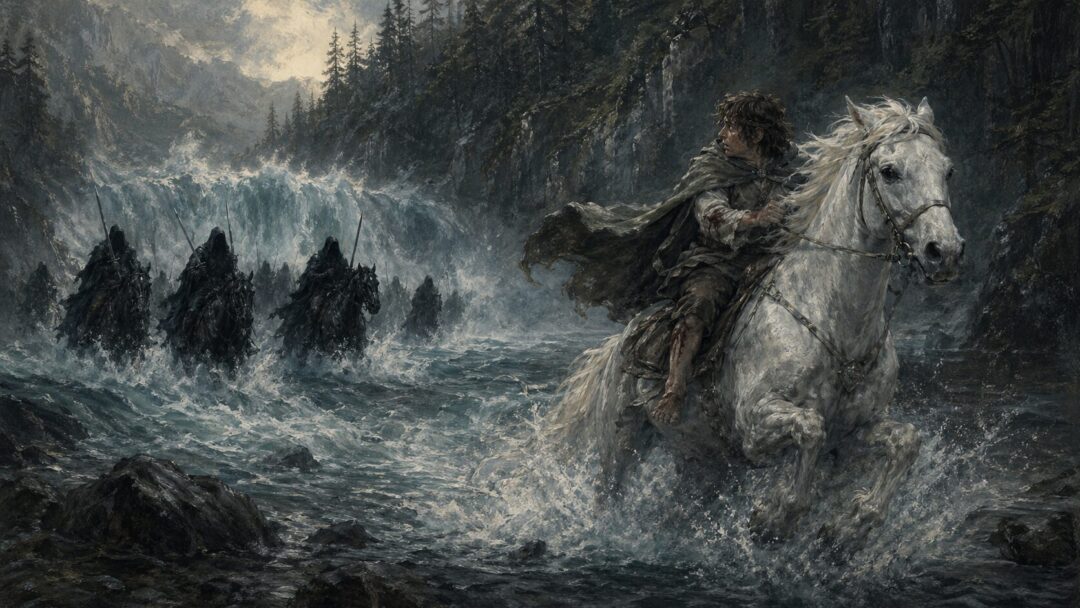
The Nazgûl losing their horses at the Ford of Bruinen can seem, at first, like a small detail.
The river rises. The black horses are swept away. Frodo is saved. The Riders vanish from the scene.
For many readers, the moment feels like a dramatic escape, not a major turning point in the War of the Ring.
But the story treats it as something more serious than that.
The Ringwraiths themselves are not destroyed. Gandalf makes this clear afterward in Rivendell. Their horses have perished, but the Nazgûl are not so easily killed. The power of their master remains in them.
And yet, despite this, the loss matters enormously.
Because the horses were never just horses.
They were the form the hunt had taken.
They were the way Sauron’s most terrible servants could move through the lands of the West, pass among ordinary people, pursue the Ring-bearer, and turn fear into a physical presence on the road.
At the Ford of Bruinen, the Nazgûl do not cease to exist.
But their first hunt for the Ring breaks.
And that changes everything.
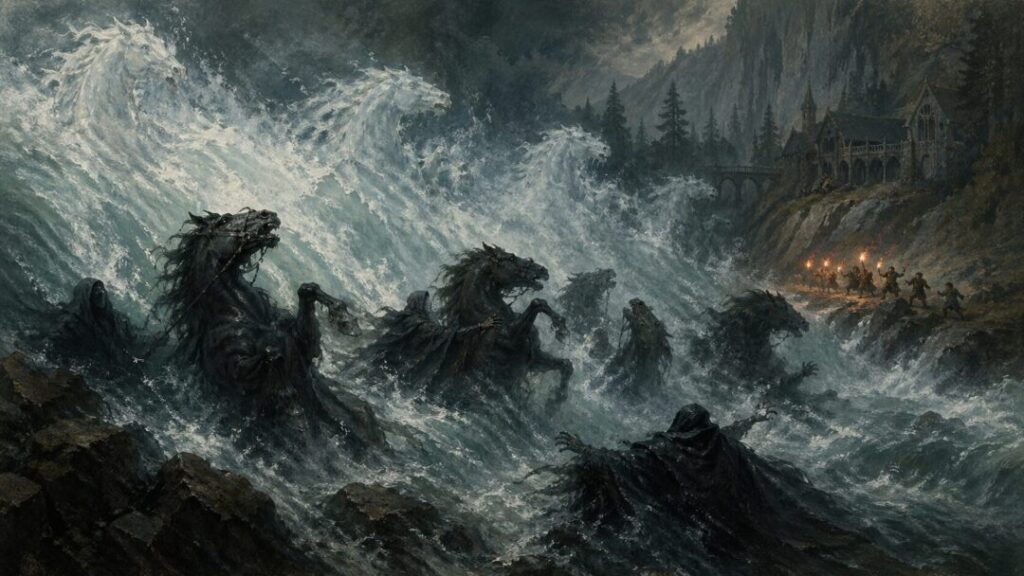
The Nazgûl Were Not Ordinary Pursuers
To understand why the horses mattered, we have to begin with what the Nazgûl are.
They are not living Men in the ordinary sense. They were once mortal kings, sorcerers, and warriors who received Rings of Power and were drawn under Sauron’s dominion. Over time, they faded from the visible world and became Ringwraiths, bound to the power of the One Ring and to the will of its maker.
That makes them terrifying.
But it does not make them all-powerful.
In the early part of The Lord of the Rings, the Nazgûl do not move through Eriador like unstoppable spirits. They ride roads. They question people. They search villages. They depend on fear, rumor, intimidation, and pursuit.
They are frightening precisely because they appear in a form the world can recognize:
Black riders on black horses.
That matters.
A bodiless horror may be terrible, but it cannot easily knock on a door in Hobbiton, speak to the Gaffer, follow hoofprints, or gallop down a road after a fleeing Ring-bearer.
The Nazgûl’s terror needs a shape.
In the first phase of the hunt, that shape is the horse.
Why Horses Were So Important to the Hunt
The horses gave the Nazgûl three things they badly needed.
Speed.
Presence.
Reach.
Sauron was searching for something small, hidden, and moving. The Ring was not in a fortress or on a battlefield. It was in the hands of a Hobbit, slipping quietly through the Shire and then across the wild lands toward Rivendell.
For that kind of hunt, the Nazgûl needed mobility.
They had to cross long distances from the south and east. They had to move through lands not yet openly under Sauron’s power. They had to pursue the Ring-bearer without beginning the full war too soon.
This is why their appearance as riders is so effective.
A Black Rider can pass as something mysterious before he is fully understood. He can question. He can threaten. He can appear at a gate, on a road, beside a hedge, outside an inn, or in the darkness beyond a camp.
The horse makes the wraith local.
It brings the Shadow to the level of hoofbeats.
That is one of the reasons the early chapters are so unsettling. The danger is not yet a vast army. It is not Mordor marching under banners. It is a rider behind you on the road, asking after your name.
Without the horses, that whole mode of terror becomes much harder.
Their Power Was Terror — But Terror Needed a Body
Aragorn says something very important at Bree.
The Black Riders do not simply attack openly at first. Their power is in terror.
That line explains much of their behavior.
The Nazgûl are strongest when fear begins working before they do. They unsettle animals. They frighten ordinary people. They bend weak wills. They make the world feel watched and hunted.
But fear in Middle-earth is rarely abstract.
It appears in signs.
A cry in the night.
A shadow on the road.
A cloaked figure bending over the ground.
A horse standing silent at a gate.
The horses help make the invisible visible.
The Ringwraiths themselves are difficult for ordinary eyes to perceive in their true state. Their cloaks give them shape. Their voices give them menace. Their weapons give them threat. Their horses give them movement and physical presence.
This does not mean the horses are magical in the same way the Rings are. The text does not say that.
But it does strongly show that the Nazgûl’s ability to hunt in the open world depends on outward forms: clothing, mounts, and instruments of fear.
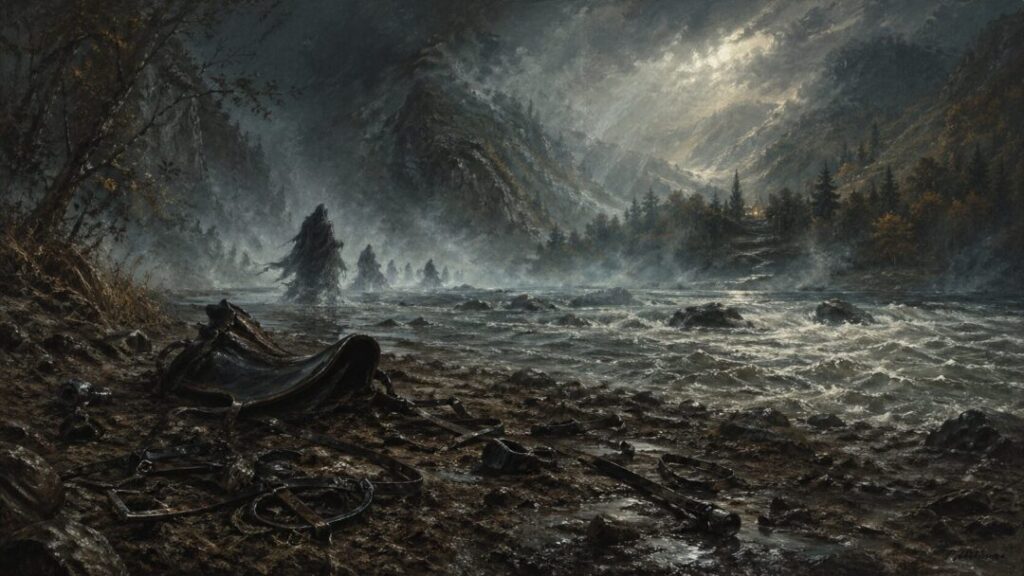
At Bruinen, one of those instruments is taken away.
The Ford of Bruinen Was Not Just an Escape
The confrontation at the Ford is one of the closest moments in the entire first half of the story.
Frodo is wounded.
The Morgul-knife has nearly done its work.
The Nazgûl have gathered.
Rivendell is near, but not yet reached.
The Ring is almost within Sauron’s grasp.
Then Frodo crosses the Ford on Asfaloth, Glorfindel’s horse. The Riders come after him. Frodo, weak but defiant, refuses them. They begin to enter the water.
And the river rises.
Later, in Rivendell, Frodo learns more of what happened. Elrond commanded the flood of the Bruinen. Gandalf added the shapes of white horses to the waters. Aragorn and the others rushed forward with burning brands, helping drive the Riders’ horses into panic.
This is important because it shows that the defeat was not simple.
The river, the power of Elrond, Gandalf’s intervention, the courage of Frodo’s companions, and the fear of the horses all come together in one moment.
The Nazgûl are not destroyed.
But their mounts are.
And because their mounts are destroyed, the hunt ends at the threshold of Rivendell.
Why the Nazgûl Themselves Survived
It is easy to imagine the flood as killing the Ringwraiths.
But that is not what the text says.
Gandalf explains that the horses must have perished, but the Riders themselves are far harder to destroy. They are sustained by Sauron’s power. Their forms can be broken, delayed, or driven away, but they are not mortal enemies who can simply drown like ordinary Men.
This distinction is crucial.
The Ford of Bruinen is not a final victory over the Nine.
It is a disruption.
That may sound less dramatic, but in strategic terms it is enormous.
Sauron’s servants had almost succeeded. They had followed the Ring across the Shire, through Bree, into the wild, and to the very borders of Rivendell. If they had taken Frodo at the Ford, the Quest would have ended before the Council of Elrond ever began.
Instead, they are forced back.
The Ring reaches Rivendell.
The Council happens.
The Fellowship is formed.
All of that becomes possible because the Nazgûl lose the physical means by which their first pursuit was carried out.
The Loss Exposed a Limit
The Nazgûl are terrifying because they seem inevitable.
They keep appearing.
On the road.
At Bucklebury Ferry.
Near Weathertop.
Outside Bree.
In the wild.
At the Ford.
They feel like the long arm of Mordor itself.
But the flood reveals something important: the Nine are not free from limitation.
They can be delayed.
They can be resisted.
Their servants and tools can be destroyed.
Their power does not operate equally everywhere.
Rivendell is not just another place on a map. It is one of the last great refuges of the Eldar in Middle-earth, guarded by Elrond and hidden in a valley difficult for enemies to enter. At its border, Sauron’s hunters meet a power they cannot simply overrun.
This does not make Rivendell stronger than Mordor in any absolute sense.
It means that in that place, at that moment, the Nazgûl’s pursuit fails.
And it fails partly because their terror is still tied to instruments that can be broken.
A horse can panic.
A horse can drown.
A rider without a horse is still dreadful.
But he is no longer a Black Rider in the same way.
Why Sauron Did Not Simply Use Winged Mounts First
This is where the question becomes even more interesting.
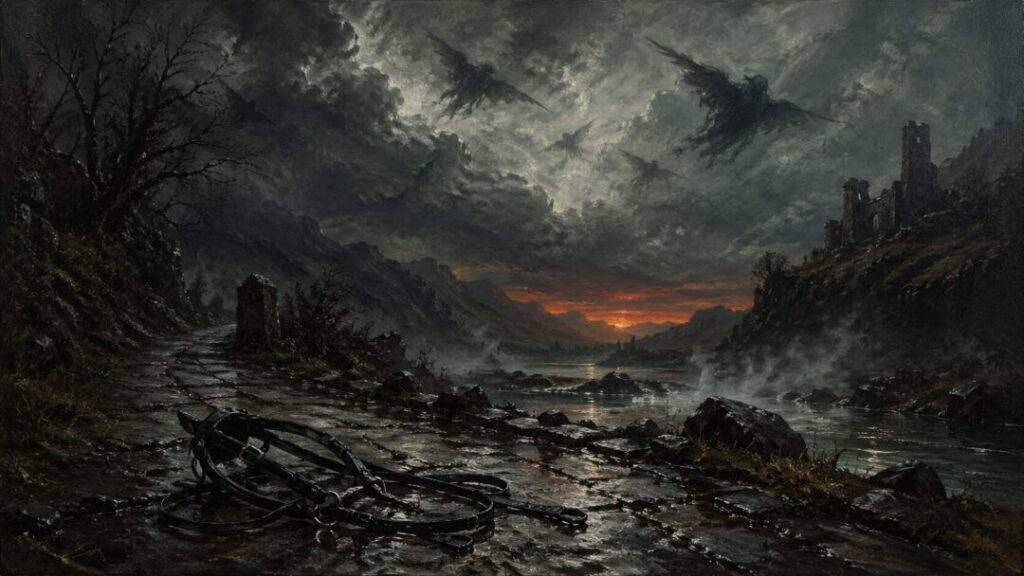
Later in the War of the Ring, the Nazgûl appear mounted on winged creatures. These are not used in the Shire-hunt at the beginning. The texts do not present the early Nazgûl as flying across Eriador from the start.
Why?
The safest answer is that Sauron’s first search was still partly secret.
He had not yet launched the open war in its full form. The Ring had been found only through uncertain reports: “Shire” and “Baggins,” names drawn from Gollum under torment. The hunt required speed, but also concealment.
Nine winged horrors crossing the skies of the West would have revealed far too much too soon.
This is not something to overstate beyond the text. The exact reasoning is not explained in a neat paragraph. But the pattern is clear: the Nazgûl begin as riders in secrecy and later return in more openly terrible forms when the war has widened.
That makes the loss of the horses even more important.
It marks the end of the hidden hunt.
After Bruinen, Sauron can no longer pretend this is merely a quiet search moving through roads and villages.
The Ring has reached Rivendell.
The Wise now know the danger.
The next phase will be darker.
The Horses Were Part of Sauron’s First Strategy
Sauron’s first strategy was not simply “send monsters.”
It was to send his most feared servants in a form that could search.
The Nazgûl on horseback could enter the world of roads, inns, ferries, gates, and fields. They could move among people just enough to gather information. They could terrify without immediately revealing the full scale of Mordor’s plans.
This strategy nearly worked.
That is the real horror.
The Shire was not defended by armies. Bree was not ready for the full meaning of the Black Riders. Frodo did not understand what was hunting him until he was already in terrible danger.
By the time the Nazgûl reached the Ford, their mission had come within a breath of success.
Then the river took the horses.
And with them, it took away Sauron’s first chance to recover the Ring before his enemies could gather.
Why the Moment Feels So Sudden
One of the reasons the Ford can be overlooked is that the story moves quickly afterward.
Frodo wakes in Rivendell.
The tone changes.
There is healing, conversation, memory, and counsel.
The terror of the road gives way to the great questions of the Council.
But beneath that shift is a major victory.
Not a complete victory.
Not a final defeat of the Nine.
Not even a wound to Sauron himself in the deepest sense.
But a victory of time.
And time is everything.
Time allows Frodo to heal.
Time allows the Wise to deliberate.
Time allows the Ring to be understood publicly among the Free Peoples.
Time allows the Quest to be chosen.
The Nazgûl losing their horses does not end the danger.
It creates the narrow space in which hope can act.
The Black Riders Become Something Worse
There is also a darker side to this.
The loss at the Ford does not make the Nazgûl less important.
It changes how they return.
When they appear later, they are no longer simply riders on roads. They become airborne terrors, circling above armies and cities, spreading dread from the sky. Their role expands from secret hunters to weapons of war.
This is not a contradiction.
It is escalation.
The Black Riders fail at the Ford, but Sauron does not abandon them. He adapts. The hunt that once moved through hedges and lanes becomes part of a greater war that reaches Gondor, Rohan, and the gates of Mordor itself.
That is why the Ford matters so much.
It is the last moment when the Nazgûl nearly win the Ring by pursuit alone.
After that, the story changes scale.
The quiet terror of the road gives way to the open terror of war.
What the Horses Really Represent
The horses represent the Nazgûl’s ability to enter the ordinary world.
That is what makes them so frightening in the first book.
They are not distant legends. They are not only battlefield horrors. They come into Hobbiton. They appear near gardens, inns, lanes, and ferries. They turn familiar places into hunted places.
The horse is the bridge between the unseen wraith and the visible world.
It gives the Ringwraith weight.
It gives him speed.
It gives his terror a sound.
Hoofbeats.
So when the horses are lost, the story is not merely removing a means of travel.
It is breaking the first shape in which Sauron’s fear entered the West.
The Nazgûl remain.
But the Black Riders are gone, at least for a time.
And that difference matters.
The Real Meaning of the Ford
The Ford of Bruinen is not just the place where Frodo escapes.
It is the place where Sauron’s first plan fails.
The Ring was almost taken before anyone could decide what to do with it. Before the Fellowship. Before Moria. Before Lothlórien. Before Rohan and Gondor entered the story in full.
Everything depended on getting Frodo across that river.
And the destruction of the black horses is the sign that the pursuit has been broken.
The Nazgûl survive because evil in Middle-earth is not easily washed away.
But their mission fails because even the greatest servants of Sauron are not beyond resistance.
That is the quiet power of the scene.
A river rises.
Horses panic.
Firebrands flare.
A wounded Hobbit refuses the darkness.
And for one brief moment, the Shadow loses its grip on the road.
The Nine will return.
But they will not return in the same way.
Sources & Notes
- J.R.R. Tolkien, The Lord of the Rings, Book I, Chapter 12, “Flight to the Ford” — Frodo’s stand at the Ford of Bruinen and the flood that sweeps away the Black Riders’ horses.
- J.R.R. Tolkien, The Lord of the Rings, Book II, Chapter 1, “Many Meetings” — Gandalf explains Elrond’s flood, his own white-horse imagery in the water, and the survival of the Ringwraiths after their mounts perish.
- J.R.R. Tolkien, The Lord of the Rings, Book I, Chapters 3–11 — the Black Riders’ road-bound search through the Shire, Bree, and the wild shows why horses matter to the early hunt for Frodo.
- J.R.R. Tolkien, The Silmarillion, “Of the Rings of Power and the Third Age” — background on the Nine Rings, the Nazgûl, and their bondage to Sauron’s will.
- J.R.R. Tolkien, The Lord of the Rings, Book V, Chapter 4, “The Siege of Gondor” — later use of the Nazgûl as winged terrors in open war, contrasting with the earlier secret hunt on horseback.