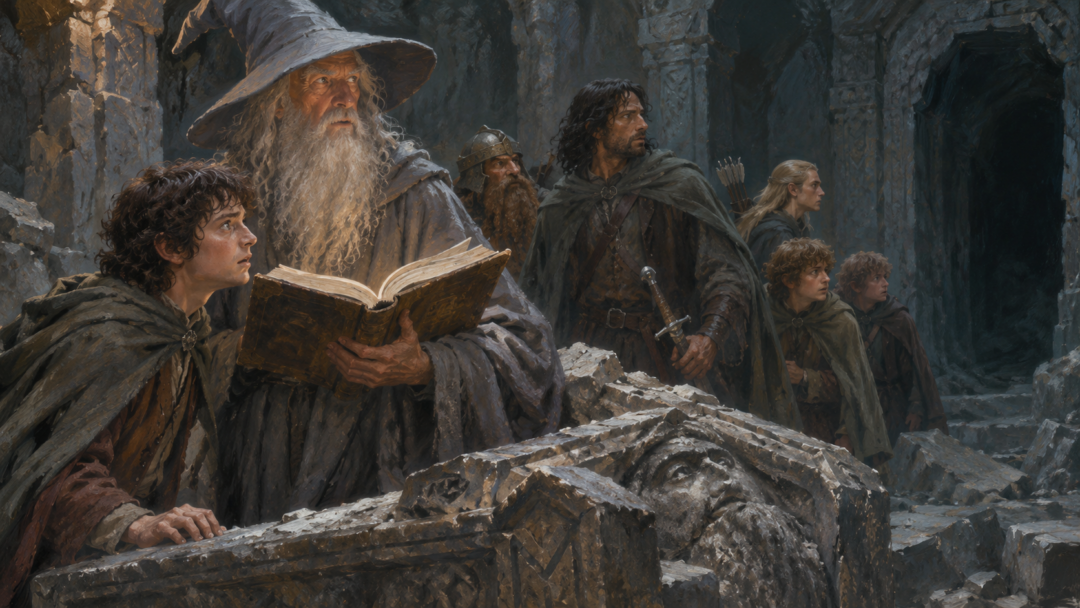
The drums are sounding beneath Moria when the Fellowship's visit to Balin's tomb turns into a desperate fight. Orcs break into the Chamber of Mazarbul, the defenders drive them back, and just as an escape seems possible, a heavily armed chieftain bursts through the doorway. He gets past two of the Company's strongest swordsmen and drives his spear straight at Frodo. It is a startlingly precise attack on the one hobbit carrying the One Ring.
But precision is not proof of secret knowledge. In The Fellowship of the Ring, the chieftain deliberately strikes Frodo; the account does not say he senses the Ring, knows who carries it, or has been personally sent by Sauron. Those possibilities are worth examining because other enemies do pursue the Ring. The key is to follow what happens in the chamber before assigning the Orc a purpose he never reveals.
The battle was already raging before Frodo was struck
The Fellowship has entered the Chamber of Mazarbul while searching for its way through the mines. There, beside Balin's tomb, Gandalf reads from a battered record of the Dwarves' doomed attempt to reclaim Moria. The grim entries describe mounting losses and a colony cut off from help. Then the distant drumbeats interrupt the reading, followed by horns, cries and the noise of approaching feet. Past disaster becomes present danger.
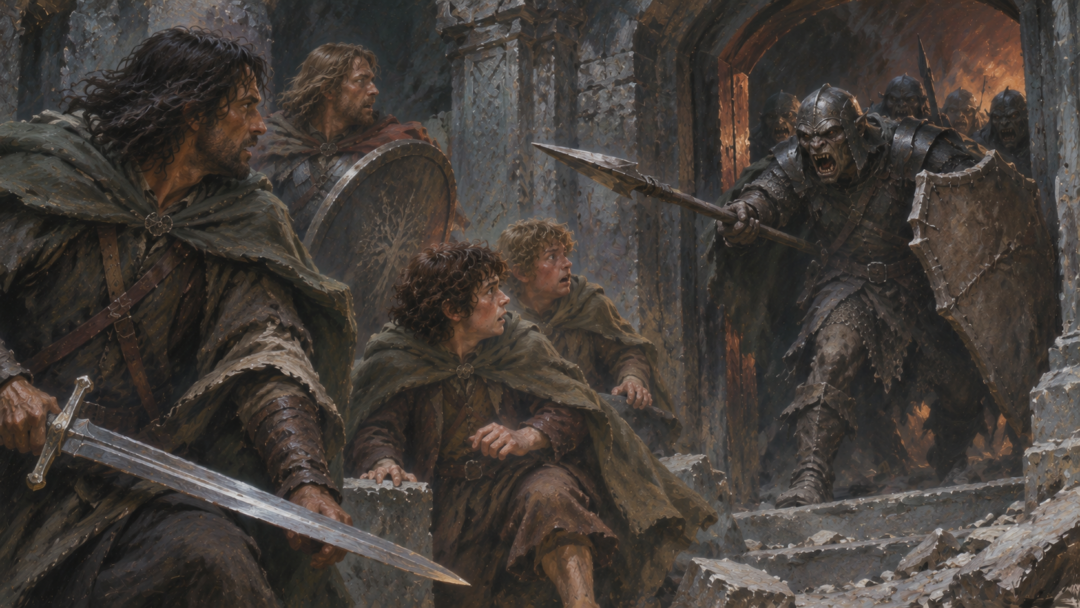
Gandalf and the others face a practical problem: enemies are approaching the western door, while an eastern exit leads down a stair they have not explored. Gandalf glimpses numerous Orcs outside, including powerful black Uruks of Mordor, and suspects a cave-troll among them. That detail establishes that Mordor's creatures are present in the attack. It does not identify the later spear-wielding chieftain as one of those Uruks, much less disclose his personal orders.
The first breach is not even made by the chieftain. A massive arm and foot force their way through the western doorway, and Boromir's sword fails against the creature's hide. Frodo then rushes forward and stabs its foot with Sting, causing it to withdraw. Frodo is not merely a passive victim: he has visibly entered the fighting with a weapon capable of wounding a formidable enemy.
After the door is battered open, Orcs rush into the chamber. Legolas shoots, Gimli fights near Balin's tomb, and Aragorn and Boromir cut down attackers. Sam is grazed but strikes down an Orc himself. Thirteen enemies fall before the survivors flee, and Gandalf urges the Company to escape before the troll returns. The chieftain appears at precisely this moment: not as the first hostile figure to find Frodo, but as a sudden new danger during an attempted retreat.
What the chieftain's spear actually proves
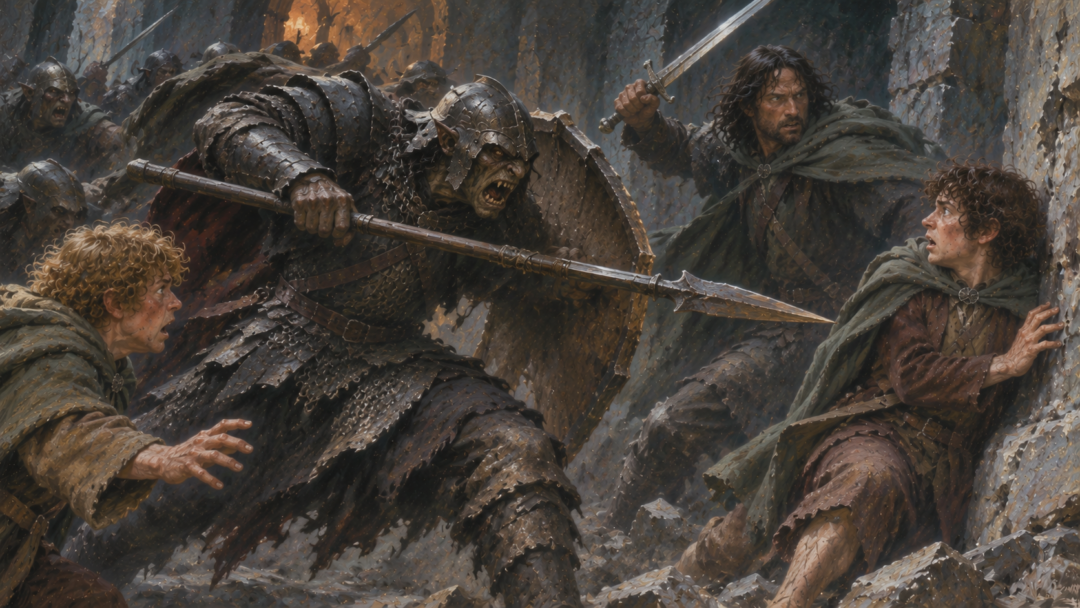
The description makes him unmistakably an Orc warrior, not the cave-troll from the earlier assault. He is almost the height of a Man, armored in black mail and carrying a great spear and hide shield. His followers crowd the doorway behind him. He turns aside Boromir's sword with his shield and throws him down, then ducks under Aragorn's stroke. Only after clearing those obstacles does he rush among the Company and thrust directly at Frodo.
That sequence supports one strong conclusion: Frodo is the chosen target of this particular blow. The spear does not accidentally strike him while the chieftain is fencing with someone else. The attacker changes position, gets through the defenders and aims at him. What the narration does not supply is the thought behind that choice. Perhaps he saw the smaller hobbit as easier prey, or perhaps he noticed Frodo wound the troll. Neither guess is established. Knowing where a spear goes is different from knowing why its wielder selected that person.
Nor does the weapon settle a hidden mission to recover the Ring. The recorded action is a violent spear thrust to Frodo's right side, powerful enough to throw him against the wall and pin him there. It looks like an attempt to put an enemy out of the fight, perhaps fatally. A command to capture someone alive and search him would be a different sort of operation. The scene gives no demand for an object, no search and no attempt to take Frodo away.
Sam reacts immediately, hacking through the spear shaft. The chieftain discards the broken length and draws his scimitar, but Aragorn brings Andúril down on his helm and kills him. His followers flee as Aragorn and Boromir press them. That is the entire opportunity the story gives this Orc to disclose his intentions. He neither speaks about the Ring nor changes his tactics in a way that reveals an effort to retrieve it.
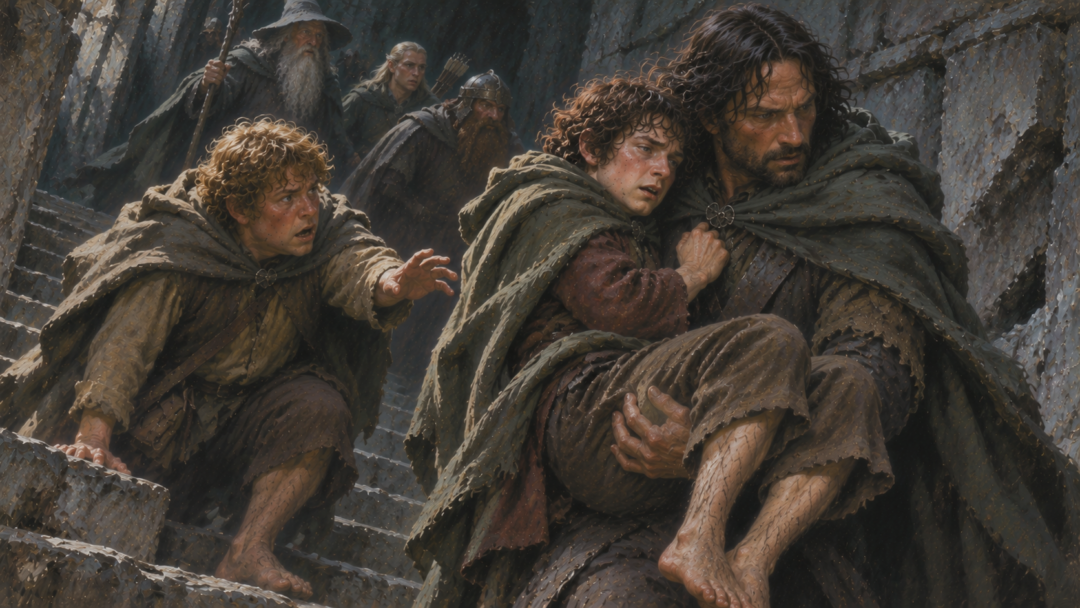
Aragorn carries Frodo from beside the wall toward the descending stair. Frodo soon insists he can walk, astonishing the others. That aftermath confirms how dangerous the thrust was without explaining why it was delivered. It also matters for the question of intent: the chieftain has not captured a Ring-bearer, interrogated him or even remained alive to discover what was concealed beneath his clothing.
Does the presence of Mordor's Orcs mean Sauron ordered it?
Mordor is certainly connected to the Moria attack. Gandalf recognizes black Uruks of Mordor among the enemies outside the chamber, and the Fellowship knows its mission is threatened by powers far beyond an ordinary band of robbers. It would be strange to pretend Mordor has no relevance. But an enemy force containing soldiers from Mordor is not the same thing as a documented order directing one specific chieftain to strike one specific hobbit.
The attack also has a clear local setting. Armed intruders have entered a stronghold occupied by hostile creatures, and the defenders of that stronghold are trying to overwhelm them. Horns, drums and a commanding voice suggest organized resistance, although the book does not identify that voice as the chieftain's. An Orc could attack during such a battle without needing advance intelligence about the Ring. This is an ordinary military explanation for the fighting, not a confirmed explanation for his choice of Frodo.
Could the chieftain nevertheless have been acting on information from Mordor? It is possible in the broad sense that the text leaves some of his knowledge unreported. Yet a theory of a special mission needs more than Sauron's general desire to obtain the Ring. The encounter contains no instruction to preserve Frodo, no recognition of an important possession and no exchange between the Orc and a superior. His title suggests standing among fighters, not a proven appointment from the Dark Lord.
Why the Ring's danger is not the same as a signal
The One Ring is not an ordinary treasure. Its history, its claim on its bearers and Sauron's determination to recover it give the reader every reason to fear encounters with his servants. That makes a Ring-related explanation tempting when Frodo is singled out. But the chamber scene does not portray the Ring as sending out a detectable beacon to nearby Orcs. Nothing describes the chieftain sensing it, following an invisible trail or recognizing Frodo through some supernatural perception.
There is a nearby detail that can make the idea especially persuasive. Earlier, outside Moria's western gate, the Watcher in the Water seizes Frodo first, and Gandalf privately notices that disturbing fact. The narrative invites unease about why the Ring-bearer was selected. But the Watcher is a different creature in a different encounter. A question raised by its choice cannot be transferred into the mind of the Orc who attacks much later in the chamber.
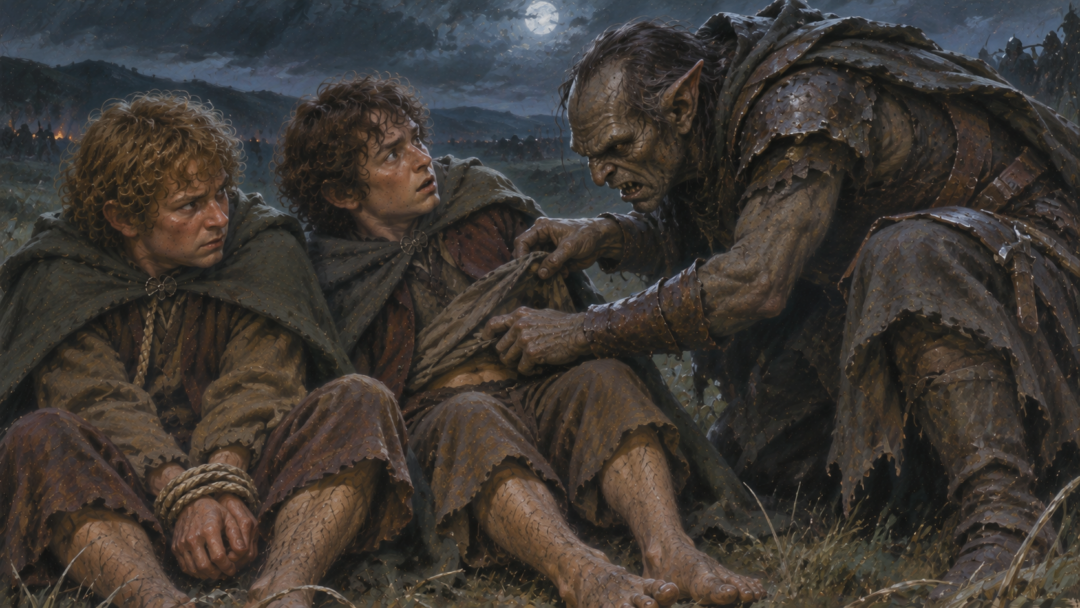
Grishnákh offers a revealing contrast, not an answer
Later, The Two Towers gives us Orcs discussing orders about hobbits. After Merry and Pippin are captured, their captors quarrel about where to take them. Some insist that the halflings must be brought back alive and left unsearched. Different groups serve different interests: Uglúk leads warriors of Isengard, while Grishnákh speaks for Mordor. The prisoners' possible value becomes part of the Orcs' argument, not merely a reader's guess.
In that same quarrel, Northerners say they have come from the Mines to kill and avenge their folk. Their words show that Orcs in this larger conflict need not share a single objective, even while fighting common enemies. They do not identify the earlier chieftain or establish what he knew. More importantly, the explicit orders concerning living halfling captives belong to the later pursuit. They cannot be inserted retroactively into the sudden spear attack in Moria.
When the Rohirrim have surrounded the Orc-band, Grishnákh approaches the bound Merry and Pippin and feels over them as though searching for something. Pippin concludes that the Orc knows about the Ring and is looking for it for himself. That conclusion arises in Pippin's mind; it is not an omniscient statement of Grishnákh's private thoughts. Still, Grishnákh's behavior gives the suspicion substance, especially when Pippin tests him by imitating Gollum and the Orc responds with heightened interest.
Merry and Pippin then exploit that interest, hinting at a coveted object and pressing Grishnákh to loosen their bonds. He asks whether either possesses it and tries to carry them away from the other Orcs. The scene gives readers actions, dialogue and bargaining from which to judge his awareness, though it leaves room for uncertainty about precisely what he understands. Neither hobbit has the Ring, and Grishnákh has no role in the earlier battle at Balin's tomb.
That contrast gives the Moria encounter its sharp edge. When Orcs hunt something beyond an immediate battlefield victory, the story can show orders, searching hands and suspicious questions. In Mazarbul we see none of that: only an intentional spear thrust, with the chieftain's knowledge and motive undisclosed. Frodo survives, the attacker falls, and the Company disappears down the dark stair still carrying a secret that nearly died with its bearer.
Sources & Notes
This article is based on close reading and interpretation of Tolkien's published works and related source material where relevant.