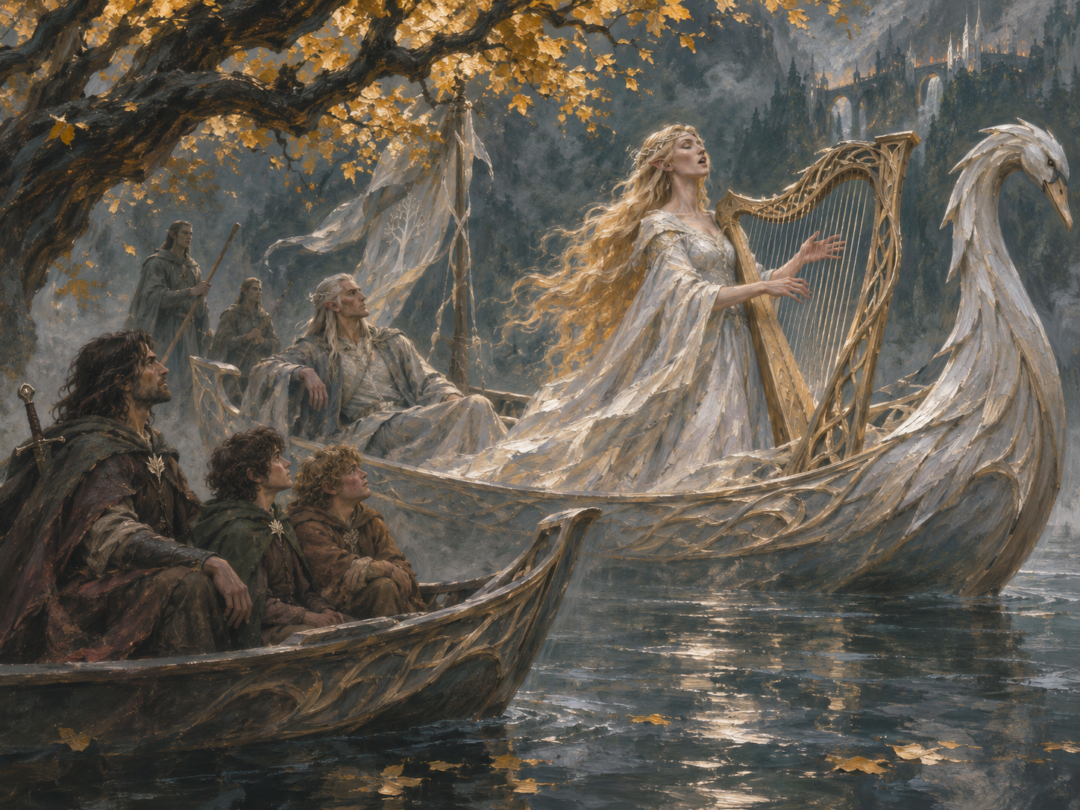
When the Fellowship leaves Lothlórien, golden leaves float on the Silverlode. Around a bend comes a vessel carved like a swan, with Celeborn aboard and Galadriel standing behind him, holding a harp. She sings of leaves, a shining Tree in the West, and the fading beauty of the land her listeners are leaving. Her farewell reaches beyond a place to an age of the world.
Does the Tree mean Laurelin alone, excluding its silver counterpart, Telperion? In the English Song of Eldamar, Galadriel describes one golden Tree but explicitly names neither Laurelin nor Telperion. The description strongly suggests Laurelin. Yet the song also mentions both Sun and Moon, and the Moon has a direct connection to Telperion in the wider legendarium. It depends on the difference between what the words describe and the history they evoke. That distinction lets us recognize a powerful allusion without forcing the poem to say more than it does.
What Galadriel actually sings
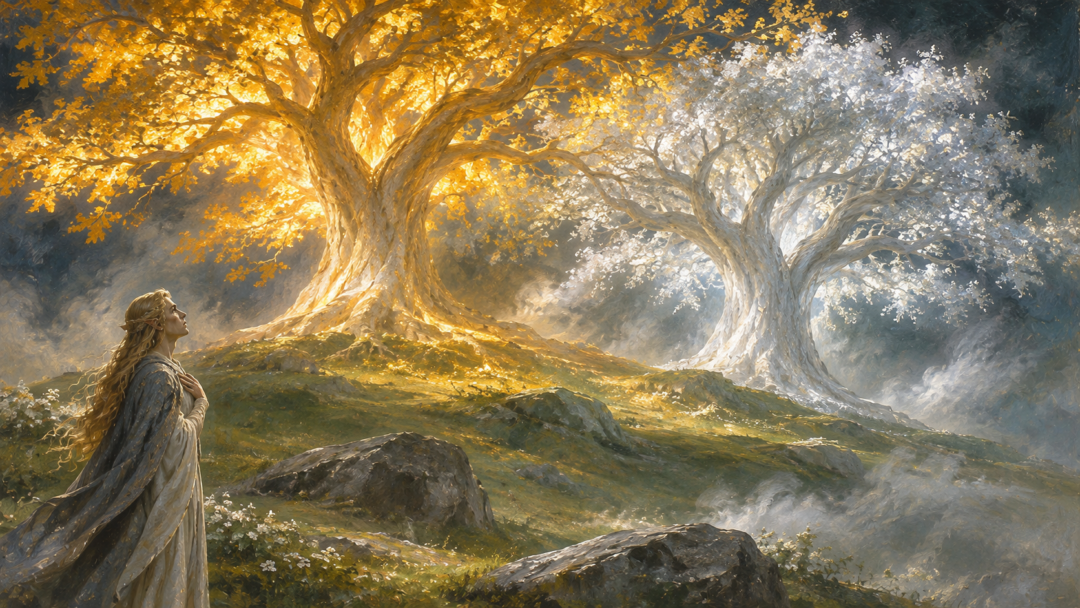
The poem speaks of "a golden Tree." Its opening establishes golden leaves and wind moving through branches. Then Galadriel looks across the Sea toward the Blessed Realm, invoking the Sun, Moon, Ilmarin, Eldamar and Tirion. One Tree is the luminous centre of that scene. There is no matching description of a silver Tree, no second trunk standing beside it, and neither Tree receives its proper name. Even the shift from many golden leaves to one golden Tree invites a connection without supplying a label.
That is narrower than saying the song is only about Laurelin. The opening remembers singing that seemed to summon leaves and wind; the middle sets distant beauty against grief on the nearer shore; the ending wonders whether a ship could carry Galadriel west again. This is no catalogue of Valinor’s wonders. It moves through memories and losses, with one golden image as its point of brightness.
This is the English poem called Galadriel’s Song of Eldamar, sung as the swan-ship approaches. Later, after the Fellowship departs, Galadriel sings another farewell in Quenya, Namárië. Both feature golden leaves and longing for the West, but they are different songs in different scenes. Words belonging to the second must not be attributed to the first.
Why the golden Tree suggests Laurelin
In The Silmarillion, the Two Trees of Valinor are Telperion, whose light is silver, and Laurelin, whose light is golden. Yavanna raises them on Ezellohar near Valimar, where their alternating light illuminates the Blessed Realm before the Sun and Moon exist. A single golden, shining Tree naturally suggests Laurelin. Colour is precisely what distinguishes the pair. Telperion was the elder Tree, but seniority gives no reason to read its silver light into a description that repeatedly stresses gold.
Galadriel herself came from the Blessed Realm, and the vanished light of the Trees belongs to her earliest history. By the time she rules Lórien, that light is irrecoverable in its original form. The golden Tree is more than an attractive backdrop: it belongs to a world older than any landscape the hobbits know. Still, this is an interpretation supported by the wider legendarium, not a name Galadriel utters. She is remembering a realm she knew, rather than presenting the hobbits with a lesson in its ancient history.
The distant Tree is said to shine, not merely to bear yellow leaves. That makes Laurelin a stronger identification than an ordinary gold-leaved tree: the Golden Tree of Valinor was itself a source of light. Nevertheless, the lyric offers an image rather than a natural history. It never explains who planted the Tree, how its light worked or what happened when it died.
Where Telperion enters the picture
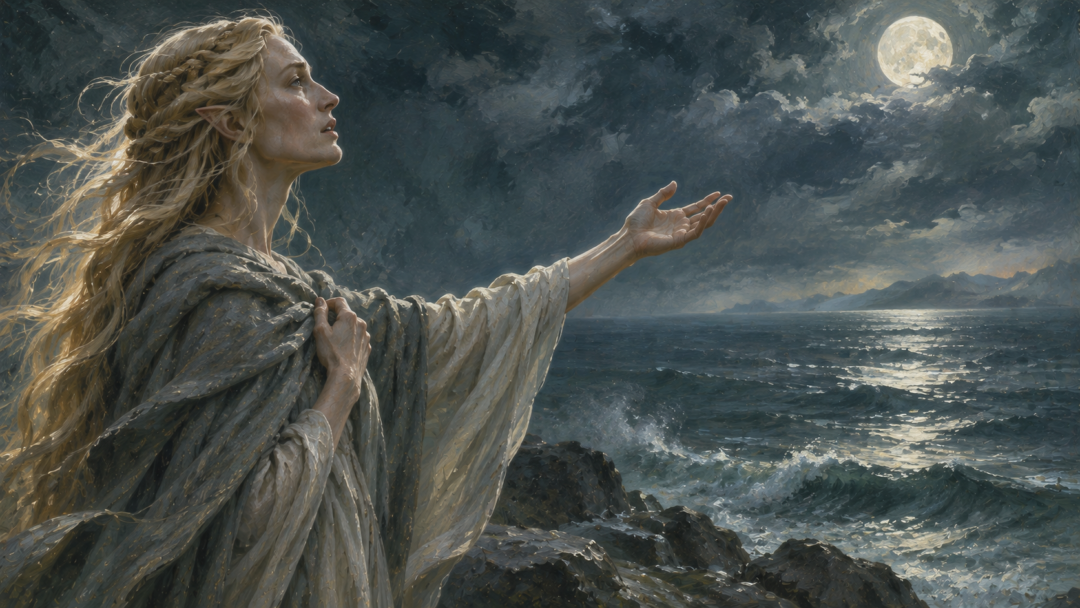
Telperion is not depicted in the song, but its history is relevant. In the account of the Darkening of Valinor, Melkor and Ungoliant destroy the Two Trees. Afterwards, the last silver flower of Telperion becomes the Moon, while Laurelin's last golden fruit becomes the Sun. The lyric explicitly invokes both heavenly lights as it turns the listener's gaze westward. Their origins allow both Trees to echo through those names.
This is an indirect connection, not proof the poem deliberately encodes the pair. Sun and Moon also convey distance: the West lies beyond the lights marking ordinary days and nights. Both associations are possible, but the verse does not choose between them. Mentioning the Moon differs from depicting Telperion standing beside Laurelin; likewise, naming the Sun does not describe Laurelin’s branches. The stars above Eldamar add to the atmosphere of an enchanted evening, but do not by themselves establish another coded reference to Telperion.
Chronology matters too. The living Trees provided light before the Sun and Moon existed; the heavenly lights arose from their remains after their destruction. Galadriel is not describing full-grown Trees shining beneath both celestial bodies. The poem crosses eras as readily as it crosses the Sea, bringing later lights into a memory of ancient Valinor without placing them in the same historical moment.
Tirion and the other White Tree
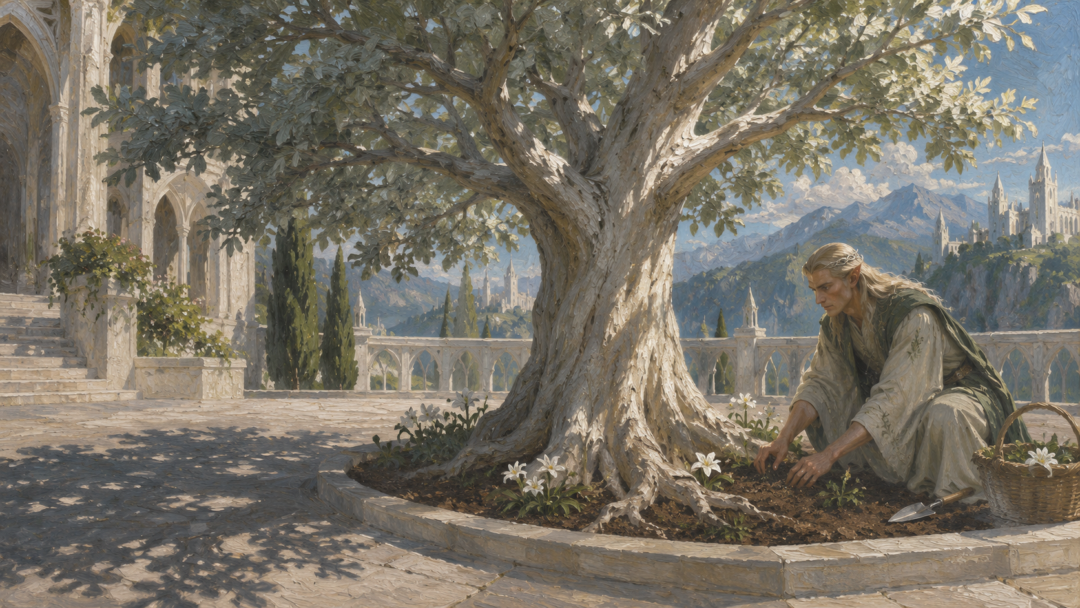
Tirion raises a real complication. The song places the golden vision beside the Elven city, but the original Two Trees stood on Ezellohar by Valimar, not in Tirion. Ilmarin is the dwelling of Manwë and Varda upon Taniquetil. These names evoke the Blessed Realm without forming a precise botanical map. Tirion itself stands in the region of Eldamar, where the Elves could receive the radiance of the Trees from farther away. Moving Laurelin physically to Tirion to make the verse literal would contradict the fuller account of its location.
Tirion had its own famous Tree. According to The Silmarillion, Yavanna made Galathilion in Telperion’s image for the Elves. This White Tree grew in Tirion, but emitted no light of its own. It recalled Telperion’s form, and its descendants eventually led through a tree on Tol Eressëa, then Númenor, to the White Tree of Gondor. Thus the silver Tree has a genuine legacy among later Elven and human kingdoms.
Galathilion does not solve the puzzle. It is white, not golden, and unlike the original Trees, it has no radiance of its own. Galadriel’s vision cannot be identified with it merely because Tirion appears nearby. Nor does Tirion’s White Tree prove Telperion is a second, unspoken Tree in the poem. The geographical tension should remain visible: poetic memory gathers associations that a historical itinerary would keep apart.
The gold of Lórien, and the things that fade
The poem’s gold belongs to two shores. First leaves answer Galadriel’s singing; in remembered Eldamar, they endure on ancient branches. In Lórien, leaves fall into the stream and winter approaches. Gold suggests splendour in both places, but one image glows with distant endurance while the other slips away on running water. The farewell scene makes that loss visible around the listeners’ boats.
The mallorn trees make this comparison especially vivid. Their leaves turn gold in autumn, remain through winter and fall only when fresh growth comes in spring. Lórien follows an extraordinary seasonal rhythm, yet it is not outside change. Galadriel has preserved a realm recalling the beauty of the West, but preservation is not restoration. The river carries leaves away even here. Their silver-grey bark provides another reminder that the Golden Wood is not coloured gold alone, though that detail cannot turn the lyric into an explicit account of both Trees. Her song can link Lórien to ancient splendour without pretending the original Golden Tree grows there.
The older name Laurelindórenan, commonly rendered as the Valley of Singing Gold, deepens the connection. A later linguistic account discussed in Unfinished Tales links the name with Galadriel and an echo of Laurelin. This is evidence for a broader pattern joining the Golden Wood, music and the Golden Tree. It is not a concealed occurrence of Laurelin in the English lyric. Explanations of Elvish names changed over time and cannot establish the wording of earlier stages of this song.
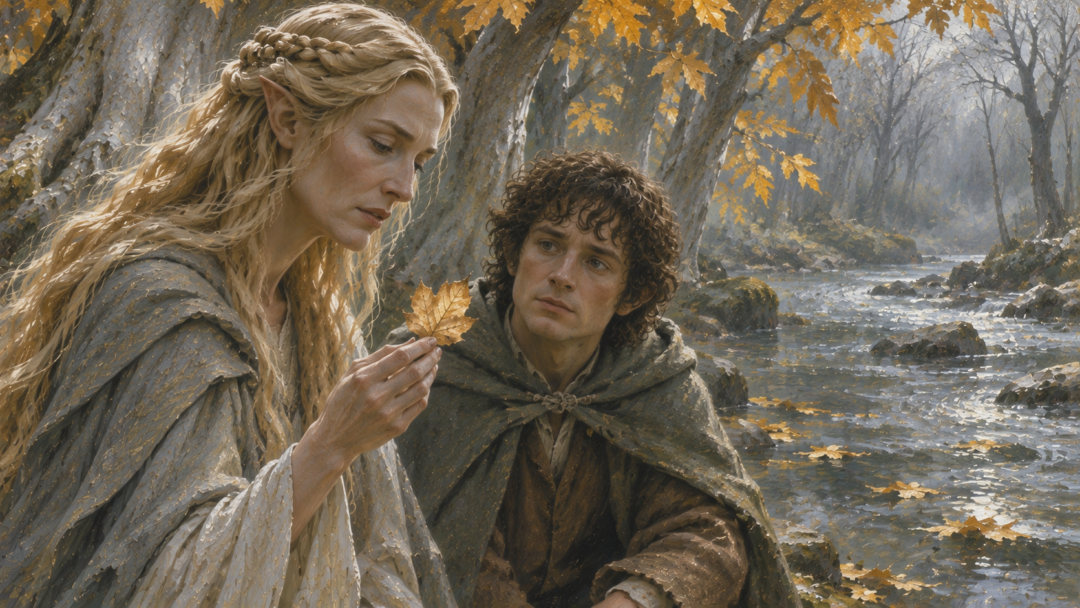
Galadriel also speaks of a fading crown of golden elanor flowers. The crown suggests the beauty of the realm she has fashioned, while fading makes that beauty vulnerable. She is not simply nostalgic for a distant Tree: she stands amid present splendour that cannot remain untouched by time. The remembered brilliance makes the falling leaves of her own woodland seem more fragile.
Why the song finishes with a ship
The poem ends not with another Tree but with the Sea. Galadriel wonders what ship could carry her back across it. Earlier place-names now sound less like map coordinates than objects of longing. She has not forgotten a route or failed to name every wonder of the West. Her distance from it is historical and personal as well as physical: ages have passed, and retracing a journey cannot recover all that has vanished.
The Fellowship is leaving one of the fairest places its members will ever see, while Galadriel sings of beauty beyond their experience. Both are parting from something precious, on different scales. The swan-shaped ship carrying her to them is almost an answer in miniature to her final question, but it travels a river in Middle-earth, not the Sundering Seas. It makes her longing tangible without resolving it. The song leaves the possibility of return as a question rather than a promise, and its listeners must continue downstream.
One golden Tree shines in the words; Laurelin is the most convincing identification. Telperion belongs to their broader resonance, not to a second Tree described aloud. That restraint gives the farewell its force. Galadriel does not need to name every lost marvel of the West. On the Silverlode, one golden leaf is enough to show how a beautiful world can slip away.
Sources & Notes
This article is based on close reading and interpretation of Tolkien's published works and related source material where relevant.