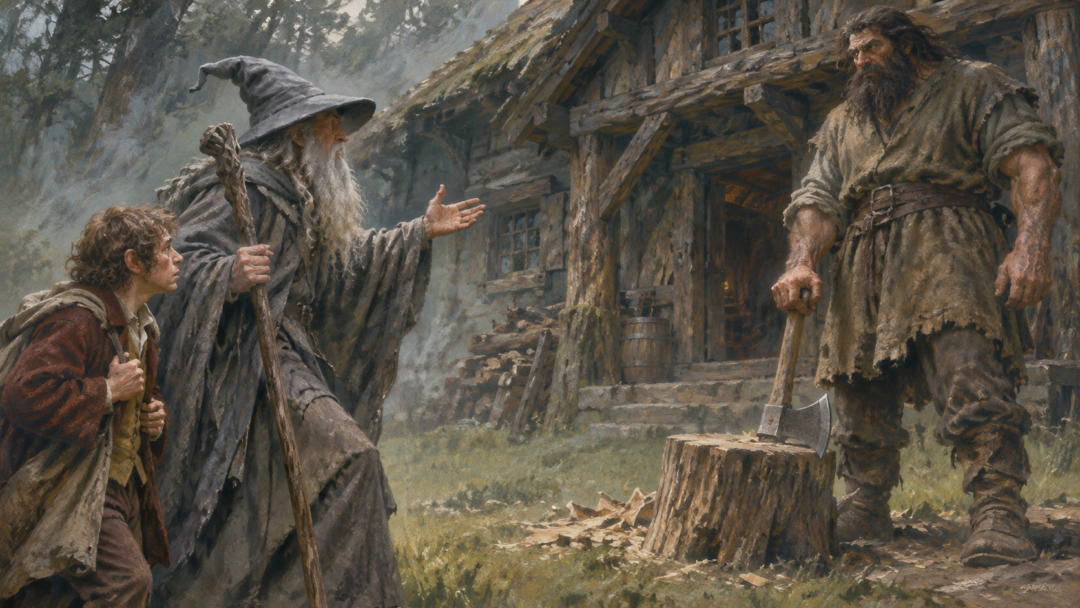
Morning at Beorn’s house is tense. The skin-changer chops wood outside while the Dwarves inside wonder how to face him. Gandalf has a solution, but it requires timing and a signal nobody has properly agreed upon.
Yes, the extended edition of The Hobbit: The Desolation of Smaug restores a gradual introduction of Thorin’s company to Beorn, echoing the famous sequence in the book. But the Dwarves are not being secretly brought into his house one by one. They have already sheltered there overnight, and now come out to meet him in successive pairs and groups. The result is book-inspired, not a literal recreation.
What happens at Beorn’s house in the book?
In Chapter 7 of The Hobbit, “Queer Lodgings,” Gandalf faces an awkward problem. The travelers need shelter and assistance, but their potential host is no ordinary farmer who can be presented with a large, unexpected party. Beorn is formidable, independent, and suspicious of intruders. The entire expedition would alarm him. Gandalf therefore approaches with Bilbo and lets the rest of the company become visible gradually.
Gandalf’s method is storytelling. Rather than announcing every companion immediately, he recounts the travelers’ troubles with the goblins and their escape through the mountains. Small groups of arriving Dwarves become part of the tale. Beorn notices that the number of travelers keeps changing and challenges Gandalf’s accounting, but the interruptions also keep him listening. The arrivals turn an awkward request for hospitality into conversation.
Humor and caution mix throughout. Gandalf knows he cannot demand Beorn’s welcome for so many companions. Yet Beorn is more than a danger. He can offer practical help on the road toward Mirkwood, and the company cannot afford to alienate him. The publisher’s teaching guide to The Hobbit specifically identifies Gandalf’s small-group introductions, accompanied by his account of their adventures, as the means by which he wins Beorn’s hospitality.
The point, then, is not that every Dwarf performs a separate secret entrance. The recognizable book device is a procession of arrivals, a host who keeps count, and a wizard who tries to manage the encounter through storytelling. The extended film adapts that pattern in different circumstances. It also recalls the unexpected party at Bag End: Bilbo, once the bewildered host of arriving Dwarves, is now helping Gandalf approach someone else’s door.
The extended film begins after an uneasy night
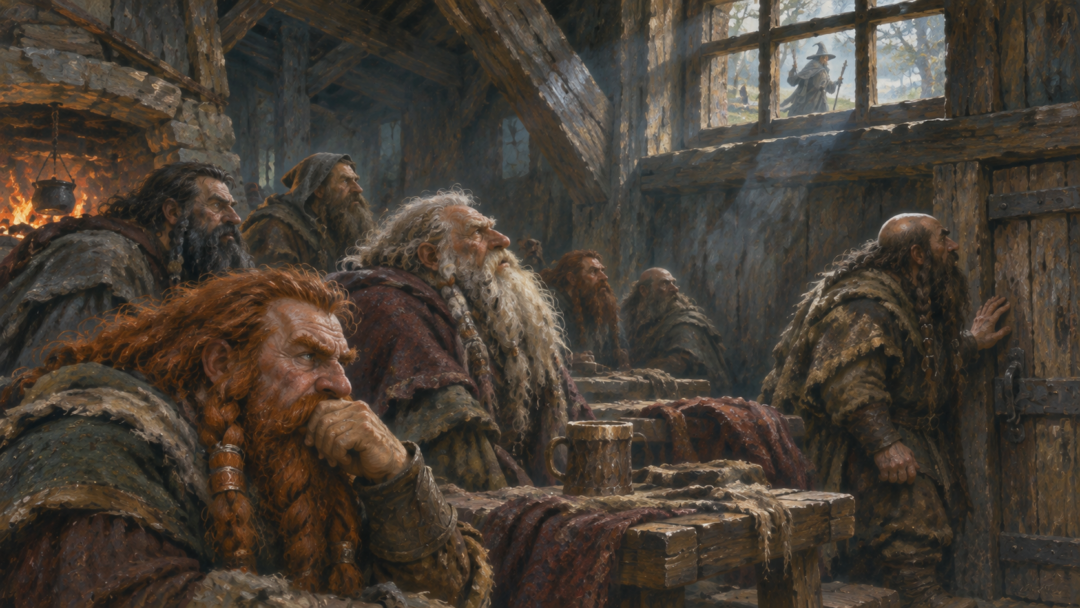
The theatrical film already establishes Beorn as a fearsome presence, with the company taking refuge from his bear form. The expanded version gives the following morning more room to unfold. Bilbo wakes, and the Dwarves gather near the door of the large timber house. They are already inside. That reverses the novel’s welcome: the immediate challenge is not getting everyone admitted, but getting everyone introduced to the owner of the shelter they used.
The Dwarves disagree about their next move. Nori favors slipping away without being noticed, while Dwalin refuses to run simply because Beorn is dangerous. Gandalf cuts through the argument with a practical objection. They will not get safely toward Mirkwood without Beorn’s help, and the threat pursuing them has not disappeared. One night beneath a roof is insufficient. They need a host willing to assist them after discovering exactly who has been staying there.
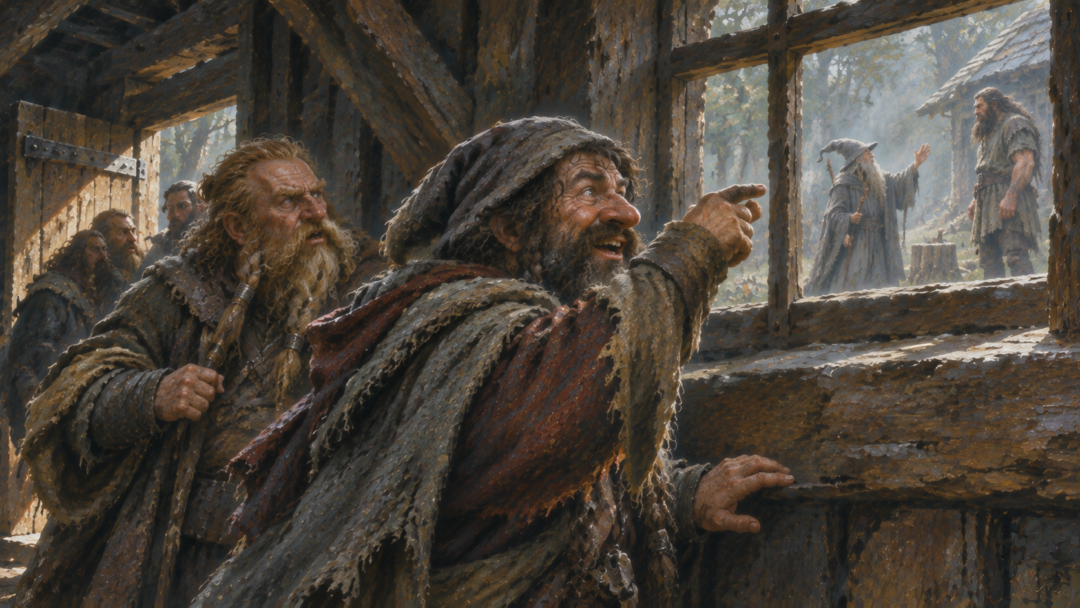
Gandalf chooses Bilbo to accompany him outside and tells the Dwarves to remain where they are until he signals that it is safe to emerge. He also stresses that they should avoid sudden movements and overcrowding Beorn. Gandalf initially proposes pairs, then makes a comic exception for Bombur, whose size, he suggests, merits an entrance on his own. His elaborate precautions show just how delicately he hopes to handle Beorn. But Bofur raises a question from a high window: what is the signal supposed to be? By then Gandalf and Bilbo have gone. The plan has a consequential flaw.
Outside, Beorn is chopping wood. Gandalf approaches cautiously, introduces himself, and attempts to explain their presence. Beorn is hardly impressed by the wizard’s name, and invoking Radagast does not instantly make the meeting comfortable. Bilbo, partly hidden behind Gandalf, catches Beorn’s attention and has to be identified as a Hobbit rather than a Dwarf. There is no guarantee the others will receive a warm welcome.
Bofur’s mistaken signal brings the Dwarves out
The comedy begins when Gandalf gestures while describing the company’s difficulties with goblins. Bofur, still watching from the window, interprets the movement as the promised signal and prompts the others to come out. It is not a carefully timed instruction from Gandalf. It is a misunderstanding by someone who was never told what movement to watch for. That mistake gives the introductions their precarious rhythm: the wizard must cope with each new appearance as it happens.
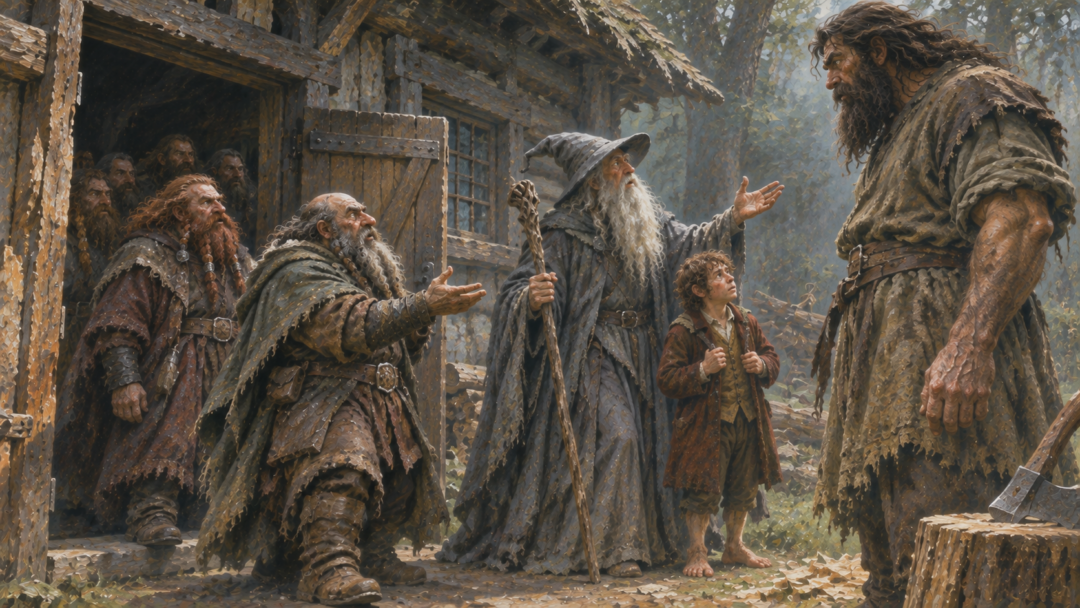
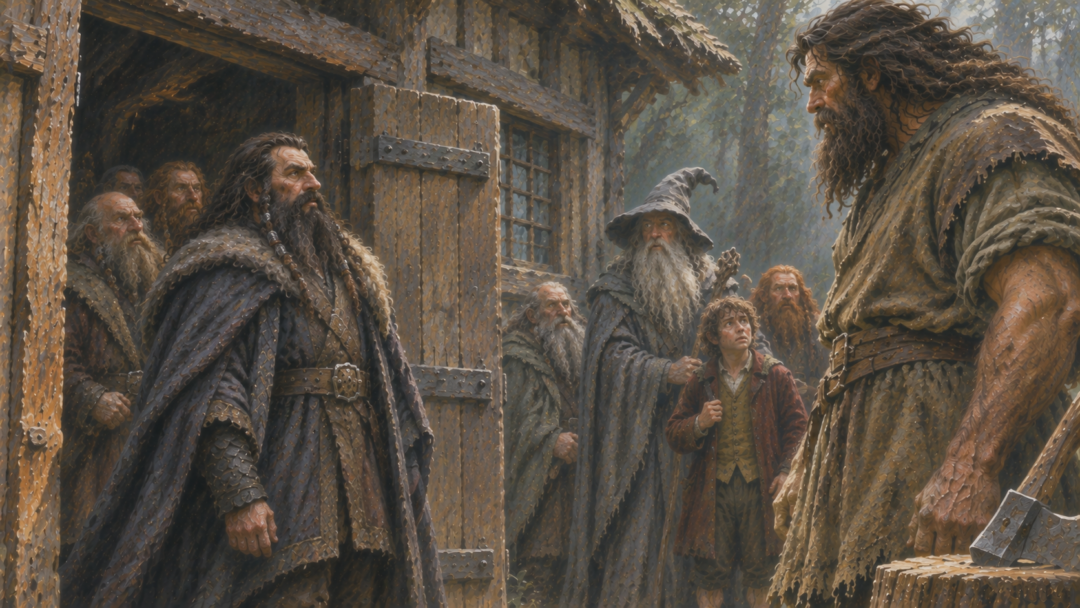
Dwalin and Balin are the first Dwarves to emerge and introduce themselves. Beorn is surprised and displeased, while Gandalf acknowledges that his traveling party includes Dwarves. The number immediately becomes a subject of dispute. The host questions the wizard’s descriptions of his companions as more appear, forcing Gandalf to revise the impression he has just given. Crucially, Beorn is not fooled into believing that only a couple of visitors exist. He notices the additions and makes Gandalf account for them.
The [Movie-Censorship comparison](https://www.movie-censorship.com/report.php?ID=433504&Page=2) describes further waves of arrivals, including introductions involving Dori and Ori, followed by other members of the company. The procession is not thirteen solo entrances. Several Dwarves appear together or are acknowledged in clusters; the comparison names Fíli, Kíli, Nori, Bofur, Bifur and Bombur among the later arrivals without presenting six separate ceremonial entrances. Gandalf’s increasingly awkward presentation supplies the humor; Beorn’s resistance shows the trick is not flawless.
The Dwarves’ ordinary manners also clash with their intimidating host. They offer names and courtesies, but Beorn is not necessarily interested in being served or flattered by unexpected guests. What might have sounded polite at another doorstep becomes another reason for Gandalf to adjust his approach. Beorn answers back rather than standing silently as an obstacle. His attention, irritation, and questions shape the pace as much as the procession itself.
Finally Thorin appears. Both [TheOneRing.net’s extended-edition scene guide](https://www.theonering.net/torwp/2014/10/21/93175-the-hobbit-the-desolation-of-smaug-extended-edition-scene-guide/) and Movie-Censorship describe Beorn as seeming to recognize him. That is a visual impression reported by the guides, not proof that the film establishes a prior meeting or explains what Beorn knows. Thorin’s final position is clear. His entrance gives the sequence a final point of attention before the film moves on to breakfast.
What does the theatrical edition leave out?
The theatrical release lacks this procession. Its treatment of the morning is much brisker. The detailed exchange in which Gandalf approaches Beorn and the Dwarves gradually emerge is an extended-edition addition. The company is quickly established around Beorn’s table, without the escalating introductions, Bofur’s misunderstanding, or Gandalf’s struggle with the headcount. The scene is therefore more than an extra joke: it restores the missing transition between taking shelter and accepting the hospitality of its owner.
Movie-Censorship assigns 269.9 seconds—about four and a half minutes—to the broader added Beorn introduction sequence. That figure covers more than the seconds spent watching Dwarves cross the threshold: it includes the Dwarves’ discussion inside, Gandalf and Bilbo’s approach, and the encounter outside. It should not be treated as a stopwatch measurement of each Dwarf’s appearance, or as the total amount of extra material in the extended film. Other additions appear in Mirkwood and Dol Guldur.
Nor does “extended” mean every theatrical shot remains untouched with new scenes simply inserted between them. The comparison identifies altered editing and missing theatrical passages. Around Beorn’s house, for example, a brief theatrical moment involving Bilbo seeing Beorn enter is removed; some background action and later shots are different. Another added conversation, in which Beorn and Gandalf discuss Orcs, Dol Guldur, and the High Fells, occurs later. That scene serves a different purpose.
Why the restored scene feels so close to the book
The scene’s kinship with “Queer Lodgings” is strongest in its social comedy. A wizard who usually seems to have an answer for everything must negotiate with someone who cannot simply be charmed or commanded. Bilbo is the smaller, less threatening companion at his side. The Dwarves are too numerous to introduce comfortably in one breath. And every attempt to make the party sound manageable gives Beorn another chance to question the number standing before him. These elements survive the rearranged circumstances.
The differences also change the flavor of the scene. On the page, the gradual arrivals are woven into Gandalf’s narrative as he brings the company to Beorn for hospitality. In the extended film, the travelers are emerging from a refuge they have already occupied, and the pace is partly driven by Bofur’s innocent misreading of a gesture. One version emphasizes a storyteller deliberately unfolding his tale; the other introduces an additional comic accident. Neither has Dwarves secretly slipping into Beorn’s house.
Restoring the exchange gives the morning a useful sense of negotiation. The great bear-like threat of the previous night is now a person with questions, judgments, and the power to decide whether these travelers deserve help. The Dwarves, for all their bravery, must stand before him and be counted. It is quieter suspense than a chase through the trees, and it changes the breakfast: the gathering at the table follows an uncomfortable meeting rather than appearing almost without explanation.
So the extended edition does preserve the pleasure of watching Gandalf’s traveling party reveal itself bit by bit. It simply places that pleasure on the other side of Beorn’s doorway. The enduring image is not a queue of secret arrivals entering a stranger’s hall, but an increasingly crowded courtyard, an unamused host, and Gandalf trying to make the next unexpected Dwarf sound like the most natural thing in Middle-earth.
Sources & Notes
This article is based on close reading and interpretation of Tolkien's published works and related source material where relevant.