It sounds like the kind of question that should not need an article.
Does Aragorn wear pants?
Surely, yes.
He is a Ranger. He walks through the wild. He rides horses. He crosses rough country, sleeps outdoors, hunts, fights, tracks enemies, climbs hills, passes through marshes, and eventually marches to war.
The practical answer seems obvious.
And yet the moment we ask the question in a lore-accurate way, the answer becomes more interesting.
Because the books never stop and say, in plain words, “Aragorn was wearing pants.”
They describe his cloak. His hood. His boots. His sword. His mail. His kingly presence. His weather-beaten face. His dark hair, flecked with grey. His keen grey eyes.
But his trousers?
Not directly.
That silence is not proof that Aragorn was strangely underdressed. It is almost certainly a matter of narrative focus. But it does reveal something about how clothing works in The Lord of the Rings.
The story tells us what matters.
And with Aragorn, what matters at first is not fashion.
It is concealment.
Strider Is Introduced as a Hidden Man
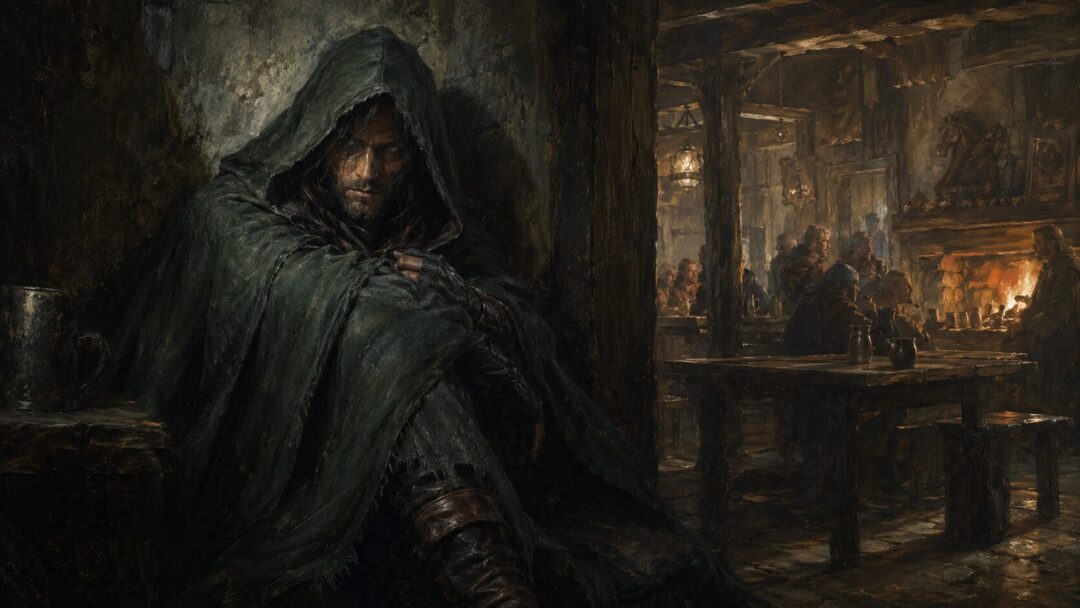
When the hobbits first see Aragorn at the Prancing Pony, they do not see a king.
They see a suspicious stranger.
He sits in a dark corner. His cloak is drawn close around him. His hood overshadows his face. He is watching them before they understand who he is. Everything about the scene is built around uncertainty.
The text gives us enough detail to create a powerful impression. Strider is travel-stained, grim, weather-beaten, and dangerous-looking. He is not presented as noble at first glance. He is presented as someone half-hidden from ordinary sight.
That is important.
A full inventory of his clothing would work against the scene. The story does not want us to study him like a costume illustration. It wants us to feel what Frodo feels: unease, curiosity, and the sense that this man may be more than he appears.
So the cloak matters.
The hood matters.
The boots matter.
They tell us that he belongs to roads, wilderness, concealment, and long journeys.
His legwear does not matter in that moment, because the scene is not asking us to admire his outfit. It is asking us whether he can be trusted.
The Boots Are the Biggest Clue
The strongest direct clothing clue is not pants at all.
It is his boots.
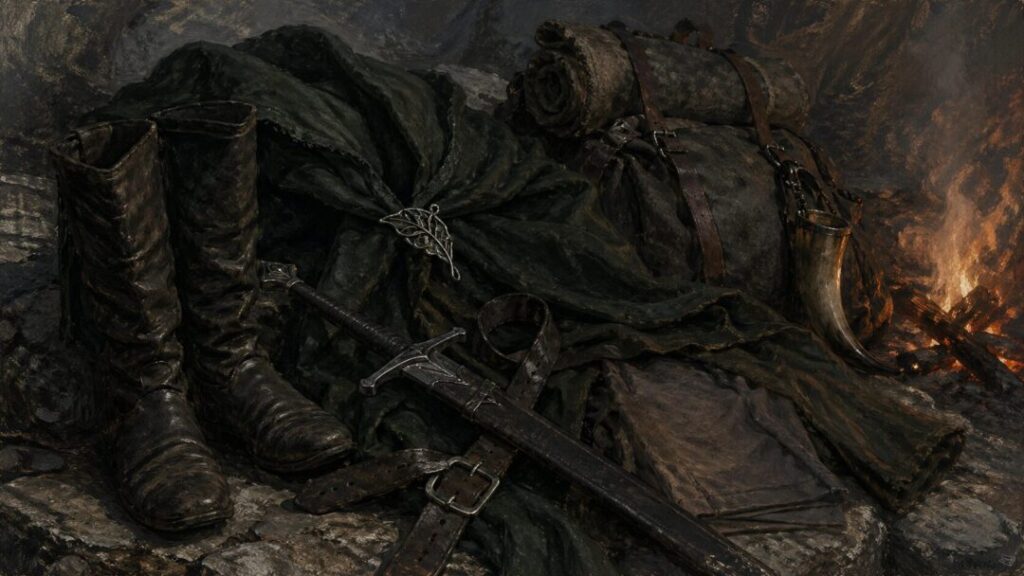
Aragorn is described as wearing high boots of supple leather. That detail matters because high boots strongly imply practical travel clothing beneath or above them.
A man wandering the North, moving through mud, grass, hills, ruins, and rough paths, would almost certainly need fitted legwear of some kind. The likely options in a medieval-style setting would be breeches, hose, leggings, or some similar garment.
But here we need to be careful.
The text does not explicitly say which.
So the safest lore-accurate answer is this:
Aragorn is never directly described as wearing “pants” in the modern sense, but the descriptions of his boots, his life as a Ranger, and the clothing customs implied elsewhere make it very likely that he wore some form of breeches or fitted legwear.
That may sound less dramatic than a simple yes or no.
But it is more honest to the text.
Pants, Breeches, or Trousers?
Part of the confusion comes from language.
When modern readers say “pants,” they usually mean trousers: a garment covering the body from the waist down, with separate sections for each leg.
But Middle-earth is not usually described in modern clothing terms.
The more fitting word is probably “breeches.”
Breeches are mentioned in connection with hobbits and northern dress. A note on clothing also indicates that males in northern regions, especially around the Shire, would wear breeches, sometimes hidden under a cloak or long mantle, or worn with a tunic.
That does not specifically name Aragorn.
But it does show that breeches fit the imagined clothing world of the North.
Aragorn is not a hobbit, of course. He is a Man of the Dúnedain, raised for a time in Rivendell and living for many years as a wandering Ranger. Still, he spends much of his life in the northern lands where such practical clothing would make sense.
So if someone asks, “Does Aragorn wear jeans-style modern pants?”
No.
If they ask, “Does Aragorn probably wear breeches, trousers, or practical leg coverings?”
Almost certainly.
If they ask, “Is it stated outright?”
No.
And that difference matters.
Why the Text Does Not Describe Everything
The Lord of the Rings is often richly descriptive, but it does not describe every object with equal detail.
Natural landscapes are frequently vivid. Mountains, rivers, trees, stars, storms, and ruins are given great attention. Clothing is described when it reveals identity, rank, culture, concealment, or transformation.
That is why cloaks matter so much.
The grey cloaks of Lórien are not just clothing. They are gifts, protection, and signs of Elven craft.
The black and silver of Gondor matters because it belongs to a realm with memory, dignity, and order.
The mail and helms of warriors matter because they show readiness for battle.
The white tree, the star, the crown, the sword, and the standard matter because they reveal kingship.
Aragorn’s ordinary legwear does not carry that symbolic weight.
His cloak does.
His sword does.
His hidden face does.
His later kingly appearance does.
So the text gives us those.
Aragorn’s Clothing Tells a Story
Aragorn’s outward appearance changes across the narrative, not always through new clothes, but through how others perceive him.
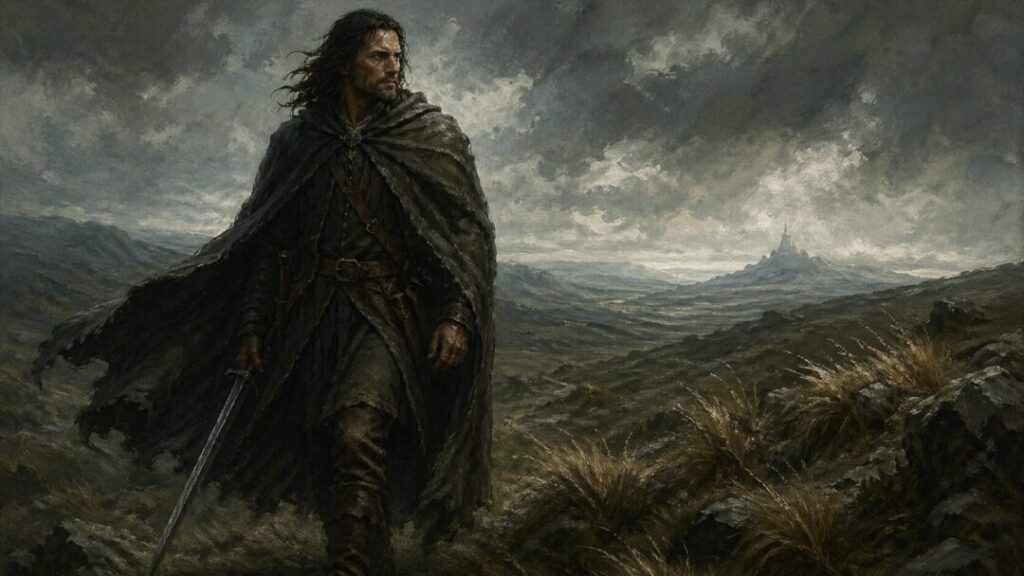
At Bree, he is Strider: suspicious, grim, and weather-stained.
In the wild, he is the guide: practical, tireless, and hard-tested.
At Rivendell, his identity begins to open.
With the reforging of Narsil into Andúril, his role becomes clearer.
After Lórien, he carries gifts that mark him as part of a larger destiny.
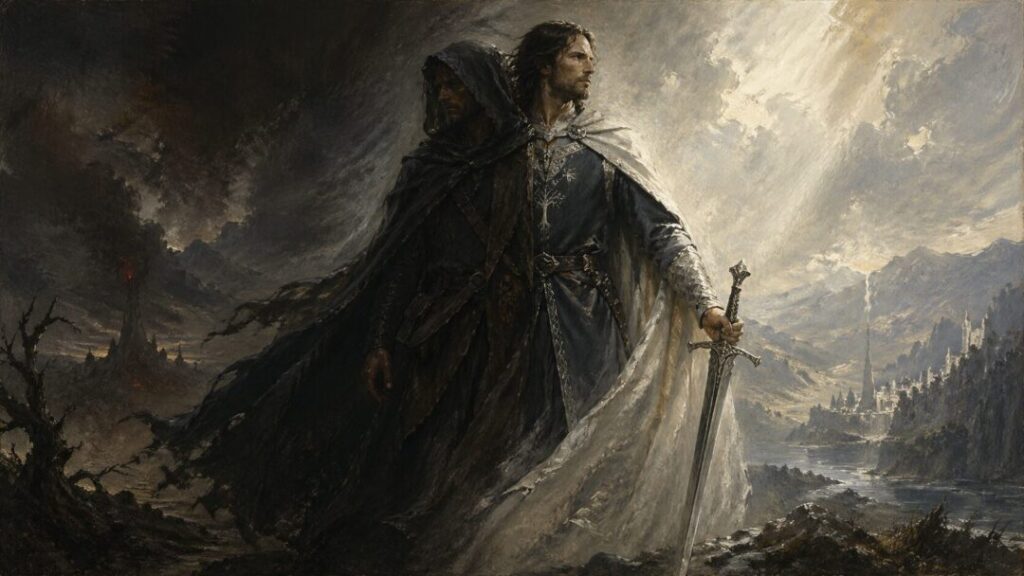
On the Paths of the Dead and before the armies of the West, he no longer appears merely as a wanderer. He begins to stand openly as the heir of Isildur.
By the time he comes to Minas Tirith, the hidden man has become visible.
This is why the “pants” question is funny, but not meaningless.
Aragorn’s clothing is part of a slow unveiling.
The story begins by hiding him in a hood and cloak. It ends by revealing him as king.
Strider Is Not Meant to Look Like a Courtly Prince
One thing the text makes very clear is that Aragorn at Bree is not supposed to look polished.
He is not introduced as a nobleman in fine garments. He does not enter the story surrounded by servants or banners. He is not wearing the visible signs of kingship.
That is the whole point.
He is the rightful heir, but the world does not recognize him.
The people of Bree know him only as Strider. They see him as one of the wandering folk. They do not understand that he is guarding lands they barely know are in danger.
This hidden labor is central to Aragorn’s character.
He protects people who distrust him.
He carries a lineage that is almost forgotten.
He lives in hardship before he receives honor.
So his clothing at Bree should not be imagined as royal costume. It should be imagined as hard-worn travel gear: cloak, hood, boots, sword, and likely practical breeches or leg coverings suitable for long roads.
Not glamorous.
Not ceremonial.
Useful.
What About Long Tunics or Robes?
Could Aragorn have worn a long tunic instead of visible trousers?
Possibly, but the text does not say.
Middle-earth contains many styles of dress. Robes, cloaks, mantles, tunics, mail, helms, belts, boots, and various kinds of garments all appear or are implied. A long outer garment could easily cover whatever was worn underneath.
That is why the answer cannot be based on visibility.
Even if Aragorn’s breeches were hidden beneath cloak and tunic, he could still be wearing them. In fact, that fits the way northern male dress is described elsewhere: breeches could be hidden by longer outer clothing.
So the absence of visible pants in a description does not mean absence of legwear.
It simply means the narration does not focus on it.
The Ranger Life Makes the Answer Practical
Aragorn’s life before the War of the Ring is not sedentary.
He is a Ranger of the North. He travels widely. He guards Eriador. He knows the wild. He tracks Gollum. He journeys through dangerous lands. He serves under hidden names. He is accustomed to hardship.
A long, impractical robe with no fitted legwear would make little sense for that life.
That does not prove the exact garment.
But it strongly supports the practical conclusion.
Aragorn probably wore clothing suited to travel and combat. His high boots suggest that his lower garments were compatible with riding, walking, and rough terrain.
“Breeches” is probably the best word.
“Pants” is a modern shortcut.
“Nothing” is not supported by the text.
The Funny Question Has a Serious Answer
So does Aragorn wear pants?
The most lore-accurate answer is:
Probably yes, in the form of breeches or similar practical legwear, though the text never explicitly names them for him.
That may feel like a small answer. But it shows a larger principle.
Middle-earth is not a world where every visual detail is catalogued. It is a world where details are chosen for meaning.
Strider’s hidden face matters.
His weather-stained cloak matters.
His high boots matter.
His sword matters.
His transformation from wanderer to king matters.
His pants, apparently, do not.
And yet even that absence tells us something.
Aragorn is introduced as a man partly concealed. The reader is not meant to see all of him at once. The hobbits do not understand him. Bree does not understand him. Even Boromir, at first, struggles to reconcile the rough Ranger with the heir of Elendil.
The story reveals Aragorn gradually.
Not through a costume description.
Through deeds.
Why This Detail Became So Memorable
The question survives because it sits at the perfect meeting point of comedy and lore.
On one hand, it is absurd.
On the other, it forces us to notice how little the books sometimes say about things modern visual culture expects to know immediately.
Film and art must decide everything. Shirt, belt, boots, trousers, fabrics, colors, layers, weapons, armor—every visible object must be chosen.
A book does not have to do that.
A book can give us a hood, a cloak, a pair of keen eyes, and a voice from the shadows.
Then our imagination does the rest.
That is why Aragorn can feel vivid without being fully itemized.
We do not know every seam of his clothing.
But we know the kind of man who wears it.
The Final Answer
Aragorn almost certainly wore some kind of practical legwear.
Breeches are the safest and most fitting guess.
The books do not directly say, “Aragorn wore pants,” and no responsible lore answer should pretend they do.
But the combination of his high boots, Ranger life, northern setting, and the broader clothing customs implied in the legendarium all point in the same direction.
So yes, Strider probably wore pants.
But the better answer is this:
The story hides his pants for the same reason it hides his crown.
At first, Aragorn is not meant to be seen completely.
He is a weather-stained wanderer in a dark corner, wrapped in a cloak, watching over people who do not yet know they need him.
Only later does the hidden man step forward.
Only later does the Ranger become the King.
And by then, whether he wore pants was never the most revealing thing about him.
Sources & Notes
- J.R.R. Tolkien, The Lord of the Rings, Book I, Chapter 9, “At the Sign of the Prancing Pony” — Strider is introduced in a dark corner with a travel-stained cloak, hood, and high boots of worn supple leather.
- J.R.R. Tolkien, The Lord of the Rings, Book I, Chapter 10, “Strider” — Aragorn’s Ranger role and rough northern travel context support practical clothing rather than courtly display.
- J.R.R. Tolkien, The Lord of the Rings, Appendix A, “The Tale of Aragorn and Arwen” — Aragorn’s long years of wandering and hardship frame Strider as a weather-worn traveller before he is revealed as king.
- J.R.R. Tolkien, The Letters of J.R.R. Tolkien, Letter 211 — Tolkien’s discussion of clothing details and costume visualization gives context for why ordinary garments are not always exhaustively described.