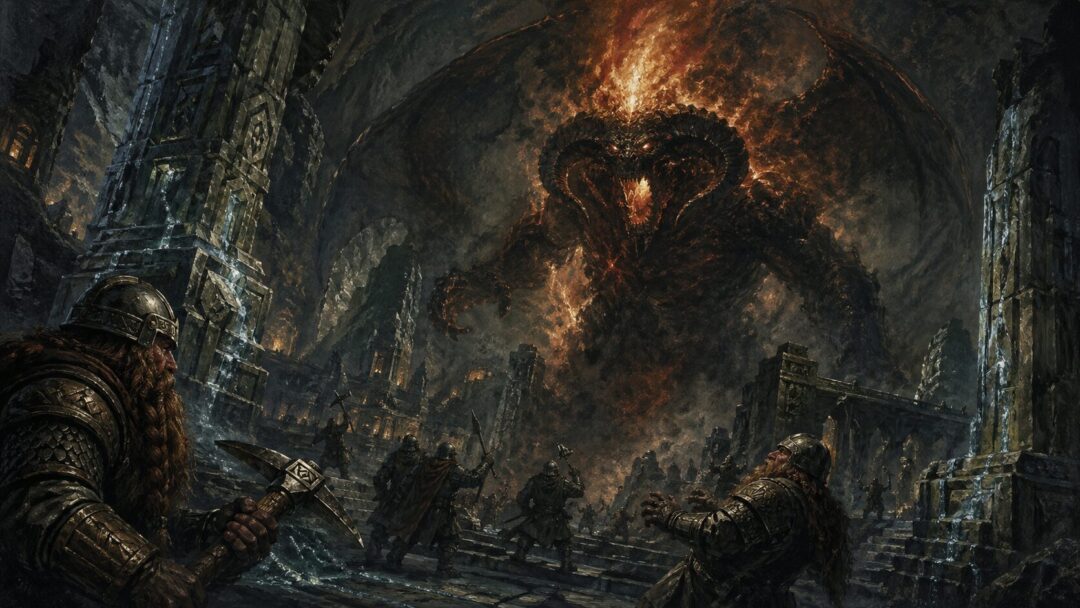
Gandalf’s stand on the Bridge of Khazad-dûm is often remembered as one of the most heroic moments in The Lord of the Rings.
The Fellowship is fleeing through Moria. Orcs are behind them. Fire rises in the deep places. A narrow bridge crosses the abyss. And Gandalf, old and grey and seemingly alone, turns to face the shadow that has followed them.
It is easy to remember the moment as simple courage.
Gandalf stands.
The Balrog comes.
The bridge breaks.
The wizard falls.
But the book gives us something more subtle than a fearless hero facing a monster.
Before the famous confrontation, Gandalf is shaken.
When he finally understands what is pursuing them, he does not treat it like another servant of Sauron. He does not speak as if the danger is ordinary. He falters, leans heavily on his staff, and calls their situation “evil fortune.”
That reaction is not weakness.
It is recognition.
Gandalf was afraid of the Balrog because he knew what it was. And what it was belonged to the oldest terror in Middle-earth.
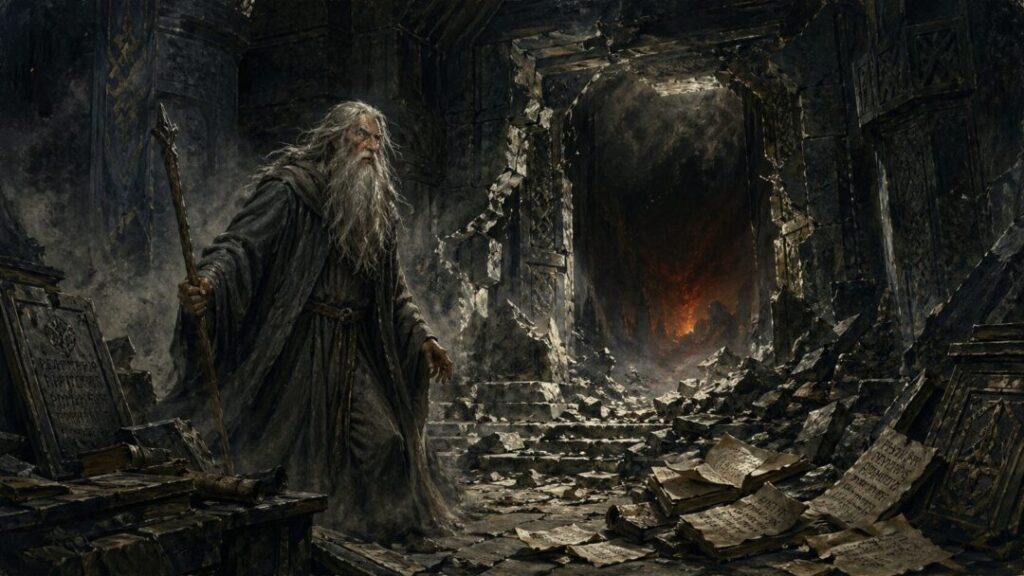
The Balrog Was Not Just a Monster
A Balrog was not simply a beast from the deep.
That is the first mistake many readers make.
The Balrogs were among the ancient spirits who served Morgoth in the Elder Days. In the Elvish tradition, they were known as Valaraukar: scourges of fire, demons of terror. They were not animals. They were not dragons. They were not merely large warriors with flame and shadow around them.
They were corrupted spirits.
This matters because the Balrog in Moria was not a new evil created by Sauron. It was a survivor from a far older darkness. It came from the age of Morgoth, when the powers of the world still moved openly, when kingdoms of Elves were broken, and when wars were fought on a scale almost unimaginable by the end of the Third Age.
By the time the Fellowship enters Moria, that age is long gone.
The great Elven realms have faded.
Morgoth has been cast out of the world.
The War of Wrath belongs to ancient memory.
And yet beneath the mountains, one of his terrors remains.
That is why Gandalf’s reaction is so grave. He is not merely thinking, “This enemy is strong.”
He is realizing that something from the Elder Days has survived into the War of the Ring.
Durin’s Bane Had Already Broken a Kingdom
The Balrog of Moria was known as Durin’s Bane.
That name was not symbolic exaggeration. It had earned it.
Long before the Fellowship passed through Khazad-dûm, the Dwarves had awakened something in the deep places beneath the mountain. The texts connect this awakening with the Dwarves’ delving for mithril. What they found was not treasure, but catastrophe.
The Balrog slew Durin VI, king of Khazad-dûm. It then slew his son Náin. After that, the great Dwarven kingdom was abandoned.
This is important because Moria was not some minor settlement lost to a random creature.
Khazad-dûm was one of the greatest works of the Dwarves. It was ancient, vast, wealthy, and strong. Yet when the Balrog awoke, the Dwarves could not simply gather armies and destroy it. Its presence became the doom of their realm.
So when Gandalf meets the Balrog, he is facing the same being whose awakening emptied one of the greatest Dwarven kingdoms in Middle-earth.
That is not a small enemy.
It is a walking disaster.
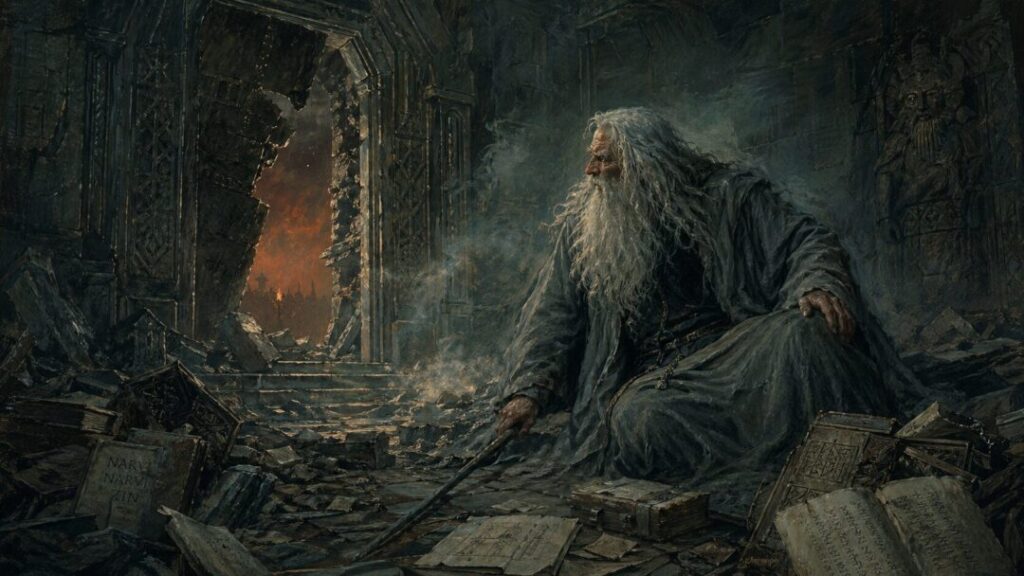
Gandalf Knew Before He Saw It Clearly
One of the most chilling details in the Moria chapters is that Gandalf senses the danger before the Fellowship fully sees it.
In the Chamber of Mazarbul, something comes to the door. Gandalf opposes it with a shutting-spell. The unseen enemy contests him. The struggle is so intense that the door bursts and the chamber collapses.
At first, Gandalf does not know exactly what he has encountered. He says he has met something he has not met before.
That uncertainty makes the scene more frightening, not less.
Gandalf is ancient, wise, and deeply learned. He has wandered Middle-earth for many lifetimes of Men. He knows the servants of the Enemy. He understands much that others do not. Yet this presence is strange even to him.
Then, later, when the Balrog is revealed, everything suddenly fits.
Now he understands.
That is the terrible moment.
The mystery becomes worse than the uncertainty.
Gandalf Was Already Weary
Another overlooked detail is that Gandalf is exhausted before the bridge.
He has already labored in Moria. He has guided the Company through darkness. He has spent himself against the power at the door. He is carrying responsibility for the Ring-bearer, the Fellowship, and the whole desperate mission against Sauron.
So when the Balrog appears, Gandalf is not meeting it at perfect strength.
He is already weary.
This makes his fear more understandable. Gandalf is not afraid because he lacks courage. He is afraid because he knows the cost of what may now be required.
The Balrog is not an obstacle the Fellowship can fight together.
Aragorn cannot defeat it.
Boromir cannot defeat it.
Gimli cannot avenge Khazad-dûm against it.
Legolas, though an Elf, is horrified by it.
The burden falls on Gandalf.
Not because victory is certain, but because no one else can stand there.
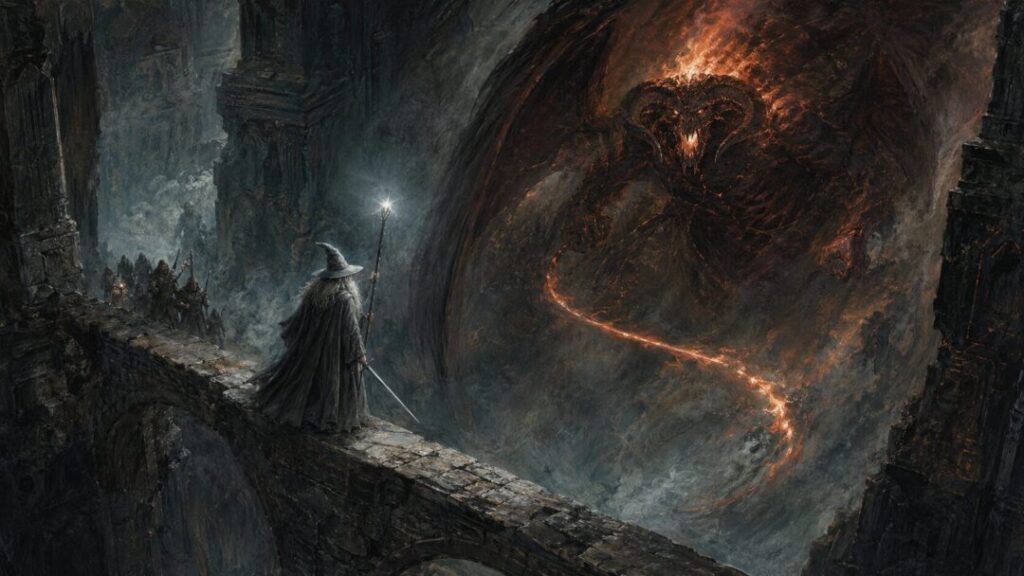
Gandalf and the Balrog Were Opposites
There is another reason the encounter carries such weight.
Gandalf and the Balrog were not the same kind of person in a simple sense, but they belonged to the same broad spiritual order: both were Maiar.
That does not mean they were equal in every way. The texts do not give a clean ranking system for their strength. It would be careless to say that every Maia had the same power. They clearly did not.
But the connection matters.
Gandalf was one of the Istari, sent into Middle-earth in the form of an old man. His mission was not to conquer Sauron by force, seize command, or dominate the wills of Elves and Men. He was sent to guide, counsel, encourage, and awaken resistance.
The Balrog represents almost the opposite.
It is a spirit that followed Morgoth into terror, domination, fire, and ruin.
So when Gandalf faces the Balrog, the scene is not only a duel between wizard and demon. It is a confrontation between two ancient possibilities.
Power humbled into service.
Power corrupted into destruction.
That is why Gandalf’s words on the bridge matter so much. He does not simply threaten the Balrog. He declares what he serves. He names himself as a servant of the Secret Fire and calls the Balrog the flame of Udûn.
The words are not decoration.
They are a spiritual boundary.
Why Gandalf Could Not Simply Reveal His Full Power
A common question follows naturally:
If Gandalf was also a Maia, why was he afraid? Why not simply unleash his true power and destroy the Balrog at once?
The answer lies in the nature of the Istari.
The Wizards were not sent to Middle-earth as unveiled powers of the West. They came in humble forms, subject to weariness, fear, pain, uncertainty, and limitation. Their task was not to dominate the struggle, but to help the free peoples resist darkness without becoming another form of domination themselves.
This does not mean Gandalf was powerless.
Far from it.
He kindles fire. He uses command. He contests wills. He breaks the bridge. He eventually fights the Balrog from the depths of the world to the peak of Zirakzigil.
But his power is not effortless.
It costs him.
And against the Balrog, it costs him everything.
The Balrog Could Actually Kill Him
The simplest answer is also one of the most important:
Gandalf feared the Balrog because the Balrog could kill him.
And it did.
After the bridge breaks, the Balrog’s whip catches Gandalf and pulls him into the abyss. The two fall into the deep places beneath the earth. Gandalf later describes pursuing and fighting the Balrog through hidden roots of the mountain and up to the peak of Zirakzigil.
There, at last, the Balrog is cast down.
But Gandalf also dies.
This proves that his fear was not theatrical. He was not pretending. He was not merely concerned for the others. The danger was real enough that the confrontation ended his life in Middle-earth, at least for a time.
His return as Gandalf the White should not make us forget this.
The victory over the Balrog was not easy.
It was not clean.
It was not safe.
It was sacrificial.
Was Gandalf Afraid in a Cowardly Way?
No.
This is where the distinction matters.
Gandalf’s fear is not cowardice. It is wisdom.
Cowardice would have meant abandoning the Fellowship. Gandalf does the opposite. He places himself between them and a terror none of them can withstand.
But he does not do it lightly.
Middle-earth often treats courage this way. True courage is not the absence of fear. It is acting rightly when the danger is fully understood.
Gandalf understands the danger better than anyone there.
That is why his stand is so powerful.
The others see a nightmare of shadow and flame.
Gandalf sees a survivor of Morgoth’s ancient host, a spirit of ruin from the Elder Days, a being capable of destroying him, and perhaps the whole Quest if it breaks through.
Then he stands anyway.
Why the Balrog Threatened More Than the Fellowship
There is one more layer.
The Balrog was not seeking the Ring in any clearly stated way. The text does not say that Durin’s Bane knew what Frodo carried. It does not say that the Balrog was serving Sauron directly at that moment. Any claim beyond that would be speculation.
But its presence was still a mortal danger to the Quest.
If it killed Gandalf, the Fellowship would lose its guide.
If it reached Frodo, the Ring might be lost in Moria.
If the Company broke in panic, Sauron’s enemies would be scattered before the Quest had truly begun.
Gandalf did not need to know the Balrog’s intentions.
Its existence in that moment was enough.
Some evils do not need a plan to become catastrophic.
The Fear Came From Memory
Gandalf’s fear also belongs to the memory of Middle-earth.
Balrogs carried the terror of the First Age with them. They were linked with the wars of Morgoth, with the fall of ancient realms, and with enemies so dreadful that even mighty heroes died facing them.
By the late Third Age, much of that world has faded into legend. Men of Gondor remember fragments. Hobbits know almost nothing. Even many Elves are living in the long aftermath rather than the full blaze of the Elder Days.
But the Balrog is not a memory.
It is the old terror made present again.
That is why Legolas cries out in dismay. That is why Gimli is overwhelmed. That is why Gandalf’s face becomes grave.
A thing that should have belonged to the ancient ruin of the world has stepped onto the path of the Ring-bearer.
The Real Reason Gandalf Was Afraid
So why was Gandalf afraid of the Balrog of Morgoth?
Not because he lacked faith.
Not because he was weaker than he seemed.
Not because the Balrog was merely large or fiery.
He was afraid because he understood.
He understood that the Balrog was one of Morgoth’s ancient terrors.
He understood that it had already destroyed the kingdom of Khazad-dûm.
He understood that the Fellowship could not defeat it.
He understood that his own embodied life could end there.
And he understood that if he failed, the Quest itself might fail with him.
That is the heart of the scene.
Gandalf’s fear does not diminish his courage.
It reveals it.
Because the bridge of Khazad-dûm was not the place where Gandalf proved he was fearless.
It was the place where he knew exactly what he was facing — and still refused to move.
Sources & Notes
- J.R.R. Tolkien, The Lord of the Rings, Book II, Chapter 5, "The Bridge of Khazad-dûm" — Gandalf senses the pursuing power, names the Balrog, and stands between it and the Fellowship.
- J.R.R. Tolkien, The Lord of the Rings, Book III, Chapter 5, "The White Rider" — Gandalf recounts his fall, pursuit, battle with the Balrog, and death on Zirakzigil.
- J.R.R. Tolkien, The Lord of the Rings, Appendix A, "Durin's Folk" — the Balrog awakened in Khazad-dûm, slew Durin VI and Náin I, and drove the Dwarves from Moria.
- J.R.R. Tolkien, The Silmarillion, "Valaquenta" and "Of the Enemies" — Balrogs are presented as ancient spirits corrupted into Morgoth's fiery servants of terror.
- J.R.R. Tolkien, Unfinished Tales, "The Istari" — the Wizards' embodied mission explains Gandalf's limits, weariness, and refusal to conquer by raw force.