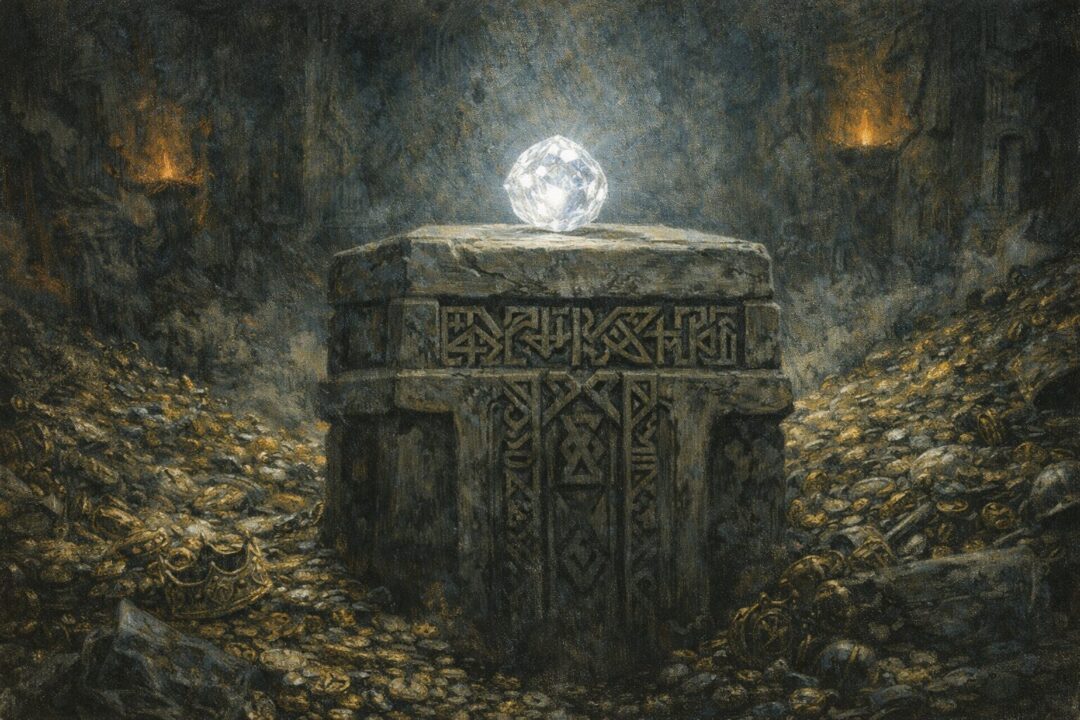
Among all the treasures described in The Hobbit, none carries the symbolic weight of the Arkenstone.
Gold fills Erebor in unimaginable quantities. Armor, weapons, and heirlooms lie scattered throughout the hoard. Yet when Thorin Oakenshield finally stands beneath the Lonely Mountain, his attention fixes on one object alone. Not a crown. Not a sword. Not even the amassed wealth of his people.
He names it the Heart of the Mountain.
From the moment the Arkenstone is introduced, it is set apart—not merely by beauty, but by meaning. Thorin treasures it above all other wealth, and as the story progresses, his attachment to it grows increasingly intense, and increasingly destructive.
All of this leads many readers to a natural assumption:
The Arkenstone must be magical.
After all, Middle-earth is full of objects whose power goes far beyond their physical form. The Rings of Power dominate wills and reshape destinies. Blades can be forged with spells woven into their steel. Even lands themselves can be corrupted by dark influence.
So where does the Arkenstone fit?
To answer that, we must look carefully at what the text actually says—and what it very deliberately does not.
What the Arkenstone Is (According to the Text)
In The Hobbit, the Arkenstone is described as a singular gem discovered by Thorin’s grandfather, Thrór, deep beneath Erebor. It is unique even among the treasures of the Lonely Mountain. Tolkien describes it as shining “like silver in the firelight, like water in the sun, like snow under the stars, like rain upon the Moon.”
This description emphasizes brilliance, purity, and reflectivity. The stone seems to hold light and return it transformed, as though it were alive with radiance.
However, Tolkien never states that the Arkenstone was enchanted.
There is no mention of spells being laid upon it.
No suggestion that it was wrought by Elves with ancient arts.
No implication that it was touched by the Valar or shaped by supernatural design.
The Arkenstone may be a marvel of nature—or possibly of Dwarven skill—but it is not described as a magical artifact in the technical sense that Tolkien uses elsewhere.
This distinction matters.
When Tolkien intends an object to be magical, he makes that clear. The Rings of Power are explicitly forged with enchantments. The Silmarils are hallowed and bound to fate through oaths and divine involvement. Even lesser items, like certain swords or cloaks, are openly identified as bearing special properties.
The Arkenstone receives no such treatment.
Its power, therefore, must lie elsewhere.
Thorin’s Obsession: Cause or Catalyst?
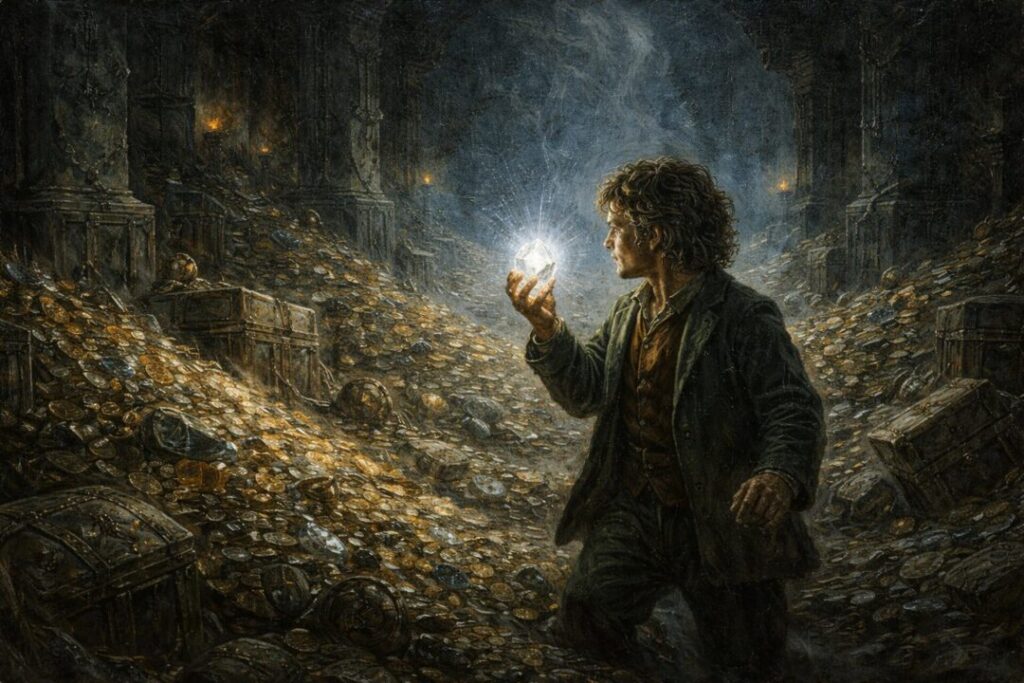
The strongest argument for the Arkenstone’s supposed magic comes from Thorin himself.
Once the stone is reclaimed, Thorin’s behavior changes noticeably. He becomes increasingly suspicious of others’ motives. He refuses reasonable negotiation. He values possession of the Arkenstone above peace, alliance, and even the safety of his people.
To many readers, this looks like corruption.
But Tolkien never attributes Thorin’s transformation to the stone acting upon him.
Instead, the narrative consistently frames Thorin’s downfall as internal. His pride intensifies. His fear of loss sharpens. His sense of identity as King under the Mountain becomes rigid and absolute.
The Arkenstone does not introduce these traits.
It concentrates them.
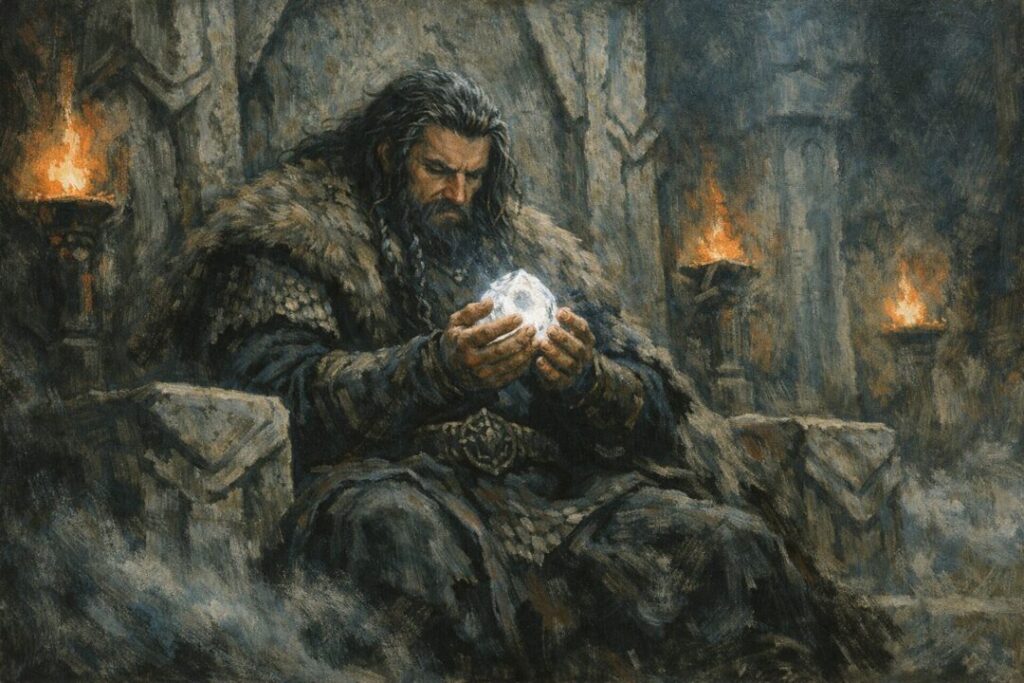
In Tolkien’s legendarium, objects do not always need magical agency to be dangerous. Symbols can exert enormous psychological force without supernatural compulsion. When an object comes to embody identity, inheritance, legitimacy, and destiny, it can dominate the mind of its bearer without altering them by force.
For Thorin, the Arkenstone is not merely a jewel. It is the visible proof of kingship restored. It is the heart of Erebor and, by extension, the heart of himself.
To lose it would mean more than losing a possession.
It would mean losing the idea of who he is.
Kingship, Inheritance, and Dwarven Culture
Understanding Thorin’s fixation requires understanding Dwarven values as Tolkien presents them.
Dwarves are deeply tied to lineage, craft, and the endurance of their people across ages of loss. Erebor is not simply a home—it is the culmination of ancestral labor and identity. Its loss to Smaug was not merely a defeat, but a spiritual wound.
The Arkenstone becomes the ultimate symbol of that loss undone.
It is unique, irreplaceable, and bound to the history of the line of Durin. Thorin’s attachment to it is inseparable from his desire to reclaim not only a kingdom, but dignity, legitimacy, and continuity.
Seen this way, his obsession does not require enchantment to be understandable.
It is tragic precisely because it is human—or rather, deeply personal.
Comparison to the One Ring (And Why It Matters)
It is tempting to compare the Arkenstone to the One Ring. Both are small objects with outsized narrative impact. Both inspire obsession. Both become focal points of conflict.
But the comparison highlights their differences more than their similarities.
The One Ring actively corrupts.
It extends the will of Sauron.
It possesses agency and intent.
The Arkenstone does none of these things.
Bilbo can hold it without harm.
Bard can possess it without obsession.
Its influence varies entirely based on the bearer.
This is a crucial Tolkienian idea: not all danger in Middle-earth comes from external evil. Some of the greatest tragedies arise from internal flaws—pride, possessiveness, and the refusal to let go.
The Arkenstone is dangerous not because it dominates wills, but because it becomes a vessel for desire.
Symbolic Power in Middle-earth
Tolkien frequently uses objects as moral mirrors.
The Silmarils, though hallowed and touched by divine light, bring immense suffering—not because they force evil upon others, but because of how fiercely they are desired. Tolkien never states that they magically compel betrayal or violence. The ruin comes from obsession, oath-making, and pride.
The Arkenstone operates on the same principle, on a smaller and more intimate scale.
It is a focal point for Thorin’s identity, fears, and ambitions. As external pressure increases—siege, famine, the approach of war—the stone becomes the axis around which his worst traits crystallize.
The tragedy is not that Thorin is bewitched.
The tragedy is that he refuses to relinquish what defines him.
Bilbo’s Insight: The Moral Counterweight
Bilbo’s decision to give the Arkenstone to Bard is often misunderstood as betrayal or theft. But narratively, it serves as a moral counterweight to Thorin’s fixation.
Bilbo recognizes that the stone’s value is symbolic, not absolute. He understands that its meaning can be redirected. By offering it as a bargaining tool, he strips it of its imagined supremacy.
This act exposes the truth that Thorin cannot face: the Arkenstone only has the power people grant it.
Bilbo, small and seemingly insignificant, demonstrates the story’s central moral insight. Power does not lie in possession alone, but in the willingness to relinquish possession when it causes harm.
Redemption Without Magic
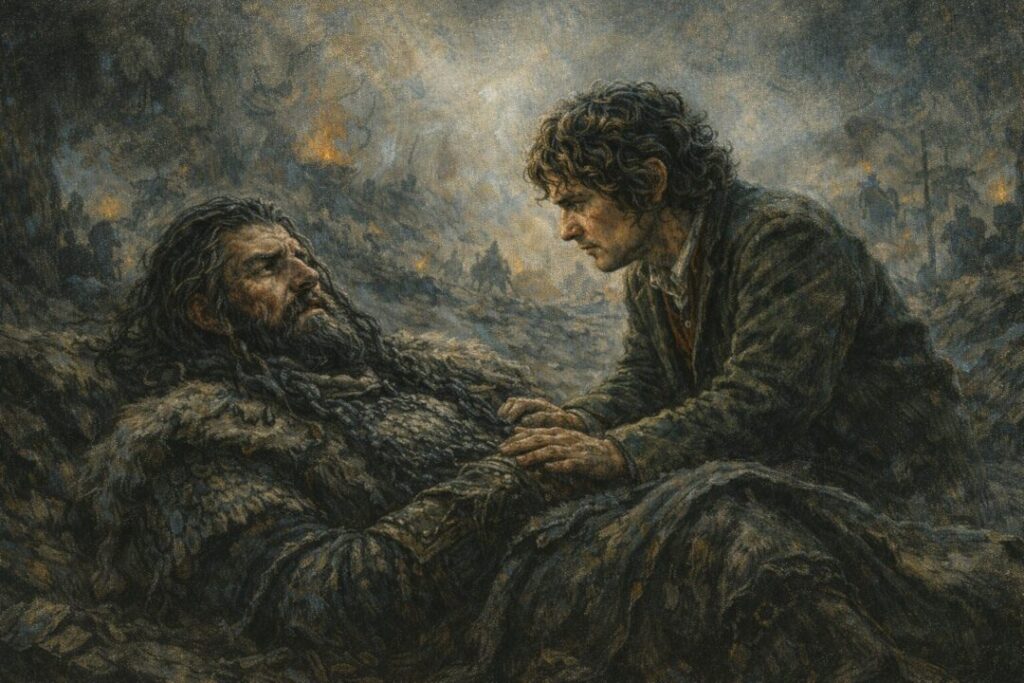
When Thorin finally repents, it is not because the Arkenstone’s influence fades.
It fades because Thorin releases it.
His final words acknowledge friendship over gold, peace over possession. The stone’s hold over him dissolves not through enchantment breaking, but through moral clarity restored.
That distinction is essential.
So… Is the Arkenstone Magical?
Based on the text alone, the answer is no.
The Arkenstone has no confirmed supernatural powers.
It does not compel behavior.
It does not alter fate.
What it does possess is symbolic gravity.
And in Tolkien’s world, that can be just as dangerous as magic.
The Arkenstone reminds us that not all corruption requires dark spells or external evil. Sometimes, the most destructive forces are pride, inheritance, and the inability to relinquish what defines us.
In that sense, the Arkenstone is not a lesser Ring.
It is something more unsettling.
It shows how ruin can arise without enchantment at all.