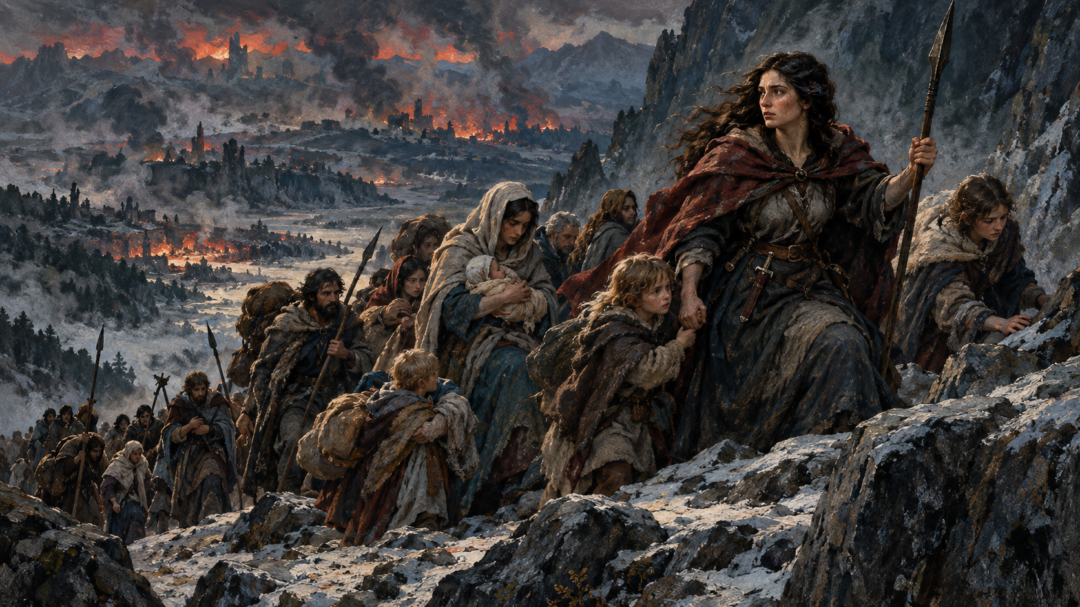
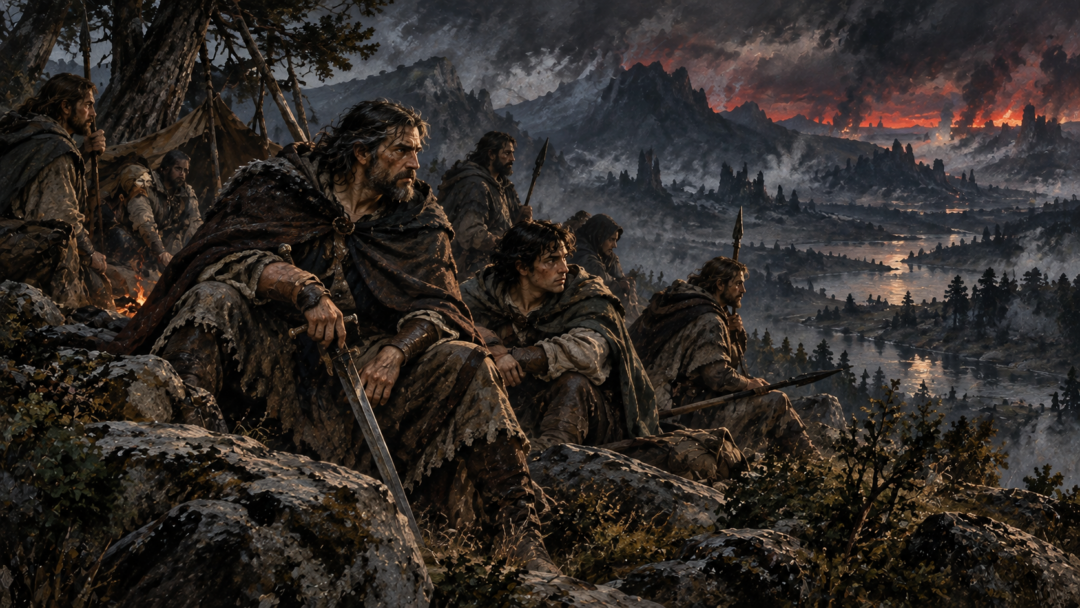
When Dorthonion fell, Barahir refused to abandon the land of his fathers. His resistance became one of the great doomed stands of the First Age: a shrinking company of hunted men surviving in the wild while Morgoth’s servants searched for them.
Yet another act of courage was happening at the same time, moving in the opposite direction.
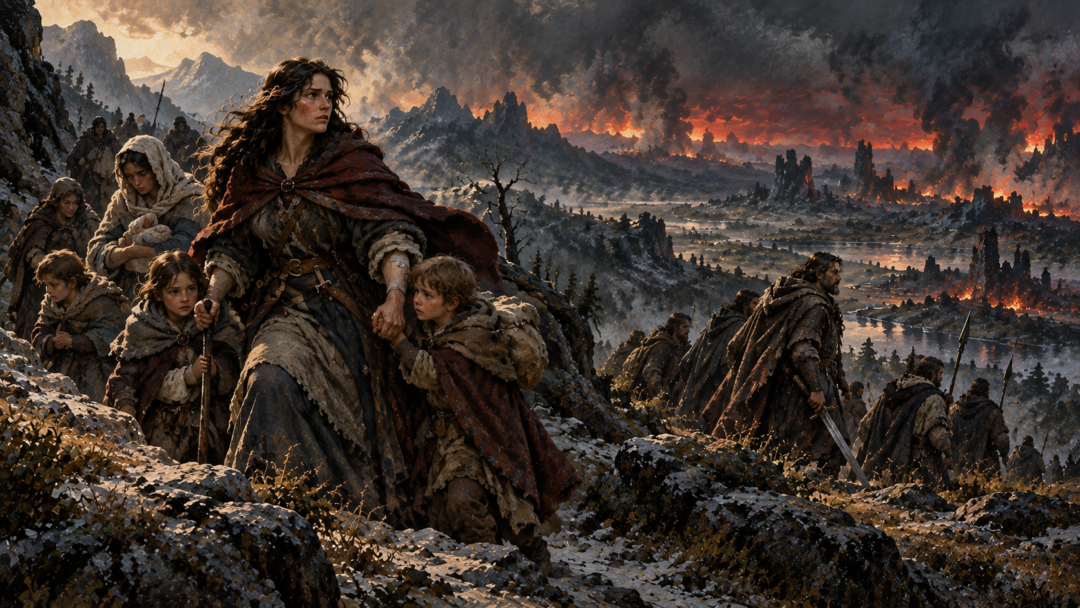
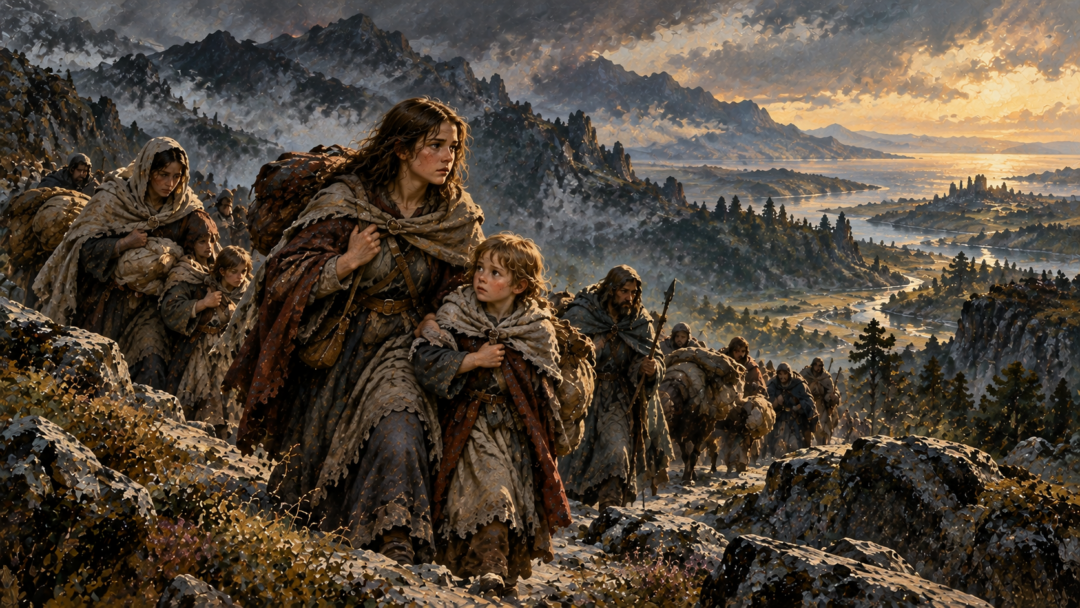
Emeldir, Barahir’s wife and Beren’s mother, gathered the women and children who remained and led them out.
The contrast matters. One group preserved its loyalty by staying. The other preserved its people by leaving. The story never requires every member of the House of Bëor to prove faithfulness through a universal last stand. Instead, after military defeat has made ordinary life in Dorthonion impossible, two different responsibilities emerge.
Barahir keeps resistance alive inside the conquered land. Emeldir carries vulnerable survivors beyond it.
Both choices belong to the same tragedy.
Dorthonion Could No Longer Be Defended as a Homeland
The decision comes after the Dagor Bragollach, the Battle of Sudden Flame, shattered the long containment of Morgoth.
Dorthonion had been held by the sons of Finarfin and by Men of the House of Bëor. The assault from Angband transformed that position catastrophically. Angrod and Aegnor were slain, Bregolas of the House of Bëor fell with many of his warriors, and the northern lands were overrun.
Barahir survived and had already performed one of his defining deeds during the disaster. At the Fen of Serech, he rescued Finrod Felagund, who in gratitude swore friendship and aid to Barahir and his kin and gave him the ring that would become the Ring of Barahir.
But courage could not reverse the strategic defeat.
Dorthonion became a place of terror beneath Morgoth’s power, eventually known as Taur-nu-Fuin, the Forest under Night. Barahir could still resist there, but resistance was no longer the same thing as maintaining a functioning homeland.
That distinction explains why the paths of Barahir and Emeldir diverged.
Emeldir's Courage Was Used for Escape, Not a Last Stand
The account of Emeldir is brief, but unusually revealing.
She is called Emeldir the Manhearted, and the text says that her own inclination was to fight beside her husband and son rather than flee. That detail prevents a simplistic reading of her departure as fear.
She wanted to remain.
Instead, she gathered the women and children who were left. She armed those willing to bear weapons and led the refugees into the mountains, following dangerous paths until they reached Brethil after suffering loss and misery.
The journey was therefore no effortless withdrawal into safety. Dorthonion had collapsed into enemy-controlled country, and the survivors were crossing dangerous terrain after a devastating military defeat.
Emeldir’s role was not to escape responsibility. It was to accept a different responsibility.
Remaining beside Barahir may have better matched her personal desire. Leading others away required her to subordinate that desire to the survival of people who could not simply be turned into another outlaw company.
That is the crucial distinction.
The women and children of Dorthonion were not presented as a reserve army expected to die beside the remaining warriors. Those willing and able to bear weapons could be armed during the flight, but the purpose of Emeldir’s company was survival.
Barahir Chose the Opposite Duty
Barahir remained in Dorthonion.
As Morgoth’s power tightened around the region, his following diminished until only a tiny company survived with him. The famous final band consisted of Barahir and twelve companions, including Beren, Baragund and Belegund.
Their existence had a different purpose from Emeldir’s refugee column.
They were no longer defending settled communities in the ordinary sense. Their homes had been lost and their people scattered. They lived as outlaws, hidden in the wild country around Tarn Aeluin, continuing to oppose Morgoth within territory he had conquered.
Their survival itself became resistance.
Morgoth therefore sought their destruction, and eventually Sauron was involved in hunting them down. The tragedy of Gorlim ultimately exposed their refuge. Barahir and his companions were slain while Beren was absent, leaving Beren to continue alone for a time.
Barahir’s decision did not preserve Dorthonion. It preserved defiance within Dorthonion.
That difference is essential.
Staying and Leaving Were Not Opposing Definitions of Loyalty
It is tempting in heroic literature to treat staying as inherently nobler than retreating.
This episode resists that assumption.
Barahir’s fidelity is expressed through refusal to yield completely to Morgoth. Emeldir’s fidelity is expressed through ensuring that defeat does not consume everyone entrusted to her.
Had every survivor remained in Dorthonion merely to demonstrate courage, the distinction between warriors, children, refugees and those dependent upon protection would have disappeared.
The narrative does not demand that.
Instead, Emeldir arms those among her company who are willing to bear weapons, but still leads the group away. Their weapons serve the flight; the flight does not become a disguised last stand.
Barahir and his companions, meanwhile, knowingly remain in an increasingly hostile land.
These are complementary responses to the same catastrophe.
One denies Morgoth uncontested possession of the conquered country.
The other denies him the complete destruction of its people.
The Refugees Carried the House of Bëor Beyond Dorthonion
The published account traces Emeldir’s company first to Brethil.
There some were received among the Haladin. Others continued onward over the mountains to Dor-lómin, among the people of Galdor of the House of Hador.
The text specifically identifies two young survivors among those who went onward: Morwen, daughter of Baragund, and Rían, daughter of Belegund.
That detail gives Emeldir’s evacuation consequences far beyond the immediate escape.
Morwen would later marry Húrin. Their children included Túrin and Nienor.
Rían would marry Huor and become the mother of Tuor.
It would be too strong to say that Emeldir single-handedly ensured the survival of the entire House of Bëor; the history and dispersal of the Edain are broader than this one refugee company. But within the Dorthonion branch of the story, her leadership plainly preserves lives through which major lines of the Edain continue.
The refugees therefore carry something that Barahir’s outlaws cannot preserve by themselves: future generations.
Barahir guards memory, honor and resistance in the ancestral land.
Emeldir carries living continuity away from it.
The Cruel Irony of the Two Companies
There is also a painful family division inside this larger historical pattern.
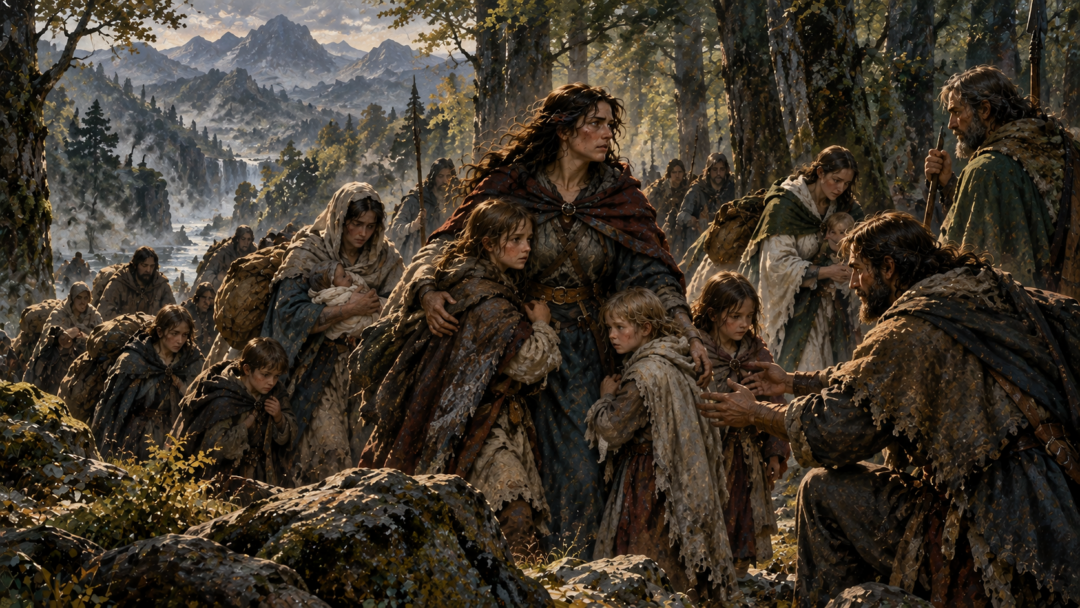
Baragund and Belegund remained among Barahir’s companions. Their daughters Morwen and Rían escaped with Emeldir.
The fathers stayed.
The daughters left.
Baragund and Belegund would die with Barahir after Gorlim’s betrayal. Morwen and Rían survived to enter the history of Dor-lómin and the House of Hador.
That is not evidence that one generation was braver than another. It reveals the terrible division of duties produced by the fall of Dorthonion.
Someone had to resist.
Someone had to survive.
The same household could therefore be divided between the two necessities.
There is no promise that either path will be painless. Barahir’s resistance ends in slaughter. Emeldir’s journey reaches Brethil only after peril, misery and loss. Even safety is relative in the First Age; the great catastrophes of Beleriand have not finished.
Yet immediate annihilation is avoided.
That matters.
Emeldir's Choice Changes How Heroism Looks
Emeldir’s personal preference makes the episode especially powerful.
If she had simply wanted to flee, the contrast with Barahir would be much simpler. Instead, the text presents someone whose inclination was toward fighting beside her husband and son, but whose actual deed was leading the vulnerable away.
Her heroism therefore lies partly in accepting the task that circumstances required rather than the role she personally desired.
She does not receive Barahir’s kind of legend. There is no dramatic final battle attached to her name, no great enemy slain, and no famous weapon associated with her.
What she accomplishes is less theatrical.
People reach Brethil.
Some find refuge there.
Others continue to Dor-lómin.
Children who might otherwise have remained trapped in a conquered Dorthonion live to adulthood.
The consequences only become fully visible later.
Beren Stands Between the Two Legacies
Beren makes the division still more striking because he is the son of both leaders.
He remains with Barahir and becomes one of the outlaw company. After the betrayal and destruction of the band, Beren alone survives because he is away when the attack falls. He recovers his father’s ring and continues his resistance before eventually escaping Dorthonion.
From Barahir he inherits the visible token of loyalty: the ring given by Finrod.
From Emeldir comes another kind of legacy, less tangible but no less significant: the example that survival after defeat need not mean surrender.
Beren eventually does what his father refused to do for years.
He leaves Dorthonion.
That departure does not invalidate Barahir’s resistance. By then the resistance has reached its limit. Beren carries its memory beyond the destroyed homeland, just as the refugees had carried the surviving people beyond it before him.
The story therefore refuses an easy equation between loyalty and geography.
There is a time to hold ground.
There is also a time when what must be saved can only be saved by leaving.
The House of Bëor Survives Because Courage Takes More Than One Form
The fall of Dorthonion is remembered through fire, outlaws, betrayal and the beginning of Beren’s great tale. Yet Emeldir’s evacuation reveals another layer of the catastrophe.
Defeat creates obligations that cannot all be fulfilled by the same people in the same way.
Barahir and his diminished company remain because resistance still has meaning even after territorial defeat.
Emeldir departs because survival also has meaning.
Her refugees are not failed defenders. They are the people for whom continued resistance is supposed to preserve a future.
That may be the deepest significance of the contrast.
A people cannot survive if everyone is required to become part of the final defensive line.
Some must hold the enemy back.
Some must carry children across the mountains.
Some must remember the lost homeland from somewhere beyond its borders.
In Dorthonion, Barahir preserved defiance for as long as he could.
Emeldir preserved lives.
The House of Bëor needed both.
Sources & Notes
- Silmarillion Writers’ Guild — Emeldir the Manhearted (Robinka) — https://www.silmarillionwritersguild.org/reference/characterofthemonth/emeldir.php
- The Encyclopedia of Arda — Emeldir — https://www.encyclopedia-of-arda.com/e/emeldir.php
- The Encyclopedia of Arda — Barahir — https://www.encyclopedia-of-arda.com/b/barahir.php
The Silmarillion, chapters 18 (Of the Ruin of Beleriand and the Fall of Fingolfin) and 19 (Of Beren and Lúthien), anchor the evacuation and outlaw resistance. The comparison of these duties is interpretation, not a separate statement by Tolkien.