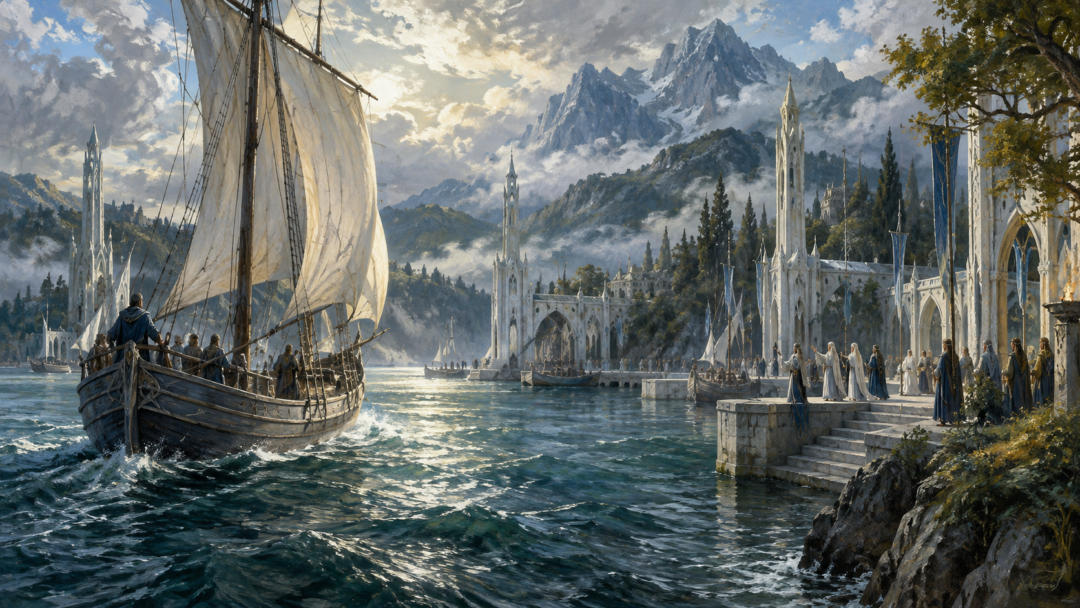
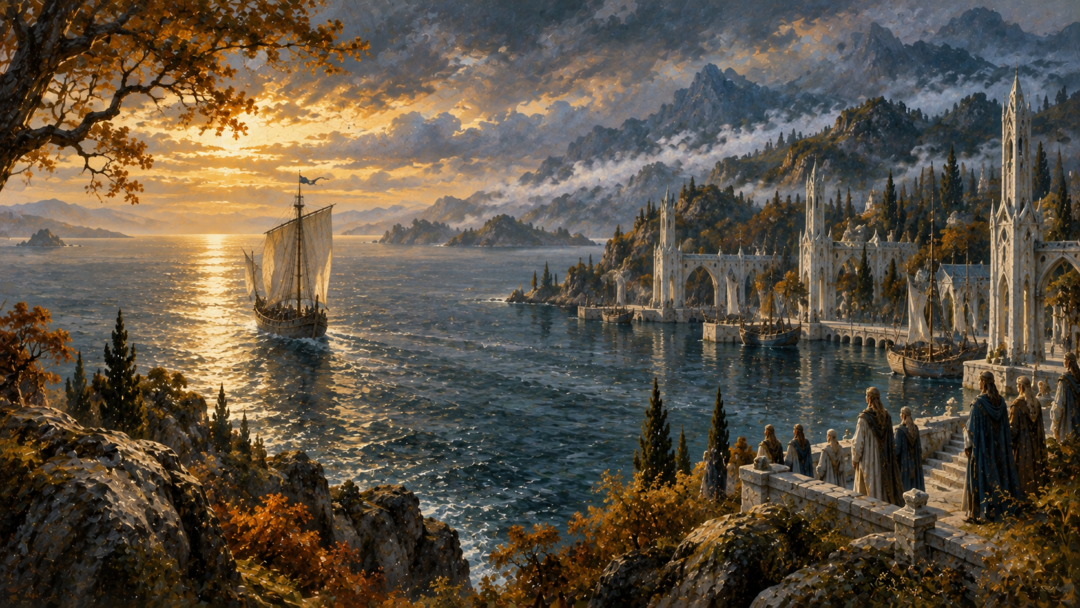
In the spring of the year 600 of the Second Age, a ship called Entulessë entered the Grey Havens of Middle-earth. Its captain was Vëantur, a Númenórean mariner whose voyage would reconnect peoples separated by the Great Sea for six centuries.
The ship’s name meant “Return.” Yet what returned was not an army, a conquering king, or a fleet carrying settlers to claim foreign shores. It was a connection between Númenor and the surviving Elven realms of the West.
That distinction matters because Númenor would eventually become a formidable maritime power, establishing strongholds, demanding tribute, and ruling peoples along the coasts of Middle-earth. But those developments belonged to a much later history.
Vëantur’s achievement was different. He demonstrated that the ocean could be crossed, reached a welcoming Elven kingdom, and helped reopen relations that would shape the Second Age.
The remarkable thing is not simply that he arrived. It is how much his arrival made possible without immediately creating an empire.
The Sea That Had Separated Númenor From Middle-earth
Númenor arose after the destruction of Beleriand and the defeat of Morgoth at the end of the First Age.
The surviving Edain, whose ancestors had fought alongside the Elves against the Dark Power, received an island home in the Great Sea. There they established a kingdom under Elros, brother of Elrond, who chose the fate of Men rather than that of the Elves.
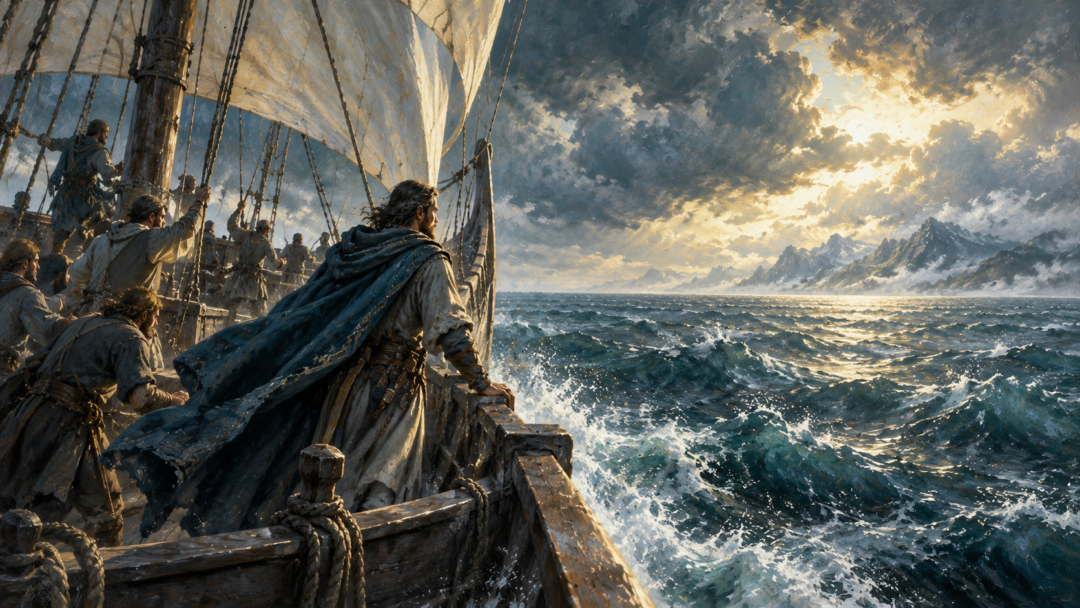
Although Númenor’s people possessed knowledge inherited from their ancestors and the Eldar, their new homeland was separated from Middle-earth by a vast expanse of water.
Their early history was not one of immediate overseas conquest.
The Númenóreans developed their civilization on the island, while their mariners gradually improved their vessels and sailing knowledge. The account in Unfinished Tales, “A Description of the Island of Númenor,” specifically connects their growing skill with instruction received from Elven shipwrights and their own subsequent improvements.
This development was essential.
A people might remember the lands of their ancestors without possessing the practical ability to reach them. Ships had to withstand the open sea, mariners had to navigate unfamiliar distances, and a voyage had to be undertaken with reasonable hope of returning.
By the time of Vëantur, Númenor had acquired the maritime capability to attempt that journey.
The sea was no longer merely a separation. It was becoming a route.
Vëantur and the Ship Called Entulessë
Vëantur served as Captain of the King’s Ships during the reign of Tar-Elendil, the fourth King of Númenor.
In the year 600 of the Second Age, he accomplished the first recorded Númenórean voyage back to Middle-earth.
His ship was Entulessë, meaning “Return.”
According to Unfinished Tales, Vëantur brought the vessel into Mithlond, the Grey Havens, carried by spring winds from the west. He returned to Númenor in the autumn of the following year.
The chronology is significant.
This was not merely a brief appearance on an unknown shore. The recorded interval between arrival and homecoming extended across parts of two years, although the surviving account does not provide a detailed itinerary for the whole period.
It does not identify the number of sailors aboard Entulessë, specify its cargo, or preserve a complete account of its provisions.
Nor does it describe a convoy of settlers arriving behind Vëantur.
The evidence establishes the successful voyage, its destination, and its eventual return. Anything more elaborate about the ship’s capacity or commercial purpose would require speculation.
Yet even these limited facts reveal something important: the Númenóreans had successfully connected their island kingdom with a functioning harbor in Middle-earth.
And that harbor belonged to people who welcomed them.
Why the Grey Havens Were the Ideal Place to Return
Mithlond stood in Lindon, the Elven realm west of the Blue Mountains, ruled by Gil-galad, High King of the Noldor.
It was also associated with Círdan the Shipwright, one of the greatest mariners and shipbuilders among the Elves.
The Grey Havens were not an empty coastline awaiting discovery.
They were an established maritime center, inhabited by people whose history was closely connected to that of the Edain. Many of the ancestors of Númenor’s people had fought beside the Eldar during the First Age.
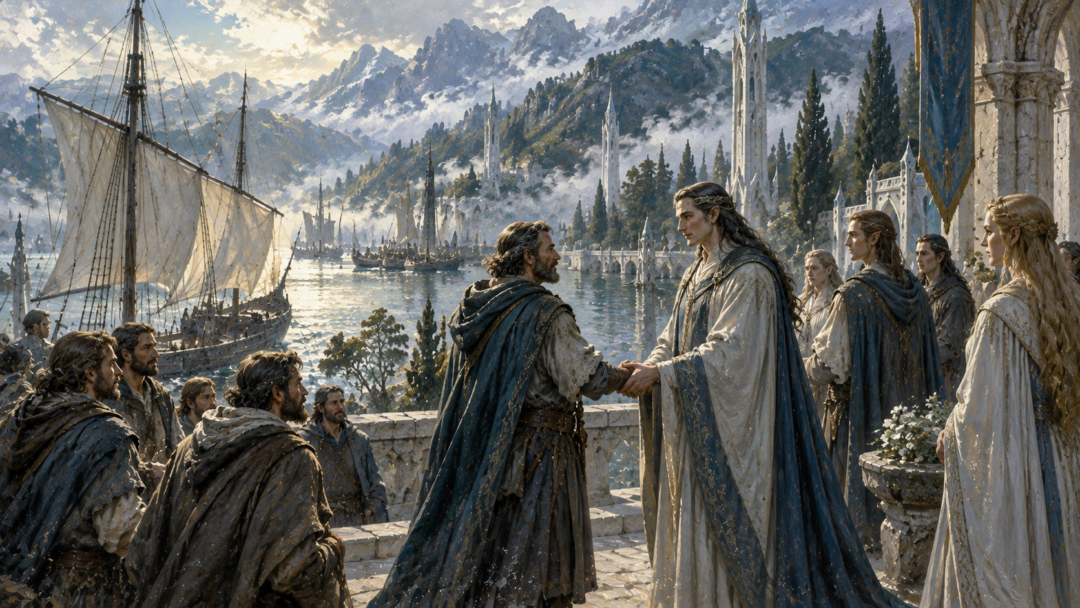
A later account of the encounter, preserved in the notes to “Aldarion and Erendis” in Unfinished Tales, records that Gil-galad welcomed the Númenórean captain and his mariners.
It also associates this renewed contact with the beginning of friendship and alliance between Númenor and the Eldar of Lindon.
That welcome changed the practical meaning of the voyage.
Vëantur had not simply reached land. He had reached a politically organized realm where the visitors were received as friends rather than invaders.
The distinction between arrival and access is crucial.
A ship reaching a foreign coast does not automatically acquire permission to use its harbors, establish a settlement, or command its inhabitants. In Lindon, the Númenóreans encountered an existing authority whose favorable reception made peaceful contact possible.
The texts do not preserve a formal treaty signed during Vëantur’s visit. The alliance is described in broader historical terms.
Nevertheless, the welcoming reception provides a clear explanation for why this particular voyage could become the beginning of continuing relations.
The Practical Achievement: A Route That Could Be Used Again
It is tempting to imagine Vëantur’s voyage as the opening of a great trading system, with regular cargoes immediately moving between Númenor and Lindon.
But the surviving account does not justify that picture.
We are not told that Entulessë carried commercial merchandise, transported settlers, or established permanent Númenórean warehouses at Mithlond.
What the voyage demonstrably achieved was more fundamental.
It proved that a Númenórean vessel could sail eastward across the Great Sea, enter the Grey Havens, and eventually return westward.
This mattered for navigation, transport, and communication.
The outward journey demonstrated that the crossing could be accomplished. The arrival at Mithlond connected that route with an established harbor. The welcome from Gil-galad created a favorable setting for future visits.
The return to Númenor was equally important.
Without a successful homeward voyage, contact might have remained a remarkable but isolated achievement. By returning, Vëantur completed the connection between the two shores.
The text does not explain how the expedition was provisioned during its stay or what assistance it received at the harbor. Given the length of the journey, such questions are reasonable, but their answers cannot be reconstructed with certainty.
The defensible conclusion is narrower: Númenor now possessed demonstrated access to Middle-earth by sea, and that access was compatible with peaceful relations in Lindon.
That was an enormous achievement without requiring the foundation of a colony.
The Forgotten Human Connection Beyond Lindon
The renewed contact did not concern the Elves alone.
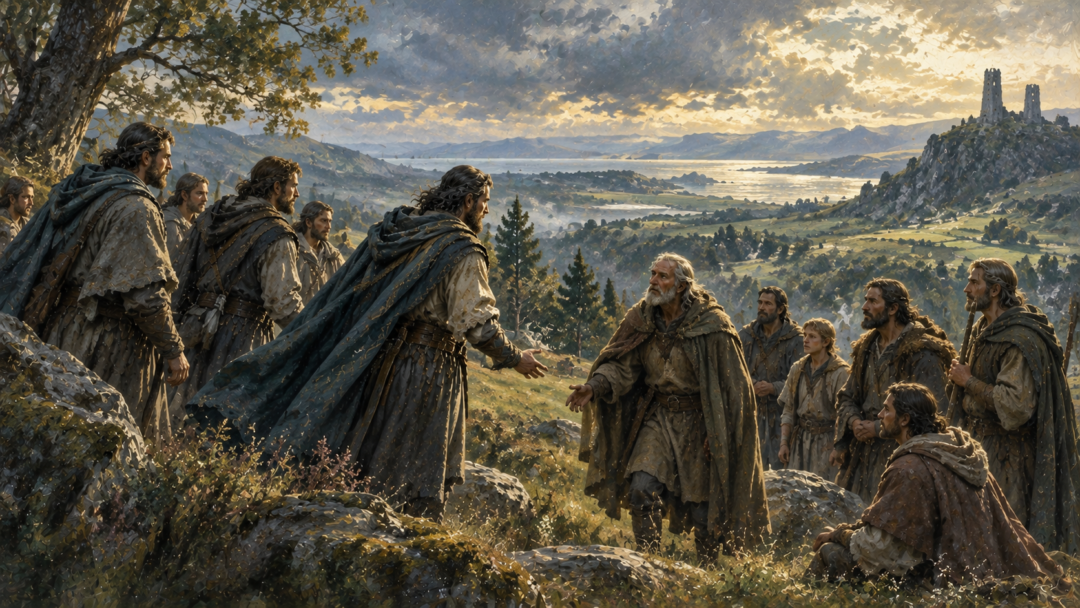
A late account discussed in the notes to “Aldarion and Erendis” also describes the response of Men living in Eriador.
News of the visitors from across the sea spread, and the encounter brought together peoples who recognized an ancient connection.
The Númenóreans were descended from the Edain who had departed Middle-earth. Other Men remained behind, including populations related to those earlier ancestors.
For these inhabitants of Eriador, the arrival of Númenórean mariners was more than an unfamiliar ship appearing on the western horizon.
It revealed that descendants of the peoples who had departed long before were still living beyond the sea.
This meeting is an important part of the voyage’s wider significance.
The renewed connection between Númenor and Middle-earth involved memory, ancestry, and recognition as well as navigation.
It did not require the Númenóreans to establish political control over those they encountered.
Indeed, the account is most striking for the wonder surrounding the meeting, not for any recorded demand for obedience.
That does not mean every later relationship between Númenor and the Men of Middle-earth would remain equal or peaceful.
It means the earliest recorded encounter should be understood on its own terms.
Why a Successful Voyage Was Not the Same as Colonization
Colonization requires more than the arrival of a ship.
Permanent overseas settlement involves people remaining in a territory, arrangements for their continued support, and some enduring relationship with the land and its existing inhabitants.
An overseas empire goes further, exercising political or military power over territories and populations.
Vëantur’s recorded expedition establishes none of those developments.
Entulessë arrived in a harbor controlled by the Eldar. Its mariners were welcomed. The ship eventually returned to Númenor.
There is no recorded foundation of a Númenórean town during this expedition, no described occupation of territory, and no tribute imposed upon the people of Lindon.
This does not prove that the voyage had no commercial consequences or that subsequent Númenórean activity was insignificant.
It simply prevents later events from being projected backward into the year 600.
The difference is especially important because Númenor’s later history can make its earliest voyages appear more aggressive in retrospect than the evidence warrants.
The maritime power that would eventually dominate coastlands had to develop over time.
Vëantur’s voyage marks an early breakthrough in access and communication, not the completed emergence of overseas dominion.
How Aldarion Built Upon a Different Beginning
More than a century later, Vëantur introduced his grandson Aldarion to the voyage eastward.
In the spring of Second Age 725, they sailed together to Middle-earth aboard Númerrámar, another ship associated with Vëantur.
Aldarion would become one of Númenor’s greatest mariners.
His subsequent career included extensive exploration, the founding of the Guild of Venturers, and the development of Vinyalondë near the mouth of the Gwathló.
His maritime undertakings involved questions of timber, shipbuilding, harbors, and Númenor’s growing strategic interest in Middle-earth.
These developments belong to a different stage of Númenórean expansion.
Aldarion’s voyages show how the maritime possibilities opened by earlier sailors could grow into organized and sustained overseas activity.
They should not, however, be treated as accomplishments of Vëantur’s first voyage.
Even Aldarion’s activities must be distinguished from the much later period when Númenórean kings increasingly sought wealth, dominion, and tribute from the peoples of Middle-earth.
The transformation was gradual, and its moral character changed.
In the account of Númenor’s history in The Silmarillion, the earlier relationship of the Númenóreans with the inhabitants of Middle-earth is contrasted with the later arrogance and oppression of their imperial age.
The ability to cross the sea remained.
What changed was how that ability was used.
The Deeper Meaning of Vëantur’s Return
There is a quiet irony in the name Entulessë.
The ship was called “Return,” and in one sense that is exactly what it accomplished: descendants of the Edain came back to the shores of the continent their ancestors had left.
But they did not return to reclaim the ancient world by force.
Their first recorded voyage brought them into the harbor of allies, where an existing Elven king welcomed them.
The expedition demonstrated the possibility of movement between two worlds that had long been separated.
It also established a distinction that the later history of Númenor makes increasingly important.
Maritime reach is a capability. Political domination is a choice made possible by power, not an automatic consequence of possessing it.
The records do not allow us to recover every detail of Vëantur’s journey. We cannot reconstruct his ship’s stores, calculate its transport capacity, or describe negotiations that were never recorded.
What survives is enough.
In the spring of the year 600, Entulessë reached Mithlond. Gil-galad welcomed its mariners. In the following year, Vëantur returned across the sea.
Between those two journeys lay the reopening of contact between Númenor and Lindon.
The later kingdoms, havens, fleets, and tribute systems had not yet emerged from that first recorded crossing.
For Vëantur, the great achievement was not possessing another shore.
It was reaching it—and finding that the old bonds between peoples could still be renewed.
Sources & Notes
- Silmarillion Writers’ Guild — Vëantur (Oshun) — https://www.silmarillionwritersguild.org/reference/characterofthemonth/veantur.php
- The Encyclopedia of Arda — Return (Entulessë) — https://www.encyclopedia-of-arda.com/r/return.php
- Silmarillion Writers’ Guild — Tar-Aldarion (Oshun) — https://www.silmarillionwritersguild.org/reference/characterofthemonth/tar-aldarion.php
Primary texts: Unfinished Tales, “A Description of the Island of Númenor” and “Aldarion and Erendis”; The Silmarillion, “Akallabêth.” The distinction between reopening contact and founding an overseas empire is interpretation; unrecorded cargoes, settlements and treaties are not asserted as fact.