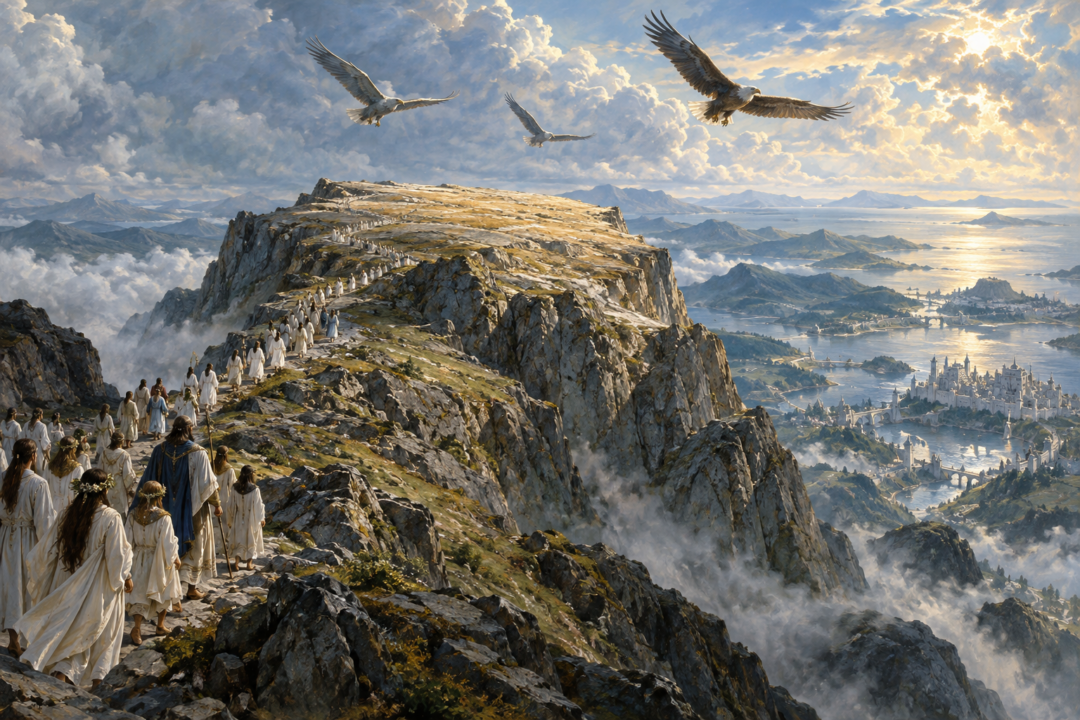
At the centre of Númenor rose the Meneltarma, the “Pillar of Heaven,” the mountain from whose summit the people of the island could look outward across their land and, in clear weather, far toward the West. Yet the most remarkable thing about Númenor’s holiest place was not what stood upon it.
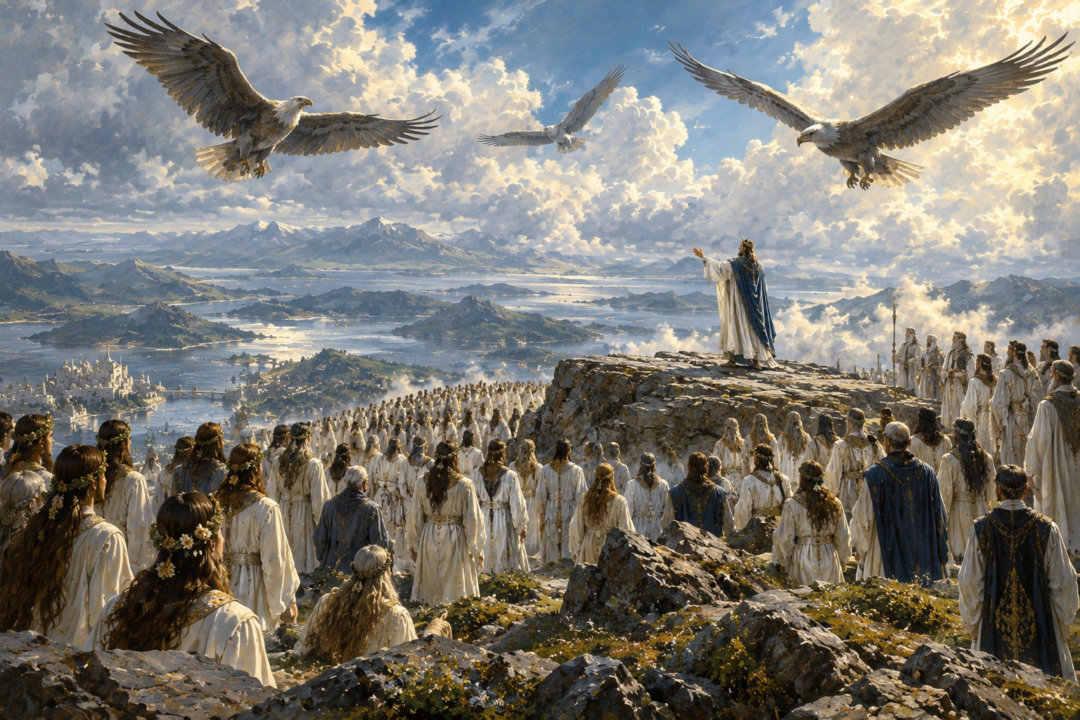
Nothing did.
There was no temple crowning the summit, no carved image of Eru Ilúvatar, and no permanent altar described there. Instead, the summit itself was the Hallow of Eru. Those who ascended it entered a place governed by an extraordinary rule: they kept silence.
Only at three appointed ceremonies of the year did that silence receive a deliberate exception. Then the ruler of Númenor spoke prayers on behalf of the people.
That distinction matters. Meneltarma was not merely an impressive mountain where religious ceremonies happened to occur. Its terrain, its restrictions, and even its silence ordered the worship performed there. Númenor’s sacred centre was defined less by what human beings constructed than by what they deliberately refused to add.
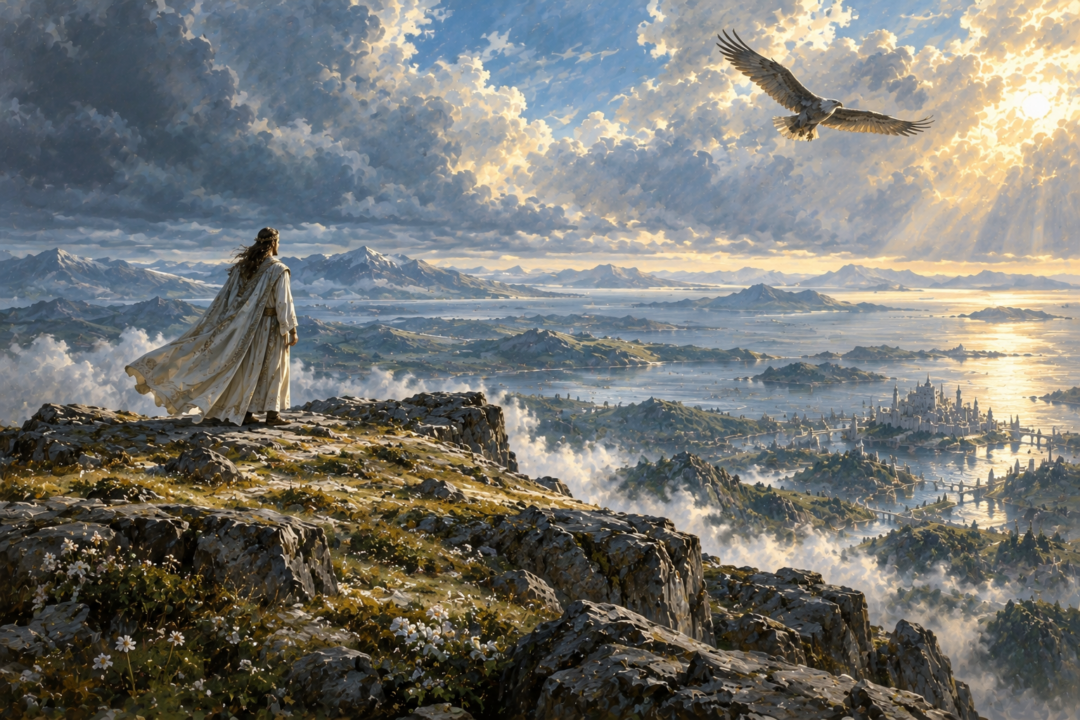
A sanctuary made from a mountain
Meneltarma stood near the geographical centre of Númenor, in the inland region of Mittalmar. Its name means “Pillar of Heaven,” and its five great roots extended into the surrounding country.
Near its summit the mountain became steeper, but a road had been made by which people could ascend. At the top lay a comparatively level area: the Hallow of Eru.
The important point is that the Númenóreans did not transform this summit into a conventional monumental sanctuary.
No building stood there. No altar was raised. No image represented Eru.
This absence is especially striking because Númenor was hardly a society incapable of monumental construction. Its people built cities, harbours, towers, roads, ships and royal works. The lack of architecture on Meneltarma therefore cannot simply be explained as technological limitation.
The texts establish the absence; they do not give us a detailed theological treatise explaining every reason for it. But the effect is unmistakable. The summit remained open beneath the sky, and the mountain itself functioned as the holy place.
Rather than enclosing sacred space inside walls, Númenórean practice marked sacredness through approach, behaviour and restraint.
The silence was a rule, not merely an atmosphere
Meneltarma is often remembered as a peaceful place, but “peaceful” is too weak a description of its ceremonial character.
Silence was expected of those who entered the Hallow.
The custom was so deeply respected that even strangers who visited Númenor observed it. This suggests something stronger than private devotion. Silence formed part of the recognized conduct appropriate to the mountain.
Even the natural world reinforced the impression. Birds and beasts did not normally approach the summit. The notable exception was the Eagles associated with Manwë, which could appear above the mountain and were regarded by the Númenóreans with reverence.
Yet it is important not to turn these details into an invented religious system. The surviving descriptions do not give us a priestly manual for Meneltarma. They do not describe ranks of clergy enforcing silence, guards policing the Hallow, or elaborate procedures for punishing violations.
What they give us is simpler and, in some ways, more powerful: people knew that the summit was holy, and silence was how human beings behaved there.
Sacredness was expressed through self-restraint.
Three times each year, the silence changed
The most revealing feature of the silence is its exception.
Three times in the Númenórean year the ruler led the people onto Meneltarma for ceremonies directed toward Eru: the Erukyermë in spring, the Erulaitalë at midsummer, and the Eruhantalë in autumn.
The names express the purposes of these observances: prayer to Eru, praise of Eru, and thanksgiving to Eru.
The people ascended in solemn procession. Accounts of these ceremonies describe them as dressed in white and wearing garlands according to the occasion. During the ascent and within the Hallow, the assembled people remained silent.
But the ruler did not remain silent throughout.
At the appointed moment, the King or Queen spoke.
That makes the ceremonial speech far more significant than it would have been in an ordinary sanctuary filled with chants, responses and continual ritual speech. The ruler’s prayer emerged from a silence maintained by everyone else.
The distinction should be kept precise. Meneltarma was not a place where nobody could ever speak under any circumstances. Rather, silence was the normal condition of the Hallow, with the ruler’s words during the Three Prayers forming a specific ceremonial exception.
The mountain’s silence therefore gave those few words extraordinary weight.
The ruler stood before Eru, but was not a priest-king in a temple
It is tempting to fill gaps in Númenórean religion with familiar institutions: priests, temples, liturgies and ecclesiastical hierarchies.
The texts do not justify doing so.
What is actually described is the ruler of Númenor performing a unique public role. The King or Queen led the people to the summit and spoke the prayers associated with the Three Prayers.
That gives the monarchy a religious function, but we should resist constructing an unattested priesthood around it.
The physical setting helps preserve the distinction.
The ruler does not enter a royal temple built to magnify the dynasty. There is no throne on Meneltarma described as placing the monarch above the worshippers. There is no divine image possessed or controlled by the Crown.
Instead, ruler and people ascend the same mountain.
The monarch alone speaks ceremonially, but does so within a place that remains conspicuously free of royal architecture.
One reading is that this arrangement simultaneously elevates and limits the ruler. The King or Queen possesses a special responsibility within the ceremony, yet the sacred place itself is not the monarch’s creation.
Meneltarma stands above the monarchy.
The landscape itself imposed an order
This is where geography becomes more than background.
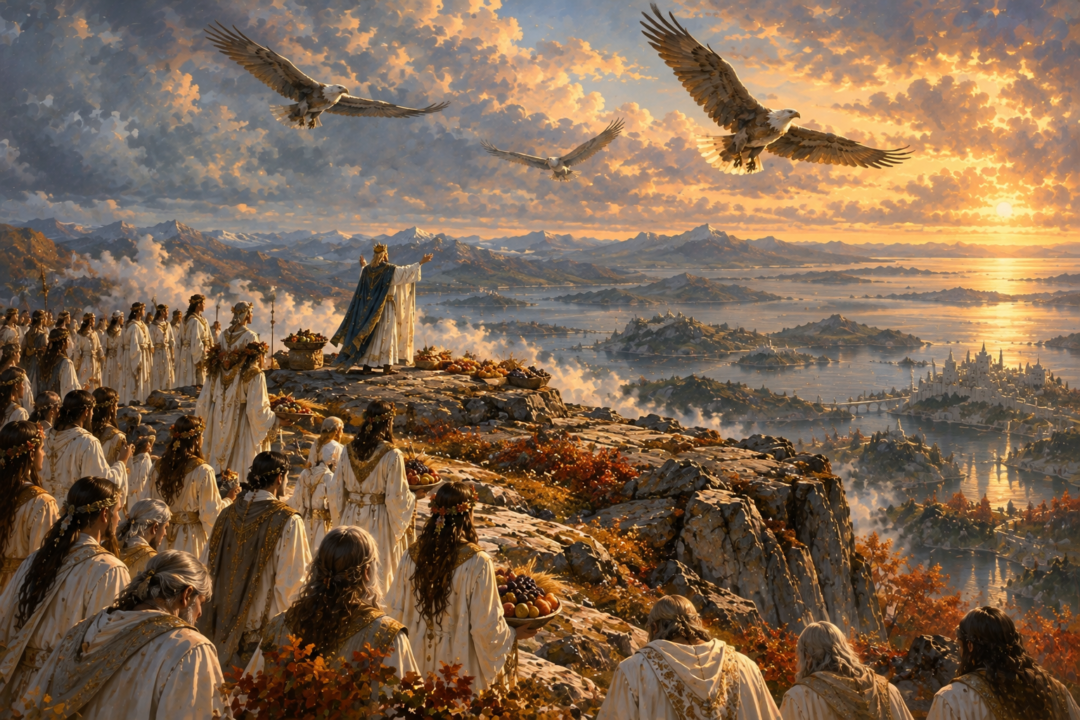
Meneltarma occupied the centre of Númenor, while its roots extended outward into the island. The Númenóreans therefore did not place their holiest site inside their greatest port or royal city. Worship required movement toward the mountain and then upward.
That physical journey created a natural sequence.
Ordinary inhabited land gave way to the slopes of the sacred mountain. The road climbed higher. The summit became increasingly separated from everyday activity. Finally came the Hallow, where ordinary speech itself ceased.
No wall was necessary to make that transition meaningful.
The landscape supplied boundaries through elevation and approach, while custom supplied the behavioural boundary of silence.
We should not invent exact checkpoints or ceremonial divisions that the texts never describe. But the broad structure is clear: worship on Meneltarma involved leaving ordinary space and entering a place where different rules applied.
The absence of a building did not mean the absence of order.
The mountain was the order.
Even the offerings did not require an altar
The Three Prayers included offerings, described as bloodless and involving fruits of the earth. Yet the sources still do not require a permanent constructed altar on the summit.
That detail fits the larger pattern.
Human beings brought something to the Hallow, but they did not need to remake the Hallow in order to do so.
This is important because later Númenórean history introduces a horrifying contrast. After Sauron gained influence over Ar-Pharazôn, a great temple was built in Armenelos for the worship associated with Melkor. That temple belonged to an entirely different religious order, involving domination, fear and ultimately human sacrifice.
The contrast should not be pushed beyond what the texts establish: Tolkien does not provide a simple architectural rule declaring every temple evil. But within Númenor’s own story, the difference is difficult to miss.
The ancient worship of Eru centred upon an open, silent summit without image or temple.
The corrupted worship encouraged by Sauron acquired a massive building and bloody sacrifice.
The visual reversal is profound.
Silence also prevented possession
There is another consequence of Meneltarma’s form that deserves attention.
A constructed sanctuary can be claimed, decorated, expanded, fortified and filled with symbols of whoever controls it. Meneltarma resisted that kind of transformation precisely because its sacred character depended upon leaving the summit substantially unbuilt.
This does not mean the Númenóreans had no influence on the mountain. A road ascended it, and their customs determined how people approached the Hallow.
But its defining sacred feature was not something a king could commission.
The ruler could lead the procession.
The ruler could offer the prayer.
The ruler could wear the crown of Númenor.
But the ruler did not manufacture the holiness of the mountain.
That distinction becomes especially meaningful in a kingdom whose later rulers increasingly desired control over things that could not truly belong to them—above all, freedom from the mortality appointed to humankind.
Meneltarma represented a relationship based upon acceptance and reverence rather than possession.
That interpretation should remain just that: an interpretation. The texts never provide a formal statement that the absence of architecture was designed as a political limitation upon Númenórean kingship. But the ritual arrangement itself is clear enough to make the contrast worth noticing.
When reverence failed, the mountain remained
As Númenor turned away from the friendship of the Eldar and from reverence toward the Valar and Eru, the old observances declined. The Three Prayers were eventually neglected, though Tar-Palantir attempted to restore the ancient practices.
Yet Meneltarma remained where it had always been.
That is part of the tragedy.
The sacred centre of Númenor did not need to be conquered by an enemy army before the spiritual order of the kingdom could collapse. The people could simply cease to honour what the mountain represented.
The Hallow had depended upon restraint: approaching in reverence, accepting silence, and allowing only the appointed ceremonial words to interrupt it.
Once that shared reverence weakened, no walls could preserve it—because there had never been walls.
And perhaps that is the most distinctive thing about Meneltarma.
Its holiness was not displayed through accumulation.
It was expressed through absence.
No temple enclosed Eru. No image attempted to represent Him. No constant noise announced devotion. At the summit of the greatest mountain in Númenor, a powerful civilization deliberately left space empty and ordinarily left it silent.
Then, three times each year, the people climbed together.
Everyone fell silent.
And only the ruler spoke.
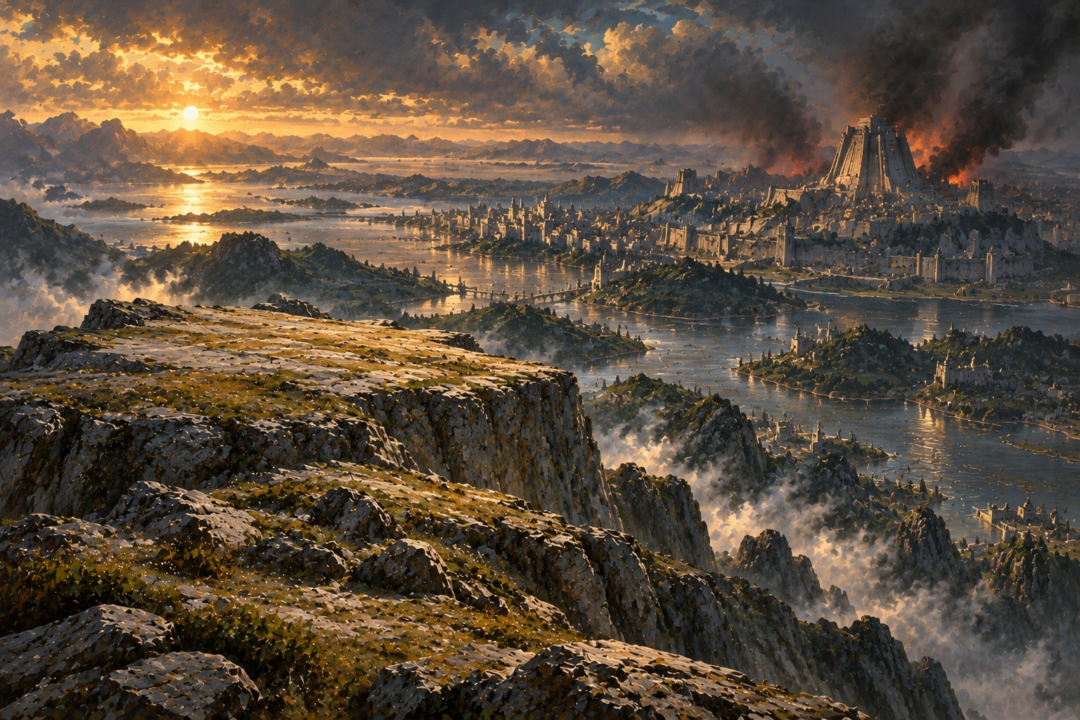
The words mattered because the silence came first.
Sources & Notes
- The Encyclopedia of Arda — Erulaitale: the midsummer royal prayer, white-clad procession and religious setting of the Hallow. https://www.encyclopedia-of-arda.com/e/erulaitale.php
- The Encyclopedia of Arda — Three Prayers: the seasonal ceremonies and the ruler's speech before the silent people. https://www.encyclopedia-of-arda.com/t/threeprayers.php
- The Encyclopedia of Arda — Meneltarma: the central mountain of Numenor and its role as the place of thanksgiving to Eru. https://www.encyclopedia-of-arda.com/m/meneltarma.html
Primary passage: J.R.R. Tolkien, Unfinished Tales, ‘A Description of the Island of Númenor’; compare The Silmarillion, ‘Akallabêth’. The silence, Three Prayers and absence of buildings are textual details; the reading of sacredness through restraint is interpretation. The linked reference entries provide context rather than replacing the primary text.