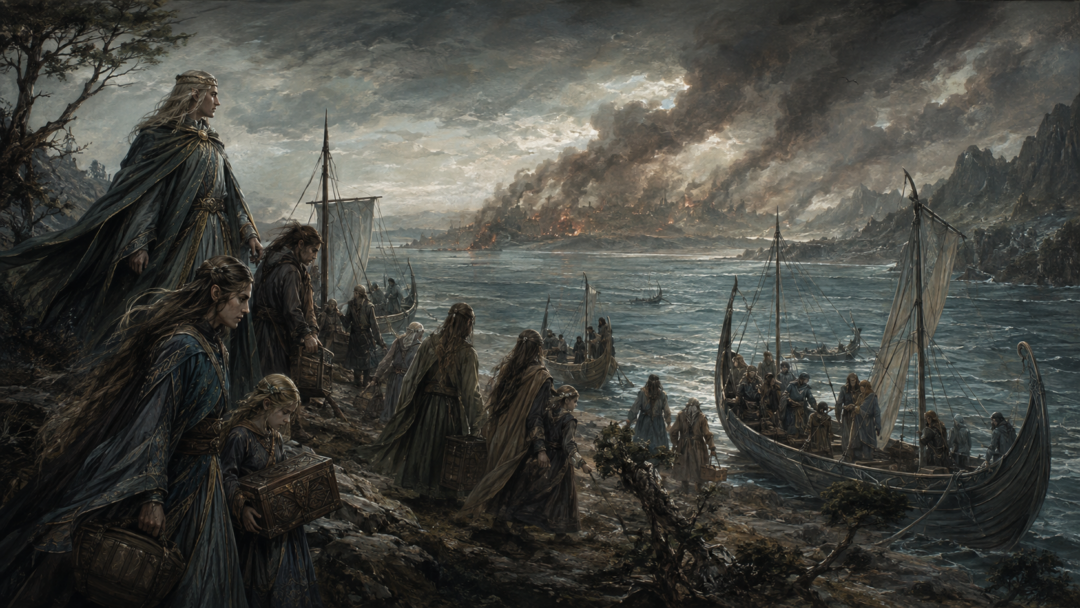
The Isle of Balar was never one of the great kingdoms of the Eldar. It had no hidden city like Gondolin, no thousand caves like Menegroth, and no long royal history like Nargothrond. Yet near the end of the First Age, when almost every greater refuge had failed, Balar became something more immediately valuable: a place where survivors could still live beyond Morgoth’s easiest reach.
That distinction matters. Balar was not built as the successor to the ruined realms of Beleriand. It functioned because nearly everything else had gone wrong.
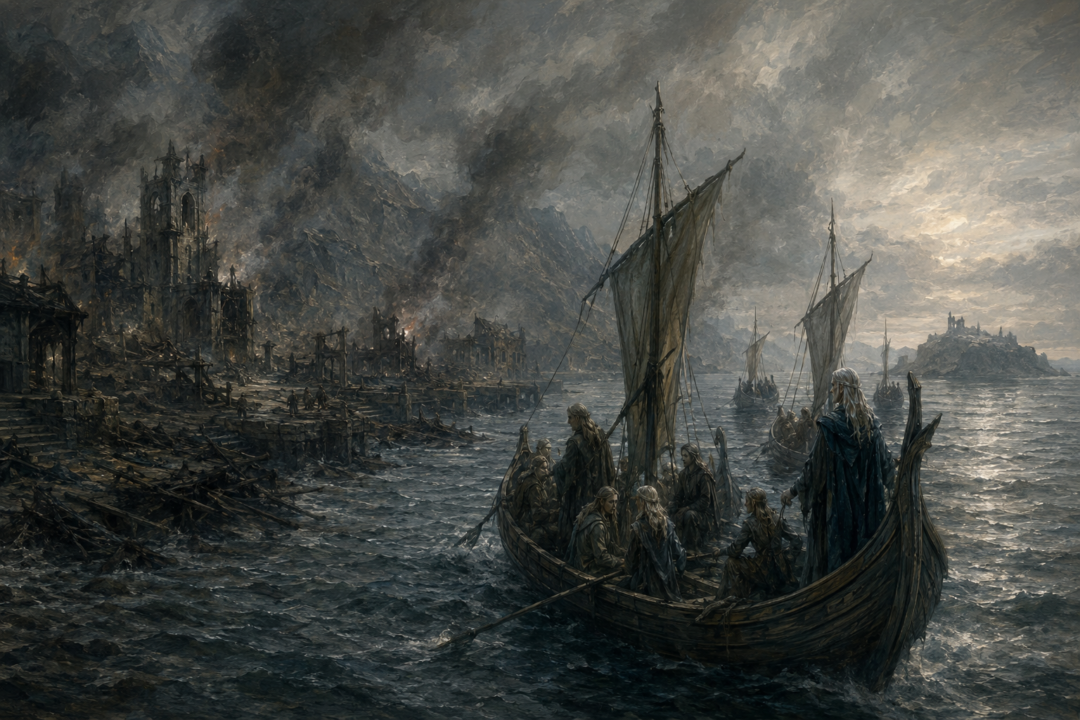
Círdan and the surviving people of the Falas fled there after Morgoth destroyed Brithombar and Eglarest. The island remained closely connected with the refuge at the Mouths of Sirion. Later, when the Havens of Sirion were devastated in the Third Kinslaying, survivors again escaped in the ships of Círdan and Gil-galad toward Balar.
For a brief and terrible period, the island stood near the end of a collapsing world.
Then Morgoth fell, Beleriand itself was broken, and an entirely different western coastline emerged. Lindon and the Grey Havens could now perform roles that a desperate island sanctuary never could.
Balar’s importance did not simply decline because somebody chose a better harbour. The emergency that had made Balar essential was ending, while the physical and political world around it was being remade.
Balar Was a Refuge Before It Became the Last Refuge
The usefulness of Balar had been recognized before the final disasters of the First Age.
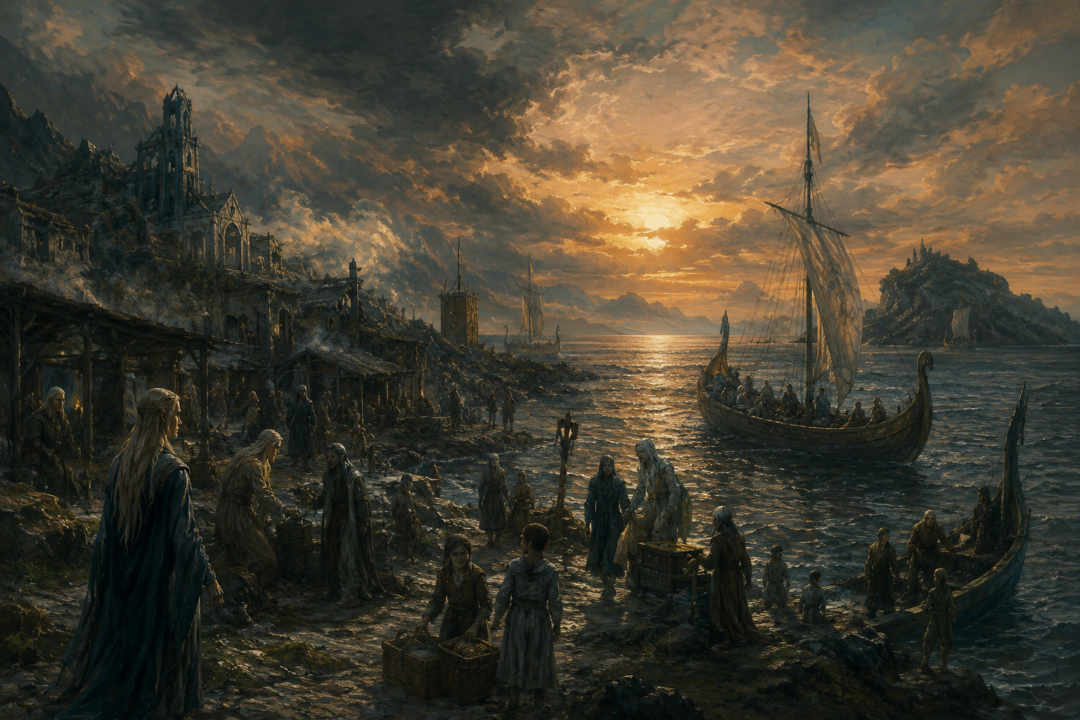
Elves of Nargothrond explored the island with ships made by the Falathrim, considering its potential as a refuge in time of need. Turgon also became connected with Balar through his desperate attempts to send mariners into the West. Círdan built ships for this purpose, although those missions failed to obtain the aid that the Eldar desperately needed.
The crucial transformation came after the destruction of the Havens of the Falas.
When Morgoth’s forces overwhelmed Brithombar and Eglarest, Círdan escaped with surviving mariners and with Gil-galad. They withdrew to Balar and maintained connections with the Mouths of Sirion.
This created something unusual in late Beleriand: a maritime refuge network rather than another heavily fortified inland kingdom.
That difference was probably one of its strengths.
Nargothrond had depended upon secrecy and military strength. Gondolin combined concealment with formidable defenses. Doriath possessed the protection associated with Melian until her departure. The Falas depended upon fortified coastal cities.
All eventually failed.
Balar survived not because it had surpassed those realms, but because an island supported by skilled mariners presented Morgoth with a different problem at a time when his attention was fixed upon conquering Beleriand.
The Refuge System Expanded as the Old Kingdoms Died
The last generations of the First Age produced an extraordinary concentration of displaced peoples.
After the ruin of Doriath, Elwing and survivors of her people eventually came to the Mouths of Sirion. After Gondolin fell, survivors led by Tuor and Idril also journeyed south until they reached the same general refuge.
The Mouths of Sirion therefore became home to remnants of societies that had once belonged to very different Elven realms.
Nearby Balar formed another component of this surviving coastal world.
The texts do not give us anything like a modern administrative account of refugee distribution between Balar and the settlements at Sirion. It would therefore be too strong to describe them as parts of a formally organized evacuation system. What can safely be said is that they remained closely connected through Círdan’s maritime people and that both served those escaping the destruction farther north.
This makes the Third Kinslaying especially grim.
The survivors had already escaped Morgoth’s wars and the destruction of older kingdoms. Yet the remaining Sons of Fëanor attacked the Havens of Sirion in their attempt to recover the Silmaril possessed by Elwing.
Once again, ships became instruments of survival.
Círdan and Gil-galad came too late to prevent the slaughter, but those who escaped the destruction of the Havens could be carried away to Balar.
The island’s role had reached its bleakest culmination: it was shelter for people displaced from a refuge that had itself been populated by earlier refugees.
Balar Could Preserve Survivors, but It Could Not Rebuild Beleriand
There was also a severe limitation built into Balar’s success.
It could keep survivors alive. It could support ships. It could remain connected with the sea. But none of those things reversed Morgoth’s conquest.
By the final years before the War of Wrath, the famous Elven kingdoms of Beleriand were effectively gone. The remaining free peoples could endure at the coast, but there was no realistic path by which Balar alone could become the base for reconquering the North.
This helps explain why Eärendil’s voyage matters so profoundly to the history surrounding the refuge.
With Círdan’s friendship and assistance, Eärendil built Vingilot and repeatedly sought the West. His eventual successful voyage was not simply another maritime adventure. It emerged from a world in which the surviving communities of Beleriand had exhausted almost every other answer available to them.
Balar was therefore both a success and evidence of failure.
Its continued existence proved that Morgoth had not destroyed everyone.
Its necessity proved how little remained.
The War of Wrath Ends the World That Made Balar Necessary
When the Host of the West finally came against Morgoth, the problem was solved on a scale far beyond anything Balar’s defenders could have achieved themselves.
Morgoth was overthrown.
But victory did not restore the old Beleriand.
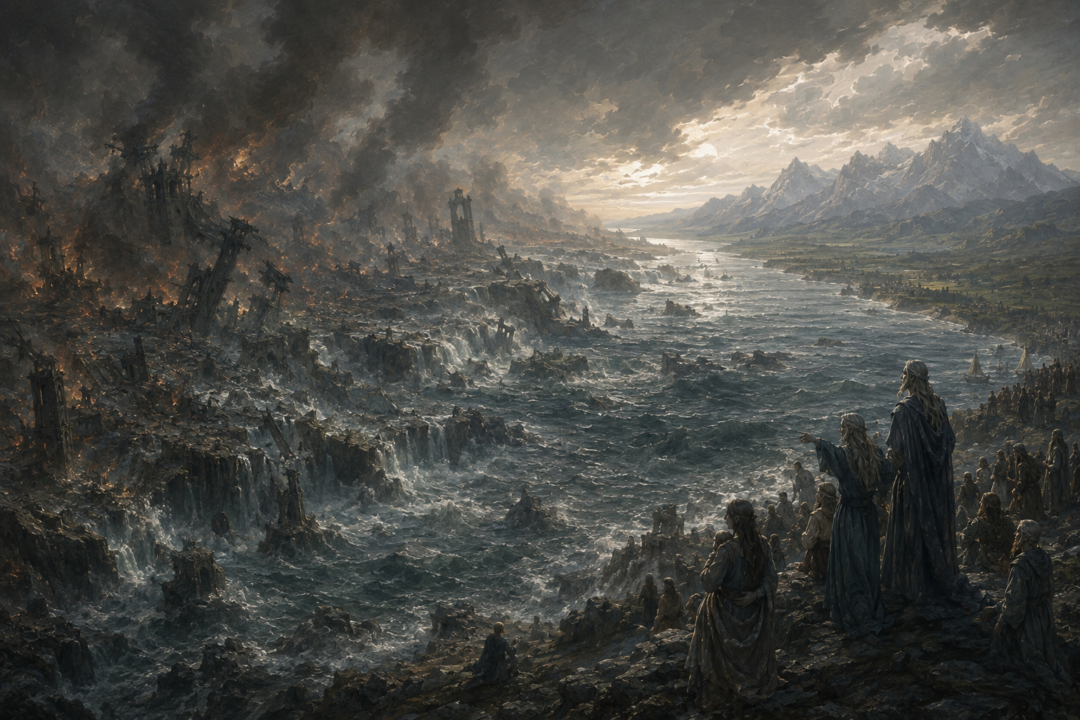
The struggle accompanying his defeat devastated the land, and most of Beleriand disappeared beneath the Sea. Rivers, mountains, coasts, and familiar territories of the Elder Days were destroyed or transformed.
This is the key break in Balar’s history.
The First Age refugee geography no longer made sense in the Second Age.
There was no Gondolin to return to. No restored Nargothrond. No renewed Doriath. The Havens of Sirion belonged to a landscape that had been shattered. Even the western limits of Middle-earth had moved dramatically eastward.
The surviving Elves now faced a different choice: depart across the Sea or remain in a remade Middle-earth.
For those who remained, the surviving territory near the Blue Mountains offered something Balar had never really been meant to provide—a durable regional homeland.
Lindon Turns Survival Into Settlement
Lindon arose from the surviving lands associated with Ossiriand, west of the Blue Mountains.
Here Gil-galad ruled the Elves who remained under his authority in Middle-earth. The beginning of the Second Age also saw the foundation of the Grey Havens upon the new Gulf of Lune.
That shift fundamentally changed what the surviving Eldar required from their western refuge.
Balar had answered the question: where can people escape while Beleriand is being conquered?
Lindon answered a different question: where can those who refuse or postpone departure from Middle-earth build a functioning realm after Beleriand is gone?
The distinction is enormous.
Lindon possessed territory in which communities could endure rather than merely shelter. Gil-galad’s kingship gave political continuity to surviving Elves of the West. Círdan again occupied a maritime position, but now his shipcraft was centered upon enduring harbours rather than a wartime island sanctuary.
The Grey Havens became one of the defining institutions of the remaining Eldar in Middle-earth.
Círdan’s Movement Shows the Change Most Clearly
Few figures connect Balar and Lindon as clearly as Círdan.
His history repeatedly follows the western shore.
He had ruled the Falathrim before their havens were destroyed. He escaped to Balar. His people maintained ships during the darkest final years of Beleriand. He aided attempts to reach Aman. He was connected with Eärendil and the maritime communities around Sirion.
Then, after the catastrophe at the end of the First Age, he became Lord of the Grey Havens.
There is a striking continuity here.
Círdan did not abandon the function that Balar represented. He transformed it.
The sea remained a route of escape, communication, hope, and eventually departure into the West. Shipbuilding remained central. Harbours remained essential.
But the institutional center moved into the new geography of Lindon.
Mithlond, the Grey Havens, was founded at the beginning of the Second Age on the Gulf of Lune. From there ships of the Eldar could sail westward, while Lindon itself provided a stable land behind the ports.
What had been an emergency maritime refuge became part of an enduring Elven realm.
Balar Does Not Need a Dramatic Abandonment Story
It is tempting to imagine a final evacuation of Balar: ships leaving an empty island while the survivors sail solemnly toward Lindon.
The surviving texts do not give us such a scene.
That absence is important.
There is no need to invent a decree closing Balar, a final governor, or a precise date on which its refugee function officially ceased. The end of Balar’s importance is better understood through the larger events that made its earlier function obsolete.
Morgoth was gone.
Most of Beleriand was gone with him.
Many Elves accepted the summons to depart into the West. Others remained in Middle-earth and gathered in surviving or newly established lands. Lindon emerged under Gil-galad, while Círdan established himself at the Grey Havens.
Under those conditions, Balar no longer occupied the extraordinary strategic position it had possessed during Morgoth’s domination of Beleriand.
The crisis architecture of the First Age gave way to the settlement patterns of the Second.
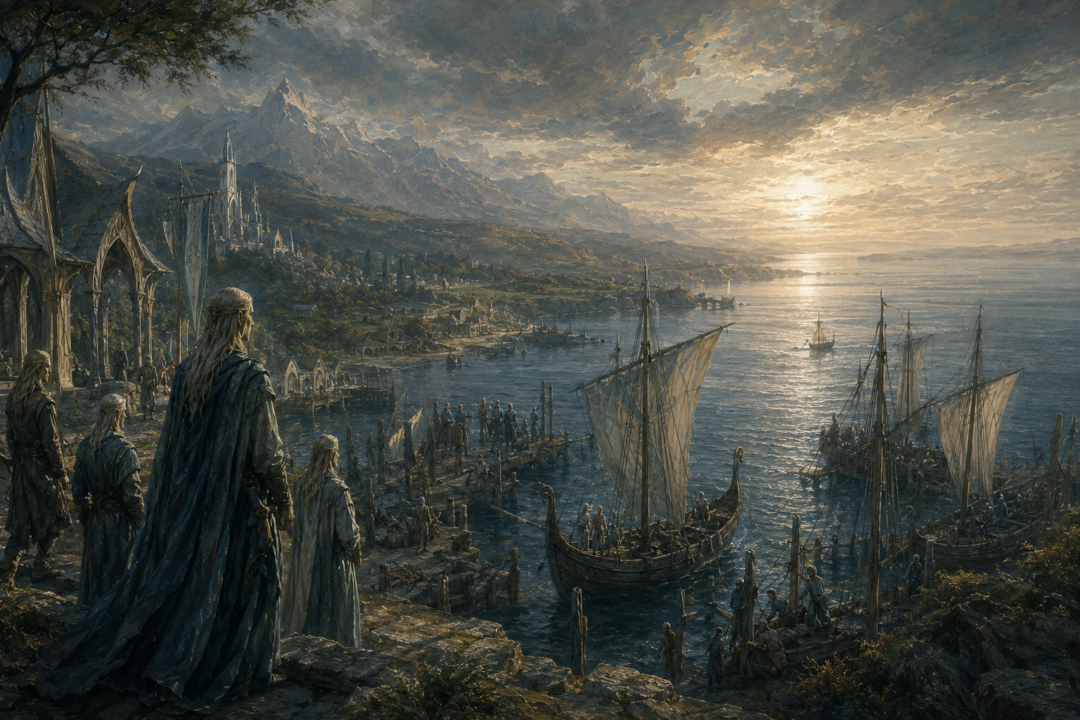
The Last Refuge Becomes a Memory of a Lost World
Balar is easy to overlook because it never receives the narrative grandeur of the kingdoms whose refugees eventually depended upon coastal sanctuaries.
Yet that is precisely what makes it revealing.
At the beginning of the long wars, the Eldar built kingdoms.
Near the end, they searched for places that could simply remain beyond immediate destruction.
Balar belongs to that final stage.
Its importance grew as stronger and more beautiful places vanished. It protected survivors precisely because the political world around it was collapsing.
Lindon represents the next stage.
It was not another temporary hiding place waiting for Morgoth’s armies to arrive. It belonged to the geography created after Morgoth’s defeat. With Gil-galad’s realm and Círdan’s Grey Havens, the surviving Eldar possessed both territory in which to remain and harbours from which they could depart.
That is why Balar fades from the story without requiring another catastrophe.
Its greatest purpose had been emergency survival.
Once the refugees of the Elder Days could either sail into the West or begin again in places such as Lindon, the island no longer needed to be the last safe edge of a dying Beleriand.
Sources & Notes
- The Encyclopedia of Arda — Isle of Balar: Círdan’s late First Age refuge and haven for survivors — https://www.glyphweb.com/arda/b/balar.php
- The Encyclopedia of Arda — Círdan the Shipwright: evacuation from the Falas, refuge on Balar, and later lordship at the Grey Havens — https://www.glyphweb.com/arda/c/cirdan.php
- The Encyclopedia of Arda — The Falas: Brithombar and Eglarest and their destruction by Morgoth — https://www.glyphweb.com/arda/f/falas.php
- The Encyclopedia of Arda — Mouths of Sirion: connected refugee settlement and its destruction in the Third Kinslaying — https://www.glyphweb.com/arda/m/mouthsofsirion.php
- The Encyclopedia of Arda — Lindon: the surviving western land reorganized after Beleriand’s ruin — https://www.glyphweb.com/arda/l/lindon.php
- The Encyclopedia of Arda — Grey Havens: the durable Second Age harbour founded in Lindon — https://www.glyphweb.com/arda/g/greyhavens.php
Background references for Balar’s refugee function, the interconnected Mouths of Sirion settlement, and the transition to Lindon and the Grey Havens after the War of Wrath. Primary narratives are in J.R.R. Tolkien’s The Silmarillion.