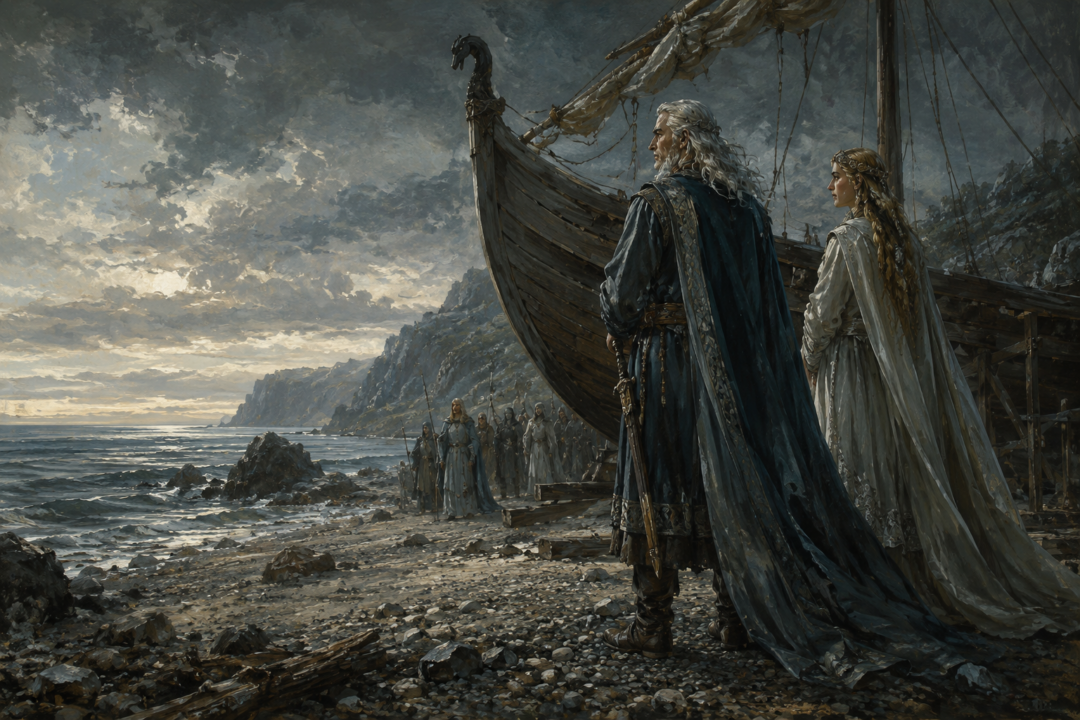
Tuor’s story ends with one of the most extraordinary claims in the history of Middle-earth.
He is a Man: son of Huor, father of Eärendil, heir to the mortality of the Edain. Yet after surviving the ruin of Gondolin and dwelling for a time near the Mouths of Sirion, Tuor grows weary with age and increasingly drawn toward the Sea. He builds the ship Eärrámë, takes Idril with him, and sails into the West.
Then the certainty stops.
The tradition preserved in The Silmarillion says that Tuor reached Valinor and, uniquely among Men, was numbered among the Eldar. But the text deliberately presents this as something believed or told among the Elves—not as an event directly witnessed and authoritatively explained.
That distinction matters because Tuor’s supposed transformation touches one of the deepest laws in the legendarium: the fundamentally different fates of Elves and Men.
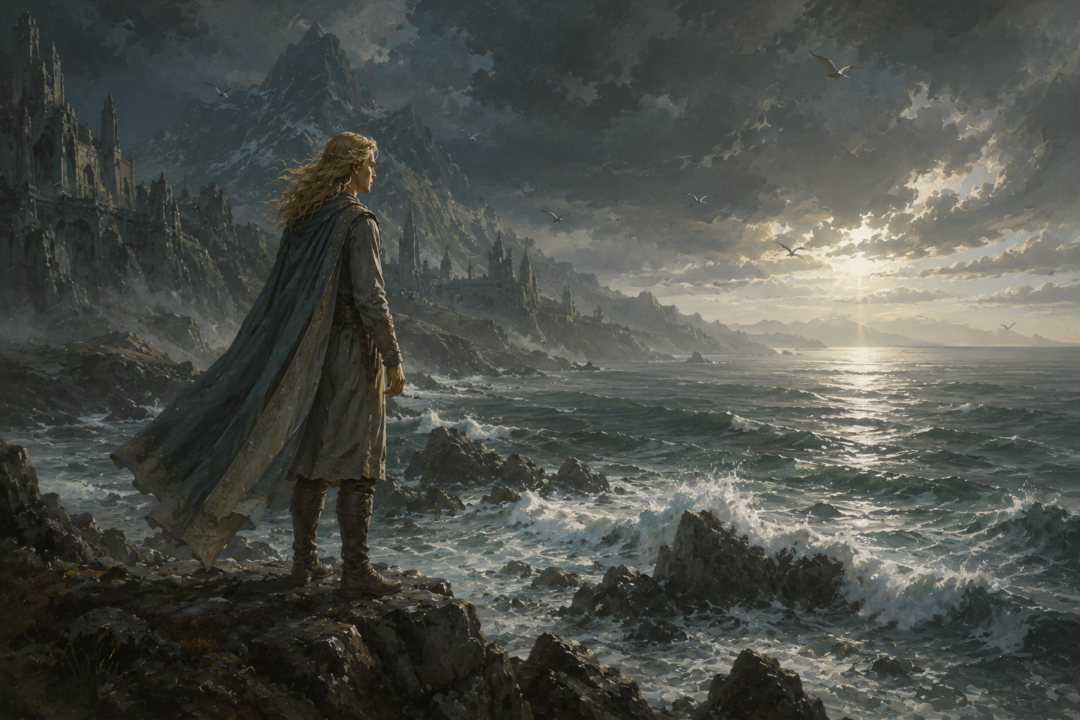
The Strange Ending of Tuor
By the time Tuor leaves Middle-earth, his life has already crossed boundaries that normally separate Men from Elves.
Born into the House of Hador, he is fostered among the Grey-elves of Mithrim. Ulmo personally chooses him as a messenger to Gondolin. He enters the Hidden City, marries Idril Celebrindal, daughter of Turgon, and becomes father of Eärendil.
After Gondolin falls, Tuor and Idril escape with the survivors. Eventually they come to the Mouths of Sirion.
There Tuor’s old attraction to the Sea returns with overwhelming force.
The published Silmarillion says that in his later years Tuor built Eärrámë, the Sea-Wing, and sailed west with Idril. They thereafter passed out of the stories of Middle-earth.
What follows is crucial. The narrative does not simply state, without qualification, that Tuor became immortal. Instead, it records a belief: it was afterwards said that Tuor alone of mortal Men was numbered among the Elder Kindred and joined with the Noldor whom he loved.
The language leaves a veil over the event.
We are being given tradition, not an eyewitness account of a judgment in Valinor.
Why Becoming One of the Eldar Would Be Extraordinary
The importance of that uncertainty becomes clearer when we remember what separates Elves and Men.
Elvish immortality is not merely an unusually long lifespan. Elves are bound to Arda for as long as its life endures. Even bodily death does not normally remove them from the world in the way death removes Men. Their spirits remain within the circles of the world.
Men possess a different destiny.
Their mortality is not simply a biological weakness that could ordinarily be repaired by sufficiently great power. Their spirits eventually depart from the world, and their ultimate fate lies beyond the knowledge available to the inhabitants of Arda.
That difference is fundamental to the nature of the Children of Ilúvatar.
This is why Tuor cannot simply be imagined as receiving an Elvish version of extreme longevity. If the tradition is literally true, something much deeper has happened: the normal destiny of a mortal Man has been altered.
Such a change would lie beyond the ordinary authority of the Valar.
And that makes Tuor’s case exceptional even by the standards of the First Age.
The Valar Cannot Simply Make Men Immortal
The fate of Númenor demonstrates why the Blessed Realm cannot itself confer immortality.
The Númenóreans eventually came to fear death and envy the Eldar. Sauron exploited that fear, persuading Ar-Pharazôn that possession of the Undying Lands could grant everlasting life.
But that belief was false.
A mortal does not become immortal merely by reaching Aman.
The distinction is essential. Valinor is called the Undying Lands because the deathless dwell there, not because the land automatically makes its inhabitants deathless.
That principle makes Tuor’s voyage particularly mysterious. Even if Eärrámë somehow reached the West, arrival alone could not explain the later tradition about him.
Something more would have been required.
The implication is that, if Tuor truly received the fate of the Eldar, the change ultimately depended upon authority higher than that of the Valar themselves.
But the narrative never gives us the scene in which such a judgment occurs.
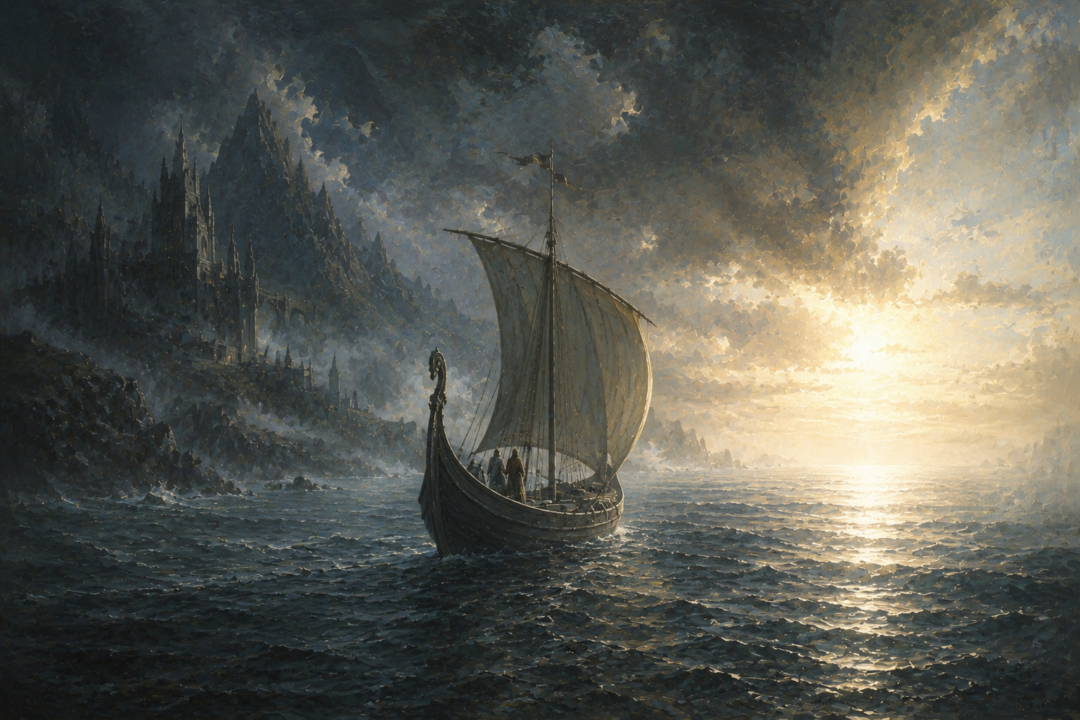
Eärendil Gives Us the Comparison Tuor Does Not
The clearest contrast is Tuor’s own son.
Eärendil also reaches Aman under extraordinary circumstances, but his fate is treated much more explicitly.
Because Eärendil is descended from both Elves and Men, the question of which kindred he and his family will belong to becomes part of the story. The choice granted to Eärendil, Elwing, and their descendants establishes the famous line of the Half-elven.
Eärendil chooses the fate of the Eldar, largely for Elwing’s sake. Elrond later makes the same choice, while Elros chooses the fate of Men.
Here the alteration of destiny is presented as an explicit judgment.
Tuor’s case is different.
He is not Half-elven. Both of his parents, Huor and Rían, are mortal. Nothing in his ancestry gives him the same divided inheritance possessed by Eärendil.
Yet the tradition concerning Tuor claims something even more remarkable: that a fully mortal Man was admitted to the fate of the Eldar.
And unlike Eärendil’s choice, the mechanism is never narrated.
Tuor Is Also the Mirror Image of Lúthien
There is another revealing comparison.
Lúthien begins with the fate of the Eldar but ultimately receives mortality so that she may share Beren’s destiny.
Her story crosses the same boundary as Tuor’s tradition, but in the opposite direction.
Lúthien relinquishes the fate of the Elves.
Tuor, according to tradition, receives it.
Yet Lúthien’s change is firmly embedded in the story of Beren and Lúthien. Her choice and its consequences are essential to the narrative.
Tuor’s transformation occurs beyond the edge of the surviving tale.
That contrast is probably the safest way to understand the degree of certainty involved. The legendarium clearly allows exceptional changes in the destinies of the Children, but such exceptions are profoundly significant and cannot be treated as ordinary acts of Elvish or Valarin power.
Tuor may represent another such exception.
The surviving narrative simply does not show it happening.
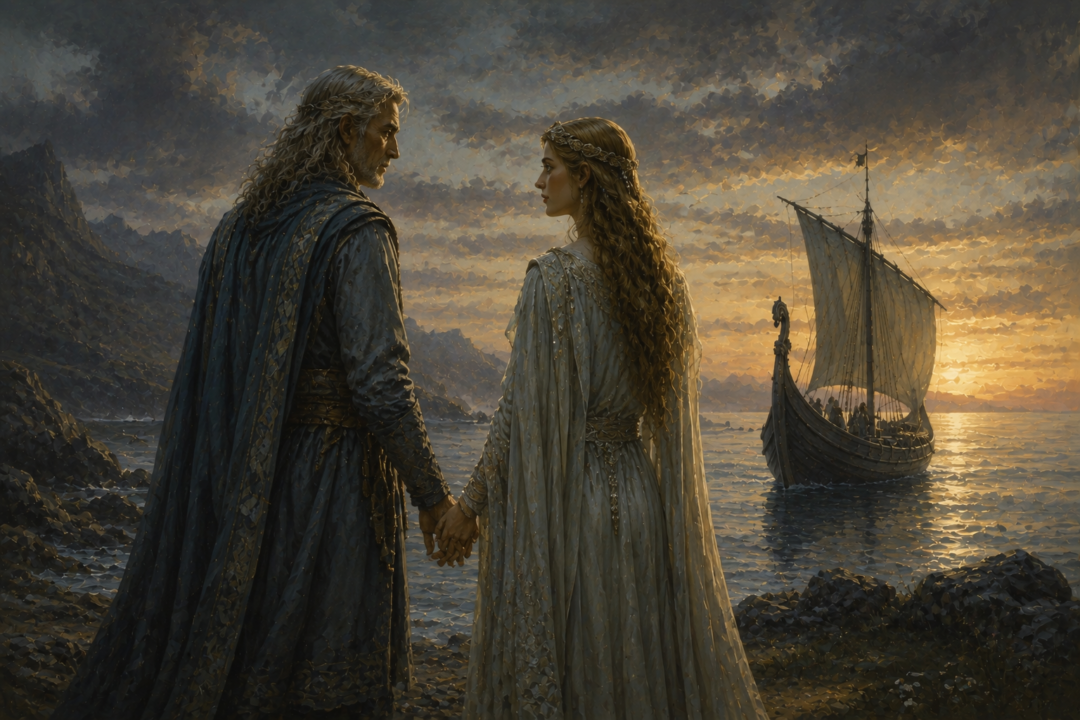
The Sea Carries Tuor Beyond Recorded History
There is something fitting about the uncertainty.
Tuor’s connection with the Sea begins long before his final voyage.
When he reaches the coast of Nevrast, he encounters the Sea with wonder. At Vinyamar he meets Ulmo, Lord of Waters, who sends him toward Gondolin. Later, after the city’s destruction, the Sea remains woven into the destiny of Tuor’s family.
His son Eärendil becomes the greatest mariner of the Elder Days.
Tuor himself eventually disappears into the same western horizon.
But disappearance matters here. The later detailed narrative published in Unfinished Tales, Of Tuor and his Coming to Gondolin, never reaches Tuor’s final years at all; it breaks off as he enters Gondolin. The fuller conclusion familiar from The Silmarillion therefore belongs to the compressed tradition of the tale rather than to a completed late narrative depicting Tuor’s arrival in Aman.
We never see Eärrámë reach harbor.
We never see Tuor stand before the Powers.
We never hear a judgment concerning his mortality.
Instead, the ship sails west and the tradition begins where direct narrative ends.
Earlier Versions Make the Mystery Even Clearer
The long development of Tuor’s story reinforces the need for caution.
In earlier forms of the legend, his departure and ultimate whereabouts were handled in differing ways. Some old conceptions imagined him sailing into the West and becoming separated from the ordinary fate of Men; other early notes left his whereabouts mysterious.
These early materials should not simply be combined into a single continuous canon. They belong to different stages in the development of the legend.
What matters for the mature conception is that the extraordinary idea survived: Tuor was remembered as uniquely separated from the normal destiny of mortal Men.
But the note of uncertainty survived with it.
The published tradition does not transform speculation into a narrated event merely because the tradition is ancient or widely accepted among the Eldar.
Why Tuor Cannot Simply Be Called “An Immortal Man”
It is therefore slightly misleading to summarize Tuor by saying, without qualification, that he “became immortal.”
That may indeed be what the tradition means.
But the more accurate formulation is that Tuor was said to have been numbered among the Eldar and to have received their fate.
The difference is important.
Middle-earth contains chronicles, songs, remembered traditions, incomplete knowledge, and events whose final truth is hidden from those living within the world. Not every statement is delivered from an all-knowing perspective.
Tuor’s ending belongs to that deliberately distant category.
The tradition may be true. Nothing requires us to dismiss it as a mere legend or error. Indeed, its persistence and Tuor’s extraordinary role make it entirely plausible within the mythology.
But plausibility is not the same thing as direct narrative confirmation.
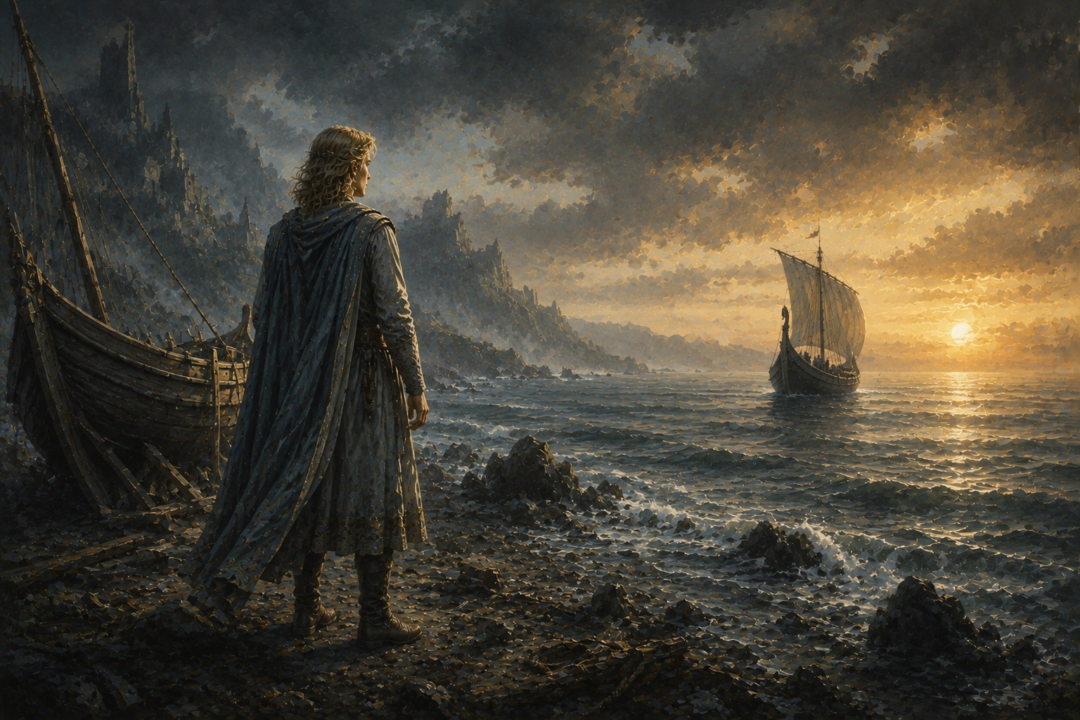
The One Man Who Sailed Beyond the Rule
That uncertainty ultimately makes Tuor’s ending more powerful.
His life begins amid catastrophe. His father dies in the Nirnaeth Arnoediad. His mother dies soon after his birth. He grows up dispossessed, becomes an outlaw, and enters Gondolin carrying a warning that its king refuses to obey.
He survives the city’s destruction, but he cannot save it.
What Tuor does preserve is a line of hope.
Through his marriage to Idril comes Eärendil. Through Eärendil comes the appeal that finally brings the intervention of the West against Morgoth. Through Eärendil’s descendants come Elrond, Elros, the Kings of Númenor, and eventually Aragorn.
And Tuor himself simply sails away.
Perhaps that is why his fate works so well as tradition rather than as a fully explained decree. The mortal messenger of Ulmo reaches the edge of the world and passes beyond the knowledge of the histories that followed him.
The texts leave us with a remarkable claim but not the scene that would settle it beyond question.
Tuor alone of Men was said to have been numbered among the Eldar.
Whether we call that immortality, a change of fate, or an exceptional act granted by the highest authority, one point should remain clear: it is presented as a unique tradition, not as an ordinary rule of Aman and not with the explicit narrative confirmation given to Eärendil or Lúthien.
Eärrámë disappears into the West.
Beyond that horizon, even the chronicles fall silent.
Sources & Notes
- The Encyclopedia of Arda — Tuor: voyage with Idril and the qualified tradition that he was numbered among the Eldar — https://www.glyphweb.com/arda/t/tuor.php
- The Encyclopedia of Arda — Idril Celebrindal: Tuor’s Elven wife and companion on Eärrámë — https://www.glyphweb.com/arda/i/idril.php
- The Encyclopedia of Arda — Eärendil: Tuor’s son and the explicitly adjudicated Half-elven comparison — https://www.glyphweb.com/arda/e/earendil.php
- The Encyclopedia of Arda — Gift of Men: mortality and departure from Arda as the distinctive destiny of humankind — https://www.glyphweb.com/arda/g/giftofmen.php
- The Encyclopedia of Arda — Undying Lands: why reaching Aman does not itself make a mortal immortal — https://www.glyphweb.com/arda/u/undyinglands.php
Background references for Tuor and Idril’s voyage, the qualified tradition of Tuor’s fate, Eärendil’s contrasting judgment, and the Gift of Men. Primary narrative: J.R.R. Tolkien, The Silmarillion, ‘Of Tuor and the Fall of Gondolin.’