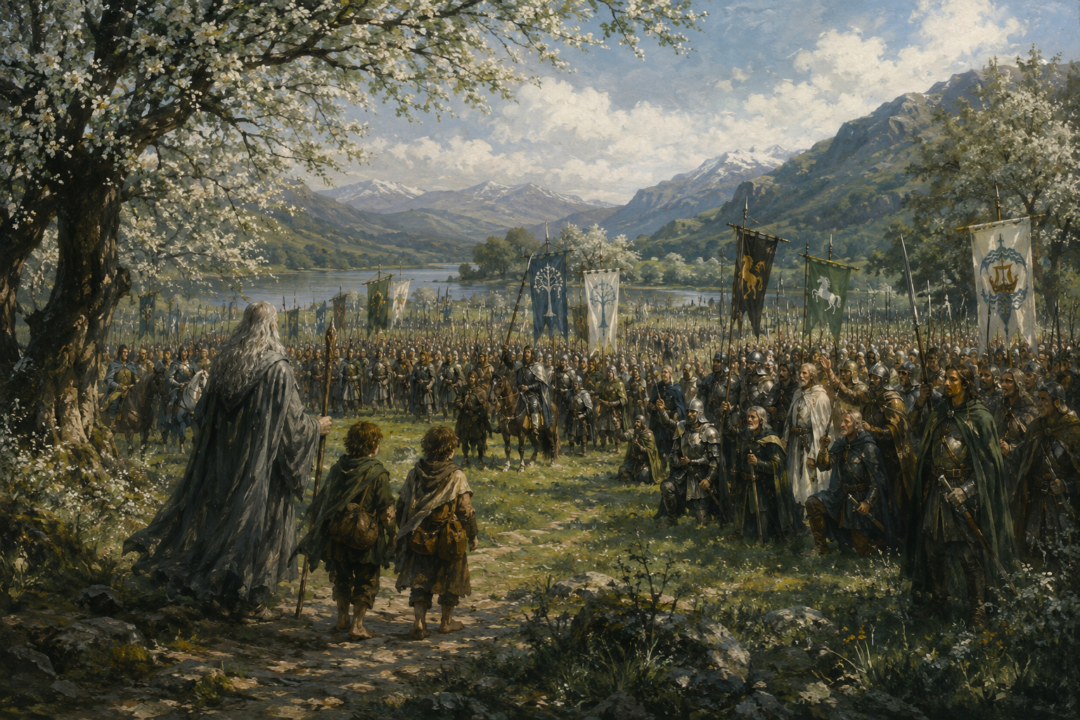
Samwise Gamgee wakes beneath the trees expecting, for one bewildered moment, that Mordor may have been a dream.
Then he sees Frodo.
The Ring is gone. Sauron has fallen. Barad-dûr has collapsed. The armies gathered at the Black Gate have survived a battle they were never supposed to win. Frodo and Sam have been carried out of the ruin of Mordor by the Eagles and brought into Ithilien.
The great war is effectively over.
Yet The Lord of the Rings does not hurry immediately to Aragorn's coronation, the restoration of Gondor, or the journey home.
Instead, it stops in a green field.
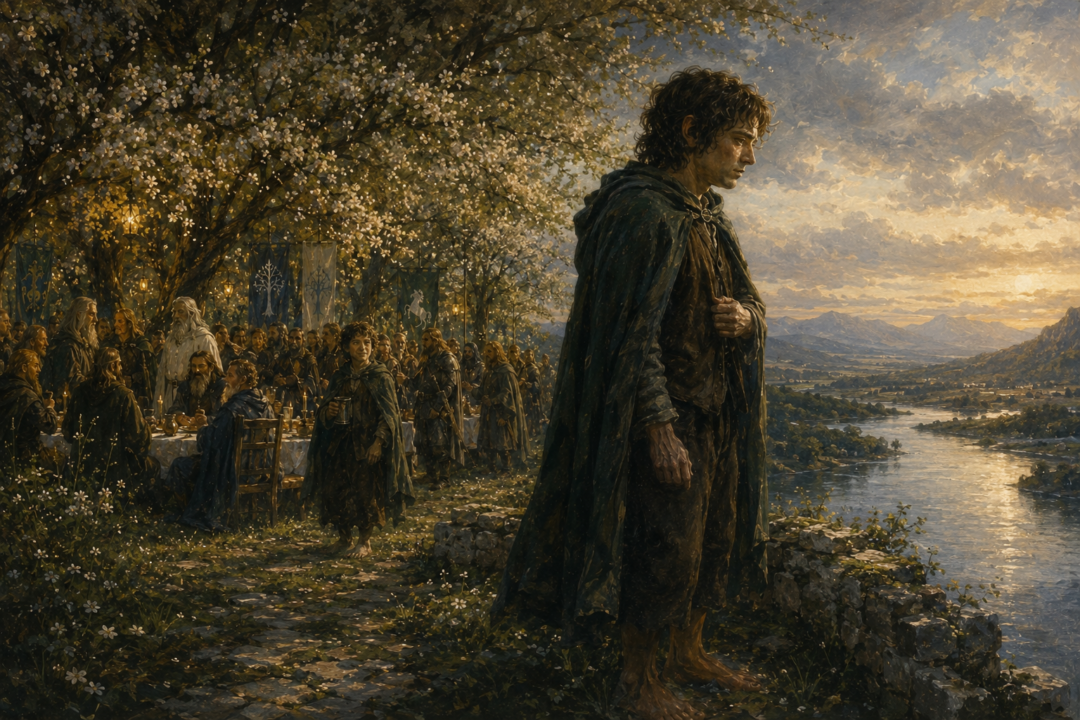
That pause matters. The Field of Cormallen is not merely where the heroes hold a victory feast. It performs several tasks the story cannot safely skip. Here the unknown suffering of two hobbits becomes public memory. Here military glory is deliberately redirected toward people who could never have defeated Sauron by military strength. Here Frodo and Sam are allowed to return to the world of the living before the larger political order of Middle-earth begins again.
Cormallen is where victory is given its meaning.
The War Ends Somewhere Else
The most important thing about the celebration at Cormallen is that Frodo and Sam did not win the Battle of the Morannon.
They were not even there.
While Aragorn, Gandalf, the Rohirrim, and the remaining strength of Gondor confronted Sauron's forces before the Black Gate, Frodo and Sam were deep inside Mordor. The Captains of the West had deliberately marched into overwhelming danger partly to draw Sauron's attention away from his own land.
Their military action was therefore inseparable from the Ring-bearer's hidden journey.
That creates a remarkable reversal after Sauron's fall.
The warriors gathered in Ithilien have fought openly. Their courage is visible and comprehensible. They have banners, swords, captains, victories, wounds, and fallen comrades.
Frodo and Sam's greatest deeds happened almost entirely without witnesses.
Cormallen corrects that imbalance.
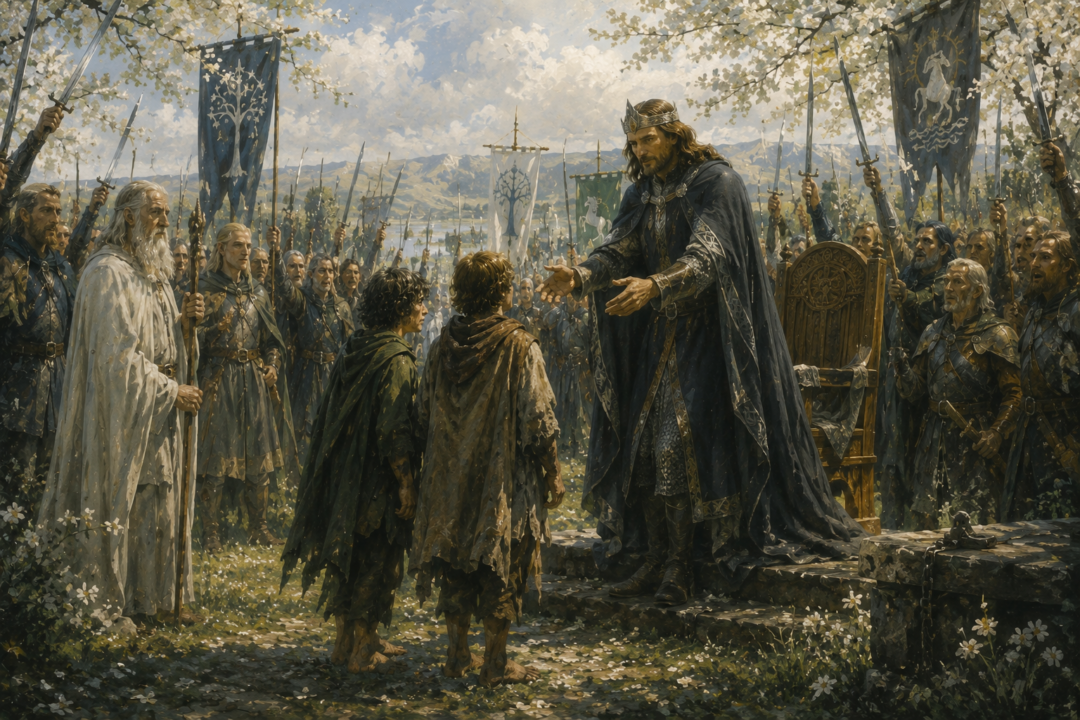
When the hobbits are brought before the assembled host, the people who fought the visible war acclaim those who endured the invisible one.
The point is not that the soldiers' courage mattered less. The Last Debate makes clear how desperate and necessary their diversion was. But Cormallen establishes what actually destroyed Sauron's power: not conquest of Mordor by a stronger army, but the successful carrying of the Ring into the place where it could be destroyed.
The greatest strategic victory of the War of the Ring therefore ends with an army celebrating two exhausted hobbits.
Frodo and Sam Are Brought Back as Themselves
There is another striking detail before the ceremony.
Frodo and Sam do not emerge dressed like princes.
Gandalf tells them that the clothes laid beside them are the ragged garments they wore in Mordor. They are washed and repaired as far as possible, but they remain the clothing of their ordeal.
That choice gives the ceremony unusual force.
Cormallen does not disguise what victory cost.
The two hobbits appear before the Host of the West carrying the visible marks of their journey. Frodo has lost a finger. Their clothing belongs to the road through Mordor rather than to a royal court.
They are honoured not after being transformed into conventional heroic figures, but while still looking like the small travellers who actually performed the deed.
Aragorn then makes the reversal even stronger.
He receives them before the host and sets them upon the throne prepared for him.
The future King does not need to diminish himself to do this. On the contrary, the gesture demonstrates what kind of king he is becoming. He knows that royal authority does not require him to claim every triumph as his own.
The man who will soon receive the crown publicly gives the place of highest honour to the Ring-bearers.
That is one of Cormallen's central purposes: it establishes the moral hierarchy of the victory before the political hierarchy of the restored kingdom is formally established.
Sam Finally Hears Himself Inside a Great Tale
Sam has imagined stories throughout the journey.
On the stairs of Cirith Ungol, he speaks with Frodo about the old tales and wonders what kind of story they have fallen into. He recognizes that the people inside great stories often do not know how those stories will end.
Cormallen completes that idea.
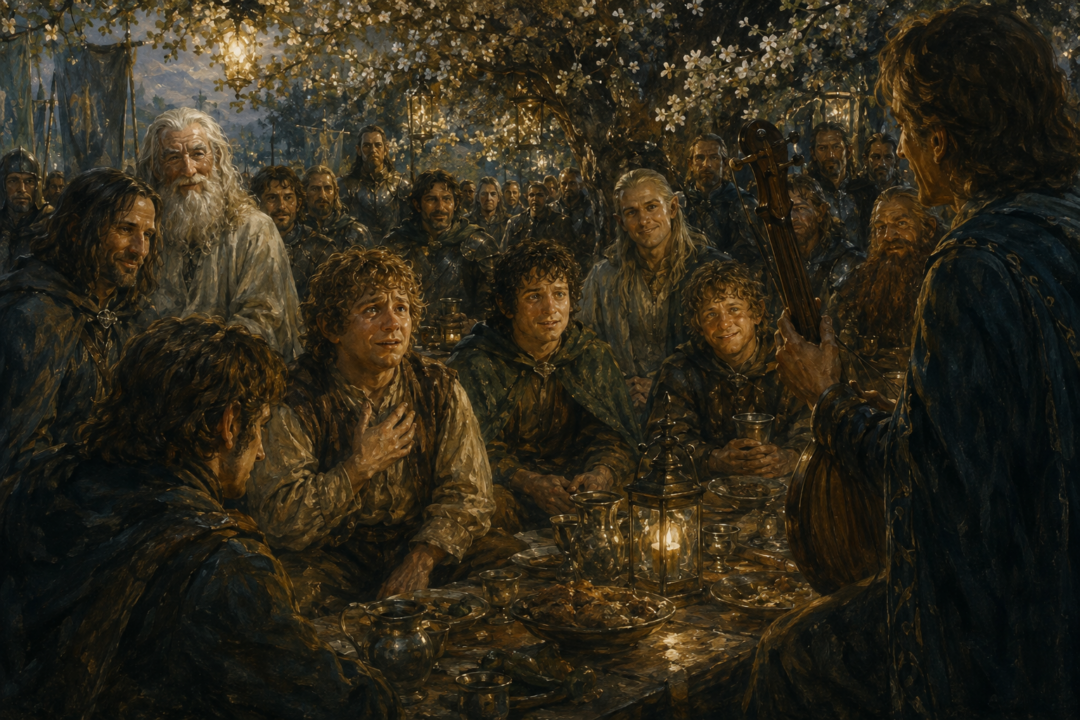
A minstrel asks the gathered company whether they wish to hear the tale of Frodo of the Nine Fingers and the Ring of Doom.
Sam's response is overwhelming.
The private suffering of Mordor has already begun turning into legend.
This is more than comic satisfaction for a hobbit who loves stories. It reveals something fundamental about how memory works in Middle-earth.
Frodo and Sam experienced the Quest as hunger, thirst, terror, exhaustion, uncertainty, and pain. They rarely possessed the heroic perspective available to the reader. From inside the story, there was usually only another mile to walk.
At Cormallen, they encounter their own journey from the outside.
Their suffering has entered the shared memory of the peoples they helped save.
Yet there is also a quiet sadness here.
A song can preserve what happened, but it cannot make another person experience what Frodo experienced. Public honour can recognize sacrifice without undoing it.
That distinction becomes increasingly important after the hobbits return home.
Cormallen Is Celebration Before Government
The location also matters.
Aragorn has not yet been crowned in Minas Tirith.
The formal transfer from Steward to King still lies ahead. So do the finding of the new White Tree, the coming of Arwen, and the beginning of the restored kingdom.
Cormallen comes first.
This ordering prevents the defeat of Sauron from becoming merely the beginning of Aragorn's royal story.
Before the King is crowned, the Ring-bearers are praised.
Before Minas Tirith becomes the centre of attention, the narrative pauses beside the Anduin in Ithilien.
Before government resumes, gratitude comes first.
Aragorn certainly has a legitimate claim to kingship, and his return is one of the great movements of the story. But his victory cannot be reduced to dynastic restoration. The world he will govern exists because countless people acted beyond the demands of power or personal advantage.
Boromir died defending Merry and Pippin. Théoden rode to Gondor's aid. Faramir resisted the temptation to seize the Ring. Éowyn and Merry helped overthrow the Witch-king. The Captains marched toward almost certain destruction. Frodo carried the Ring, and Sam carried Frodo.
Cormallen gathers that larger moral structure into one scene.
The future king stands before the smallest members of the Fellowship and honours them.
Only afterward does he go to receive his own crown.
The Setting Is the Opposite of Mordor
Cormallen lies in North Ithilien, on the eastern side of Anduin.
That matters because Ithilien itself has already been established as a land caught between beauty and war.
Frodo and Sam passed through it earlier under very different circumstances. They encountered green life again after the desolation around the Morannon, but they were still moving toward Mordor. Even the refuge of Henneth Annûn could only delay the journey.
After the destruction of the Ring, they awaken in Ithilien again.
But now the direction has reversed.
They are no longer travelling east toward darkness.
They have been carried westward out of it.
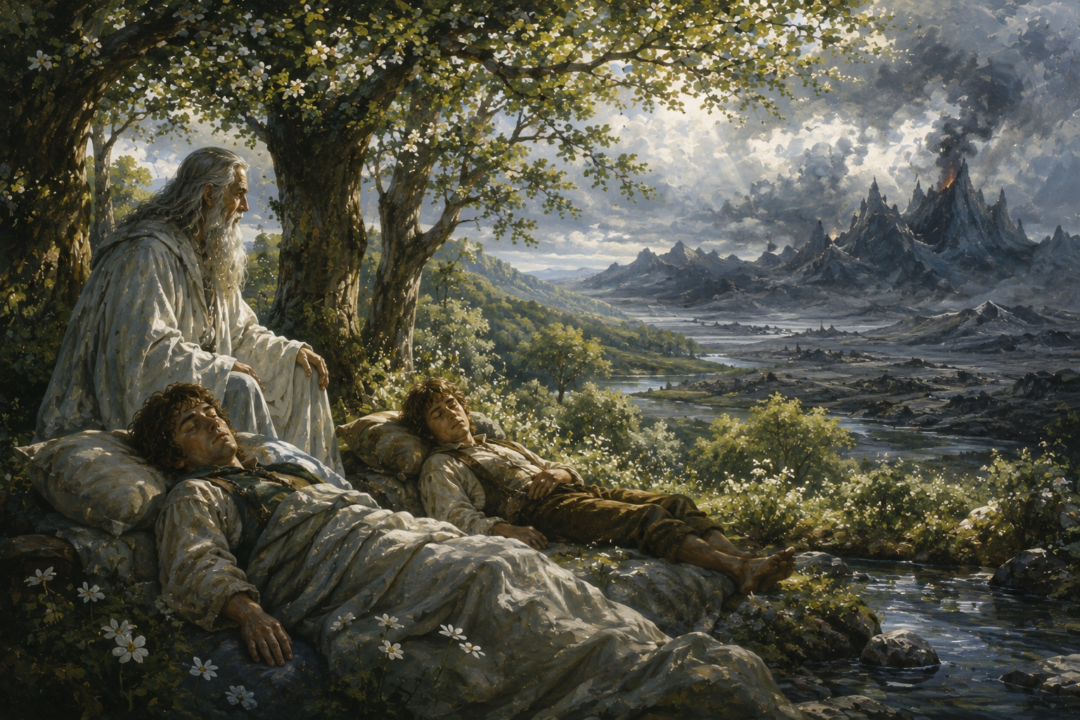
The landscape around Cormallen is living, fragrant, watered, and green. The contrast with the ash, fumes, thirst, and barren slopes of Mordor could hardly be stronger.
The texts do not present the Field as possessing some magical power of restoration. Its function is narrative and emotional rather than supernatural.
But the symbolism is difficult to miss.
Frodo and Sam crossed a dead land to destroy the instrument by which Sauron hoped to dominate the living world. When they wake after his fall, they wake among growing things.
The world has survived.
Victory Does Not Mean Everyone Is Healed
Cormallen can initially feel like the point at which everything has been made right.
Sam laughs and weeps. Old friends are reunited. There is feasting and praise. The impossible Quest has succeeded.
But Frodo's later story prevents us from reading the scene too simply.
The destruction of the Ring saves Middle-earth.
It does not restore Frodo to the person he was before carrying it.
His wounds remain. The anniversary of Weathertop troubles him. The memory of Shelob's attack returns. He eventually tells Sam that some people must surrender what they hoped to enjoy so that others may keep it.
Cormallen therefore becomes more poignant in retrospect.
The world can honour Frodo.
It cannot repay him.
Aragorn can place him on a throne. Armies can praise him. A minstrel can preserve his name. None of those things can erase the burden he carried.
This is one reason the chapter matters so much. Without Cormallen, Frodo's later inability to remain happily in Middle-earth might look as though his sacrifice had simply gone unnoticed.
It did not.
He receives extraordinary recognition.
And still he cannot remain.
The tragedy is not that Middle-earth fails to thank him. The tragedy is that gratitude has limits.
Why Cormallen Has to Come Before the Shire
There is one final reason for the Field of Cormallen.
The hobbits must be honoured by the great world before they return to a place that has almost no idea what they have done.
The Shire cannot measure their experience.
When they eventually return, they do not arrive to find monuments or cheering crowds. They find their own country damaged and must help free it themselves.
The contrast is deliberate and powerful.
At Cormallen, kings and warriors understand enough to bow before the Ring-bearers.
In the Shire, Frodo increasingly withdraws from public action while Merry, Pippin, and Sam take leading roles in setting things right.
Cormallen guarantees that the reader knows Frodo's quietness afterward is not evidence that he accomplished little.
We have already seen the judgment of the wider world.
The King stood before him.
The Host of the West acclaimed him.
His story was sung.
And then he went home.
That may be what the Field of Cormallen is ultimately for.
It is the space between saving the world and trying to live in it again.
For one brief moment, before crowns, rebuilding, departures, and the long road back to the Shire, everyone understands what two small travellers have done.
The hidden journey becomes public memory.
Power bows to sacrifice.
The living gather beneath the trees after escaping the Shadow.
And Frodo and Sam, who expected to die together on the slopes of Mount Doom, discover that there is still a world waiting to welcome them back.
Sources & Notes
- The Encyclopedia of Arda — Field of Cormallen: recovery, honours, and celebrations after Sauron’s fall — https://www.glyphweb.com/arda/c/cormallen.php
- The Encyclopedia of Arda — Ithilien: the land where the Host camped and the Ring-bearers recovered — https://www.glyphweb.com/arda/i/ithilien.php
- The Encyclopedia of Arda — Morannon: the Captains’ diversionary battle at the Black Gate — https://www.glyphweb.com/arda/m/morannon.php
- The Encyclopedia of Arda — Frodo Baggins: the Ring-bearer’s rescue and honour at Cormallen — https://www.glyphweb.com/arda/f/frodobaggins.php
- The Encyclopedia of Arda — Samwise Gamgee: Frodo’s companion and fellow honouree at Cormallen — https://www.glyphweb.com/arda/s/samwisegamgee.php
Background references for the Ring-bearers’ rescue and recovery, the Morannon diversion, and the ceremony in Ithilien. Primary narrative: J.R.R. Tolkien, The Return of the King, ‘The Field of Cormallen.’