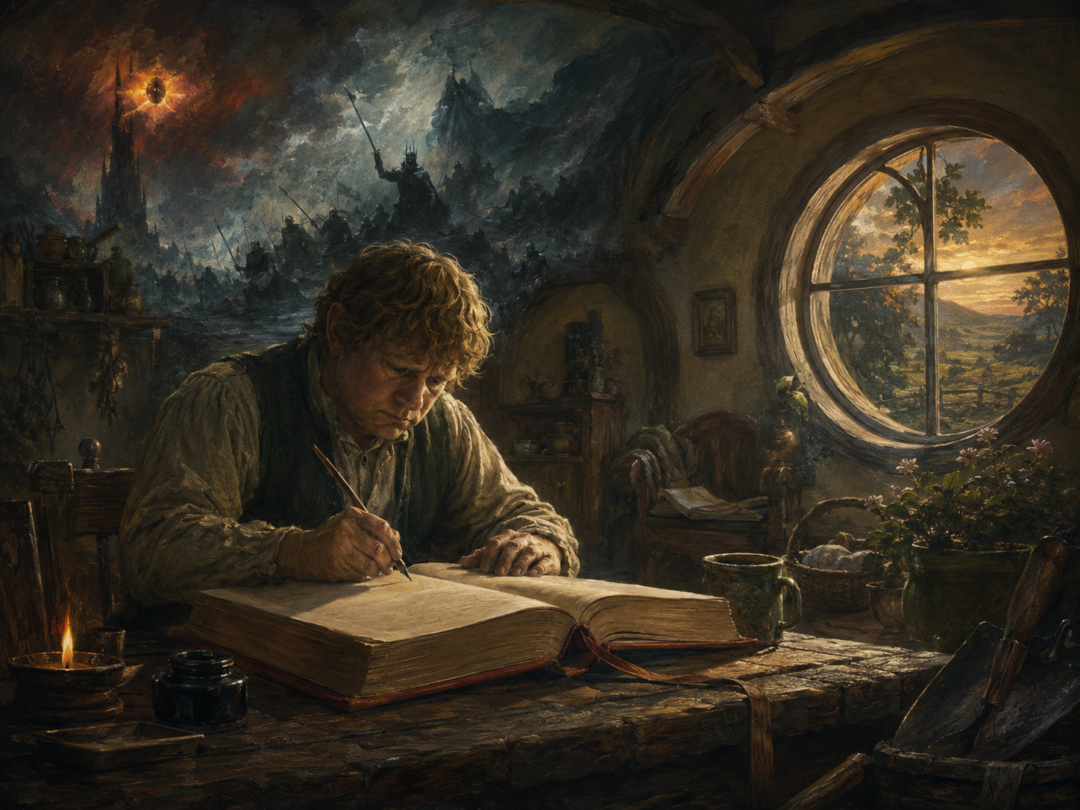
The Red Book begins with some of the most personal writing imaginable. Bilbo records his own adventure. Frodo continues the history through the War of the Ring. Sam, after carrying Frodo home and watching him depart across the Sea, becomes the final keeper of the book.
Yet the volume does not remain merely the possession of one famous household.
Long after the travellers are gone, the Red Book is preserved at Undertowers by Sam’s descendants. Copies multiply. Genealogies and other material accumulate around the central narrative. One crucial copy travels beyond the Shire and enters the learned world of Gondor, where names and Elvish words are checked and additional historical material is attached. More than a century later, a royal scribe named Findegil produces the copy that becomes especially important to the surviving textual tradition.
The result is one of the quietest transformations in Middle-earth: a family remembrance becomes something resembling an archive.
Not because Sam planned an institution around it, and not because his heirs rewrote his memories into official history, but because successive generations preserved, copied, organized, supplemented, and transmitted what one generation had experienced.
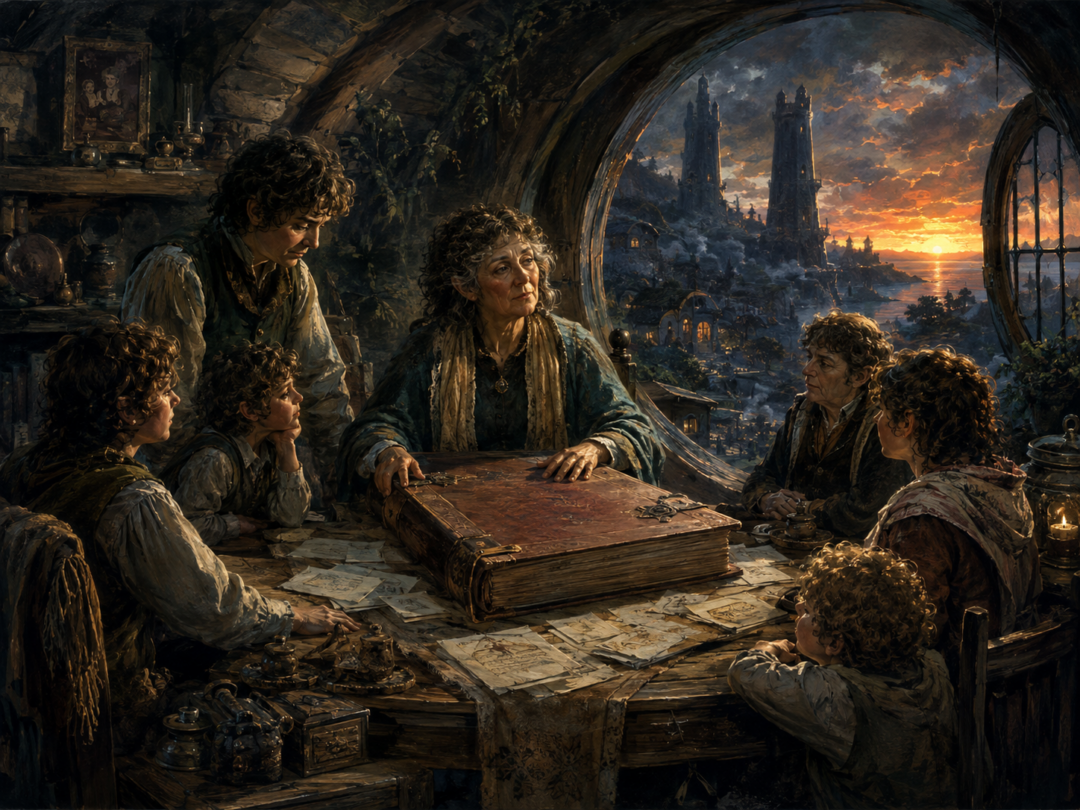
The Red Book Was Personal Before It Was Historical
The great irony of the Red Book is that the people inside its story do not initially experience themselves as figures from remote history.
Bilbo’s writings begin with his own adventures. Frodo inherits both the Ring and the responsibility of continuing the record. Sam then inherits something different: the task of living after the story seems to have ended.
That makes the book intensely domestic.
At Bag End it belongs among relationships, grief, memory, and unfinished farewells. Frodo does not simply leave Sam a chronicle of kings and battles. He leaves behind the written shape of experiences that wounded him too deeply for ordinary Shire life to heal.
Sam’s role therefore matters enormously. The Red Book passes through someone who was both participant and witness. He knew Frodo before the Quest, walked beside him into Mordor, returned with him to the Shire, and remained after Frodo departed.
But Sam is not the endpoint.
The “Note on the Shire Records” says the original Red Book was not preserved, while many copies were made, particularly of its first volume, for descendants of Sam’s children. That small detail changes the scale of the object. What had belonged to a handful of travellers becomes reproducible family inheritance.
Barrow Downs Forum
A book ceases to depend on one physical copy.
That is the beginning of archival survival.
Elanor Creates the Bridge Between Memory and Institution
Sam and Rose had thirteen children, but Elanor becomes especially important to the Red Book’s later history.
She married Fastred of Greenholm. After the Westmarch was added to the Shire, Fastred became its first Warden, and the family settled at Undertowers beneath the Tower Hills. Their descendants became the Fairbairns of the Towers, hereditary Wardens of Westmarch.
Encyclopedia of Arda
The Red Book was preserved there.
This is more significant than simply saying that Elanor inherited her father’s belongings.
Sam’s memories move from Bag End into a continuing household whose identity lasts across generations. The book becomes attached not merely to an individual owner but to a family seat and a hereditary line.
The text itself gives us no detailed picture of an archive room at Undertowers, no librarians cataloguing shelves, and no formal rules governing access. Those images would go beyond the evidence.
But the effect is unmistakably archival in the broader sense: custody becomes continuous.
Sam can die. Elanor can die. Her children can die. The manuscript tradition survives because responsibility for it no longer depends upon personal memory of the people who wrote it.
That is the decisive transition.
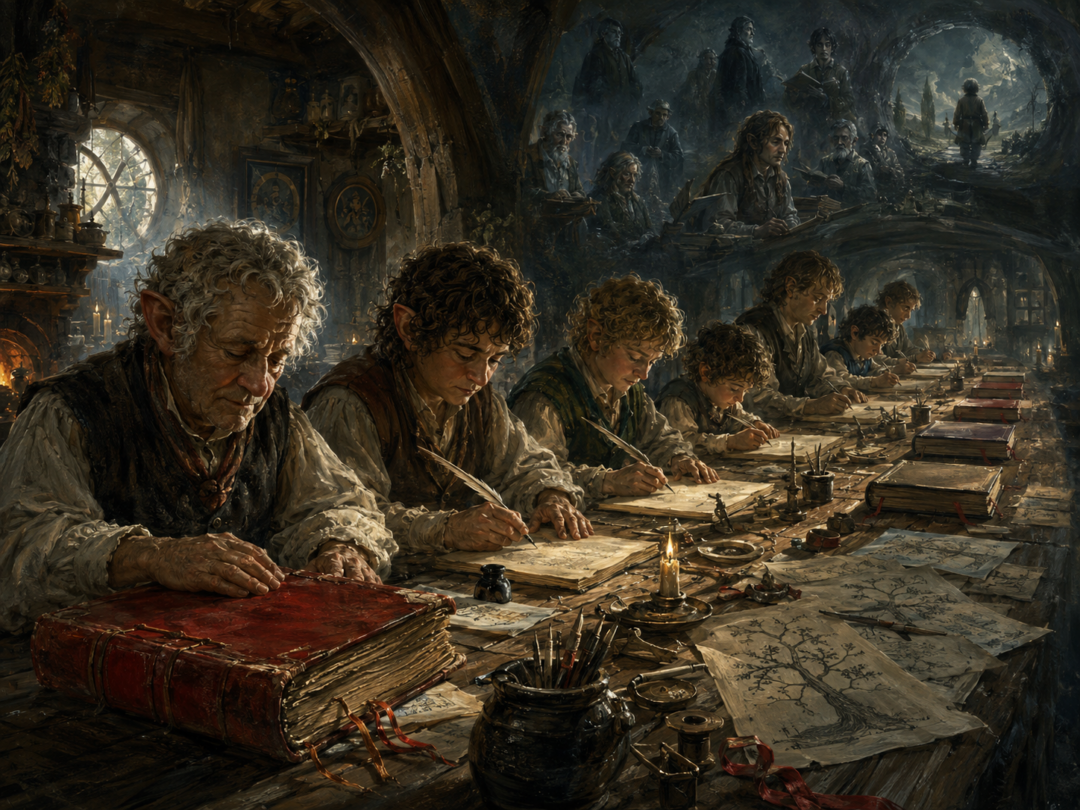
Sam’s Descendants Do More Than Keep an Heirloom
A treasured family object can be preserved without becoming a historical source. The Red Book goes further.
The Shire records associated with it contain genealogical material, and the genealogies were developed in Westmarch. One surviving family tree traces Sam’s own ancestry and descendants and includes people born generations after the War of the Ring. This means that later hands were continuing to organize information around the original narrative rather than merely locking the old manuscript away.
Encyclopedia of Arda
That distinction matters.
The family is no longer preserving only what Sam remembered. Later generations are situating Sam himself inside history.
To Sam, Hamfast Gamgee was his father, Rose was his wife, and Elanor was his daughter. To descendants born decades later, those people were ancestors. Their relationships could be charted, dated, and connected to later branches of the family.
Memory had become genealogy.
The heroes of the War of the Ring were becoming predecessors.
This is one of the clearest signs that the Red Book tradition has passed beyond memoir. An autobiographical story tells what happened to “us.” An archive allows later generations to ask who “we” were.
Copying Saves the Story by Allowing the Original to Disappear
There is another striking detail: the original Red Book itself was eventually lost.
At first that sounds like failure.
In fact, the survival of its contents demonstrates why copying mattered.
The Note on the Shire Records explicitly says that numerous copies were made. The text therefore develops something an ordinary heirloom lacks: redundancy. Its survival is no longer tied to the survival of a single set of pages.
Barrow Downs Forum
This is perhaps the most archival thing Sam’s descendants accomplish.
They allow the physical object and the information it contains to become separate problems.
A sword preserved by a family remains one sword. If it is destroyed, it is gone.
A manuscript that has been faithfully copied can lose its original and still possess descendants.
That principle becomes essential to everything that follows, because the Red Book tradition eventually leaves the immediate Fairbairn family and enters a much larger network of preservation.
Peregrin’s Copy Connects Hobbit Memory to Gondor
The most important branch of the textual tradition did not remain at Undertowers.
According to the Note on the Shire Records, a copy was made at King Elessar’s request. Peregrin Took later brought that book to Gondor when he retired there in the Fourth Age. It became known as the Thain’s Book.
Once in Minas Tirith, the text underwent a new kind of preservation.
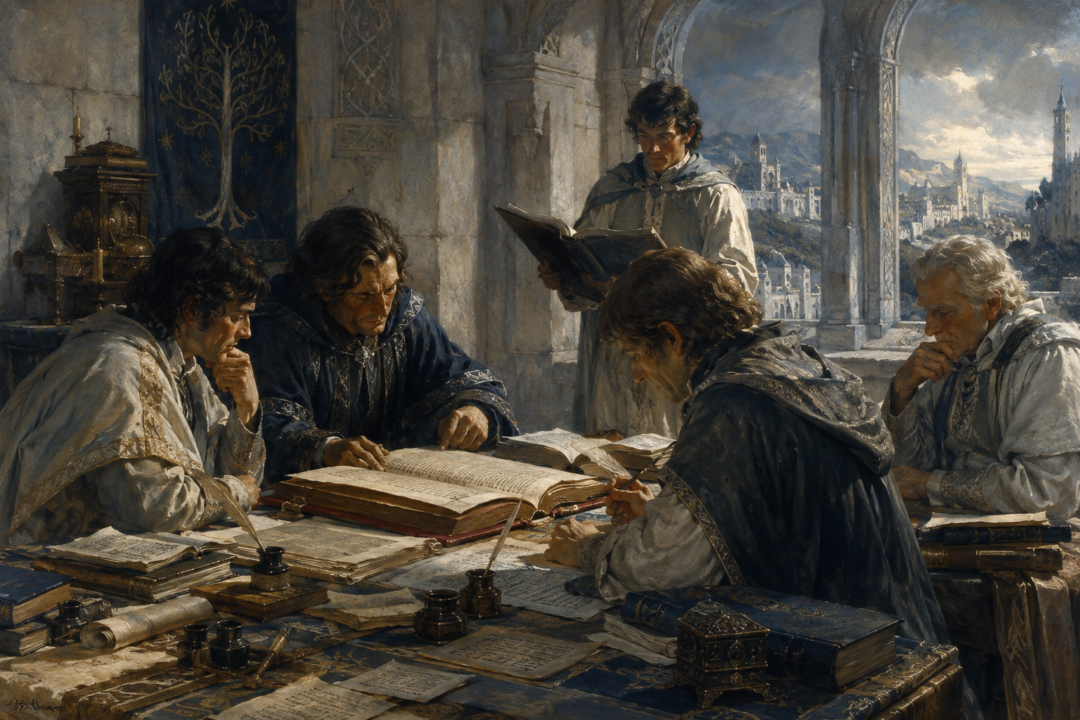
It received annotations and corrections, particularly involving names, words, and quotations in Elvish languages. An abbreviated form of material concerning Aragorn and Arwen was also added.
This does not mean Gondorian scholars replaced the hobbits’ account with an official royal version.
The surviving description instead suggests layers.
The central narrative remains associated with the hobbit authors, while later readers add knowledge available from other traditions. Hobbit testimony can now be compared with linguistic expertise and records preserved outside the Shire.
The Red Book has crossed another threshold.
It is no longer simply something descendants copy because their ancestors were involved.
Other communities regard it as evidence.
Findegil Marks the Moment the Tradition Becomes Truly Scholarly
The clearest symbol of that change is Findegil.
More than a century after Peregrin’s journey south, Findegil, identified as the King’s Writer, completed an exact copy of the Thain’s Book in Minas Tirith. That copy was preserved at Great Smials in the Shire and was particularly valuable because it retained material that other copies had lost, including the entirety of Bilbo’s “Translations from the Elvish.”
Consider how far the book has travelled conceptually.
Bilbo had once written about an adventure he personally survived.
Now a professional scribe of the Reunited Kingdom was copying a textual tradition whose contributors belonged to previous generations, attempting to preserve its contents in detail.
That is archival culture.
The value of the text no longer depends upon knowing Bilbo, Frodo, or Sam. Its authority has become transmissible.
People who never met the authors consider the record important enough to reproduce carefully.
The Fairbairns Preserve Something Larger Than Sam’s Reputation
It would be easy to interpret the Fairbairns’ preservation of the Red Book as family pride.
That may have played some human part, but the texts do not tell us their private motives, so certainty would be unjustified.
What can be seen is the outcome.
At Undertowers, the Red Book becomes associated with a stable line of custodians. Copies serve Sam’s descendants. Genealogical information grows around the original narrative. Through other hobbit families and Gondor, the manuscript enters a broader documentary tradition. Eventually even portions that were vulnerable to loss survive because particular copies preserve them.
Encyclopedia of Arda
The Fairbairns therefore preserve far more than evidence that their ancestor was a hero.
They preserve perspectives belonging to people who ordinarily vanish from great histories.
A gardener’s observations survive beside the deeds of kings.
Hobbit meals, roads, fears, jokes, misunderstandings, songs, friendships, and grief remain part of the record of an age dominated elsewhere by armies and rulers.
That may be the deepest consequence of the entire manuscript tradition.
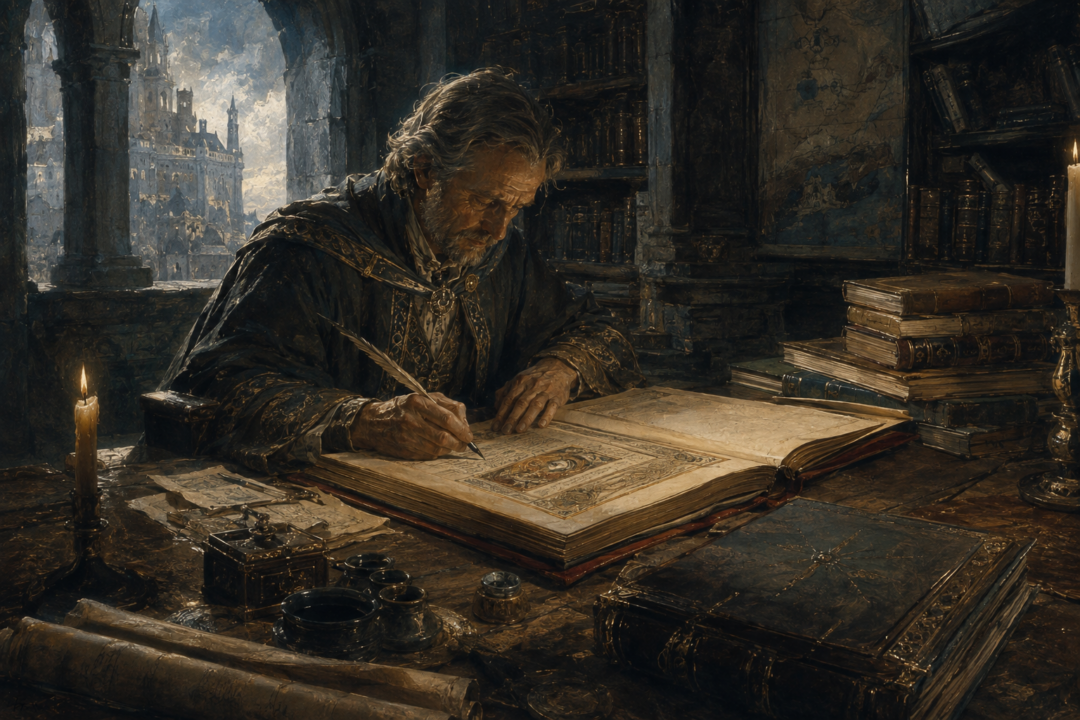
Sam’s Greatest Legacy May Be the Survival of Other People’s Voices
Sam returns from Mordor and becomes an important figure in the Shire, but the Red Book suggests another kind of legacy.
He becomes a link in a chain.
Bilbo writes. Frodo continues. Sam preserves and completes. His descendants keep the record. Later hobbits copy it. Gondorian scholars annotate it. Findegil reproduces an important textual descendant with extraordinary care.
No single person creates the archive.
That is precisely the point.
Archives outlive eyewitnesses because memory stops belonging to eyewitnesses alone.
By the time Sam’s distant descendants handle the Red Book, Frodo’s pain is no longer living memory. Bilbo’s riddles belong to another age. Aragorn has passed into history. Even Sam himself has become a figure on a family tree.
Yet their words continue travelling.
The humble book begun in the world of Bag End survives because succeeding generations treat memory as something worth handing on accurately rather than merely remembering fondly.
The War of the Ring ends when the Ring is destroyed.
But the struggle against forgetting continues for generations afterward.
And in that quieter struggle, Sam’s descendants become custodians of an age they never saw.
Sources & Notes
- The Encyclopedia of Arda — Red Book of Westmarch: authorship, custody, copies, and later additions — https://www.glyphweb.com/arda/r/redbook.php
- The Encyclopedia of Arda — Elanor: Sam’s daughter and the Red Book’s inheritor at Undertowers — https://www.glyphweb.com/arda/e/elanor.php
- The Encyclopedia of Arda — Fairbairn Family: hereditary Wardens who preserved the Red Book — https://www.glyphweb.com/arda/f/fairbairn.php
- The Encyclopedia of Arda — Undertowers: Westmarch seat where Sam’s descendants kept the manuscript — https://www.glyphweb.com/arda/u/undertowers.php
- The Encyclopedia of Arda — Findegil: royal scribe who made the Gondorian copy of the Thain’s Book — https://www.glyphweb.com/arda/f/findegil.php
- The Encyclopedia of Arda — Thain’s Book: the Gondor-annotated copy underlying later textual transmission — https://www.glyphweb.com/arda/t/thainsbook.php
Background references for the Red Book’s family custody, copying, supplementation, and transmission through Undertowers, the Thain’s Book, and Findegil. Primary textual frame: J.R.R. Tolkien, The Lord of the Rings, Prologue, ‘Note on the Shire Records.’