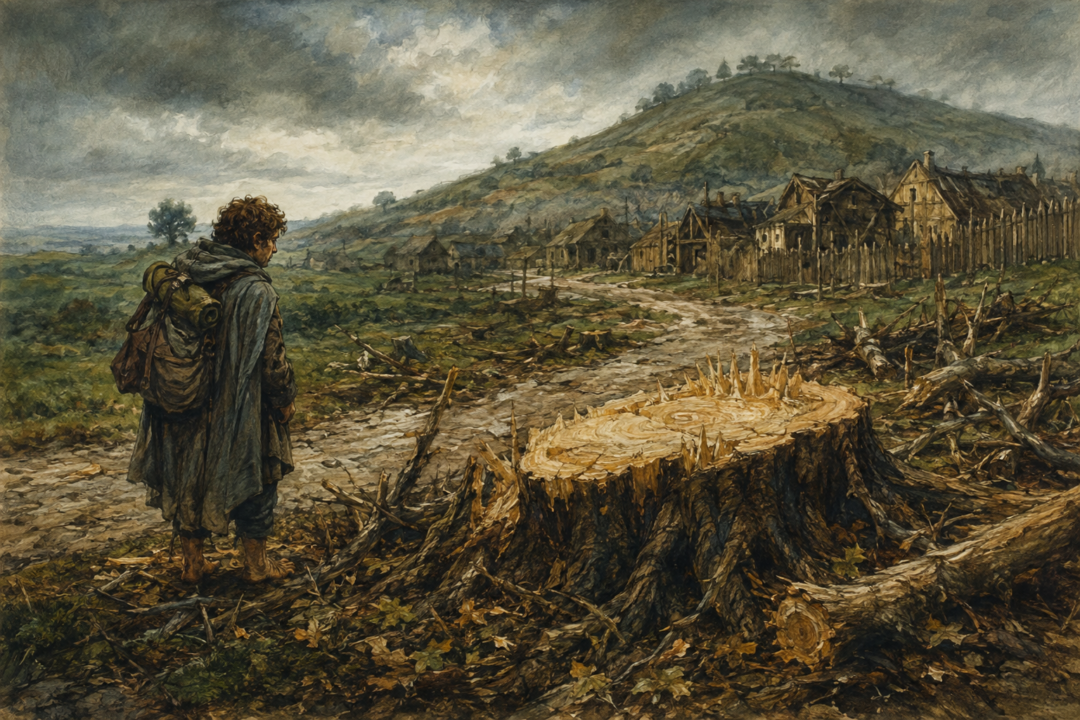
When Sam Gamgee returned to Hobbiton, one loss struck him with particular force.
The houses could be rebuilt. Bagshot Row could be dug again. Damaged villages could be repaired, sheds replaced, gardens replanted, and the ugly works of Sharkey's regime pulled down.
But the trees were different.
Along the road toward Hobbiton, the returning Travellers found trees felled and new, mean houses standing where the familiar green landscape had been. The Party Tree itself—the great tree beneath which Bilbo's birthday feast had been held—was gone. In The Return of the King, the destruction of trees repeatedly carries an emotional weight beyond ordinary property damage.
That distinction reveals something important about the Shire. A house belongs to a generation. A mature tree may belong to several.
And after the Scouring, the hobbits discovered that defeating their oppressors was quicker than restoring what those oppressors had destroyed.
Sharkey Damaged More Than Buildings
The occupation of the Shire under Lotho Sackville-Baggins and then Saruman—called Sharkey by his Men—was destructive partly because it attacked the ordinary structures of hobbit life.
There were rules, locked holes, confiscated goods and armed Men. Old inhabitants were displaced. Bagshot Row was dug up, and the Gaffer was among those turned out. New buildings appeared that the returning hobbits regarded as ugly. The old mill was replaced by a much larger one that polluted the Water.
Yet the devastation was not merely architectural.
Trees had been cut down extensively around Hobbiton and Bywater. The returning Travellers see the loss immediately. The landscape they remembered was not simply occupied; it had been altered.
This matters because the Shire had never been defined by monumental architecture. Its identity depended upon the relationship between habitation and cultivated land: holes in hillsides, low houses, gardens, hedges, fields, lanes and trees.
Sharkey's regime breaks that relationship. It does not merely build. It builds without affection for the place in which the building occurs.
That is why reconstruction after the Battle of Bywater has two very different clocks.
One is the clock of labour.
The other is the clock of growth.
Hobbit-Holes Can Be Remade
The rebuilding of Bagshot Row makes the contrast especially clear.
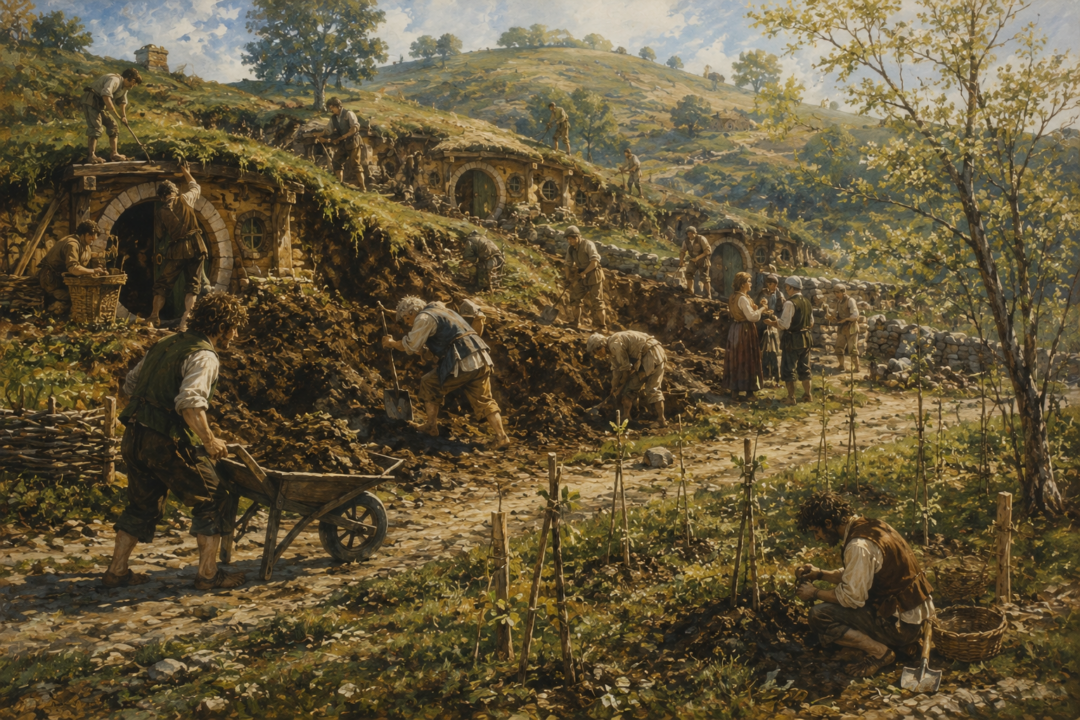
The old holes beneath Bag End had been destroyed during the occupation. After the Shire was liberated, new holes were dug there. The rebuilt settlement became New Row, though other names were considered, and it was jokingly called Sharkey's End in Bywater.
This is not presented as a project requiring generations.
Hobbits possess the practical skills necessary to restore their homes. The Prologue to The Lord of the Rings makes clear that although hobbits traditionally favoured holes, many also lived in houses, and they had long practiced building above ground as well as delving suitable dwellings into hills.
Once Sharkey and his Men are gone, the fundamental obstacles to reconstruction are therefore human ones: labour, organization and materials.
Those problems can be solved.
A wall can be raised. A roof can be repaired. A hole can be dug. A mill can be torn down. A family can move back into a rebuilt home.
A mature tree cannot be constructed in the same way.
A Tree Contains Years That Labour Cannot Replace
The books never give a botanical rule stating how many years every Shire tree requires to mature. There is no canonical table comparing construction time with tree growth.
The distinction is nevertheless built into the narrative.
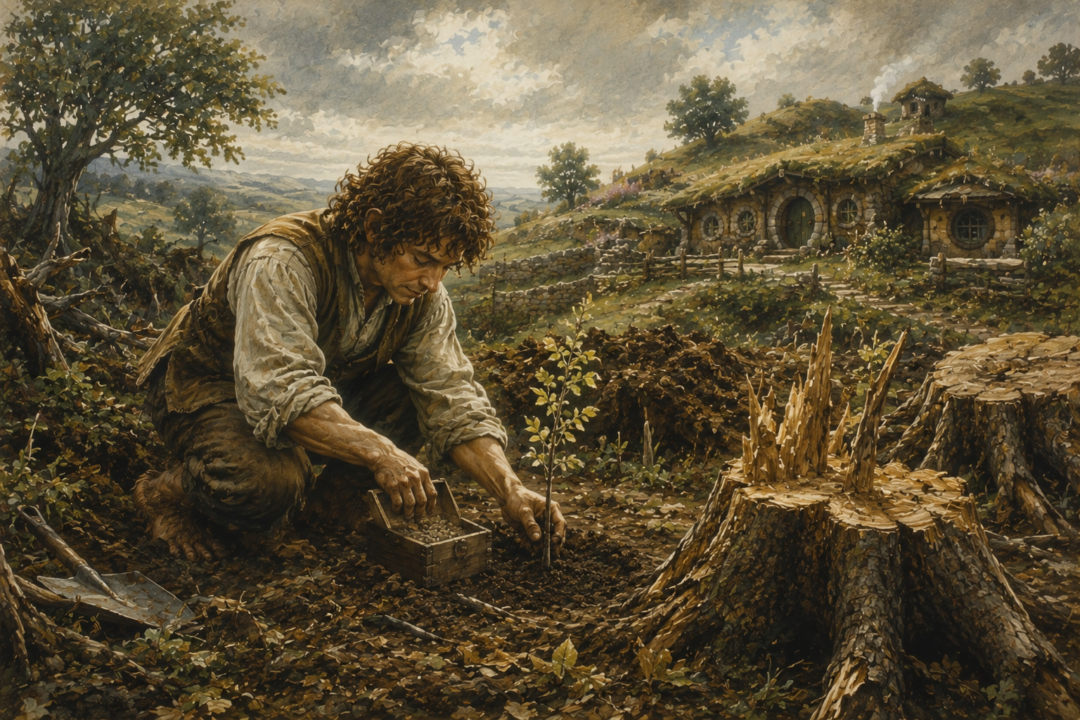
When Sam begins restoring the Shire, he plants saplings where especially beautiful or beloved trees have been destroyed. A sapling is a beginning, not an immediate replacement for the mature tree that preceded it.
This is the hidden cruelty of indiscriminate felling.
Cutting down a tree can take hours. Growing its equivalent can take years or decades, depending upon the tree. Tolkien does not specify those figures for the Shire, so they should not be treated as canonical measurements. The important textual point is simpler: Sam must plant young trees and entrust their completion to the future.
A rebuilt dwelling can restore shelter relatively quickly.
A replanted landscape requires patience.
The people who remember the old tree may never experience its replacement at the same age and scale.
That gives the Scouring a form of loss that victory cannot instantly reverse.
Sam's Gift Changes the Equation—but Does Not Erase the Loss
Sam possesses one extraordinary advantage.
Before leaving Lothlórien, Galadriel gave him a small box containing earth from her orchard and a silver nut. Sam did not initially know precisely what he would do with the gift.
After seeing the devastation of the Shire, its purpose became clear.
He used the precious earth sparingly, placing a grain at the root of each tree he planted in places where beloved trees had been destroyed. He devoted special attention to Hobbiton and Bywater, and then scattered what remained into the air so that it would fall across the Shire.
The result was extraordinary.
The year 1420 by Shire-reckoning became famous for its abundance. Growth was exceptionally rich, and the young trees prospered remarkably well.
Yet even this almost miraculous renewal does not simply reverse time.
Sam cannot recover the individual trees that Sharkey's people felled. He can encourage new life where they stood.
That difference is essential.
Restoration in the Shire is not resurrection.
It is inheritance.
The Party Tree Shows What Cannot Be Rebuilt
No tree demonstrates this more powerfully than the Party Tree.
It had stood in the Party Field beneath the Hill and formed the living centre of Bilbo's great birthday celebration. When Sam returns and discovers it has been cut down, the loss is personal as well as communal.
He does not replace it with an ordinary sapling.
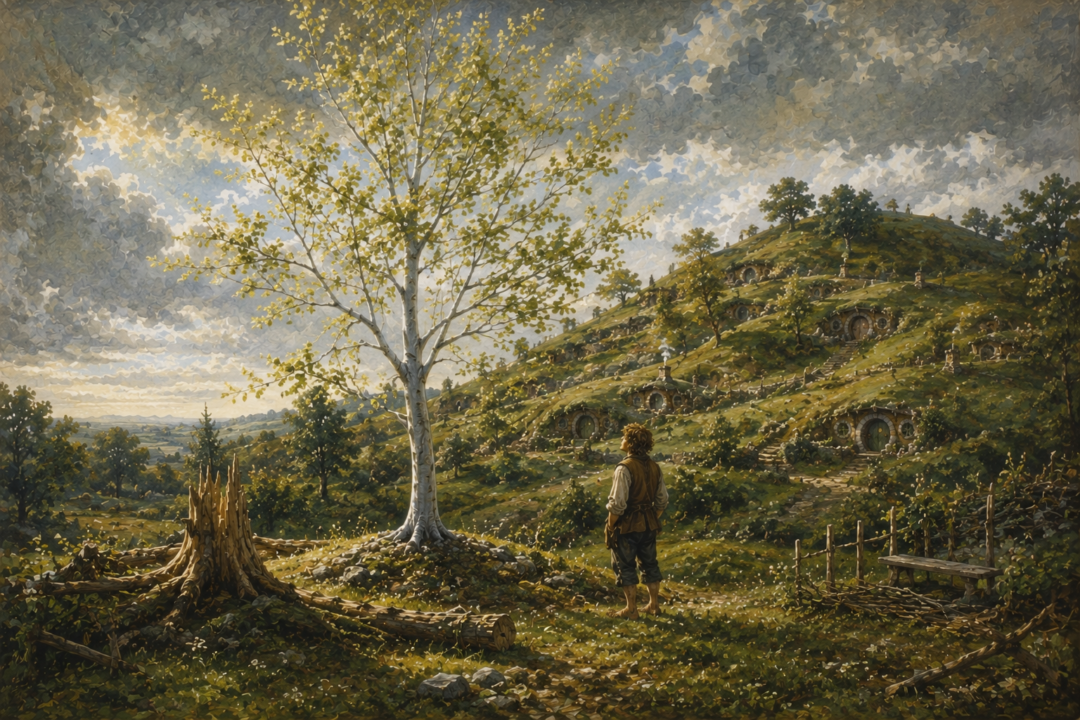
He plants Galadriel's silver nut in the Party Field.
What grows is a mallorn, the great golden tree associated above all with Lothlórien. It becomes famous as the only mallorn of its kind in that region of Middle-earth, and its beauty eventually draws visitors from far away.
In one sense, the replacement becomes more remarkable than what was destroyed.
But it is still not the Party Tree.
The old tree carried memories that no new tree, however beautiful, could literally reproduce. The mallorn creates new history instead.
This is one of the quietest but most important ideas in the Shire's recovery: healing does not require pretending that nothing happened.
The scar can become the site of something new.
Saruman's Final Defeat Is Measured in Growth
Saruman once possessed immense knowledge and power. By the time he reaches the Shire, much of that greatness has narrowed into domination, spite and destruction.
His final works are correspondingly ugly.
He can command trees to be cut down. He can order buildings raised. He can foul water and reorganize ordinary life through coercion.
But he cannot create the kind of beauty he destroys.
That is why Sam is such a fitting opposite to him.
Sam's answer is not another system of control. It is gardening.
He plants.
He tends.
He distributes Galadriel's gift rather than hoarding it in one private garden. Then he waits.
The contrast should not be pushed into a rigid magical rule that the text never states. But as a thematic opposition it is difficult to miss: Sharkey's power produces rapid damage, while Sam's labour works through cultivation, patience and living things.
Destruction imposes its will upon the present.
Gardening makes a promise to the future.
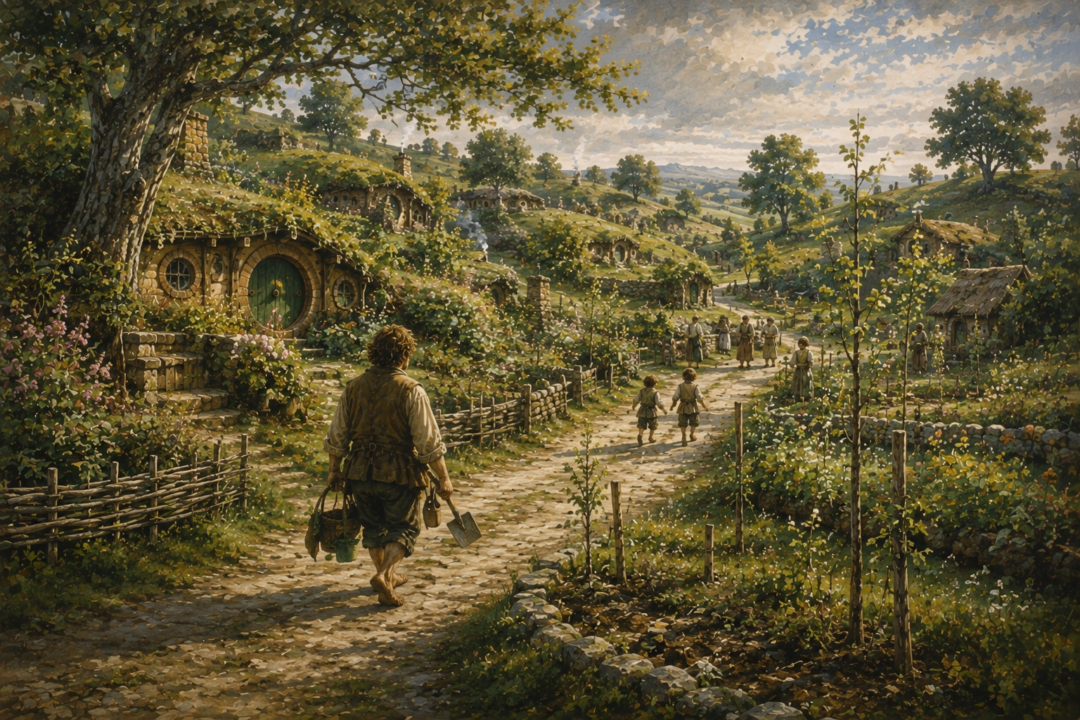
The Shire Is Restored by Accepting Two Different Kinds of Time
The rebuilding after the Scouring is remarkably successful. Homes are restored, New Row replaces Bagshot Row, the intrusive structures of Sharkey's regime disappear, and the exceptional year of 1420 brings extraordinary fertility.
Yet the Shire's recovery works because the hobbits do not treat every kind of damage as identical.
Some things can be repaired.
Some things must be regrown.
That distinction explains why the trees matter so much.
A house is primarily an object made by hands. Given sufficient skill, labour and materials, people can reconstruct one.
A tree is alive. People may plant it, protect it and cultivate the ground around it, but they cannot simply manufacture the years contained in a mature trunk and spreading crown.
Even Galadriel's gift accelerates renewal rather than making the past unhappen.
And that may be the deepest reason the Scouring ends with planting rather than building.
The Shire does not survive because its inhabitants somehow restore every detail of the world they knew before the War of the Ring. They cannot.
It survives because they refuse to let destruction have the final word.
New holes can shelter the families whose old homes were ruined. New saplings can stand where old trees fell. A golden mallorn can rise where the Party Tree once carried the memories of Bilbo's feast.
The houses tell the hobbits that life can resume.
The trees tell them something harder.
Some acts of destruction create losses that only time can answer—and the person who plants a tree may be working partly for people who come after him.
Sources & Notes
- https://tolkiengateway.net/wiki/Scouring_of_the_Shire — Tolkien Gateway: Scouring of the Shire (Sharkey’s destruction, the Battle of Bywater, and the hobbits’ subsequent cleanup and rebuilding).
- https://tolkiengateway.net/wiki/Bagshot_Row — Tolkien Gateway: Bagshot Row (the demolished hobbit-holes rebuilt after the occupation as New Row).
- https://tolkiengateway.net/wiki/Party_Tree — Tolkien Gateway: Party Tree (the beloved felled tree replaced by Sam’s mallorn seedling).
- https://tolkiengateway.net/wiki/Mallorn — Tolkien Gateway: Mallorn (the exceptional Lórien tree grown from Galadriel’s gift, which still required time to mature).
- https://tolkiengateway.net/wiki/Samwise_Gamgee — Tolkien Gateway: Samwise Gamgee (his use of Galadriel’s earth and seed to restore the Shire’s damaged landscape).
Sources document the Scouring’s damage, the quick rebuilding of Bagshot Row, and Sam’s longer-term restoration of the Party Tree and other lost trees.