How the Beginning of the First Age Depends on Which Tolkienian Reckoning Is Being Used
Ask when the First Age began, and the obvious answer seems to be: Year 1.
That answer is useful—and also potentially misleading.
The familiar chronology of Beleriand numbers the first rising of the Sun as the beginning of its solar year-count. Men awaken in the East, Fingolfin’s people enter the new daylight after their terrible crossing of the Helcaraxë, and the wars against Morgoth enter the period that readers can follow year by year toward the War of Wrath.
But the Elves were already ancient by then.
Fëanor had already made the Silmarils. Melkor had already been imprisoned and released. The Two Trees had already been destroyed. Finwë was dead. The Noldor had rebelled, the Kinslaying at Alqualondë had occurred, and much of the history that defines the Elder Days was already behind them.
The apparent contradiction comes from treating several overlapping ways of reckoning time as though they were one calendar. They are not. The safest distinction is between the First Age of the Children of Ilúvatar and the Years of the Sun within the First Age.
Once that distinction is made, the chronology becomes much clearer.
The First Age Does Not Simply Mean “The First 590 Years”
The number most readers encounter for the First Age is approximately 590 years. That number belongs to the solar chronology of the wars in Beleriand.
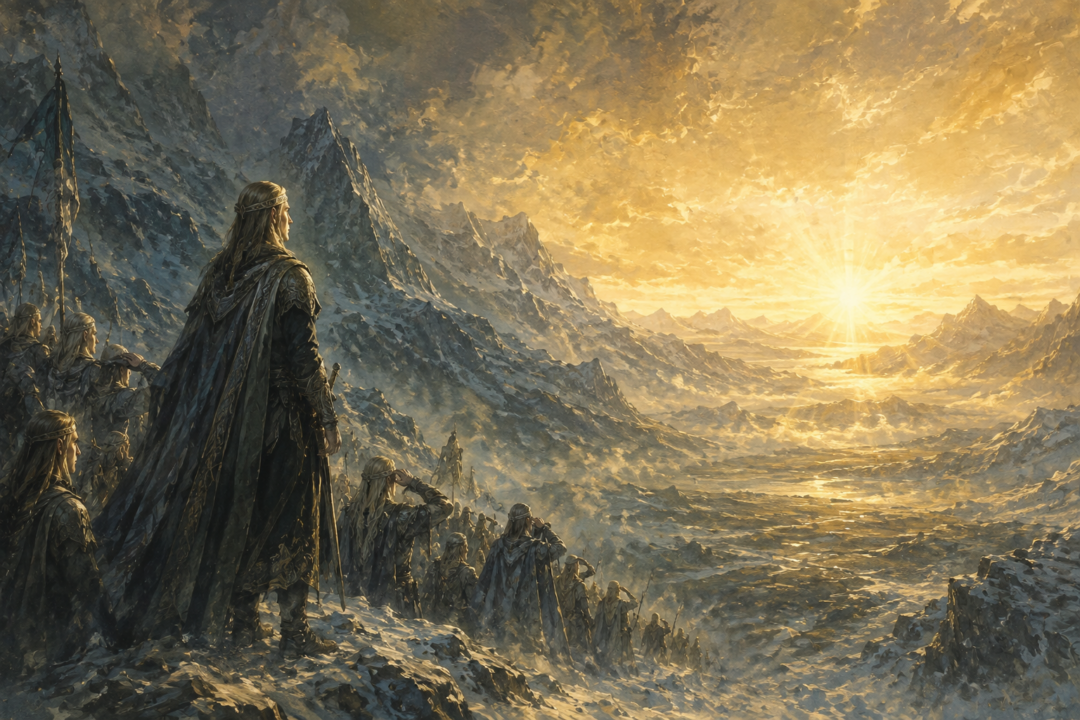
The first rising of the Sun establishes the beginning of the numbered Years of the Sun used for this part of the chronology. From there, events can be dated with familiar-looking numbers: the rescue of Maedhros, the building of Nargothrond and Gondolin, the coming of Men into Beleriand, the great battles against Morgoth, the fall of the hidden kingdoms, Eärendil’s voyage, and eventually the War of Wrath.
That makes “First Age 1” convenient shorthand for the first Year of the Sun in the First Age.
It does not necessarily mean that the First Age itself had only just begun.
This distinction is important because Tolkienian chronology contains periods that overlap conceptually. The Years of the Trees describe one mode of measuring the ancient world, while the Ages of the Children of Ilúvatar describe another division of history.
The two systems do not have to begin and end together.
The Deeper Beginning Is the Awakening at Cuiviénen
In the chronology represented by the Annals of Aman, the decisive beginning is not sunrise but the Awakening of the Elves.
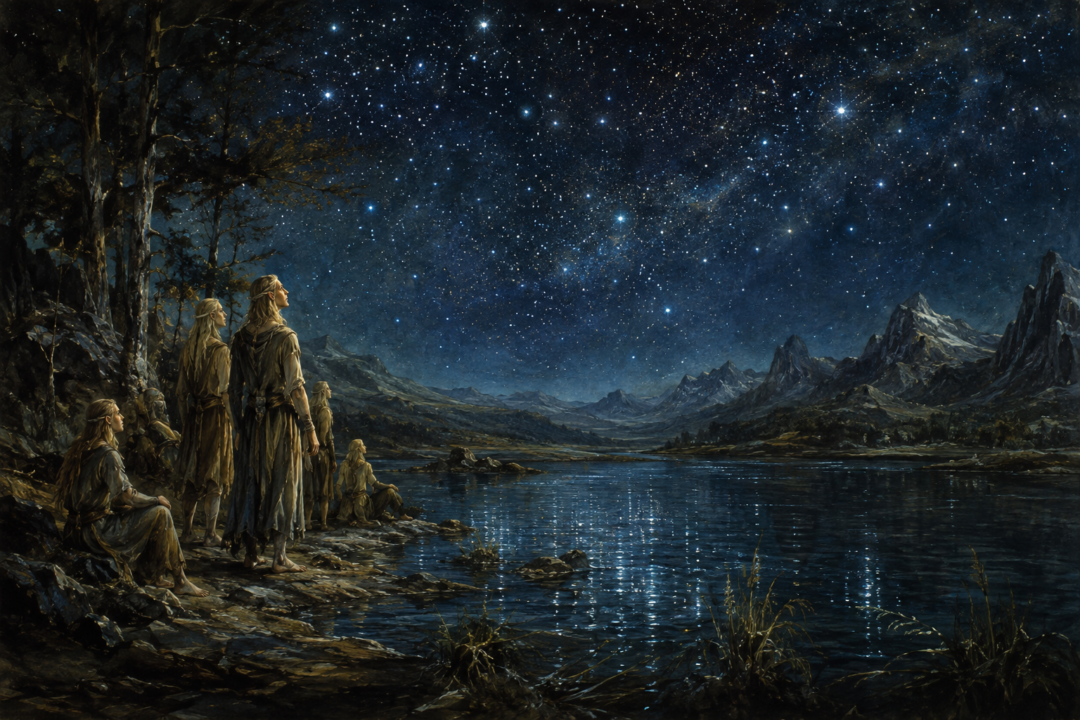
The Elves awaken beside the waters of Cuiviénen beneath the stars, before the Sun and Moon have appeared. This event occurs during the Years of the Trees, traditionally at Valian Year 1050 in that chronology.
More importantly, the annalistic tradition explicitly associates their awakening with the beginning of the First Age of the Children of Ilúvatar.
That wording reveals what an “Age” fundamentally means in this reckoning.
The First Age is not simply the first period illuminated by the Sun. It is the first age of the Children—the incarnate beings whose histories will dominate Arda from that point onward.
Before Cuiviénen there is already an immense history: the shaping of Arda, the struggles of the Valar and Melkor, the destruction of the Lamps, the establishment of Valinor, and the growth of the Two Trees.
Yet these belong to a world awaiting the Children.
At Cuiviénen, that changes.
The first Elves open their eyes beneath Varda’s stars, and history acquires a new center.
Why the First Sunrise Still Looks Like a Beginning
Confusion is understandable because the first sunrise really is one of the greatest chronological dividing lines in the legendarium.
The Two Trees have been killed. Their light survives principally through their last flower and fruit, from which the Moon and Sun are fashioned. The old illumination of Valinor has passed away.
Meanwhile, the exiled Noldor have returned to Middle-earth.
Then the Sun rises.
Its coming is also bound to the awakening of the Secondborn, Men, in Hildórien. The Silmarillion presents Men as awakening with the first rising of the Sun, just as the Elves had awakened beneath the stars.
So the moment functions as a spectacular transition.
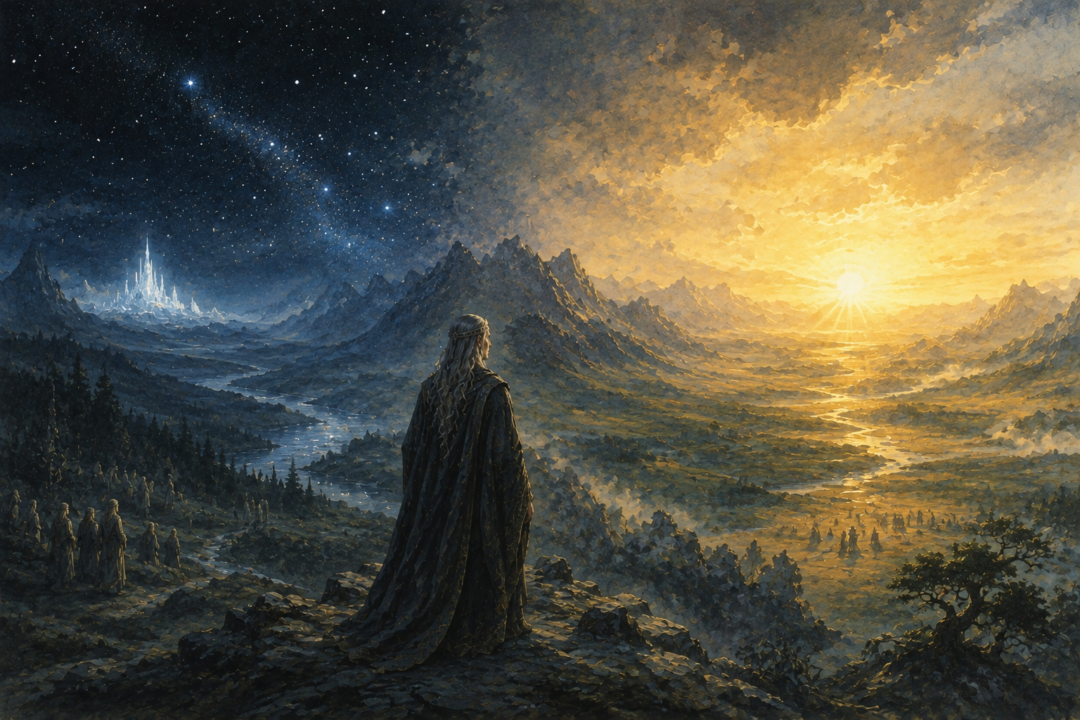
Before it lie the long starlit centuries of the Elves and the Years of the Trees. After it comes the solar world in which Men will increasingly take their place.
It is therefore perfectly sensible to speak of the first Year of the Sun at this point.
The problem begins only when “first Year of the Sun” is silently converted into “beginning of the First Age.”
Those are not necessarily the same statement.
Fëanor’s Rebellion Is Already First Age History
One consequence of the broader reckoning is surprisingly important: much of the story normally treated as the “prologue” to the wars of Beleriand actually occurs within the First Age.
Fëanor is born during the Years of the Trees. He creates the Silmarils before the Sun exists. Melkor and Ungoliant destroy the Two Trees. Finwë is murdered at Formenos. The Silmarils are stolen. Fëanor swears his terrible oath with his sons.
The Noldor depart from Aman. Blood is shed at Alqualondë. Mandos pronounces the Doom of the Noldor. Fëanor abandons Fingolfin’s people and burns the stolen ships at Losgar.
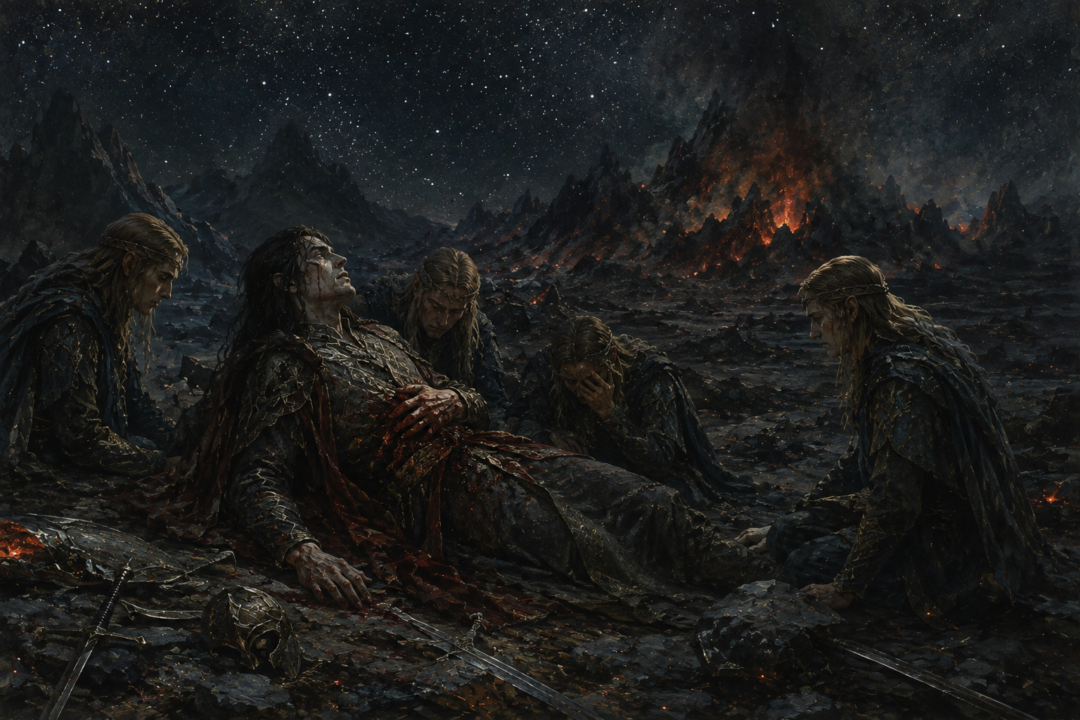
Fëanor then reaches Middle-earth and fights Morgoth’s forces beneath the stars. He is mortally wounded before the first sunrise.
If the First Age began only with the Sun, Fëanor would die before the First Age properly started.
That is possible only under a narrowly solar numbering convention, not under the broader reckoning of the First Age of the Children.
The broader definition makes the narrative structure much more intuitive: Fëanor’s rise, rebellion, return to Middle-earth, and death belong to the same great Age that his oath will help devastate.
Why “First Age 1” Is Still Useful
None of this means that dates such as F.A. 1 or F.A. 455 are useless.
They are extremely useful provided we understand what is being numbered.
Once the Sun appears, the chronology becomes much easier to express in ordinary solar years. The surviving annalistic material can therefore describe the wars of Beleriand with comparatively precise dates.
The first solar year is the year of the first sunrise and the awakening of Men. The numbered sequence then continues through the long struggle against Morgoth.
Thus a timeline can call that year “First Age 1” without necessarily claiming that no part of the First Age preceded it.
The number identifies the solar year within the Age, rather than proving where the Age itself began.
This is similar to placing two grids over the same landscape. One divides history according to forms of celestial timekeeping; another divides it according to the great historical Ages of the Children.
Their boundaries need not coincide.
There Is an Additional Complication: Not Every Tradition Defines the Boundary Identically
Tolkienian chronology is not perfectly uniform across every surviving text and phase of composition.
There are traditions in which the terminology around the First Age and the first rising of the Sun differs from the broader chronology described above. In material associated with the lore of Aman, the first sunrise can itself function as an ending boundary for an earlier “First Age,” while the Exiles’ historical reckoning extends the First Age through the wars against Morgoth.
That variation matters.
It means the question “When did the First Age begin?” should not always be answered by pretending that every chronological text uses First Age in precisely the same technical way.
The strongest general answer for the First Age of the Children of Ilúvatar is the Awakening of the Elves at Cuiviénen. But when discussing a specific chronology, annal, or numbered date, the particular system being used should be identified.
This is why apparently contradictory Tolkien timelines can sometimes both contain defensible information: they may be counting different things.
The Length of the First Age Is Therefore More Complicated Than 590 Years
If the Age begins with the Awakening of the Elves rather than the first sunrise, then it obviously lasts far longer than approximately six centuries.
The 590-year figure represents only the solar portion at the end of the Age.
Earlier chronology measured time using Valian Years, and converting those ancient units into solar years introduces another complication. Different chronological schemes and later conceptions of the length of the Valian Year do not always produce the same conversion.
One frequently used calculation based on the Annals of Aman chronology and its stated relationship between Valian and solar years places more than four millennia of solar-equivalent time between the Awakening of the Elves and the first sunrise. Under that scheme, the whole First Age would therefore span roughly 4,900 solar-equivalent years.
But that figure should not be mistaken for a universal master chronology valid across every version of the mythology.
The secure point is simpler: the pre-solar portion is enormously longer than the roughly 590 numbered Years of the Sun that conclude the Age.
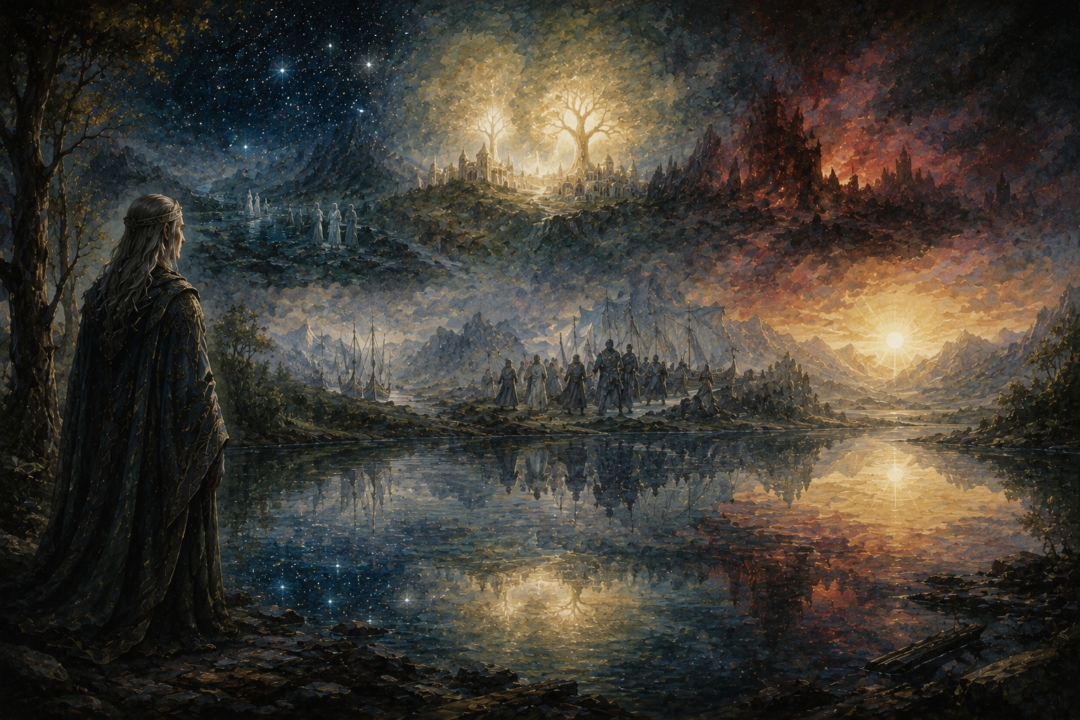
The Real Divide Is Between Cosmic Time and the Time of the Children
The distinction also changes how the First Age feels.
The beginning is not a sunrise over an empty world.
It is an awakening in darkness.
The stars are above Cuiviénen. The Sun does not yet exist in the form familiar to the later world. The Elves awaken, learn, wander, divide into peoples, encounter the Powers, travel westward or remain behind, and eventually build civilizations long before the first mortal ever sees daylight.
Then the Sun rises, and Men awaken.
The symmetry is striking: the Firstborn enter history beneath the stars; the Secondborn enter it with the Sun.
That makes the first sunrise less the birth of the First Age than a profound turning within it.
By that morning, the Age has already accumulated memory, beauty, exile, murder, rebellion, and irreversible loss.
And that may be the most useful way to remember the chronology.
If someone says the First Age lasted about 590 years, ask what is actually being counted.
If they mean the numbered Years of the Sun during the wars of Beleriand, the figure is broadly useful.
If they mean the entire First Age of the Children of Ilúvatar, the story begins far earlier—beside the dark waters of Cuiviénen, when the first Elves opened their eyes beneath the stars.
Sources & Notes
- https://tolkiengateway.net/wiki/First_Age — Tolkien Gateway: First Age (the competing chronological usages and the distinction between the Age as a whole and its roughly 590 solar years).
- https://tolkiengateway.net/wiki/Awakening_of_the_Elves — Tolkien Gateway: Awakening of the Elves (the event at Cuiviénen associated with the beginning of the First Age of the Children of Ilúvatar).
- https://tolkiengateway.net/wiki/Years_of_the_Trees — Tolkien Gateway: Years of the Trees (the pre-solar chronology in which the Elves awaken and much early Eldarin history occurs).
- https://tolkiengateway.net/wiki/Years_of_the_Sun — Tolkien Gateway: Years of the Sun (the reckoning beginning with the first sunrise and awakening of Men).
- https://tolkiengateway.net/wiki/Valian_Year — Tolkien Gateway: Valian Year (the non-solar unit and differing conversion schemes that complicate a single total for the First Age).
Sources distinguish the First Age of the Children from the numbered Years of the Sun and document the pre-solar chronology and Valian-year conversion issue.