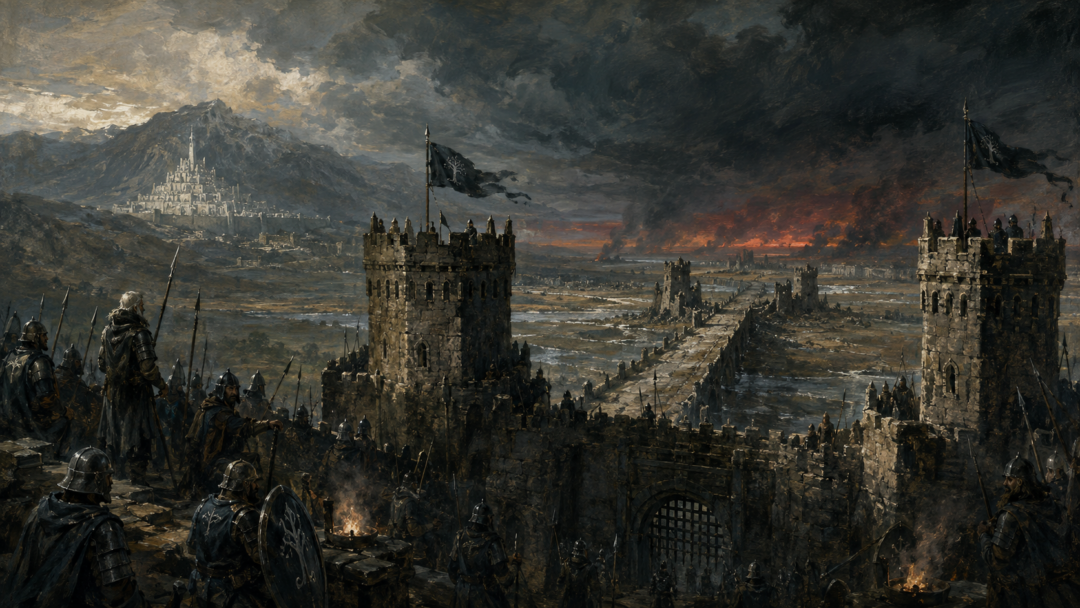
When Pippin first sees Minas Tirith, the White City seems almost impossibly strong: tier upon tier of stone climbing beneath Mount Mindolluin, crowned by the Citadel and guarded by a great gate. Yet Gondor’s real defensive line begins far beyond those walls.
Twelve miles to the east, at the edge of the Pelennor Fields, stood the Causeway Forts. They guarded the great road from ruined Osgiliath where it passed through the Rammas Echor, the wall enclosing the City’s surrounding farmlands.
And those forts fall before Minas Tirith is actually surrounded.
That timing can seem strange. If the Causeway Forts formed part of the capital’s defenses, why does their destruction not immediately mean the siege has begun?
The answer reveals something important about Gondor’s military position. The Rammas was never another Minas Tirith. The Causeway Forts were an advanced barrier meant to delay an invading army, while the City itself remained the final fortress. Their destruction opened the Pelennor to Sauron’s forces—but opening the battlefield was not the same thing as completing the siege.
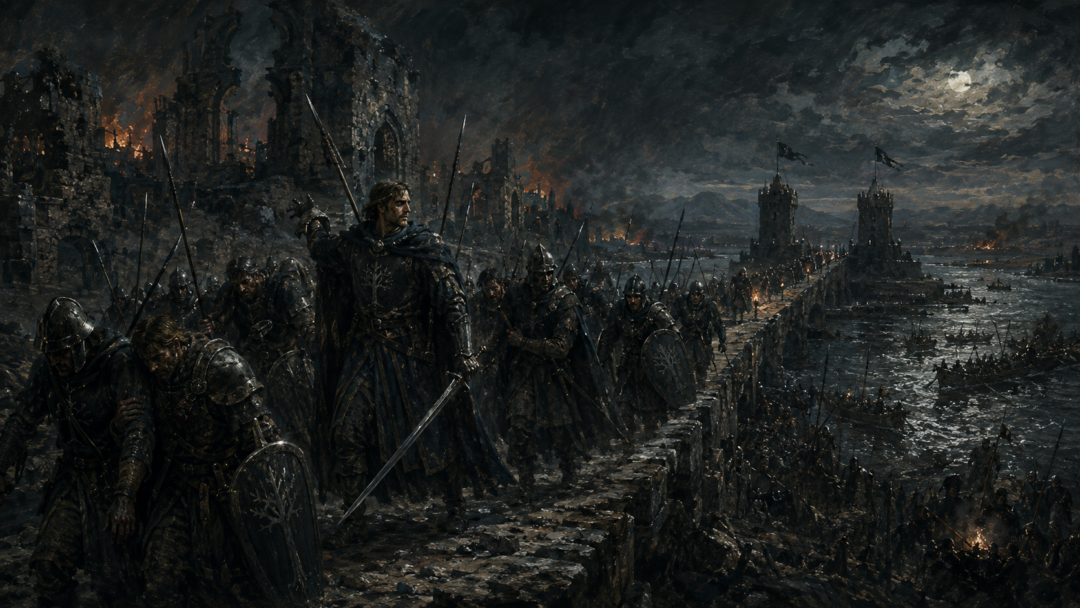
Minas Tirith Had More Than One Defensive Line
The defense of Gondor’s capital stretched eastward in layers.
The first critical obstacle was the Anduin. Osgiliath, though largely ruined, still controlled one of the most important approaches across the River. Beyond western Osgiliath ran the Causeway toward the Rammas Echor. At the point where that road entered the Pelennor, the gate was guarded by the two Causeway Forts.
Only after passing them did an attacker enter the broad Pelennor Fields.
Minas Tirith itself still stood four leagues—roughly twelve miles—farther west.
That distance matters enormously.
The Causeway Forts were therefore not simply towers attached to the City. They were an advanced strongpoint at the eastern edge of an enormous defended district. An enemy who captured them had broken through the outer barrier, but still had to move an army across the Pelennor, bring forward siege equipment, close the roads, and surround Minas Tirith itself.
The fall of the forts was the breach.
The siege required something larger: encirclement.
Faramir Already Understood the Problem
Before the attack, Denethor insists that Gondor should not abandon its outer defenses without resistance.
His reasoning is understandable. The Rammas had required great labor, and Osgiliath was the most likely place for Sauron’s main army to force the River. Denethor wanted the Enemy to pay heavily for every step westward.
Faramir saw the danger more clearly.
At the council before his departure, he argues that even if Gondor could inflict vastly greater losses at the crossing, the exchange might still favor Mordor. Sauron could replace thousands more easily than Gondor could replace hundreds.
More ominously, Faramir warns that if troops were sent far forward and the Enemy crossed in overwhelming strength, their retreat would be dangerous.
That is almost exactly what happens.
This is the central military problem behind the Causeway Forts. Gondor needs them because abandoning every outer position would allow Sauron to approach Minas Tirith almost unopposed. Yet Gondor does not possess enough soldiers to turn every defensive line into an impregnable fortress.
The defenders are buying time with men they cannot easily afford to lose.
Osgiliath Falls First
Sauron’s assault comes where Denethor expects it: at Osgiliath.
But the attack is prepared with greater strength than Gondor can match. The forces under the Witch-king cross the Anduin using numerous floats and barges concealed on the eastern side of the ruined city.
Faramir’s men are heavily outnumbered.
Once the crossing is forced, remaining in Osgiliath would risk destruction. Faramir therefore withdraws westward and rallies his surviving troops at the Causeway Forts.
This is important because it shows the forts performing their intended strategic role.
They are not the opening defense.
They are the next line after Osgiliath.
Instead of allowing defeat at the River to become an uncontrolled flight all the way to Minas Tirith, Faramir attempts another stand at the Rammas. The Enemy must attack a prepared obstacle before entering the Pelennor.
For a shrinking army, however, every additional stand increases the danger that the retreat will eventually collapse.
Why the Forts Cannot Stop the Witch-King
The Causeway Forts were real fortifications, but nothing in the text suggests that they were designed to withstand indefinitely the full weight of Sauron’s greatest offensive against Gondor.
By this stage, the defenders who reach them have already fought at Osgiliath. They face an enemy with overwhelming numerical superiority, and the Witch-king is not merely sending a raiding force against the wall.
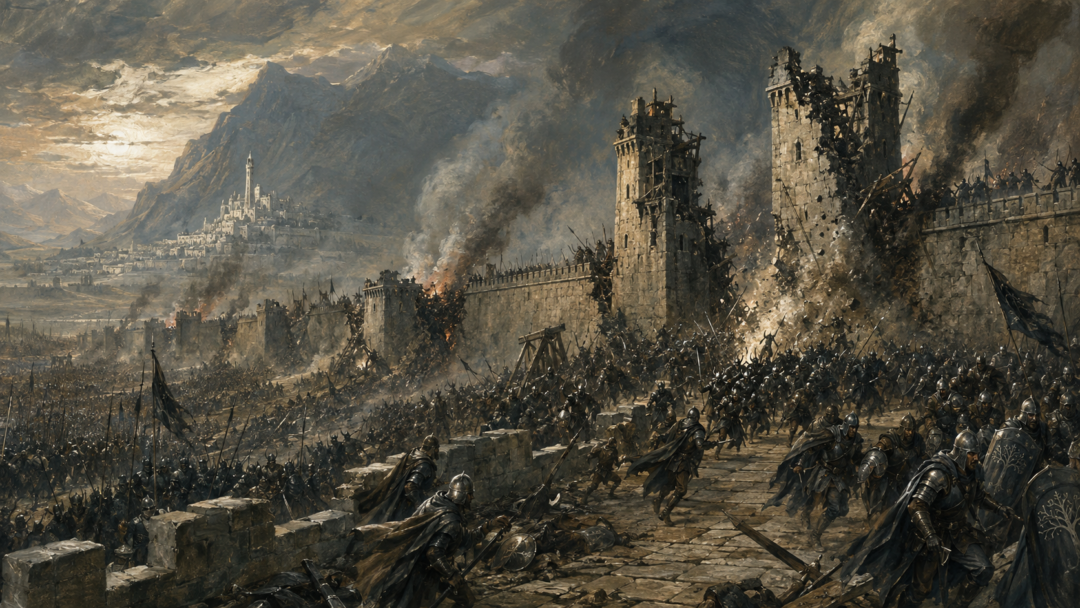
Early on March 13, the assault breaks the position.
The Causeway Forts are wrecked, and breaches are blasted through the Rammas Echor at multiple points.
That detail is crucial.
Sauron does not need to reduce the entire thirty-mile circuit of the Rammas stone by stone. Once his forces can tear openings through it, its value as a continuous barrier collapses. The eastern gate and its forts may have controlled the obvious road, but an army capable of making breaches can widen the penetration beyond one narrow entrance.
The Rammas becomes a broken defensive line.
Faramir has little choice except to withdraw again.
And now the danger he predicted begins.
The Worst Part Is the Retreat
Once the Causeway Forts fall, Gondor’s soldiers must cross miles of exposed Pelennor before reaching Minas Tirith.
A retreat from an outer fortress is not automatically a disaster if troops can disengage in good order. But Faramir’s men are being pursued by faster enemies, including mounted warriors, while the Nazgûl spread terror from above.
The retreat begins to disintegrate.
From Minas Tirith, watchers see scattered men coming back across the fields before more organized bodies appear. Faramir remains with the rearguard, trying to prevent the withdrawal from becoming a complete rout.
The City’s cavalry eventually rides out to rescue the survivors.
Faramir himself is brought back gravely wounded.
The cost proves the point he made before leaving: positions far from the City can force the Enemy to fight, but they also expose Gondor’s limited manpower during the withdrawal.
The tragedy of the Causeway Forts is therefore not simply that stone defenses fail.
It is that Gondor cannot afford the men required to keep trading ground for time.
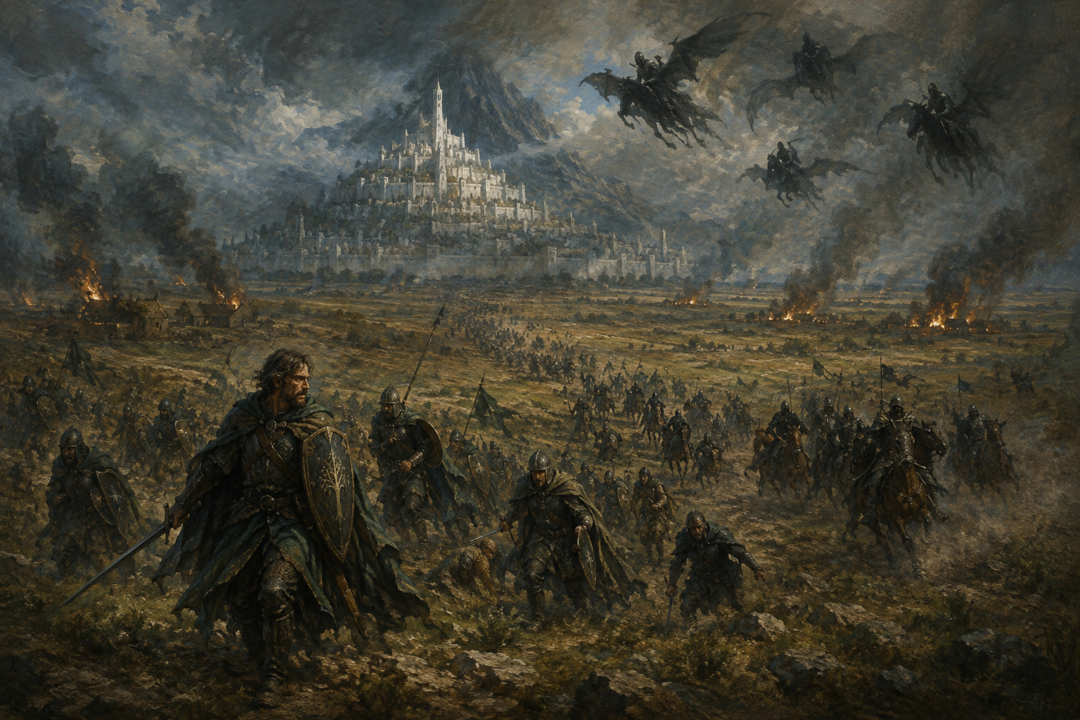
Breaking the Rammas Is Not Yet Besieging the City
This is where the chronology becomes easy to misunderstand.
After the Causeway Forts and the Rammas are broken, the Pelennor is open to the Enemy.
But Minas Tirith is not instantaneously surrounded.
Sauron’s army still has to pour through the breaches, advance across the fields, organize its forces, secure approaches, and occupy the ground around the City.
The Pelennor is huge. The Causeway Forts stood four leagues from the Great Gate. Thousands of soldiers, beasts, siege engines, supplies, and commanders must move through the captured outer defenses before the City can be completely enclosed.
Meanwhile other forces are approaching from different directions.
The assault through Osgiliath is the principal eastern thrust, but Gondor also faces enemies coming after the loss of Cair Andros and threats to the roads linking Minas Tirith with the rest of the realm.
Only when the remaining outer guards withdraw and hostile forces close around Minas Tirith does the narrative explicitly mark the City as besieged.
The distinction is precise:
The Rammas has fallen.
The Pelennor has been abandoned.
Then Minas Tirith becomes enclosed within a ring of enemies.
Those events occur in sequence, not simultaneously.
Sauron Wants the Pelennor, Not Merely the Gate
Capturing the Causeway Forts gives the Witch-king something more useful than possession of two ruined towers.
It gives him the battlefield.
Once inside the Rammas, Sauron’s forces can spread across the Pelennor and prepare the machinery required to attack Minas Tirith. Siege engines can be brought forward. Trenches and fires can be established. Troops can deploy around the City rather than remaining compressed along the road from Osgiliath.
The enormous open space between the Rammas and Minas Tirith therefore becomes a weakness after the outer wall is breached.
Before the breach, the Pelennor is protected territory.
Afterward, it becomes the staging ground of the besiegers.
This transformation helps explain why the Witch-king’s army does not simply rush straight from the Causeway Forts into the Great Gate. A siege army gains enormous advantage by organizing the ground around its target first.
Minas Tirith is too formidable to treat like a minor fortress seized in one charge.
Denethor’s Decision Was Not Pointless
It is tempting to read the destruction of the Causeway Forts as proof that defending them was useless.
The text supports a more complicated judgment.
Denethor is correct that allowing Sauron to cross the Anduin and reach Minas Tirith without resistance would surrender valuable defensive ground for nothing. Every obstacle forces the Enemy to deploy, fight, and spend time.
Faramir is equally correct that Gondor’s manpower makes such delaying actions terribly expensive.
That tension cannot be solved cleanly.
Gondor is defending a great realm with diminishing strength against an enemy capable of accepting losses on a scale it cannot match. Holding forward positions costs lives. Abandoning them gives Sauron freedom of movement.
The Causeway Forts sit exactly inside that dilemma.
Their fall does not prove they had no purpose.
It proves that they were never the place where Gondor could make its final stand.
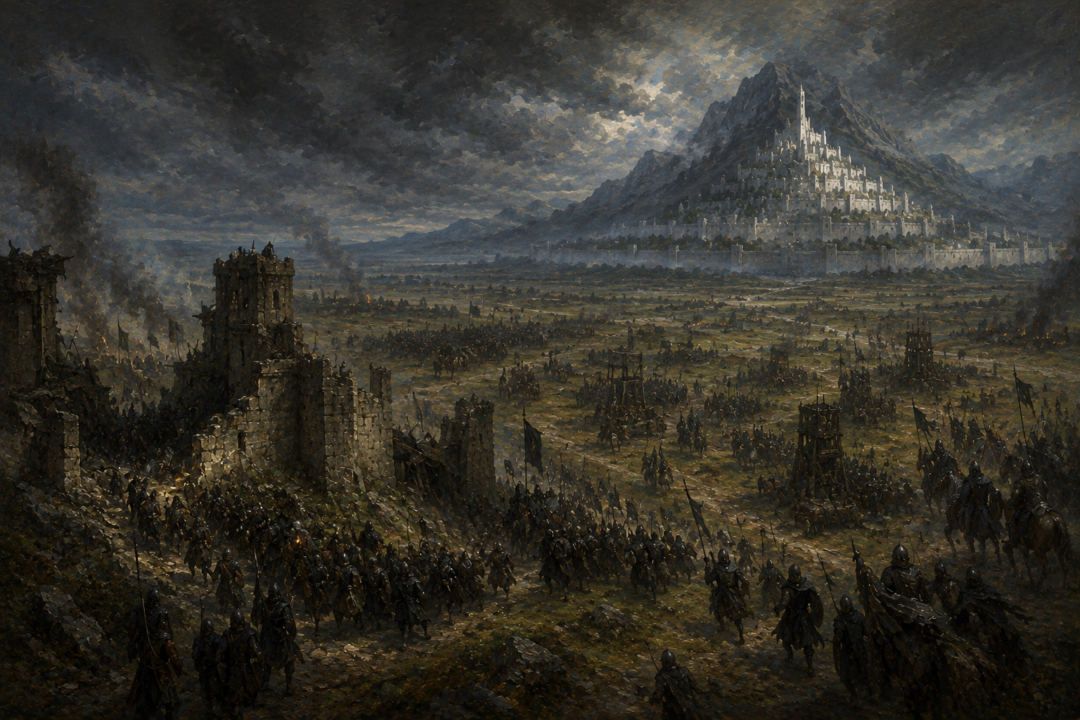
The Outer Wall Falls, but the Battle Is Not Over
By the time the Enemy surrounds Minas Tirith, the Causeway Forts are already behind Sauron’s lines.
Osgiliath has been lost.
The Rammas has been breached.
The Pelennor has been surrendered.
Faramir has returned wounded.
Yet the White City still stands.
That sequence gives the siege its terrible sense of compression. Each defensive layer disappears, bringing the Shadow physically closer to the people watching from the walls.
The Causeway Forts fall first because they belong to the outer battle—the attempt to slow the Enemy before he can reach Minas Tirith in full strength.
Their destruction does not mark the completed siege.
It marks the moment when the protection of distance is lost.
After that, there is no substantial defensive country left between the armies of Mordor and the walls of the White City. The Enemy must still cross the Pelennor and close his ring, but the strategic barrier has already been broken.
The forts were meant to keep war outside.
Once they fall, war enters the Pelennor.
And from the walls of Minas Tirith, the defenders can watch it coming.
Sources & Notes
- https://tolkiengateway.net/wiki/Causeway_Forts — Tolkien Gateway: Causeway Forts (the paired defenses where the Osgiliath road crossed the Rammas into the Pelennor).
- https://tolkiengateway.net/wiki/Rammas_Echor — Tolkien Gateway: Rammas Echor (Gondor’s outer wall around the Pelennor and its repair before the assault).
- https://tolkiengateway.net/wiki/Battle_of_Osgiliath — Tolkien Gateway: Battle of Osgiliath (the forced Anduin crossing and Faramir’s retreat toward the Causeway Forts).
- https://tolkiengateway.net/wiki/Siege_of_Gondor — Tolkien Gateway: Siege of Gondor (the sequence from the breached outer defenses to the encirclement and attack on Minas Tirith).
- https://tolkiengateway.net/wiki/Faramir — Tolkien Gateway: Faramir (his command of the retreat from Osgiliath and defense of Gondor’s eastern approaches).
Sources document Gondor’s layered eastern defenses and the battle sequence from Osgiliath through the Causeway Forts to the siege of Minas Tirith.