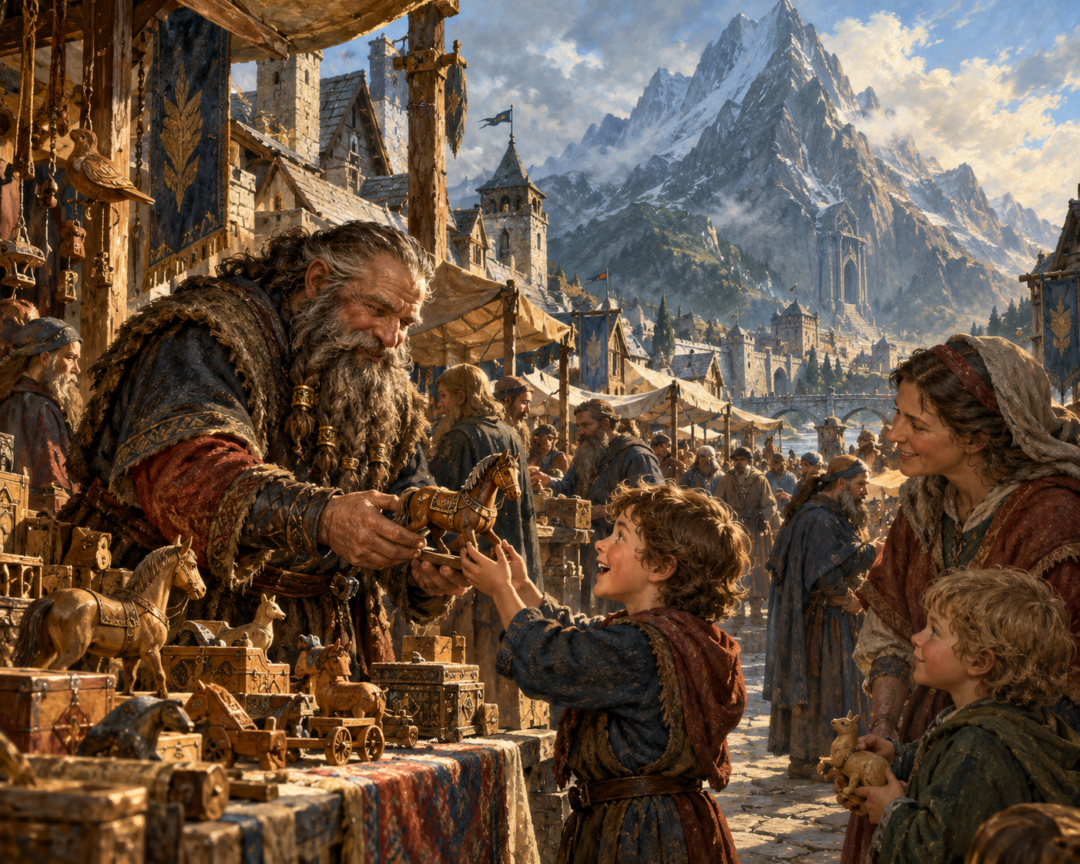
When Thorin Oakenshield remembers the lost kingdom beneath the Lonely Mountain, he speaks of gold, jewels, great halls, and skilled smiths. Yet among these familiar signs of Dwarven greatness, he remembers something surprisingly small: toys.
Before Smaug destroyed the old prosperity of Erebor and Dale, Dwarves made extraordinary playthings, and Dale possessed a toy market famous throughout the North.
It is an easily overlooked detail in The Hobbit. Dwarves are usually remembered for their weapons, armor, mining, and magnificent stonework. But Thorin's recollection reveals another side of their craftsmanship: the ability to create beautiful objects intended not for battle or royal display, but for delight.
The significance becomes greater when we consider what these toys required, what they meant to their makers, and how their tradition appears again many decades later.
The toys of Dale suggest that Dwarven craftsmanship reached beyond necessity and wealth. At its height, it could also serve imagination, leisure, and the happiness of others.
The Forgotten Wonder of Dale's Toy Market
In Chapter 1 of The Hobbit, Thorin explains how his grandfather Thrór established a prosperous kingdom beneath Erebor.
The Dwarves expanded their mines, tunnels, halls, and workshops. Their wealth increased, and their reputation spread among neighboring peoples.
The Men living south of the Mountain gradually established Dale, creating a flourishing settlement close to the Dwarven kingdom.
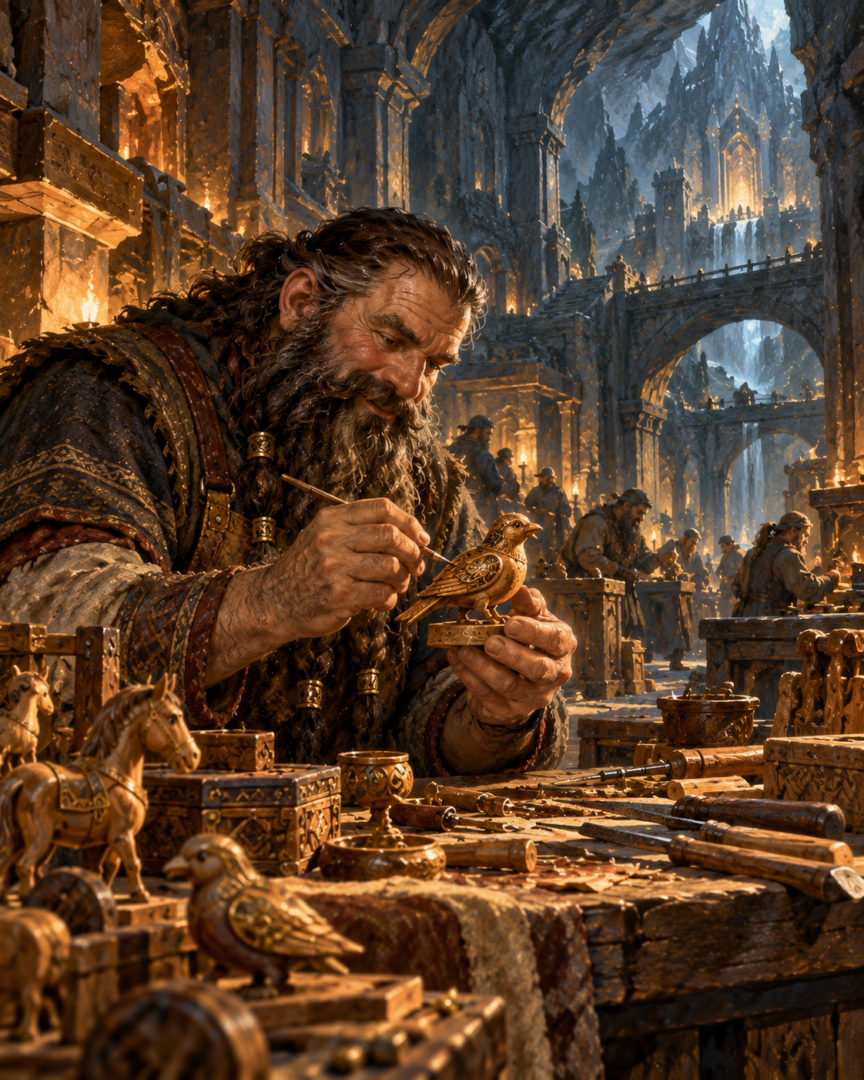
Thorin remembers an age when even poorer Dwarves enjoyed prosperity and craftsmen possessed enough leisure to produce beautiful objects for pleasure.
Among their creations were remarkable toys.
He concludes that the toy market of Dale was “the wonder of the North.”
That description is important.
Thorin does not merely mention a few curious objects hidden inside the royal treasury. He remembers an entire market associated with the neighboring town.
The passage establishes that exceptional toys formed part of the remembered prosperity of Erebor and Dale.
It does not describe the market's organization, identify individual toy makers, or explain precisely how the goods were sold.
Nevertheless, its reputation suggests that these creations were admired beyond the immediate households of their makers.
Dwarven skill was not confined to underground halls. Its products could become objects of wonder in the wider world.
Why Toys Reveal a Different Kind of Mastery
A sword must endure combat. Armor must protect its wearer. A stone hall must support enormous weight and survive generations.
These are familiar measures of Dwarven excellence.
A toy serves another purpose.
Its success depends on the experience of the person receiving it. It may be beautiful, surprising, amusing, or mysterious without possessing the practical importance of a weapon or tool.
This makes Thorin's recollection especially revealing.
The Dwarves of Erebor possessed the ability to make objects whose value could lie primarily in enjoyment.
Their craftsmanship was not restricted to solving problems or displaying wealth.
It could also create pleasure.
The exact construction of the ancient toys remains unknown. The text does not establish whether they were made from wood, metal, stone, or combinations of materials.
Nor does it describe particular mechanisms.
Yet their exceptional quality suggests careful workmanship, whatever their materials.
A small object can demand extraordinary precision. Its surfaces, proportions, and details may require as much artistic judgment as something much larger.
The toys therefore invite a different understanding of Dwarven mastery.
Greatness in craft need not always be measured by physical size, military usefulness, or material value.
Sometimes it can be measured by the wonder a finished object inspires.
The Importance of Leisure in Thorin's Memory
One of the most revealing parts of Thorin's account concerns the conditions under which these objects were produced.
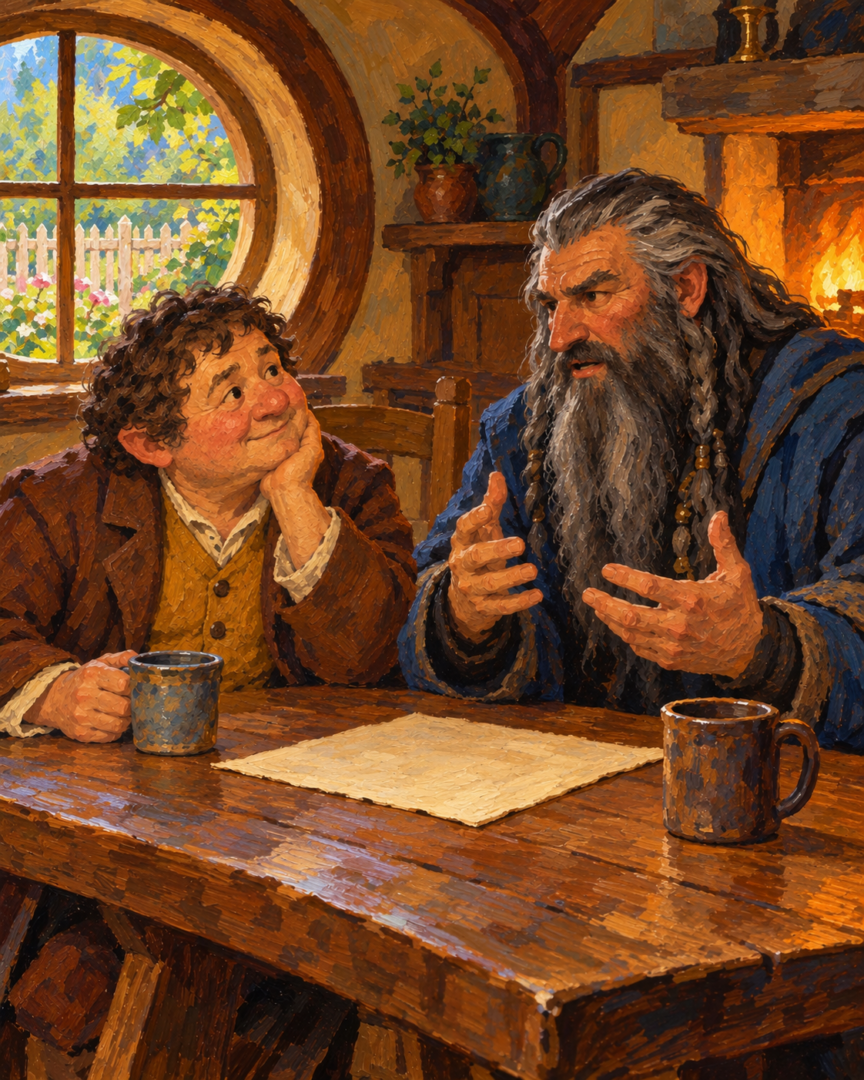
He remembers prosperity not only because the Dwarves possessed wealth, but because they possessed time.
They could make beautiful things “just for the fun of it.”
This phrase changes the meaning of the entire passage.
The workshops of Erebor were not merely places where craftsmen labored to satisfy kings, armies, or merchants.
At least in Thorin's recollection, prosperity allowed room for creative enjoyment.
The toys belong to that broader picture.
This does not prove that every Dwarf enjoyed such leisure, or that all Dwarven craftsmen participated in toy making.
It does suggest that the kingdom's prosperity created opportunities for artistic work beyond immediate necessity.
That distinction matters because wealth alone does not explain cultural achievement.
Gold can purchase materials and reward skilled workers. But the freedom to experiment, refine, and create for pleasure represents another kind of abundance.
Thorin remembers both.
His account is also colored by loss. Speaking as an exile, he recalls an earlier age through the contrast with everything Smaug destroyed.
The passage should therefore be understood as a personal recollection of prosperity rather than a complete economic description.
Even so, the association between leisure and beautiful craftsmanship is explicit.
A Craft Shared Across the Mountain and Dale
The relationship between Erebor and Dale provides another important part of the story.
Thorin explains that kings sought Dwarven smiths and that fathers wanted their sons accepted as apprentices.
The Dwarves received valuable rewards, including food supplies.
These details show that Dwarven expertise was respected outside their own communities.
They also reveal an exchange of skills, goods, and resources between neighboring peoples.
The toy market belongs within this larger setting.
The Dwarves possessed celebrated craftsmanship, while Dale provided a neighboring human settlement where remarkable products could be encountered and appreciated.
However, the evidence has limits.
The text does not establish a separate guild of toy makers, a standardized production system, or an exclusive Dwarven monopoly over every toy sold in Dale.
Nor does it specify which craftsmen produced individual objects.
What it does establish is more modest and more interesting: Dwarven creative skill existed within a world of contact and exchange.
The toys were not simply another form of treasure stored beneath the Mountain.
They were associated with a market in a living town.
Their significance therefore extends beyond the workshop.
They represent craftsmanship entering ordinary social life, where its purpose could be enjoyment rather than defense or royal magnificence.
What Made the Toys Magical?
Thorin describes the toys of the old kingdom as both marvelous and magical.
That naturally raises a question.
Were they genuinely enchanted, or were they so ingeniously constructed that ordinary observers experienced them as magic?
The passage does not explain.
It would be tempting to imagine intricate mechanical animals, moving figures, or elaborate devices that performed impossible tricks.
Such inventions might suit the atmosphere of the story, but their specific existence is not established by the text.
The distinction is important.
Dwarven craftsmanship is repeatedly associated with extraordinary skill, and Middle-earth contains objects whose properties exceed ordinary expectations.
Yet those general facts cannot establish the workings of the toys of Dale.
Thorin's description confirms their exceptional character without providing a technical explanation.
The uncertainty is part of their fascination.
Their makers evidently possessed abilities that impressed those who encountered their work, but the surviving description preserves the wonder rather than the mechanism.
The toys remain remarkable precisely because their complete nature is unknown.
Smaug Destroyed More Than a Treasury
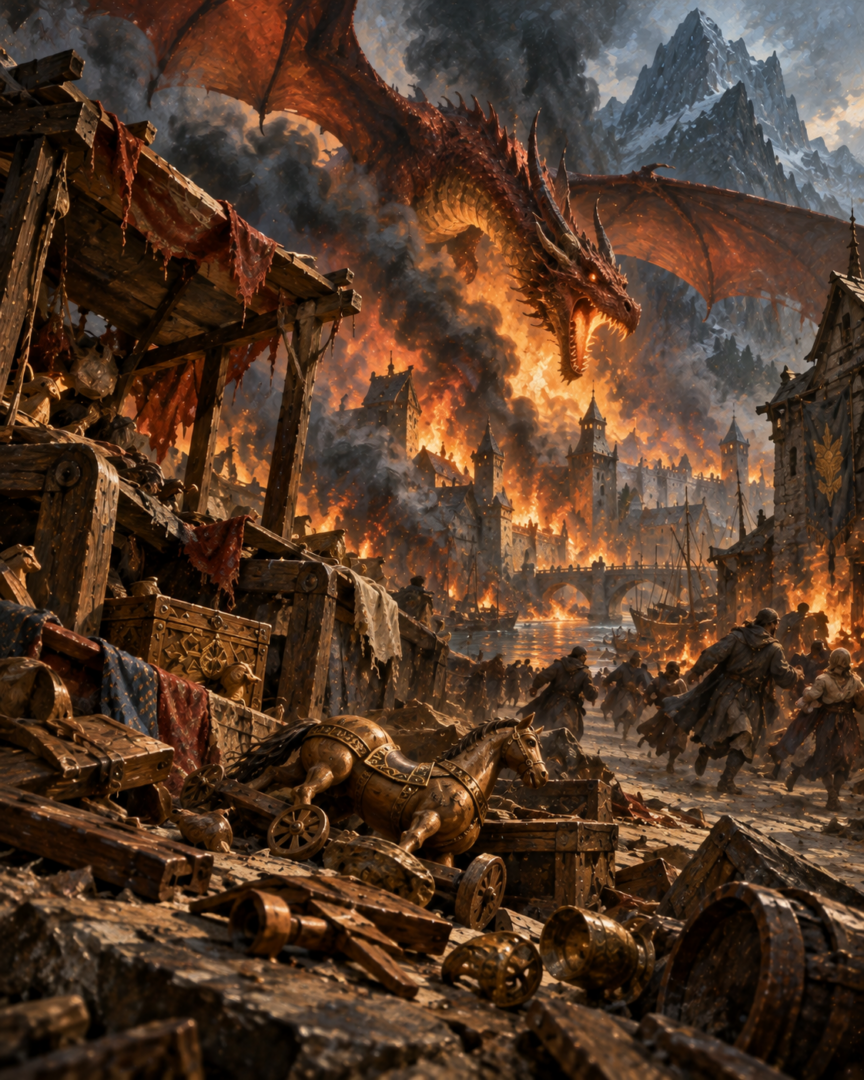
The destruction of Erebor and Dale transforms the meaning of Thorin's memory.
When Smaug descended upon the Lonely Mountain, the Dwarves lost their kingdom and the neighboring settlement suffered devastation.
Thorin's account moves directly from the prosperity of the old workshops and toy market to the coming of the dragon.
His explanation emphasizes the wealth that attracted Smaug.
But the consequences extended far beyond the loss of gold.
The workshops, trade relationships, and settled conditions that supported such craftsmanship were violently disrupted.
The toy market becomes a symbol of what vanished.
Not merely precious objects, but an environment in which craftsmen could devote their abilities to beauty and enjoyment.
The contrast with Smaug is especially striking.
Thorin describes dragons as creatures that seize and guard treasure without truly enjoying or creating it.
The Dwarves, by contrast, could transform materials into objects that gave pleasure to others.
This opposition is central to the tragedy.
Smaug could possess the products of craftsmanship, but possession was not the same as making or appreciating them.
His conquest replaced a productive society with a hoard.
The disappearance of the toy market therefore illustrates a cultural loss that cannot be measured simply by counting stolen treasure.
The Toys Return in the Shire
The story does not end with Thorin's recollection.
In The Fellowship of the Ring, Chapter 1, the tradition of extraordinary northern toys appears again during Bilbo Baggins's famous birthday celebration.
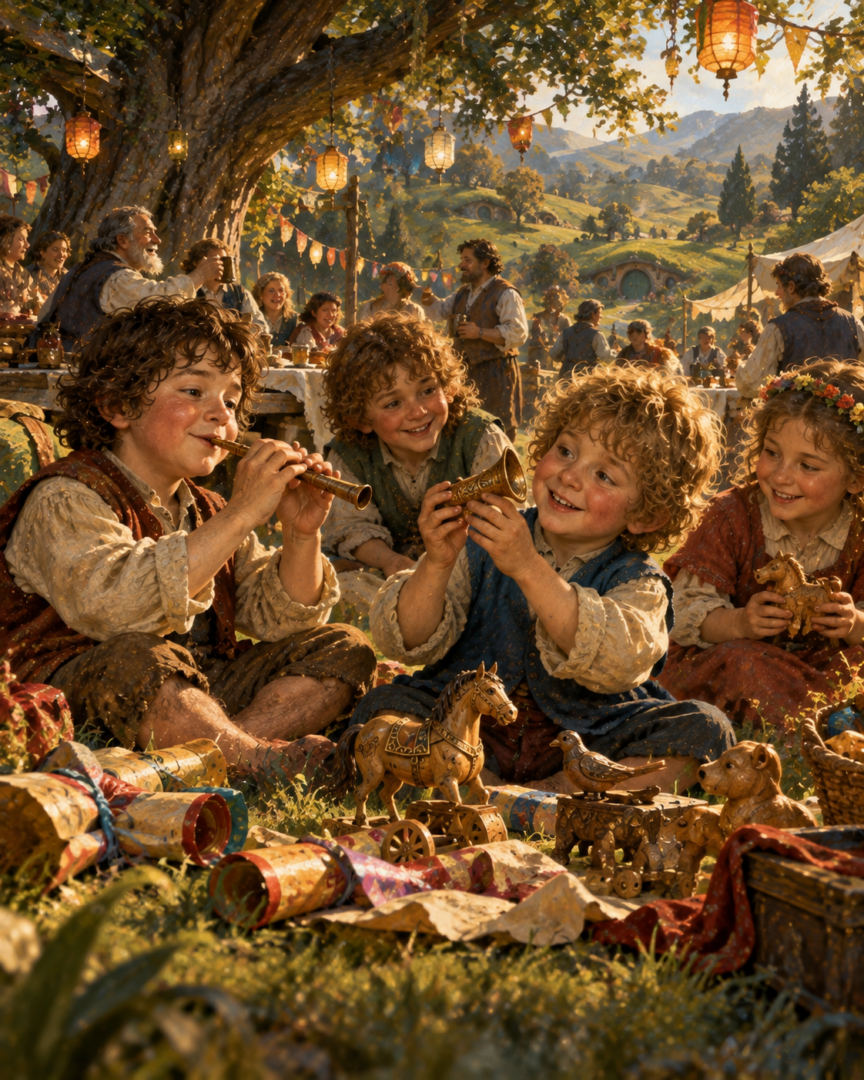
The young Hobbits receive unusually wonderful presents.
Some are described as magical, and many had been ordered well in advance.
The narrative identifies toys brought from the Mountain and Dale as genuine Dwarven workmanship.
This is significant evidence of continuity.
By Bilbo's farewell party, Erebor had been reclaimed and Dale restored.
Remarkable toys were once again reaching distant customers.
The text does not prove that the original designs survived unchanged or that the same workshops continued operating.
It does, however, show that Dwarven toy making was not merely a forgotten curiosity from Thorin's childhood.
The craft appears again in a later generation.
And this time, the recipients are Hobbit children far from Erebor.
The geographical distance makes the detail especially meaningful.
Objects associated with the northern kingdoms could travel all the way to the Shire, carrying the reputation of their makers into another society.
Their value was immediately understood by children who had never seen anything like them.
The Small Musical Instruments of Dale
The birthday celebration offers another revealing detail.
During Bilbo's party, the guests pull musical crackers, many marked with the name of Dale.
Inside are miniature musical instruments of exceptional quality.
The instruments produce beautiful sounds despite their small size.
Some young Hobbits use them to begin an impromptu performance.
This is one of the clearest descriptions of small, finely crafted objects associated with Dale.
It offers a glimpse of the precision and delight that northern craftsmanship could produce.
However, a distinction must be maintained.
The passage identifies the crackers with Dale, but it does not explicitly state that every instrument inside them was manufactured by a Dwarf.
Their connection to the broader tradition is suggestive rather than proof of individual makers.
Even with that limitation, the scene reinforces the central point.
The northern kingdoms were associated with objects that combined small scale, remarkable workmanship, and entertainment.
The instruments were not monumental treasures.
They were made to be handled, played, and heard.
Their beauty became complete through use.
Why the Smallest Crafts Matter
Dwarven history is often told through enormous things.
Mountains are excavated. Kingdoms are founded. Great doors are fashioned. Weapons and treasures pass through the hands of kings.
Yet the toys of Dale reveal something that these grand achievements cannot show by themselves.
They demonstrate that high craftsmanship could exist on an intimate scale.
A toy did not need to preserve a dynasty or defeat an enemy to justify the skill invested in it.
Its purpose could be delight.
The evidence does not support one simple explanation for the excellence of these objects.
Their reputation may reflect several connected conditions: skilled makers, prosperous workshops, access to materials, established relationships with neighboring peoples, and enough leisure to pursue beauty beyond necessity.
The texts establish some of these conditions directly and leave others as reasonable possibilities.
They do not reveal a single secret technique responsible for the toys' extraordinary character.
That uncertainty should not diminish their importance.
Instead, it keeps attention on what the narrative actually preserves.
Thorin remembered the toys because they belonged to a world he had lost.
Decades later, children in the Shire encountered wonderful creations from the restored northern kingdoms.
Between those moments lay exile, destruction, war, and recovery.
The continuity is not necessarily one of identical designs or uninterrupted workshops. It is a continuity of creative excellence.
And perhaps that is the most revealing detail of all.
The Dwarves could build halls that endured for ages and forge weapons remembered in legend.
But they could also make something small enough for a child to hold, beautiful enough to inspire wonder, and delightful enough to be remembered long after the kingdom that first produced it had fallen.
The toy market of Dale reminds us that a civilization's greatness is not found only in what it builds to withstand the world.
Sometimes it is found in what it creates simply to make the world more joyful.
Sources & Notes
- Tolkien Gateway — Dale. https://tolkiengateway.net/wiki/Dale
- Tolkien Gateway — Dwarves. https://tolkiengateway.net/wiki/Dwarves
- Tolkien Gateway — Lonely Mountain. https://tolkiengateway.net/wiki/Lonely_Mountain
Primary text: The Hobbit, “An Unexpected Party,” and The Fellowship of the Ring, “A Long-expected Party.” The sources cover Dale’s crafts and the two party chapters. The argument about creative leisure is interpretation; the ancient toys’ materials and mechanisms are not specified.