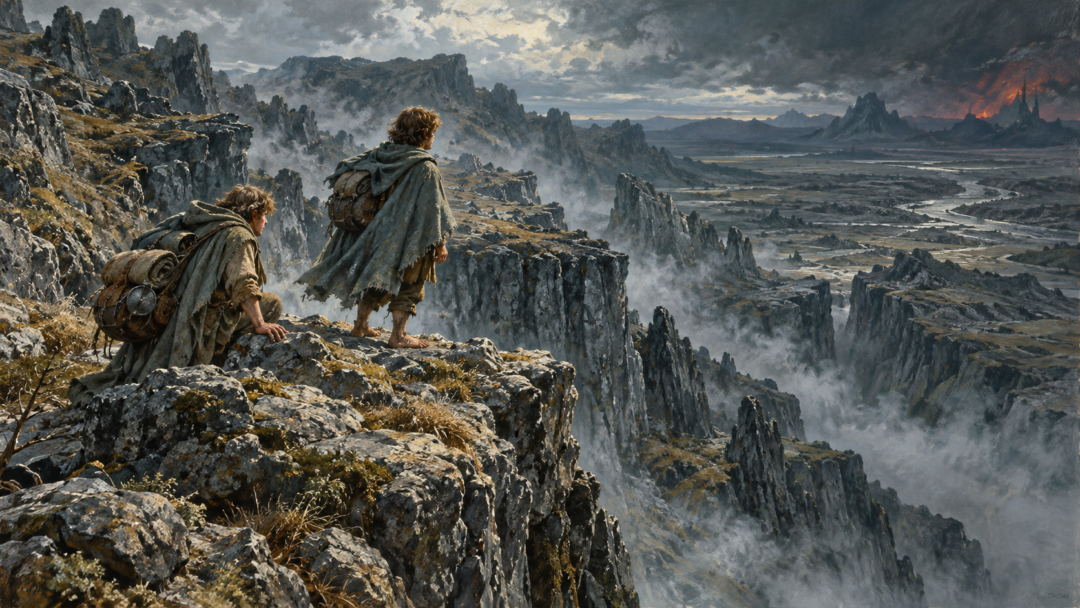
Frodo and Sam still have lembas when they reach the eastern cliffs of the Emyn Muil. They have survived the breaking of the Fellowship, crossed a bewildering wilderness of stone, and kept moving toward Mordor. Yet their immediate problem is something no amount of Elven waybread can solve.
They cannot get down.
Ahead of them lies the land they must cross to reach the Black Gate. Beneath them is a dangerous descent, and behind them stretches a maze of hills that has already cost them precious time. They can see the direction of their journey, but they cannot safely continue.
This is why one of the most important objects in Sam's pack is not food, a weapon, or even a map. It is a coil of rope from Lothlórien.
In The Two Towers, Book IV, Chapter 1, "The Taming of Sméagol," the rope becomes the answer to a surprisingly practical problem. Before the hobbits can worry about how they will survive the road ahead, they must find a way to reach that road at all.
The Emyn Muil Is a Trap Made of Geography
The Emyn Muil is not simply another range of hills on the journey to Mordor.
Its ridges, ravines, broken slopes, and sudden cliffs make ordinary navigation exhausting. The name is commonly understood as referring to dreary hills, and the landscape deserves it.
After leaving the Fellowship near Amon Hen, Frodo and Sam attempt to cross this difficult country east of the Anduin. Their progress is painfully slow. They struggle to maintain their direction, encounter obstacles, and repeatedly find that apparent routes lead nowhere useful.
The problem becomes particularly severe along the eastern edge.
The lower country lies in the direction they need to travel, but the high ground ends in a steep barrier. They cannot simply walk downhill toward Mordor.
The distinction matters. Being able to see the country ahead is not the same as being able to reach it.
For travellers already moving under the threat of pursuit, every failed descent means further wandering, wasted strength, and another delay.
Their food can sustain them during this search. It cannot turn a cliff into a path.
That is the first reason rope becomes more immediately important than provisions: the hobbits have encountered a physical obstruction that eating cannot remove.
They Have Food, but Food Is Not Their Immediate Solution
It would be misleading to suggest that Frodo and Sam have no provisions in the Emyn Muil.
They still possess lembas, the Elven waybread provided in Lothlórien. Its sustaining qualities make it especially valuable on a journey where ordinary supplies are increasingly difficult to obtain.
But their situation is hardly comfortable.
Sam has brought cooking equipment, yet the barren hills offer little opportunity for the kind of meals he understands. He misses familiar food and drink, and his complaints reveal how far the two hobbits have travelled from the ordinary comforts of the Shire.
Lembas keeps them going, but it does not make their journey pleasant or remove the need to find a route.
The crucial distinction is between a continuing survival concern and an immediate obstacle.
Food matters because the hobbits must remain strong enough to travel. Rope matters because, at this particular moment, they cannot travel safely without a means of descending.
Even if their packs contained more provisions, they would still face the same cliff.
And if they spent their remaining strength wandering along the heights, their supplies would only be consumed while the journey itself remained stalled.
The terrain therefore changes the order of their practical priorities.
They must solve the descent before they can make meaningful progress toward Mordor.
The First Attempt Shows How Dangerous the Cliff Really Is
The descent does not begin with Sam calmly producing a rope and lowering Frodo over the edge.
The actual sequence is considerably more dangerous.
After searching along the eastern heights, the hobbits reach a place that seems to offer a possible way down. Sam is eager to test it and attempts to go first, but Frodo pulls him back from a hazardous position.
Frodo then tries the descent himself.
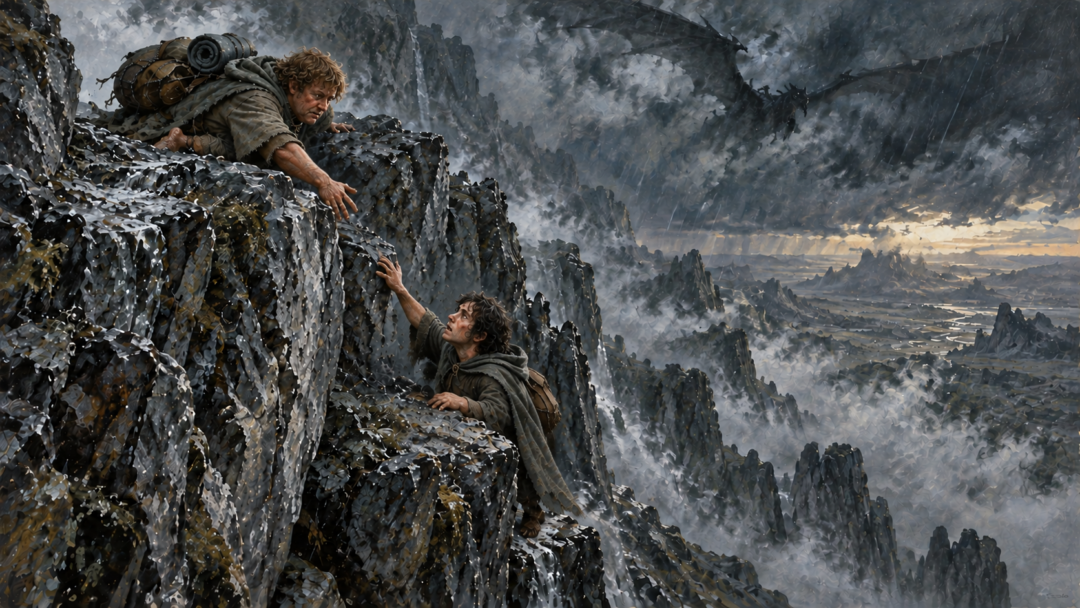
At this moment, an ominous disturbance comes from above: a dark shape passes overhead, accompanied by a terrifying sound and violent weather. Frodo is overcome by fear and loses his footing.
He falls onto a ledge below rather than plunging all the way down.
It is a narrow escape.
Rain begins, darkness deepens, and Frodo is stranded beneath Sam. The scene turns an already difficult climb into an immediate emergency.
Now the problem is not merely how to leave the Emyn Muil. It is how to get Frodo out of danger.
Frodo needs a rope.
This is the decisive moment in the chapter. The need is no longer theoretical, and the cliff has demonstrated what a mistake could cost.
A meal would not rescue Frodo from the ledge. More lembas would not give Sam a secure way to reach him.
They need equipment suited to the danger directly in front of them.
Sam Remembers the Gift from Lothlórien
The solution has been travelling with them all along.
Sam suddenly remembers the Elven rope packed among his belongings.
Earlier, when the Fellowship prepared to leave Lothlórien, the Elves supplied their boats with useful equipment, including coils of slender, strong rope.
Sam had shown particular interest in it.
That small moment in "Farewell to Lórien" becomes enormously important here. The rope is not a grand weapon or an object associated with kingship. It is practical travelling equipment, exactly the kind of thing Sam understands the value of carrying.
Yet in the confusion and danger of the Emyn Muil, even Sam has not immediately remembered it.
Once he does, the situation changes.
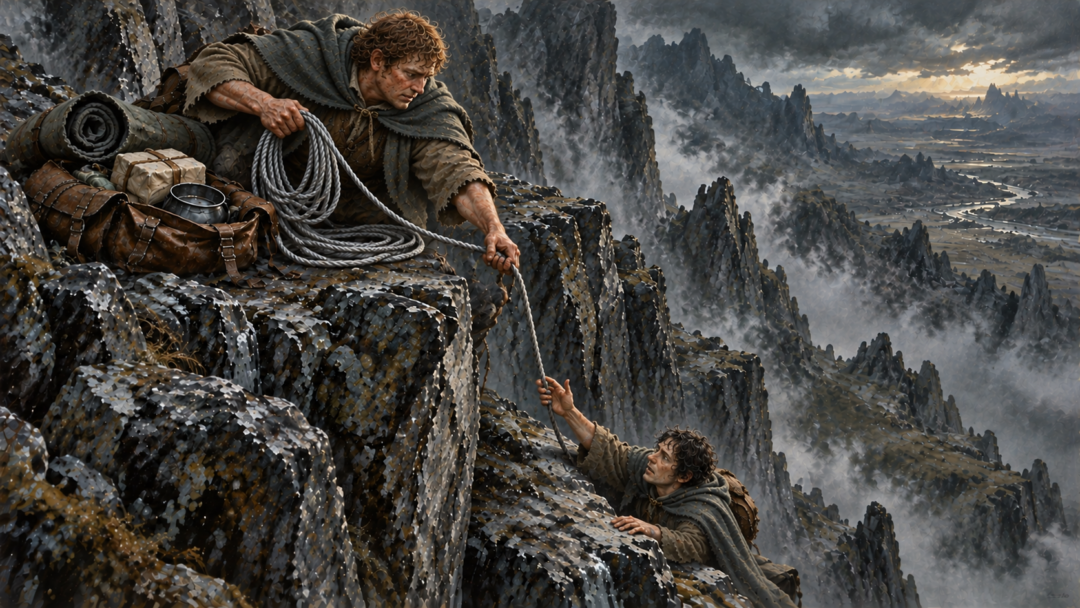
He gets the rope out and lowers an end to Frodo. The rope provides the means for Frodo to return from the ledge to safety.
But rescuing Frodo from his fall is only the first task.
They still need to descend the cliff itself.
The hobbits examine the rope's length, and Sam measures it at thirty ells. The text establishes that it is sufficient for the descent they must make.
That is the important measurement for this story: the rope is long enough to solve the immediate problem.
Its usefulness is not abstract. It answers a particular question about the landscape.
Can two small travellers safely get from the upper edge to the lower ground?
With Sam's rope, they finally have a workable answer.
Why a Coil of Rope Changes the Entire Journey
The rope does not remove the cliff, and it does not eliminate every danger of climbing.
Instead, it allows the hobbits to approach the descent differently.
Rather than trusting uncertain footholds on exposed rock, they can use the rope as support.
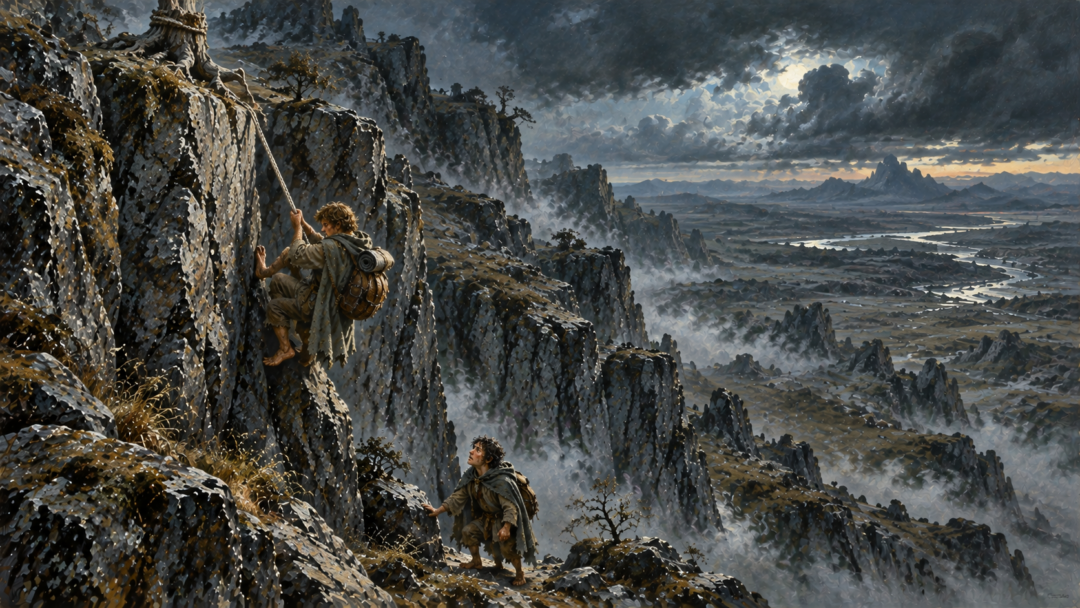
Sam fastens it securely to an old stump near the brink. Frodo makes the descent first, and Sam follows.
Both reach the bottom.
The passage is easy to underestimate because the object involved is so ordinary. But the consequences are enormous.
Until this point, the Emyn Muil has repeatedly frustrated their attempts to move eastward. Their determination has not been enough. Neither has their ability to endure discomfort.
They need a practical solution suited to the landscape.
The rope provides it.
This is also an important distinction in the way the journey unfolds. The hobbits do not conquer the hills through superior strength or force. They find a way to negotiate one of their obstacles using equipment, caution, and cooperation.
The rope cannot guarantee that they will reach Mordor. It cannot protect them from every enemy or prevent exhaustion.
But it makes the next stage of the journey possible.
That is more than enough to justify its place in Sam's pack.
The Small Gift That Matters More Than It First Appears
The rope's origin adds another layer to the scene.
It comes from Lothlórien, where the Fellowship received gifts and provisions before continuing south along the Anduin.
Some of those gifts have obvious significance. Frodo receives Galadriel's phial, which will later become vital in darkness. The Elven cloaks offer concealment and protection.
The rope seems humbler.
It belongs to the category of objects that travellers might easily take for granted until something goes wrong.
Yet the Elves' provision of rope shows an understanding of the needs of a difficult journey. It is light, strong, and useful in circumstances that cannot always be anticipated.
Sam's particular appreciation for such things also fits his character.
He is attentive to the everyday requirements of travelling: food, cooking, carrying, resting, and looking after Frodo.
His practical habits can appear almost comically domestic beside the immense purpose of the quest.
In the Emyn Muil, however, the usefulness of that outlook becomes unmistakable.
The object that gets them off the cliff is not a legendary blade.
It is something Sam has thought worth carrying.
One reading of the episode is that the great quest depends repeatedly on humble forms of preparation. Extraordinary courage remains necessary, but courage alone cannot provide a foothold where none exists.
The Rope Also Creates a New Problem
Even after the successful descent, the rope presents another difficulty.
Sam has tied it above them, and retrieving it from below appears impossible.
Leaving it behind would mean losing valuable equipment. It could also provide an easier descent for anyone following them.
This concern is especially relevant because the hobbits have suspected that Gollum is on their trail.
Sam is reluctant to abandon the rope. When he gives it a final pull, it unexpectedly comes loose and falls down.
The moment is remarkable, but the text does not establish a definite mechanism.
Frodo suggests that Sam's knot may have been less secure than he believed. Sam is convinced that he tied it properly and regards the rope's return as something more extraordinary.
The episode preserves that uncertainty.
For the immediate story, the important consequence is that the hobbits have descended successfully and still possess the rope.
They have escaped one obstacle without permanently sacrificing the tool that helped them overcome it.
And its usefulness is not finished.
The Descent Brings Them Closer to Gollum
Getting down from the Emyn Muil does not mean the hobbits are suddenly safe.
They have reached lower ground, but they remain exposed, weary, and uncertain about the way ahead.
The next danger is already approaching.
Gollum, who has been following them, eventually appears climbing down the rock face. His ability to negotiate the cliff without the hobbits' equipment sharply contrasts with their own difficulties.
What Frodo and Sam could scarcely manage without rope, Gollum can attempt through his extraordinary climbing ability.
The encounter leads to a struggle, Gollum's capture, and the beginning of a deeply uneasy relationship.
The rope becomes useful again when Sam uses it to restrain Gollum. Its Elven nature causes Gollum intense distress, and Frodo eventually has it removed.
But the most important consequence of the cliff descent is broader than the rope's later use.
By reaching the foot of the eastern heights, Frodo and Sam have moved into the region where their meeting with Gollum becomes possible.
That meeting will change the direction of their journey.
Gollum knows ways through the country ahead that the hobbits do not. His guidance will become essential to their attempt to approach Mordor, even though trusting him carries serious dangers.
The rope does not cause Gollum's appearance, and the text does not suggest that the descent was arranged for that purpose.
Nevertheless, the sequence is striking.
A practical solution to a cliff leads directly into one of the most consequential relationships in the story.
The Deeper Meaning of Sam's Rope
There is a larger contrast hidden in this episode.
Frodo carries the One Ring, an object of immense power and danger. The fate of Middle-earth depends upon his journey.
Yet his immediate progress can still be stopped by ordinary stone.
The Ring cannot provide a safe descent. The importance of Frodo's mission does not exempt him from weather, exhaustion, fear, or the physical limits of a hobbit's body.
The quest must be accomplished within the actual landscape of Middle-earth.
This is where Sam's contribution becomes so important.
His loyalty is not expressed only through declarations of devotion or dramatic acts of courage. It is also expressed through remembering what is in his pack, carrying useful things, and helping Frodo overcome obstacles that cannot be wished away.
The Emyn Muil episode gives that loyalty a tangible form.
Sam has brought something that Frodo needs, precisely when he needs it.
The rope does not make Sam more important than Frodo, nor does it replace the courage required of either hobbit. It shows how their different strengths work together.
Frodo bears the burden of the quest. Sam helps make its continuation possible.
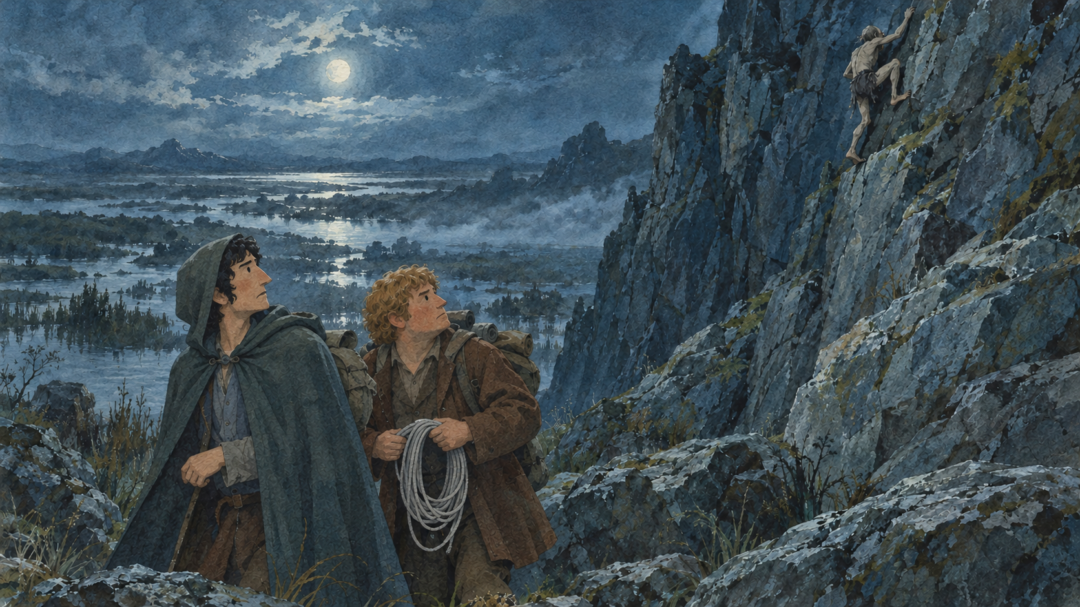
Before They Can Survive Mordor, They Must Reach It
The answer to why Frodo and Sam need rope before food in the Emyn Muil is therefore simple, but revealing.
They are not choosing rope because hunger no longer matters. They are not without provisions, and the story does not establish a universal rule that climbing equipment is always more valuable than food.
They need rope first because their next obstacle is a cliff.
Lembas can sustain them while they travel. It cannot get Frodo off a dangerous ledge or give both hobbits a safe way down the eastern heights.
Sam's rope solves the problem that must be solved before anything else can happen.
And that is what makes the episode memorable.
The road to Mount Doom is not made only of great decisions, ancient powers, and confrontations with evil. It is also made of immediate, stubborn problems: an impassable slope, an uncertain foothold, a frightened companion, and a useful object almost forgotten in a travelling pack.
In the Emyn Muil, the future of the quest depends, for a moment, on getting down a cliff.
Sam has brought the means to do it.
And because of that, the two hobbits can go on.
Sources & Notes
- Tolkien Gateway — The Taming of Sméagol. https://tolkiengateway.net/wiki/The_Taming_of_Sm%C3%A9agol
- Tolkien Gateway — Elven-rope. https://tolkiengateway.net/wiki/Elven-rope
- Tolkien Gateway — Emyn Muil. https://tolkiengateway.net/wiki/Emyn_Muil
Primary text: The Two Towers, “The Taming of Sméagol,” with the gift of rope in The Fellowship of the Ring, “Farewell to Lórien.” These references cover the terrain, descent, and rope. The title compares immediate practical needs; it does not claim the hobbits lacked food.