Long before Túrin Turambar wore the Dragon-helm of Dor-lómin, it had already passed through the hands of some of the greatest lords of the First Age. Its grey steel had been fashioned by a Dwarf, entrusted to a Dwarf-lord, given to a prince of the Noldor, passed between Elven kinsmen, and finally bestowed upon a lord of Men.
That history changes the meaning of the helm.
To many readers, the Dragon-helm is remembered as one of Túrin's most recognizable possessions: a formidable inheritance associated with his courage, his battles, and the terrible shadow hanging over his life.
But its earlier history tells another story.
Before the Dragon-helm became the emblem of one tragic hero, it was a record of relationships between Dwarves, Elves, and Men who resisted Morgoth.
Each transfer preserved a particular connection. One gift repaid a rescue. Another honored friendship and a victory against a dragon. The last marked the establishment of a great human lordship in the northern lands.
The helm did not create these alliances. It made their history tangible.
And when it eventually reached Túrin, he inherited far more than an extraordinary piece of armor.
A Dwarven Masterpiece That Was Never Made for Men
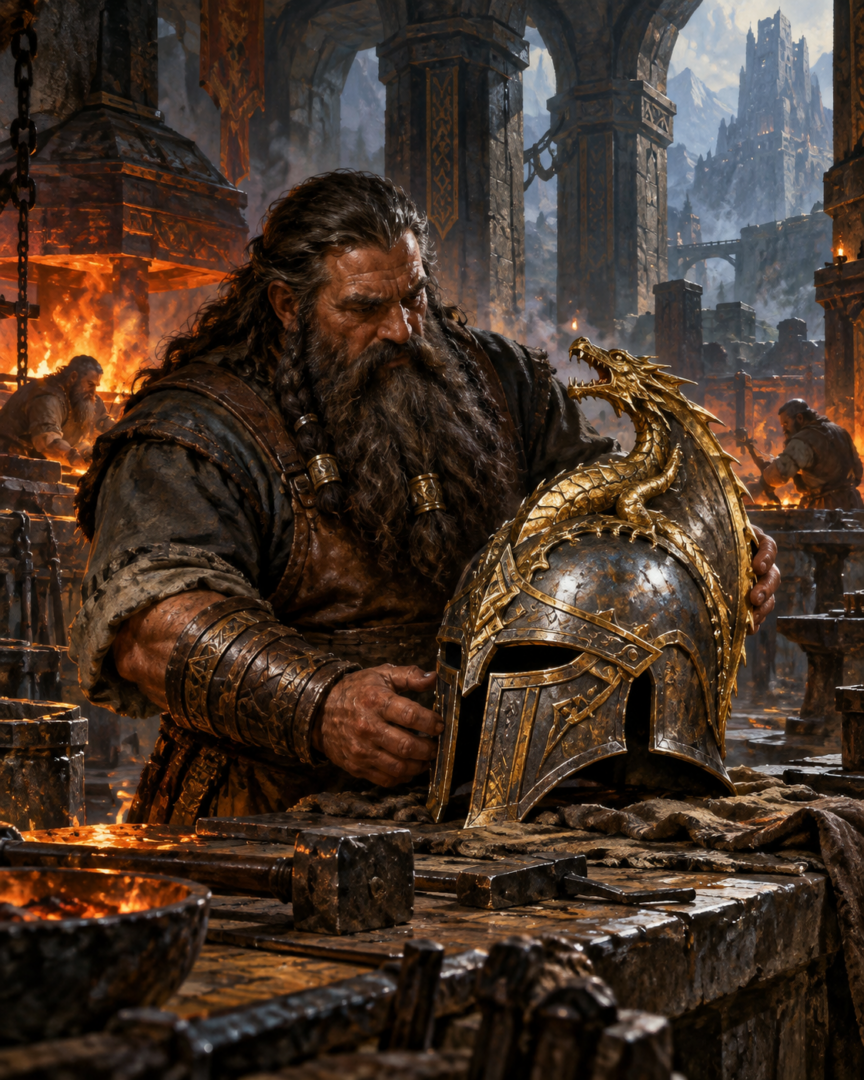
The Dragon-helm began with Telchar, the celebrated Dwarven smith of Nogrod.
In the account preserved in Unfinished Tales, the helm was originally made for Azaghâl, Lord of Belegost. Its first intended wearer was therefore neither an Elf nor a Man, but a powerful Dwarven leader.
This matters because the helm's construction reflected its origins.
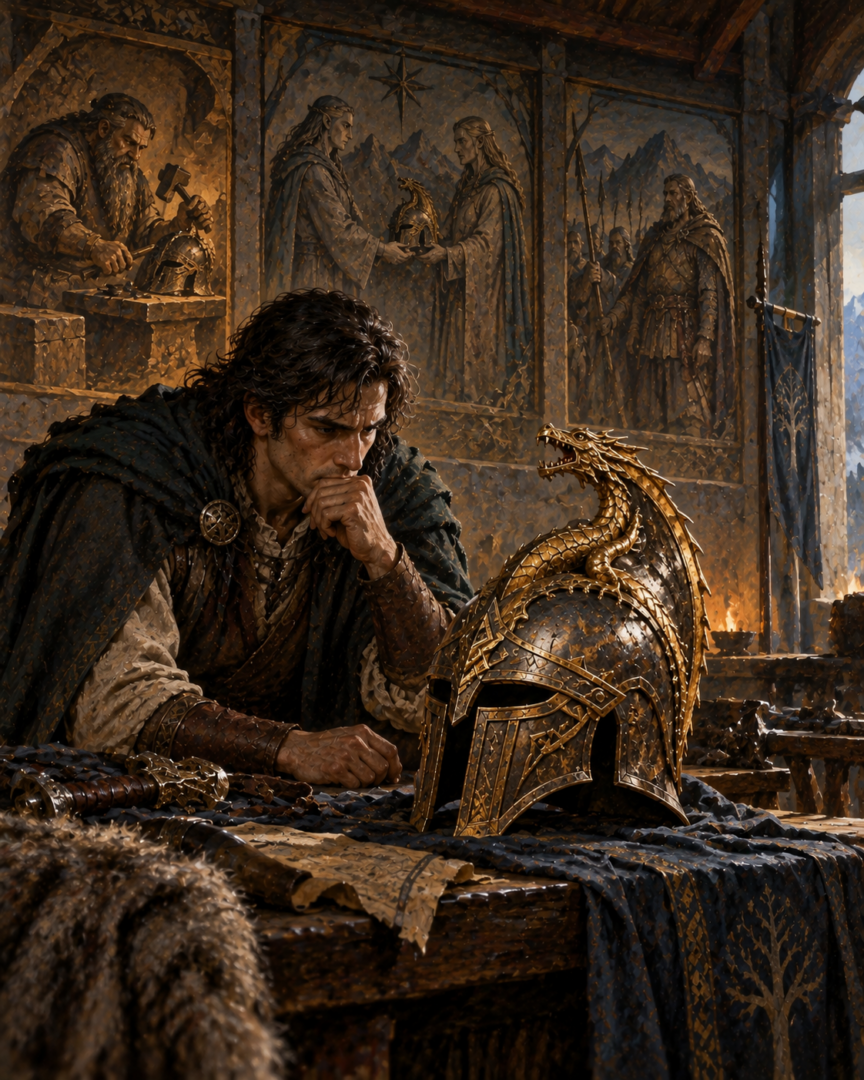
It was made of grey steel adorned with gold, bearing runes of victory. Its design included a protective visor in the fashion of Dwarven war-gear, and its crest displayed a gilded representation of Glaurung, the great dragon of Morgoth.
The helm was also exceptionally heavy.
Its weight would later become important when it passed into the possession of the Elves and eventually the House of Hador.
The account attributes extraordinary protective power to it, describing weapons breaking or glancing away rather than injuring its wearer.
Yet its importance was not merely practical.
A Dwarven lord had commissioned or received a masterpiece of his own people's craftsmanship. Its materials, workmanship, and imposing dragon crest made it an object worthy of the greatest warriors.
The surviving account does not describe the precise circumstances in which Telchar presented the helm to Azaghâl. Nor does it establish a formal political purpose behind its original creation.
What it establishes is its Dwarven origin.
That origin remained part of the helm's identity even after it left Dwarven hands.
Azaghâl and Maedhros: A Gift Born from Rescue
The first great transfer occurred because of an act of protection.
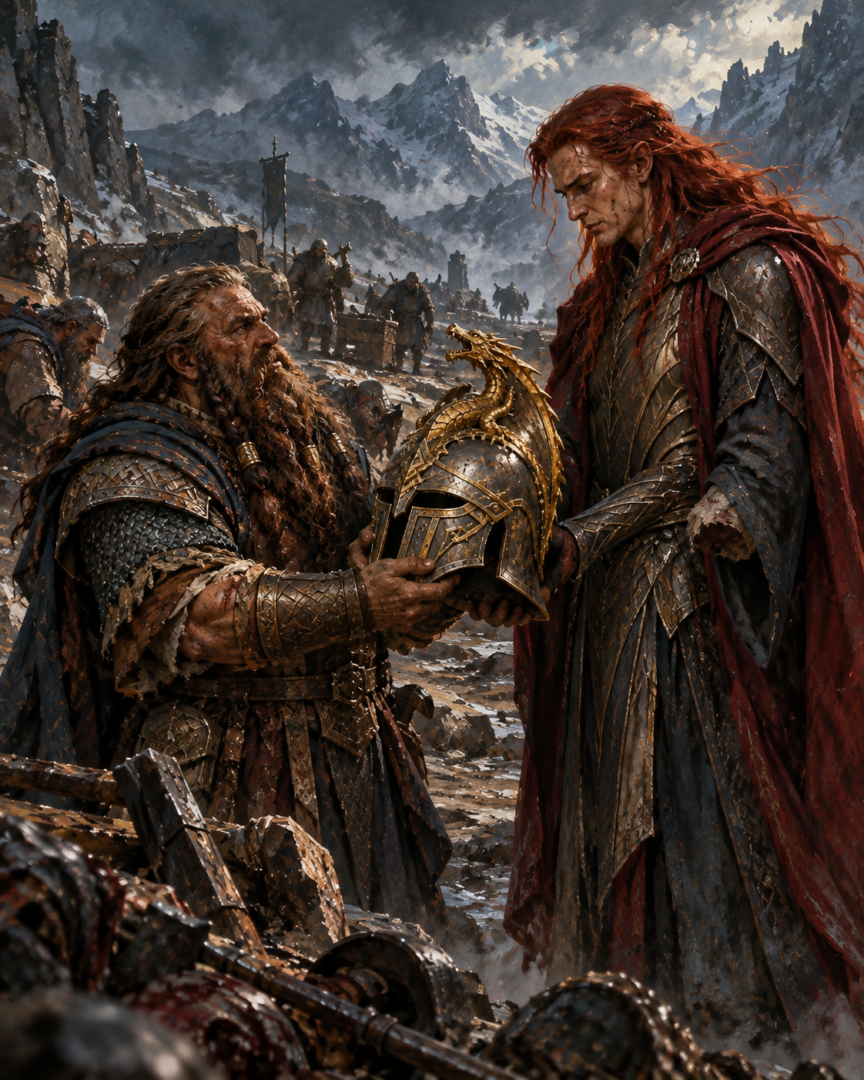
According to Unfinished Tales, Azaghâl was travelling along the Dwarf-road in East Beleriand when Orcs attacked him.
Maedhros, the eldest son of Fëanor, saved both the Dwarf-lord's life and his treasure.
In gratitude, Azaghâl gave Maedhros the helm.
This is one of the most revealing details in its entire history.
The gift was not described as payment for a negotiated military treaty. It was a reward for a specific deed.
Maedhros had intervened when Azaghâl faced danger, and the Dwarf-lord responded by surrendering something of exceptional value.
The exchange reveals a personal connection between two leaders belonging to different peoples.
It also fits the wider political landscape of eastern Beleriand.
The Noldorin princes maintained dealings with the Dwarves of the Blue Mountains, and cooperation between these peoples became increasingly important during the struggle against Morgoth.
Yet the rescue should not be confused with the later formation of the Union of Maedhros.
The text does not say that the helm established that alliance or that Azaghâl promised military service in exchange for his rescue.
Its significance is more personal and more precisely documented.
The first gift preserved gratitude for a life saved.
A Dwarven treasure became an Elven possession because one leader had protected another.
That was the first link in the chain.
Maedhros and Fingon: Friendship Remembered Through a Gift
The next transfer carried a different meaning.
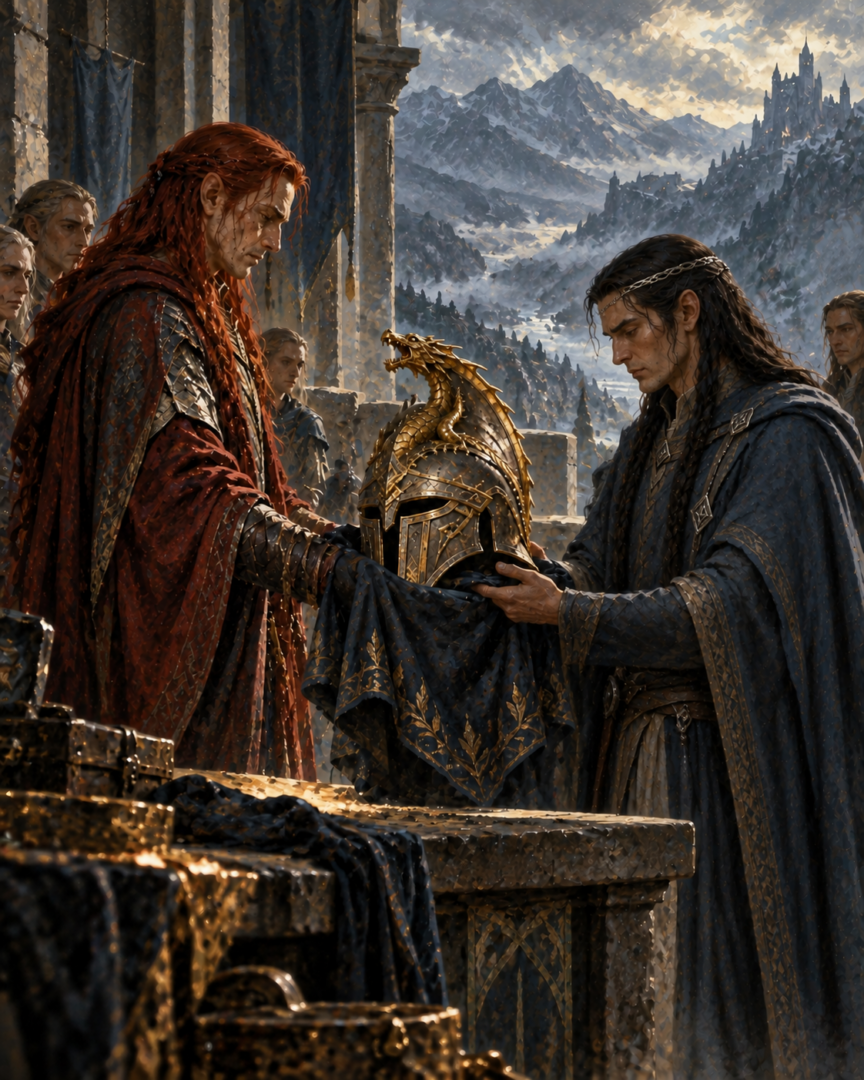
Maedhros sent the Dragon-helm to Fingon, son of Fingolfin.
The account in Unfinished Tales explains that Maedhros and Fingon frequently exchanged gifts as tokens of friendship.
It also gives a particular reason for this gift: Maedhros remembered Fingon's deed in driving Glaurung back toward Angband.
The dragon had emerged from Morgoth's stronghold before his full strength was grown. During that early appearance, Fingon led mounted archers against him and forced his retreat.
This victory made Fingon a fitting recipient of a helm bearing the dragon's likeness.
But the gift had another layer of meaning.
Maedhros and Fingon shared a friendship that had already survived one of the most painful divisions among the Noldor.
After the rebellion and the crossing into Middle-earth, the followers of Fëanor and those of Fingolfin had been separated by betrayal and suffering.
Fingon's extraordinary rescue of Maedhros from Thangorodrim helped heal the breach between their peoples.
That earlier rescue is not identified as the specific reason for the Dragon-helm gift. The text instead connects the gift to their continuing friendship and Fingon's achievement against Glaurung.
Nevertheless, their established relationship gives the exchange its deeper context.
A treasure received by Maedhros for saving a Dwarf-lord's life passed to an Elven prince who had himself once saved Maedhros.
The parallels are striking, even though the text does not present them as a deliberate symbolic pattern.
The helm now carried memories of courage across two different relationships.
It had moved from Dwarven gratitude into Noldorin friendship.
Why the Dragon on the Crest Matters
The gilded dragon on the helm was not an incidental decoration.
Its association with Glaurung connected the object to one of Morgoth's most terrifying servants.
The Narn i Hîn Húrin tradition describes the dragon image as a defiant challenge rather than an expression of loyalty to the creature it represented.
That distinction is essential.
The helm was not a tribute to Morgoth's dragon. Its appearance proclaimed resistance.
This makes Maedhros's gift to Fingon especially appropriate.
Fingon had already confronted Glaurung and driven him back to Angband. A helm displaying the dragon in defiance could therefore commemorate a real achievement against the Enemy.
There is also a bitter irony in the helm's Dwarven origins.
Azaghâl would eventually encounter Glaurung himself during the Nirnaeth Arnoediad, the Battle of Unnumbered Tears.
The Dwarves of Belegost proved unusually capable of withstanding the dragon's fire. When Glaurung struck Azaghâl down, the dying Dwarf-lord wounded him with a knife, forcing the dragon to withdraw.
Azaghâl died, and his people carried his body away from the battlefield.
The Dragon-helm's earlier journey must not be rewritten as a prophecy of that encounter.
Yet the later event gives its history a poignant resonance.
The Dwarf-lord for whom the helm was originally made ultimately faced the very dragon whose likeness crowned it.
The object had passed beyond his possession, but the struggle represented by its crest remained central to his fate.
Fingon and Hador: When Friendship Became an Heirloom
The Dragon-helm's final major transfer before its inheritance within the House of Hador brought it into the keeping of Men.
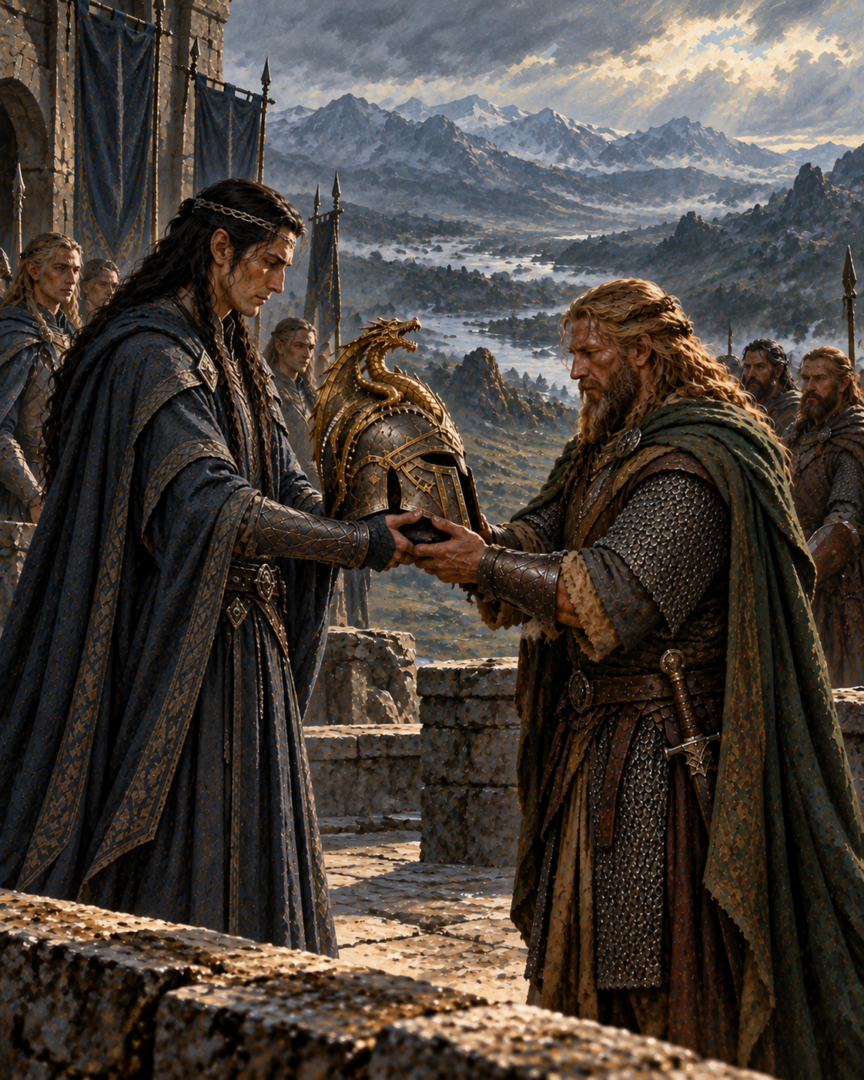
Fingon gave the helm to Hador when Hador received the lordship of Dor-lómin.
This transfer connected an extraordinary piece of Dwarven craftsmanship with the political relationship between the Noldor and their human allies.
Hador belonged to the Edain, the houses of Men who befriended the Elves and fought against Morgoth.
The House of Hador became especially associated with Hithlum and Dor-lómin.
In The Silmarillion, Fingolfin, High King of the Noldor, grants Hador the lordship of Dor-lómin. The more detailed account of the helm in Unfinished Tales associates Fingon's gift with Hador's reception of that lordship.
These details should be kept distinct.
Fingolfin's grant established Hador's position. Fingon's gift marked the occasion with an exceptional heirloom.
The helm itself did not confer sovereignty, nor is there evidence that possessing it was a legal requirement of lordship.
Its significance was commemorative and personal.
An Elven prince entrusted a valuable object to a human lord whose people had become indispensable allies.
The gift also had a practical explanation.
The Dragon-helm had been made for a Dwarf, and its weight made it difficult for most potential wearers to bear comfortably.
The account specifically identifies Hador and his son Galdor as possessing the necessary strength and build.
Thus the helm found a new home where it could actually be used.
It was no longer merely a prestigious gift exchanged between great leaders.
It became the war-gear of a ruling family.
The House of Hador Inherited More Than Steel
Hador and Galdor wore the Dragon-helm in battle.
The sight of its towering crest encouraged the warriors of Hithlum, who associated it with the strength of their leaders and their resistance to Angband.
This was a transformation in the helm's meaning.
For Azaghâl, it had been a masterpiece of Dwarven craftsmanship.
For Maedhros, it had been a reward for rescuing a friend and ally.
For Fingon, it had commemorated friendship and victory against Glaurung.
For Hador and Galdor, it became a visible symbol of their house in war.
These meanings did not necessarily replace one another.
They accumulated.
The helm's history was now inseparable from the relationships that had carried it across Beleriand.
Its inheritance also reveals an important distinction between possessing an heirloom and wearing it.
Húrin, son of Galdor, valued the Dragon-helm greatly but did not wear it comfortably. He also preferred to confront his enemies with his face uncovered.
The helm nevertheless remained among the treasures of his house.
Its importance therefore survived even when its owner chose not to use it.
That is one of the clearest indications that the Dragon-helm was more than a useful defensive object.
It represented a family history that reached beyond the family itself.
The Alliance Behind the Object
The Dragon-helm's journey can be understood as a miniature history of cooperation among the Free Peoples of Beleriand.
But this interpretation needs an important qualification.
The sequence of gifts was not a single coordinated diplomatic ceremony.
Azaghâl, Maedhros, Fingon, and Hador did not gather to establish a unified political order through the transfer of one helmet.
Each exchange had its own circumstances.
The first arose from gratitude.
The second expressed friendship and remembered a military achievement.
The third commemorated a human lord's new position.
What connects them is not an invented treaty, but a succession of documented relationships.
The broader history of the First Age shows why those relationships mattered.
The Noldor could not resist Morgoth through their own strength alone. The Dwarves possessed formidable craftsmanship and military capabilities. The Edain contributed warriors whose loyalty and courage became essential to the defense of northern Beleriand.
These partnerships were never perfectly unified.
The Elven princes had their own rivalries and obligations. The Dwarves maintained their own interests. The houses of Men faced terrible dangers because of their friendship with the Eldar.
Nevertheless, cooperation repeatedly crossed the boundaries between their peoples.
The Dragon-helm offers a particularly concrete example.
Its successive owners were connected not by common ancestry, but by deeds, gifts, and shared resistance to the Enemy.
In that sense, the helm preserved a history of alliance before it became a symbol of hereditary identity.
The Tragedy of the Chain's Final Inheritance
By the time the Dragon-helm came to Túrin, the world that had given it meaning was already being destroyed.
Hador had fallen in battle. Galdor had died defending Eithel Sirion. Húrin had been captured after the catastrophic defeat of the Nirnaeth Arnoediad.
The House of Hador had suffered devastating losses.
The helm eventually reached Túrin in Doriath, where its earlier history remained part of the account of his inheritance.
Its subsequent appearances belong to a complicated textual history.
The Narn material and related accounts do not provide an entirely uniform narrative of its later movements. In particular, references to the Dragon-helm must be distinguished from the gilded Dwarf-mask associated with Túrin's fighting at Nargothrond in the published narrative.
Those objects should not automatically be treated as identical.
Some surviving material envisages the Dragon-helm returning to Túrin's possession later than the narrative otherwise clearly establishes, but the details were not fully reconciled.
For the earlier history of the helm, however, the sequence of gifts is unusually informative.
And that earlier history gives its inheritance a meaning beyond Túrin's personal fate.
He received an object that had once passed freely between leaders capable of protecting one another.
By his lifetime, many of those leaders were dead, their strongholds threatened or destroyed, and their peoples increasingly scattered.
The helm endured longer than the political world that had carried it from one owner to the next.
A History of Friendship Hidden Inside a War-helm
The Dragon-helm of Dor-lómin is often remembered because of the man who eventually wore it.
Yet its deeper historical significance begins generations earlier.
Telchar's craftsmanship gave it form. Azaghâl's gratitude brought it to Maedhros. Maedhros's friendship carried it to Fingon. Fingon's gift placed it in the hands of Hador, where it became an inheritance of the Edain.
Every stage added a different meaning.
The helm was never a magical instrument for creating alliances or transferring political authority. It did not guarantee victory, and its possession could not preserve the kingdoms of Beleriand from ruin.
Its value lay partly in something more fragile.
It remembered relationships.
Long before Túrin became associated with the Dragon-helm, it had already connected a Dwarven lord, two princes of the Noldor, and the ancestors of one of the greatest houses of Men.
What Túrin inherited was not simply the emblem of his family, but the surviving evidence of friendships and obligations that had helped unite different peoples against Morgoth.
The Dragon-helm became famous through a tragic hero.
But before it belonged to his story, it belonged to the history of an alliance.
Sources & Notes
- Tolkien Gateway — Dragon-helm of Dor-lómin. https://tolkiengateway.net/wiki/Dragon-helm_of_Dor-l%C3%B3min
- Tolkien Gateway — Azaghâl. https://tolkiengateway.net/wiki/Azagh%C3%A2l
- Tolkien Gateway — Hador. https://tolkiengateway.net/wiki/Hador
Primary text: Unfinished Tales, “Narn i Hîn Húrin,” and The Silmarillion’s account of Hador. The sources document Telchar’s making and the transfers from Azaghâl through Maedhros and Fingon to Hador. Reading the gifts as remembered alliance is interpretation, not a formal treaty.