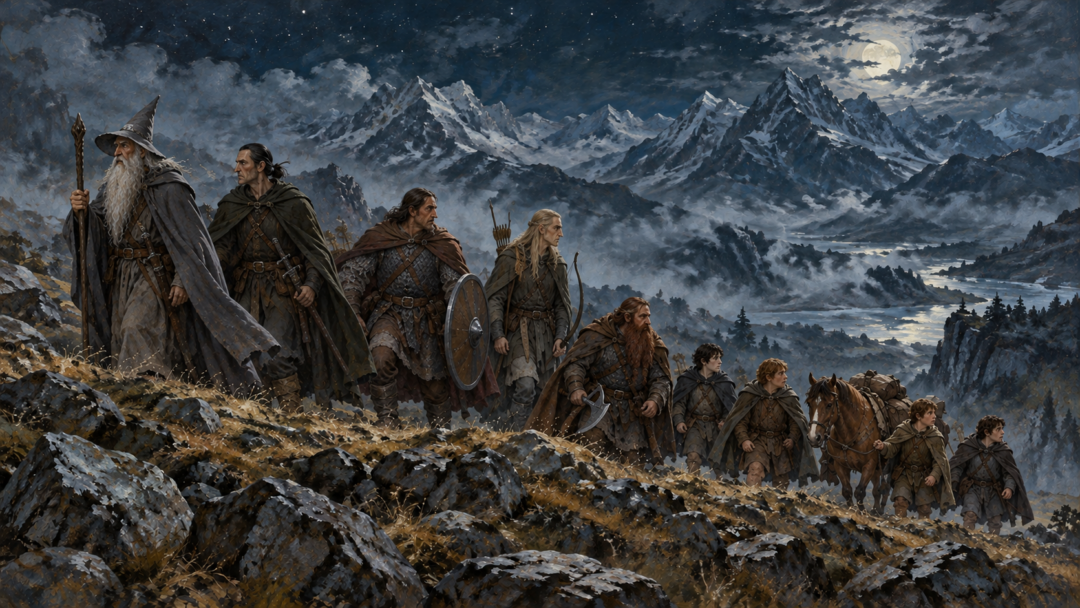
Nine companions left Rivendell under the stars, carrying a secret that could decide the fate of Middle-earth. Among them were a Wizard, two experienced warriors, an Elf, a Dwarf, four Hobbits, and a pony laden with supplies. Yet their greatest protection was not the strength of their weapons. It was the hope that no enemy would notice them passing.
This creates a fascinating problem. How does such an unequal company travel through dangerous country after dark? Who goes first when the path is uncertain? Who watches behind? And where does a baggage pony belong when the travellers must remain quiet and concealed?
The answer is more subtle than a fixed military formation.
In The Fellowship of the Ring, particularly the chapter "The Ring Goes South," the Company's movements reveal a flexible arrangement shaped by secrecy, experience, terrain, and the needs of its most vulnerable members. The narrative sometimes identifies who leads, who follows, and who handles particular dangers. But it does not provide a permanent marching diagram.
That distinction matters. The Fellowship survives not by following an elaborate system of ranks, but by adapting the abilities of its members to the changing road.
Why the Fellowship Travels After Dark
When the Company leaves Rivendell on December 25, 3018, its immediate task is to cross the lands west of the Misty Mountains without attracting attention.
The journey is deliberately secretive.
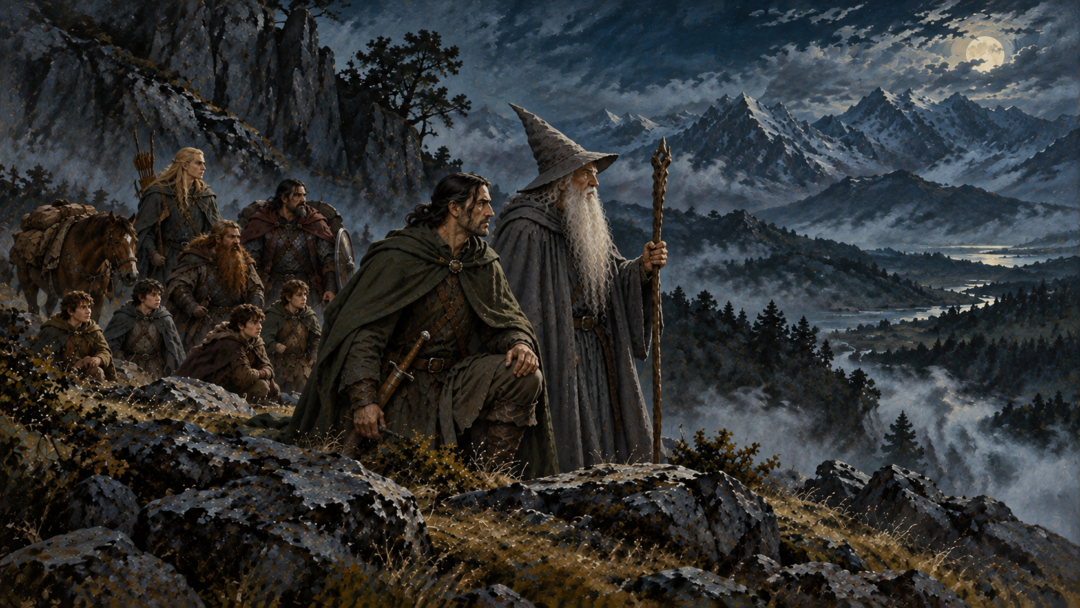
For the first part of their travels, the companions generally move by night and rest during daylight. They follow the country southward, avoiding the attention that a visible party might attract.
This choice is particularly important because the Ring-bearer is travelling with companions who would otherwise be conspicuous. Aragorn carries the reforged sword Andúril. Boromir is a warrior of Gondor. Gandalf is known to many peoples. Together with an Elf, a Dwarf, and four Hobbits, they make an unusual gathering.
Their mission cannot be accomplished by announcing their presence.
The Council of Elrond has already established that the Ring must be carried toward Mordor rather than used as a weapon against Sauron. The Company's secrecy therefore serves a purpose greater than avoiding ordinary travellers.
They must preserve the possibility that the Enemy does not know their exact whereabouts or intentions.
Night travel reduces their visibility, but it introduces another difficulty: moving safely when the ground itself may be hard to read.
Who Takes the Lead?
Gandalf and Aragorn are the two most important figures in the Company's early decisions about the road.
Gandalf possesses knowledge of distant lands, ancient places, and the wider danger confronting the mission. Aragorn has extensive experience travelling through the wilderness, including the lands west of the mountains.
Their abilities complement one another.
The text describes them guiding the Company's progress and discussing possible routes. Aragorn's knowledge is particularly important as they approach the mountains, while Gandalf weighs alternatives that may be less familiar or more dangerous.
But this does not mean Gandalf always walks first, or that Aragorn permanently occupies the position immediately behind him.
The narrative does not establish such a rule.
Instead, leadership changes according to circumstances. The person best able to judge a particular danger may take the initiative, even when another companion has been directing the journey.
This becomes especially apparent when the Fellowship encounters difficult terrain.
The distinction between deciding the route and physically leading the line is important. A traveller may guide the Company without occupying the front position at every moment.
The Rear of the Company: What the Text Actually Shows
It is tempting to imagine the Fellowship with a permanent rear guard: perhaps Boromir watching behind while Aragorn scouts ahead.
That arrangement might seem sensible, but the text does not identify it as the Company's established practice.
Boromir is certainly a capable warrior, and his strength proves invaluable during the journey. Yet assigning him a fixed rear-guard position throughout the night marches would go beyond the evidence.
The same caution applies to Legolas.
His keen sight and hearing make him especially valuable when danger is difficult to detect. Nevertheless, the narrative does not describe him as a permanently detached scout patrolling the flanks.
The Fellowship is a small travelling company, not an army moving with documented scouting detachments.
Its members remain close enough to share decisions, warnings, and assistance. Specific passages reveal particular companions taking the lead or responding to danger, but not an unchanging system of forward scouts and rear guards.
This absence of a rigid formation is itself revealing.
The companions are crossing country where concealment matters more than displaying strength. Their greatest advantage lies in remaining together and responding to what the journey demands.
Where Does Bill the Pony Walk?
One of the most easily overlooked complications in the Fellowship's movement is Bill the pony.
Bill accompanies the Company from Rivendell, carrying supplies and equipment that the travellers would otherwise have to bear themselves.
His presence changes the practical nature of the journey.
A party consisting entirely of walkers can sometimes negotiate ground that presents much greater difficulty for a loaded animal. A pony also requires handling and cannot simply be expected to follow every dangerous path unaided.
Sam has a particular attachment to Bill and takes responsibility for him.
But the text does not establish that Bill always travels at the centre of the Fellowship, between designated guards, or at the very rear.
Those are plausible arrangements, not documented rules.
What is clear is that the pony's needs influence what the Company can do. Bill must be considered when choosing difficult ground, especially as the journey approaches the mountains.
His role is therefore more significant than that of a background animal.
He represents a practical limitation upon a mission whose success depends on moving quietly through increasingly hostile country.
The Fellowship must carry enough to survive, but its means of carrying those supplies cannot negotiate every possible route.
Hollin: When Concealment Becomes More Important Than Progress
The Company's arrival in Hollin, the ruined land once known as Eregion, provides one of the clearest examples of how its movement responds to danger.
After travelling south from Rivendell, the companions enter a country associated with the ancient Elven realm.
For a time, the land seems deserted.
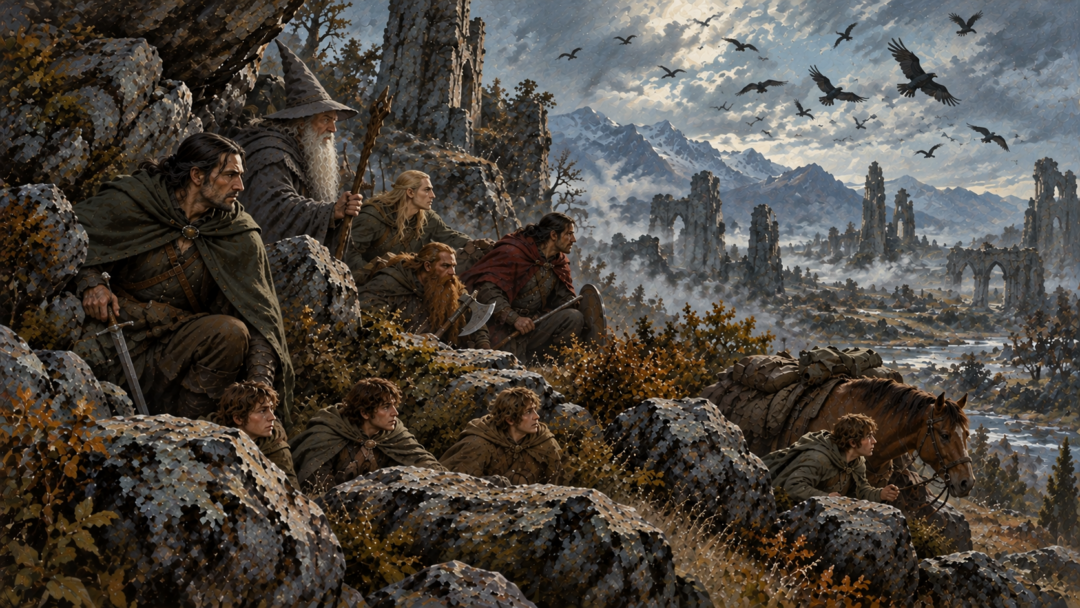
Then Aragorn notices black birds moving across the sky.
He identifies them as crebain from the lands around Dunland and Fangorn, and suspects that they may be searching for information.
The Company cannot know with certainty that every bird is an enemy spy. Nevertheless, the possibility is serious enough to alter its behaviour.
Rather than continue openly, the companions conceal themselves among the stones and bushes.
Their response demonstrates the real logic behind their night journeys.
Remaining unseen takes priority over maintaining a convenient pace.
A marching order cannot protect the Ring-bearer if the entire party is exposed to observation from above. The best decision may be to stop moving altogether.
Later, the Company resumes its journey under darkness.
The danger has not been defeated. It has merely been avoided for the moment.
This is a crucial distinction in understanding the Fellowship's early progress: secrecy is not a permanent condition guaranteed by darkness, but something that must be preserved through repeated choices.
Caradhras: When Strength Determines the Order
The attempted crossing of the Redhorn Gate shows how quickly practical circumstances can change the Company's arrangement.
As the companions climb toward the mountain pass, snow and bitter weather make the route increasingly difficult.
The smaller travellers suffer particularly badly.
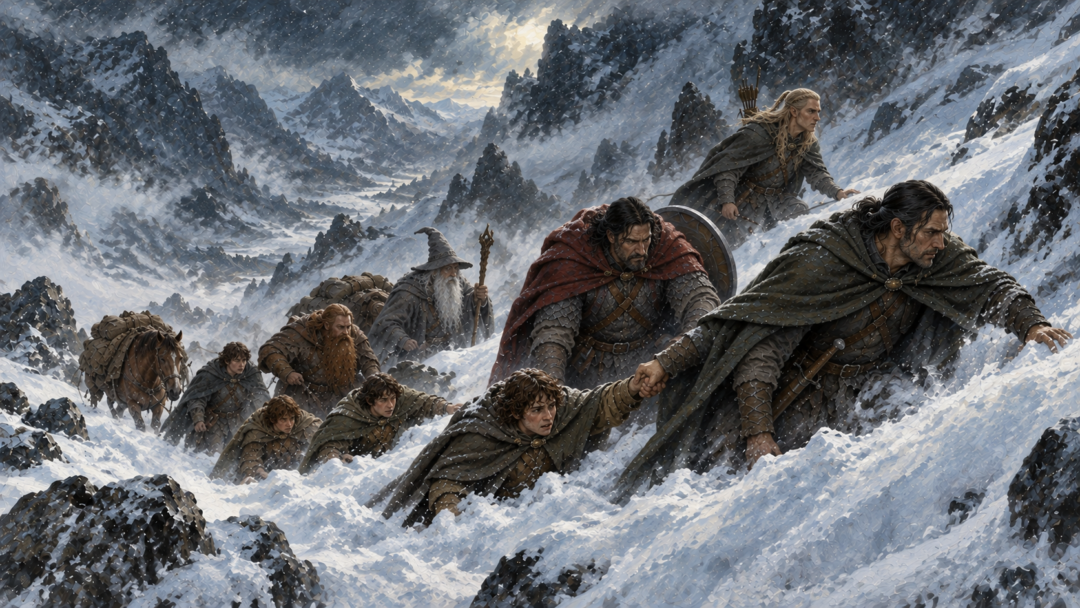
Eventually, deep snow prevents the Company from advancing normally. The question is no longer how to remain inconspicuous on open ground, but how to escape a mountain that has become impassable.
Here, the narrative gives unusually clear evidence of who moves ahead.
Boromir and Aragorn use their strength to force a passage through the snow. Their work allows the others to retreat along the route they have opened.
They also help carry the Hobbits through the worst conditions.
Legolas, meanwhile, can move lightly over the snow in a way the others cannot. His unusual ability gives him freedom of movement that the rest of the Company lacks.
This is not evidence of a permanent formation. It is evidence of adaptation.
The strongest companions take the physically demanding task. Legolas's abilities become useful in a different way. The Hobbits receive assistance because the conditions make ordinary progress extremely difficult for them.
The marching order emerges from the obstacle.
The Company's arrangement is therefore best understood as something that changes with the ground beneath its feet.
Why the Hobbits Are Not Simply Kept at the Back
A conventional military interpretation might place the four Hobbits permanently behind the stronger warriors.
But the Fellowship's purpose is not to fight its way across Middle-earth in battle formation.
Frodo is the Ring-bearer, and his safety is essential to the mission. Yet he is also a participant whose choices matter.
Sam, Merry, and Pippin are not merely burdens to be transported.
Their friendship with Frodo is one reason they are included in the Company, despite their relative inexperience in the wider world.
The text does not assign the Hobbits a single permanent position during the night marches.
Instead, their vulnerability becomes particularly visible when conditions demand special assistance, as on Caradhras.
There is an important difference between protecting companions and treating them as incapable of contributing.
The Fellowship must do the former without assuming the latter.
That balance reflects the unusual character of the mission: the Ring is carried not by its greatest warrior, but by a Hobbit whose courage cannot be measured by physical strength.
What Happens When the Company Can No Longer Hide?
The Fellowship's encounter with wolves after descending from Caradhras illustrates the limits of concealment.
As threatening howls surround them, the companions take shelter on a small hill crowned with trees and broken stones.
They establish a defensive position and light a fire.
This is a striking departure from the earlier emphasis on travelling unseen.
But their circumstances have changed.
The Company has reason to believe that the hunting creatures already know where they are. Darkness and silence can no longer provide the protection they need.
The narrative describes companions keeping guard while others rest uneasily.
Here, watchfulness becomes an explicit defensive activity rather than something readers must infer from a travelling arrangement.
The episode does not reveal the Company's usual marching order. Instead, it shows that the principles governing its behaviour are flexible.
When secrecy offers protection, they attempt concealment.
When concealment has failed, they prepare to defend themselves.
The change is driven by immediate danger, not by a permanent military doctrine.
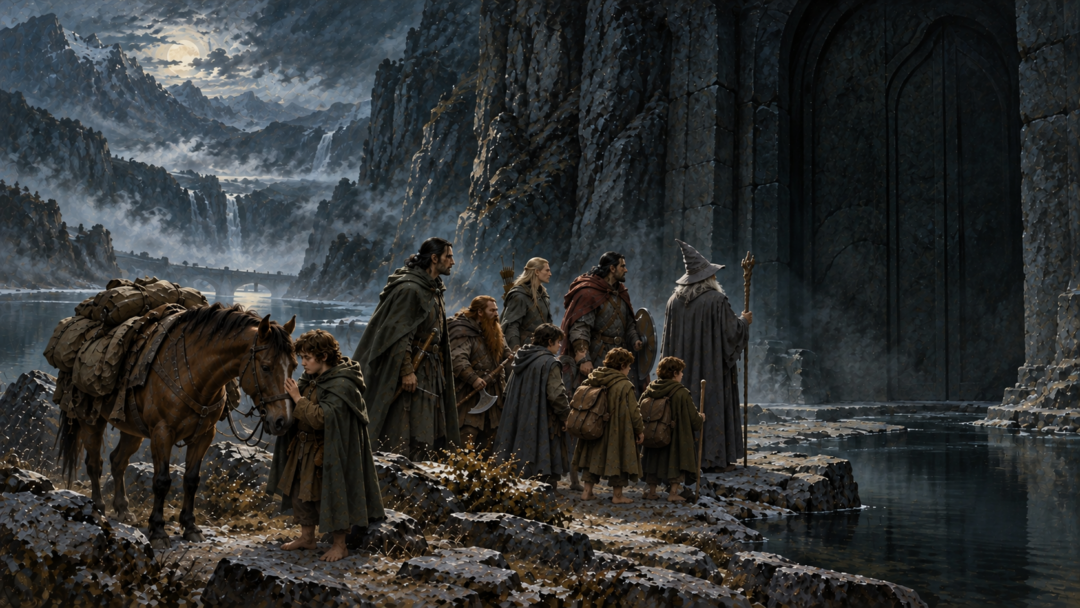
The West-gate and the End of the Pony's Journey
The approach to Moria creates another change in how the Fellowship can travel.
The Company reaches the western entrance, where Gandalf attempts to open the Doors of Durin.
Bill cannot accompany them through the mines.
This separation matters for any reconstruction of the Fellowship's movement. The pony belongs to the earlier journey across the open country and mountains, not to the Company's subsequent passage through Moria.
Sam is deeply distressed at the prospect of leaving him.
Gandalf speaks words intended to help Bill find his way to safety, and the pony eventually escapes when the Watcher in the Water attacks.
Once inside Moria, the companions face a different environment.
The darkness is no longer the open darkness of the night sky. Their progress depends upon finding passages through an ancient underground complex.
Gandalf's knowledge and guidance become particularly important, although even he does not possess perfect knowledge of the way.
The earlier travelling arrangement cannot simply be carried unchanged into these conditions.
The landscape has altered the problem.
The Hidden Principle Behind the Fellowship's March
The most important conclusion is also the easiest to miss.
The Fellowship does not appear in the text as nine travellers arranged according to a permanent, precisely documented marching order.
Instead, its journey reveals a set of practical priorities.
Experienced guides help determine the route. The Company uses darkness and concealment to reduce the risk of discovery. Companions with unusual abilities become especially valuable when circumstances demand them. Those who struggle receive assistance. Bill's presence must be accommodated until the entrance to Moria makes his continued journey impossible.
None of these observations requires inventing a formal system of scouts, guards, or fixed positions.
And that makes the Fellowship more interesting.
Its members come from different peoples, possess different strengths, and face dangers that cannot always be anticipated. They must continually adjust to circumstances without losing sight of the shared purpose that brought them together.
The night marches south of Rivendell are therefore more than a quiet prelude to greater adventures.
They reveal how fragile the quest already is.
A few black birds can halt the travellers. Snow can render their strongest weapons irrelevant. A pony can complicate a mountain crossing. A hidden enemy can force them to abandon secrecy altogether.
The Fellowship's real strength is not that every companion has an assigned place in an unchanging line.
It is that, when the road changes, they find a way to keep moving together.
Sources & Notes
- Tolkien Gateway — The Ring Goes South. https://tolkiengateway.net/wiki/The_Ring_Goes_South
- Tolkien Gateway — Fellowship of the Ring. https://tolkiengateway.net/wiki/Fellowship_of_the_Ring
- Tolkien Gateway — Bill the Pony. https://tolkiengateway.net/wiki/Bill_the_Pony
Primary text: The Fellowship of the Ring, “The Ring Goes South” and “A Journey in the Dark.” The cited chapter and companion references support route decisions, secrecy, and the pony’s role. No permanent marching diagram, fixed rear guard, or military scouting doctrine is asserted.