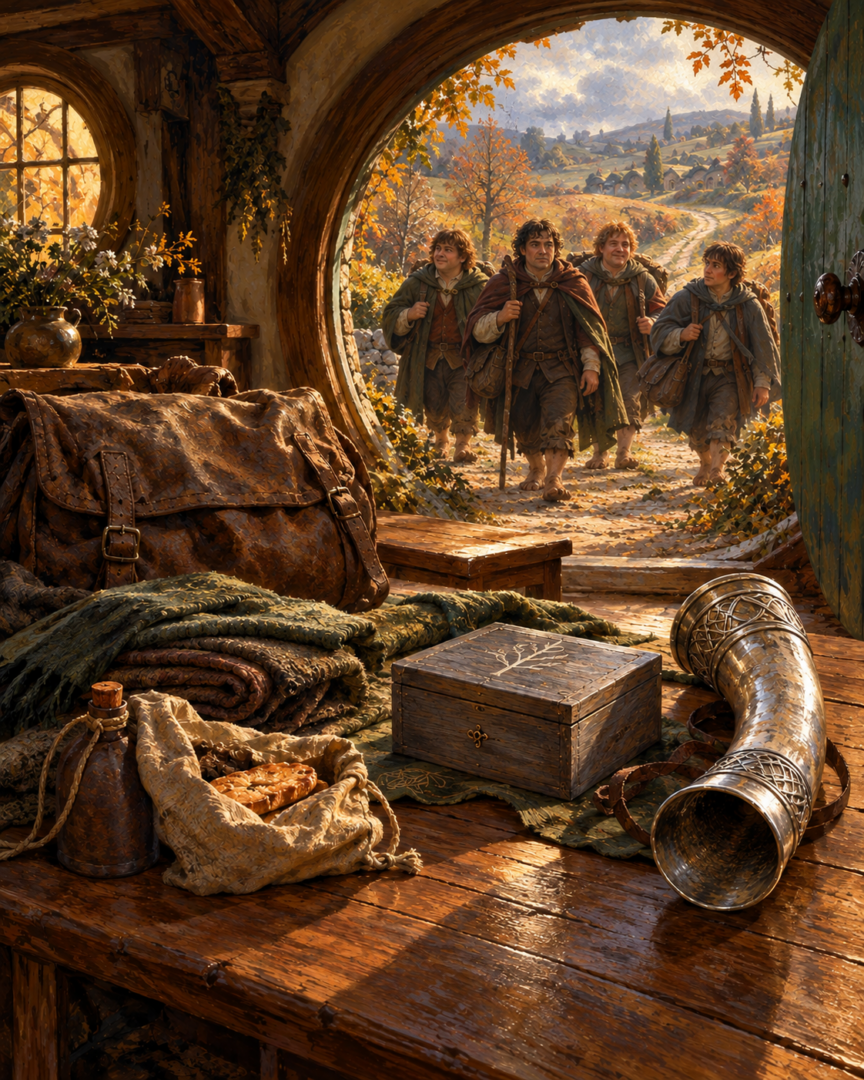
When Frodo, Sam, Merry, and Pippin left the Shire, their belongings were chosen for a journey into uncertainty. They needed food, clothing, and whatever might help them survive the road ahead. By the time they returned, they carried possessions of a very different kind: weapons and equipment associated with distant kingdoms, gifts from friends, and, in Sam's keeping, a small wooden box containing earth and a seed.
The difference is easy to overlook because the four hobbits return to familiar country. Yet the objects accompanying them reveal something important about the ending of The Lord of the Rings.
An expedition is equipped to get its travellers through danger. A return may require them to use what they have acquired to preserve, defend, and restore the place they left behind.
The distinction becomes especially clear when the hobbits discover that the Shire has suffered during their absence.
Their possessions are no longer simply travelling necessities. Some become instruments of resistance. Others preserve connections with people and places far away. One extraordinary gift makes possible a renewal that ordinary labour alone could not have produced.
And not everything they carry home can repair what has been lost.
The Outward Journey: Possessions Chosen for Survival
At the beginning of the story, the hobbits' practical concerns are immediate.
Leaving Bag End and travelling through the countryside requires provisions, spare clothing, and suitable equipment. Food is especially important, as it repeatedly becomes throughout their adventures.
Their preparations are not those of experienced soldiers setting out on a military campaign. Frodo initially hopes to leave the Shire without attracting attention, and the journey begins with the familiar practical concerns of hobbits travelling on foot.
Even after reaching Rivendell, the Fellowship's equipment remains directed toward the demands of the road.
The Company departs with supplies, weapons, and provisions suited to a difficult expedition. Later, in Lothlórien, the Elves provide additional necessities, including travelling cloaks and lembas, the sustaining waybread.
These things serve recognizable purposes.
Food is consumed. Clothing protects against weather. Weapons offer some defence. Travelling equipment helps its owner reach the next destination.
Their value lies primarily in what they allow the travellers to endure.
But the gifts received in Lothlórien introduce another possibility: an object carried on a dangerous journey might be intended for a purpose beyond that journey.
Sam's gift provides the clearest example.
Sam's Wooden Box: A Gift That Was Never Meant for the Road
When Galadriel distributes her gifts before the Fellowship leaves Lothlórien, she gives Sam a small box made of plain grey wood.
It contains earth from her orchard, bearing what blessing she can still bestow.
Galadriel makes an important distinction. The gift will not sustain Sam during his travels or protect him from danger. Its possible benefit belongs to a future in which he survives and returns home.
That makes the box fundamentally different from ordinary expedition equipment.
Sam must carry something that offers no immediate practical advantage against the dangers ahead.
Its value depends upon a homecoming that is far from certain.
The gift also reflects Sam's particular interests. He is a gardener who loves growing things, and Galadriel offers him something connected to cultivation rather than warfare.
At this stage, however, neither Sam nor the reader knows exactly how the gift will eventually be used.
Its purpose remains suspended between hope and uncertainty.
Only after the hobbits return does the full significance of the box become apparent.
Merry's Horn: A Farewell Gift That Becomes a Call to Action
Another remarkable return possession belongs to Merry.
After the War of the Ring, Éowyn gives him a silver horn as a farewell gift in recognition of his service to Rohan.
The horn has a history reaching back to the northern ancestors of the Rohirrim. It had belonged to the treasure associated with Scatha the dragon and eventually became an heirloom of the House of Eorl.
Unlike Sam's box, the horn is not intended for planting or restoration.
It is an object associated with memory, honour, and the martial traditions of Rohan.
Yet its significance changes when Merry returns to the Shire.
In November 3019, the four travellers discover that their homeland has fallen under the control of oppressive Men and their collaborators.
The Shire's ordinary institutions have been distorted. Movement is restricted, property has been seized, and many hobbits have been intimidated into obedience.
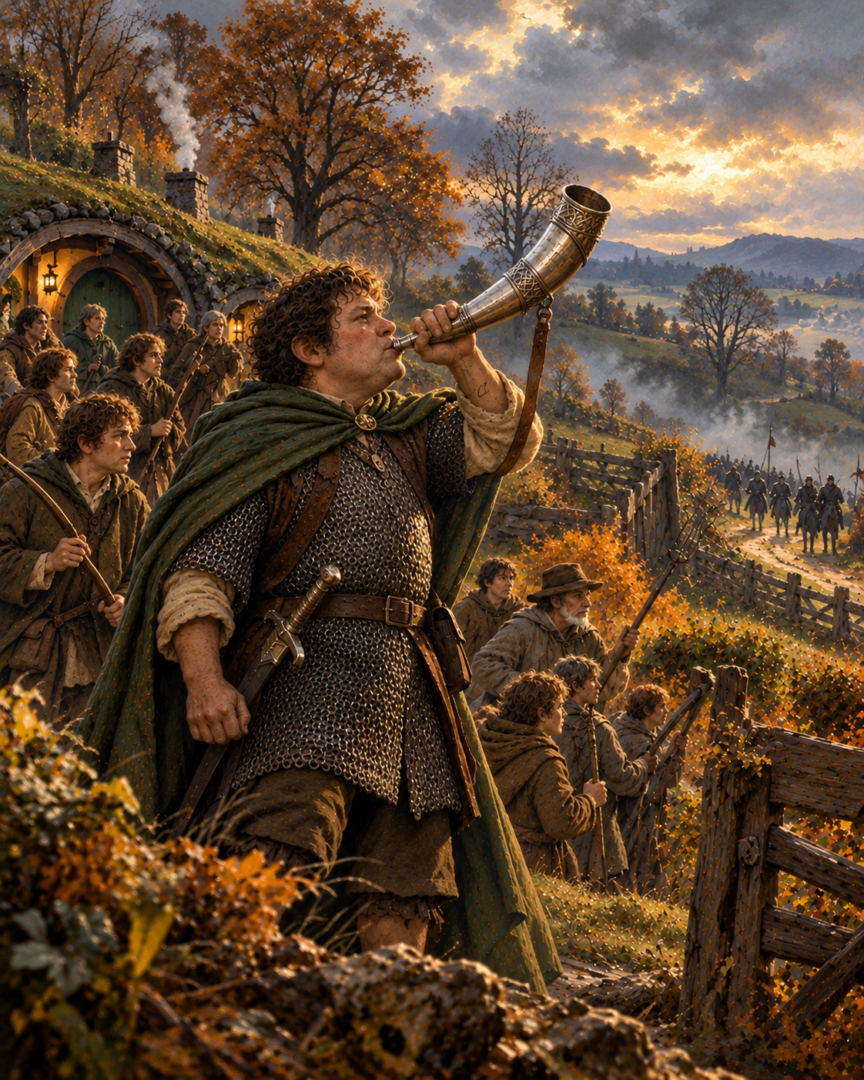
Merry uses the horn to summon resistance.
In Buckland, its sound becomes part of the effort to rouse the inhabitants against the intruders.
A gift received in remembrance of service to one land becomes useful in the defence of another.
The horn does not defeat the ruffians by itself. Its importance lies in the people who answer its call.
Afterward, the horn continues to have a place in Buckland's remembrance of the Shire's liberation.
It is therefore more than a souvenir of Rohan. It becomes part of the Shire's own history.
The Armour and Weapons That Returned With Merry and Pippin
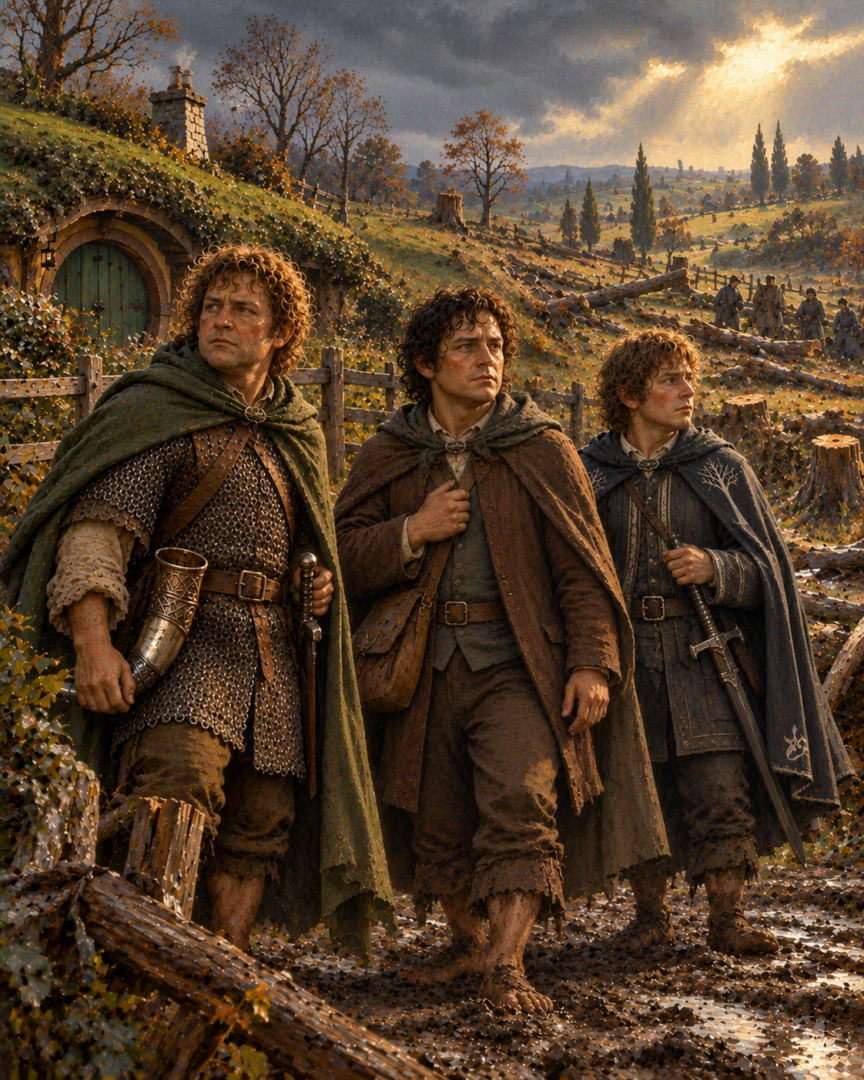
The contrast between departure and return is especially visible in Merry and Pippin.
When they come home, they are no longer dressed merely as hobbits who have spent months travelling.
Their equipment reflects their service in two great kingdoms.
Merry has served King Théoden of Rohan, while Pippin has entered the service of Gondor.
In "The Scouring of the Shire," their military appearance makes an immediate impression.
The hobbits who encounter them are confronted with travellers wearing equipment associated with lands far beyond their experience.
Their swords and armour have practical importance because the Shire is not peaceful when they arrive.
The four travellers must confront armed Men, and Merry and Pippin take leading roles in organizing resistance.
Their equipment is not simply decorative evidence of adventures elsewhere.
It belongs to the immediate circumstances of the homecoming.
There is also a difference between carrying weapons into an unknown wilderness and bringing them back to a familiar country.
On the outward journey, weapons are intended to protect travellers from dangers they expect to encounter beyond the Shire.
On the return, those weapons help defend the Shire itself.
The threat has crossed the boundary that once separated home from the wider world's conflicts.
This does not mean the hobbits return as conquerors. Their purpose is to free their own communities from coercion and restore ordinary life.
The weapons are useful precisely because the situation is abnormal.
Their success should eventually make such military equipment unnecessary for everyday Shire life.
Frodo's Mithril Coat: Protection Cannot Undo Every Injury
Frodo's possessions complicate any simple distinction between the outward journey and the return.
Among the most important things he retains is the mithril coat that Bilbo gave him in Rivendell.
Originally made for a young Elf-prince, the extraordinary coat had already protected Frodo during the Fellowship's journey through Moria.
Its protective value remains important after the destruction of the Ring.
When Saruman attacks Frodo near Bag End, the blade strikes the hidden mail and breaks.
The coat therefore still serves its original defensive purpose, even at the very end of the hobbits' adventures.
But the scene also exposes the limits of material protection.
Frodo survives the attack, yet his suffering cannot be reduced to injuries that armour might prevent.
The wound inflicted at Weathertop and the consequences of his long burden continue to trouble him.
He has helped save the Shire, but returning to it does not mean recovering everything he once possessed in health and peace.
This is an essential qualification to the idea of homecoming.
Not every useful object becomes an instrument of renewal.
Some possessions can preserve life without restoring the life their owner previously knew.
The Shire's Ruined Trees Change the Meaning of Sam's Gift
After the ruffians have been defeated, the hobbits face another task.
The Shire must be repaired.
Buildings have been damaged or altered. Trees have been cut down. Places associated with generations of ordinary hobbit life have been disfigured.
The destruction of trees is especially painful to Sam.
Near Bag End, the loss of the old Party Tree and the damage to the surrounding countryside reveal how deeply the occupation has affected the Shire's familiar landscape.
The travellers can remove the intruders, but removing them does not automatically restore what has been destroyed.
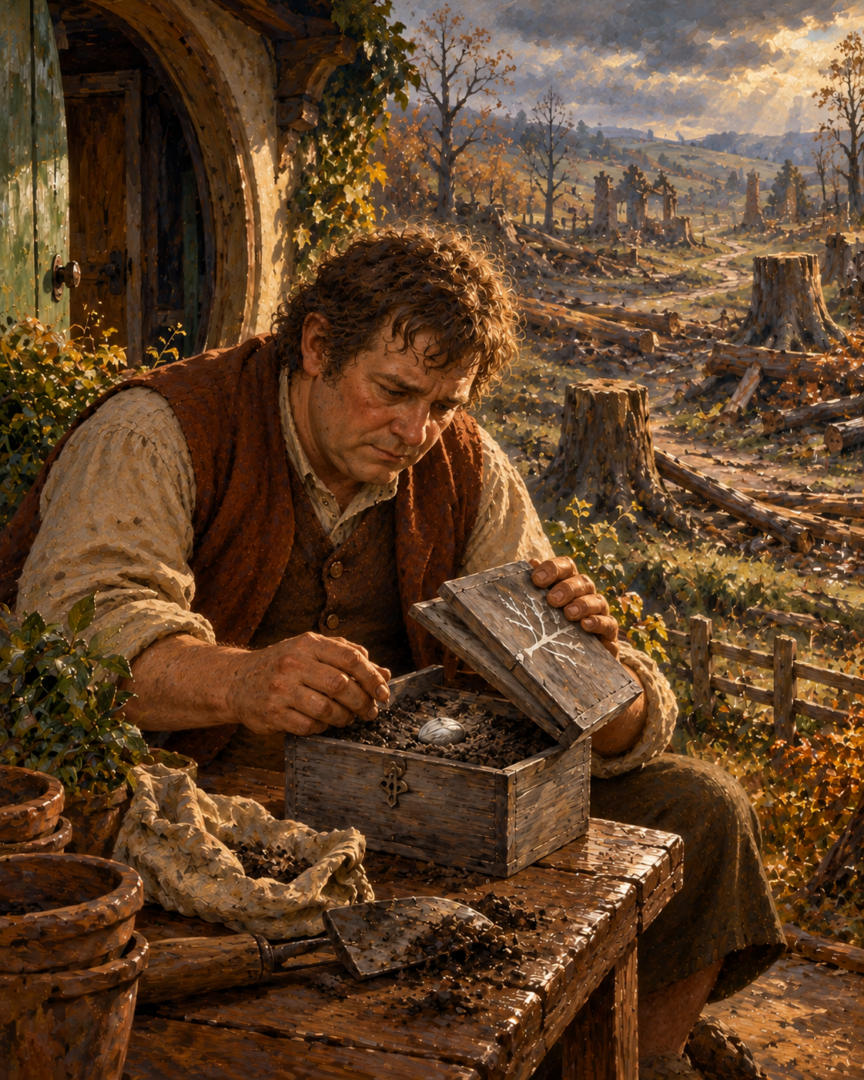
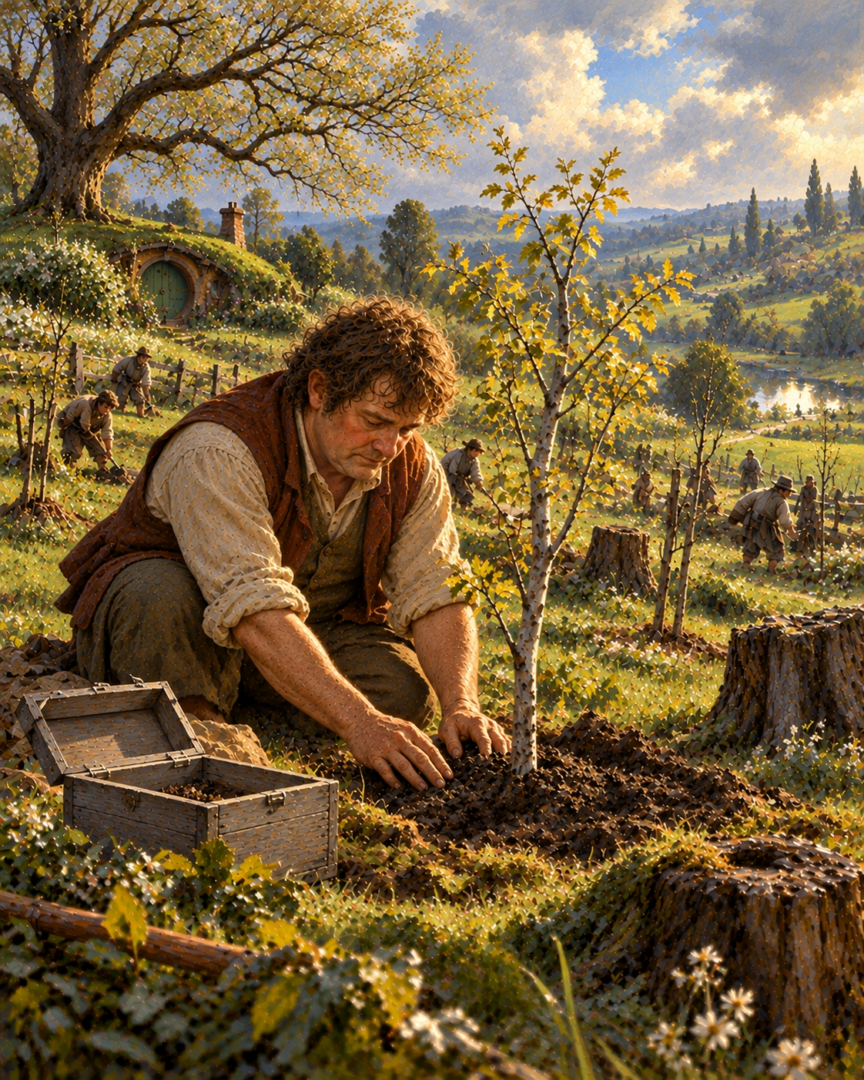
This is where Sam's wooden box becomes important.
In "The Grey Havens," he finally remembers Galadriel's gift and opens it.
Inside is a fine grey substance, with a seed resembling a small nut with a silver shell.
The contents now have a definite use.
Sam plants young trees where beloved trees have been destroyed, placing a little of the precious earth at their roots.
He distributes it carefully rather than concentrating everything in his own garden.
This matters because the gift had originally been presented in terms of what it might do for Sam's home.
Once he sees the damage across the Shire, its benefit extends beyond his personal property.
The gardener's work becomes part of the wider restoration.
The contrast with the expedition's food supplies is striking.
Provisions taken on a journey are gradually diminished as they sustain the travellers.
Sam's gift is also used up through distribution, but its purpose is to encourage new growth that will continue after the original material has been scattered.
Its usefulness is measured not by how long it lasts in the box, but by what grows after it leaves.
One Silver Seed and the Return of the Party Tree
Sam reserves the silver-shelled seed for a particularly meaningful place.
He plants it in the Party Field, where the old Party Tree had stood.
The following spring brings extraordinary growth.
The seed produces a mallorn, a tree associated with the golden woods of Lothlórien.
It becomes the only mallorn growing west of the Mountains and east of the Sea.
This is one of the most remarkable consequences of any gift brought back from the wider world.
A tree belonging to the distant beauty of an Elven realm takes root in the Shire.
The result is not simply a replacement for what was destroyed.
The new tree preserves a connection between two places that had once seemed almost impossibly distant from one another.
It also changes the landscape of home.
The Shire does not return to precisely the condition it possessed before the War of the Ring. Something has been lost, but something new has also taken root.
The year 1420 in the Shire Reckoning becomes a season of exceptional abundance.
The text connects this flourishing with Sam's planting and Galadriel's gift, although it does not provide a precise accounting of every effect produced by the blessed earth.
The distinction matters.
The story gives us a definite account of Sam's actions and their extraordinary results, not a complete set of rules governing the gift.
What the Hobbits Did Not Bring Home
There is a temptation to imagine the returning travellers with a complete collection of everything they received during their adventures.
The narrative does not provide such an inventory.
Some gifts and possessions are explicitly shown in use after the journey. Others are documented at earlier points without their final disposition being described in detail.
The distinction is important when reconstructing the homecoming.
The Fellowship's gifts did not all belong to the four hobbits, and the story does not describe a shared collection of treasures being carried back to Bag End.
Nor should every memorable object associated with the Fellowship be treated as a surviving return possession.
Boromir's great horn, for example, was broken during his final battle. It belongs to a different story of loss and remembrance, not to the hobbits' equipment during the Scouring.
Even among the four travellers, their experiences of return are unequal.
Merry and Pippin can take active roles in defending their homeland.
Sam can participate in its physical renewal.
Frodo helps secure its freedom, but the peace that follows cannot fully heal him.
The objects they possess illuminate these different circumstances without explaining away their personal costs.
The Final Difference Between Expedition and Return
By the end of The Lord of the Rings, the possessions carried by the hobbits reveal a quiet transformation in the purpose of their journey.
They set out needing things that would help them survive.
They return with some objects that help others survive, resist oppression, remember distant friendships, and rebuild damaged places.
Merry's horn summons neighbours to defend their homes.
The weapons and service equipment of Merry and Pippin become useful against the Men who have occupied the Shire.
Frodo's mithril coat still protects him, though it cannot restore his lost peace.
Sam's box, whose contents offered no defence on the road, becomes one of the most important instruments of the Shire's renewal.
These are not interchangeable gifts, and they do not produce identical outcomes.
Their purposes are as different as the circumstances in which they are used.
Yet together they reveal why the return journey is more than the expedition travelled backward.
The hobbits do not merely bring themselves home.
They bring back things whose meanings can only be completed there.
And perhaps the clearest expression of that difference is Sam's small wooden box.
For much of the adventure, its contents cannot feed him, shelter him, or save him from an enemy.
Only when the road is finished, the fighting is over, and the ruined earth of home lies before him does the gift fulfil its promise.
The expedition required provisions for the journey.
The return required something that could be planted after the journey was done.
Sources & Notes
- Tolkien Gateway — Sam's garden box; Galadriel's earth and mallorn seed, and Sam's restoration of the Shire (references: The Fellowship of the Ring, Farewell to Lórien; The Return of the King, The Grey Havens). https://tolkiengateway.net/wiki/Sam%27s_garden_box
- Tolkien Gateway — Horn of the Mark; Éowyn's farewell gift to Merry, the Buckland uprising, and annual remembrance (references: The Return of the King, Many Partings and The Scouring of the Shire; Appendices A, B and D). https://tolkiengateway.net/wiki/Horn_of_the_Mark
- Tolkien Gateway — Mithril-coat; Bilbo's gift to Frodo, its recovery after the Quest, and protection against Saruman at Bag End (references: The Fellowship of the Ring, The Ring Goes South; The Return of the King, The Field of Cormallen and The Scouring of the Shire). https://tolkiengateway.net/wiki/Mithril-coat
- Tolkien Gateway — The Scouring of the Shire; the returning hobbits' resistance, Merry and Pippin's leadership, and Frodo's encounter with Saruman. https://tolkiengateway.net/wiki/The_Scouring_of_the_Shire
Primary narrative: J.R.R. Tolkien, The Fellowship of the Ring, ‘Farewell to Lórien’; The Return of the King, ‘Many Partings’, ‘The Scouring of the Shire’ and ‘The Grey Havens’. The linked reference entries document the gifts and their uses at home. The contrast between expedition equipment and possessions used for resistance, remembrance and renewal is this article's interpretation; the narrative does not provide a complete inventory of everything brought home.