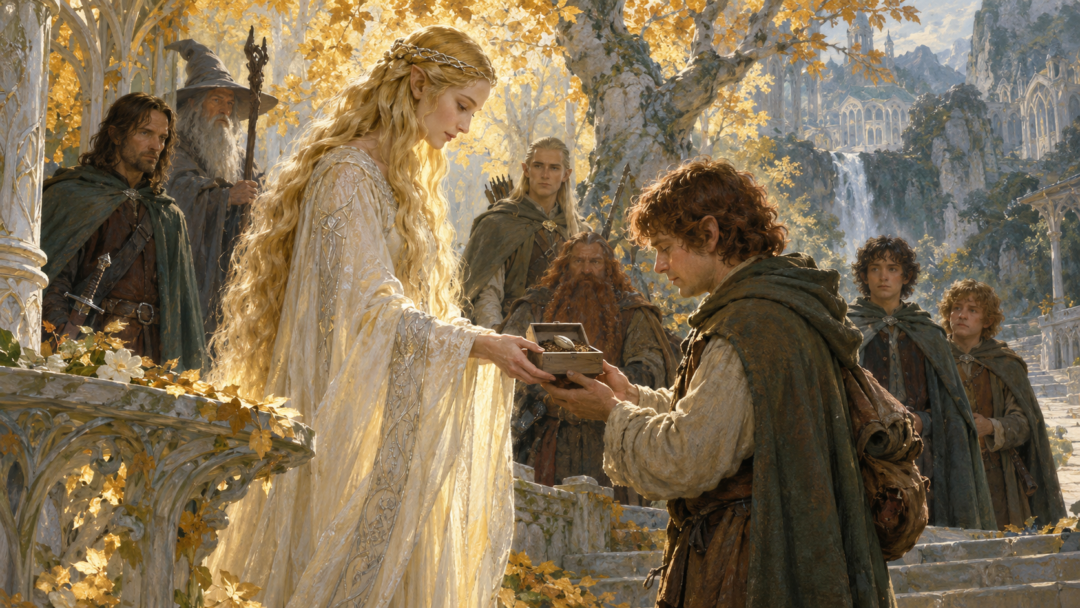
When the Fellowship prepares to leave Lothlórien, Galadriel gives them gifts suited to who they are and to the roads ahead. Aragorn receives a sheath made for Andúril. Legolas receives a bow of the Galadhrim. Merry and Pippin receive silver belts. Frodo receives the Phial that will later shine in some of the darkest places in Middle-earth.
Samwise Gamgee receives a box.
It is made of plain grey wood, marked with a silver rune, and inside is earth from Galadriel’s orchard. Buried within that earth is a single silver-grey nut.
Beside swords, bows, enchanted light, and royal heirlooms, Sam’s gift can look almost domestic. That is precisely why it matters.
Galadriel does not prepare Sam to become a greater warrior. She recognizes something more fundamental about him: Sam’s deepest strength has always been his desire to preserve, nurture, and return home. And when the war finally reaches the Shire, the little box proves to be exactly the gift that is needed.
Galadriel Gives Gifts According to the Person
The farewell gifts in Lothlórien are not simply equal shares of treasure. Galadriel addresses individual members of the Company and gives them objects with particular significance.
Her gift to Sam follows that pattern.
Sam has already revealed what matters to him. When Galadriel asks what he would desire from the Elves, his thoughts turn toward things that grow. In the book, his fascination with Elven gardening is unmistakable. He would have liked something that could help him make his own garden beautiful, though he worries about carrying such a thing home.
Galadriel remembers.
Her small box contains earth from her orchard, blessed by her, with a seed from a mallorn tree. She tells Sam that the earth will not keep him on his road or defend him against danger. Instead, if he returns home, it may reward his labor as a gardener.
That qualification matters: if he returns.
The gift points beyond the war at a moment when nobody can know whether Sam will survive it.
Sam Is Not Defined by the Weapon He Carries
Sam is capable of violence when necessity demands it.
He fights Orcs. He wounds Shelob with Sting after Frodo falls. At Cirith Ungol, believing Frodo dead, he takes the Ring and continues the quest for a time alone. He later enters the tower to rescue his master.
But none of those acts changes what Sam fundamentally wants.
He does not dream of becoming a famous warrior. His imagination repeatedly returns to the Shire, to food, gardens, familiar places, and the possibility that ordinary life might continue after the horror surrounding him.
This becomes especially powerful in Mordor.
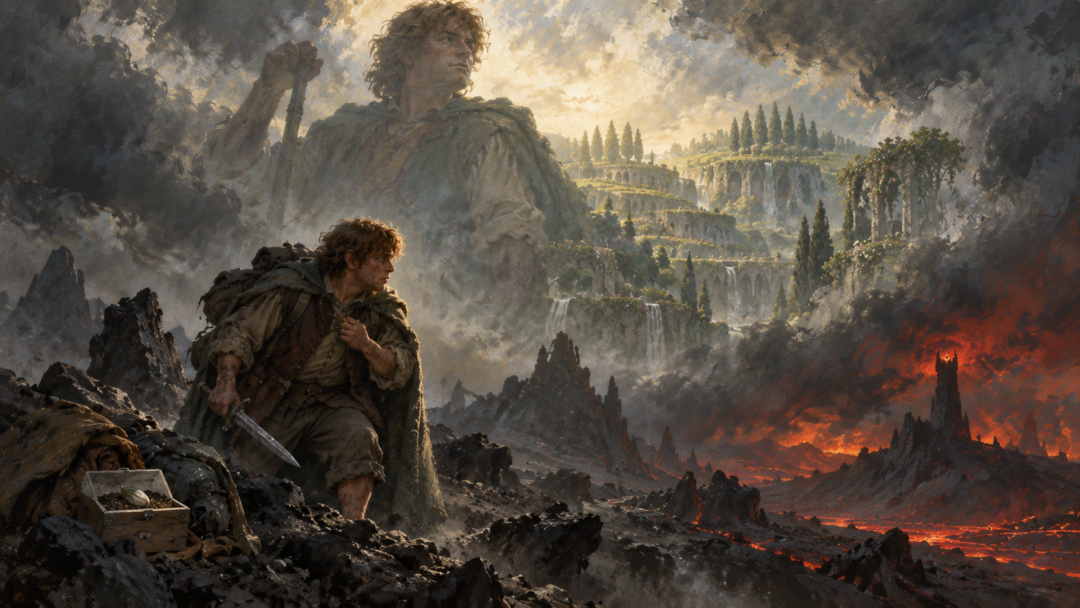
There, Sam briefly imagines what the Ring might offer him. Its temptation enlarges his identity as a gardener into something grotesquely grand: Samwise the Strong, a heroic figure commanding armies and transforming the wasteland into a vast garden.
Yet Sam rejects that vision.
The text emphasizes his plain hobbit sense. He does not need an enormous realm converted into his garden. His own hands and his own small garden are enough.
That moment helps explain why Galadriel’s box suits him so perfectly. Sam’s relationship with growing things is not based on domination. He does not truly want the power to force the world into the shape he desires.
He wants to tend something entrusted to him.
The Box Represents a Kind of Power the Ring Cannot Understand
The One Ring magnifies the desire to possess and control.
Even intentions that begin well can become dangerous when joined to that kind of power. Galadriel herself recognizes this when Frodo offers her the Ring in Lothlórien. She imagines the terrible greatness she could achieve with it, then refuses it.
Her gift to Sam works according to almost the opposite principle.
The box does not dominate anything.
Its earth must be scattered. Its seed must be planted. Sam must perform the labor himself. He cannot command the tree to grow, nor can he instantly repair the Shire by possessing the box.
The gift assists cultivation rather than replacing it.
That distinction becomes important because Sam eventually encounters the Ring’s own distorted version of gardening. The Ring offers magnitude: armies, authority, an entire land remade according to his will.
Galadriel gives him something much smaller.
A handful of earth.
A seed.
The possibility of growth.
One reading, therefore, is that the box represents a form of power fundamentally different from the power sought by Sauron. It does not impose Sam’s will upon the world. It helps living things flourish through patience, labor, and care.
The Cruel Irony Is That Sam Comes Home to Destruction
For much of The Lord of the Rings, the Shire exists in the hobbits’ minds as the place they are trying to save.
Then they return.
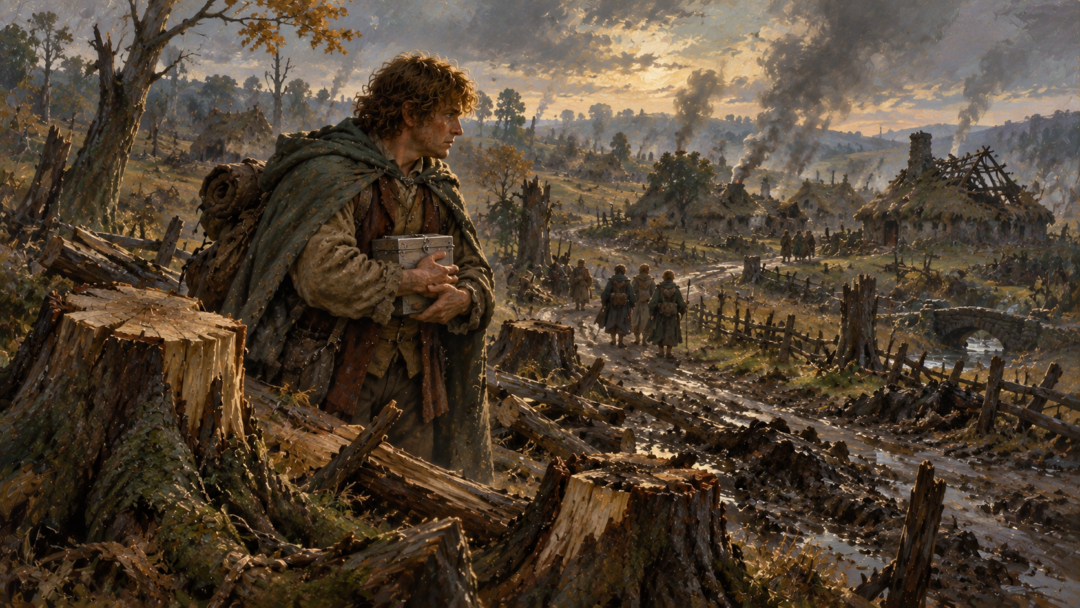
The final stages of the story reveal that the Shire has not remained untouched. Under the regime the hobbits find there, trees have been cut down, old buildings damaged or replaced, ugliness spread through familiar places, and the landscape subjected to destructive changes.
For Sam, the loss of the trees is particularly painful.
This is where Galadriel’s gift ceases to be merely sentimental.
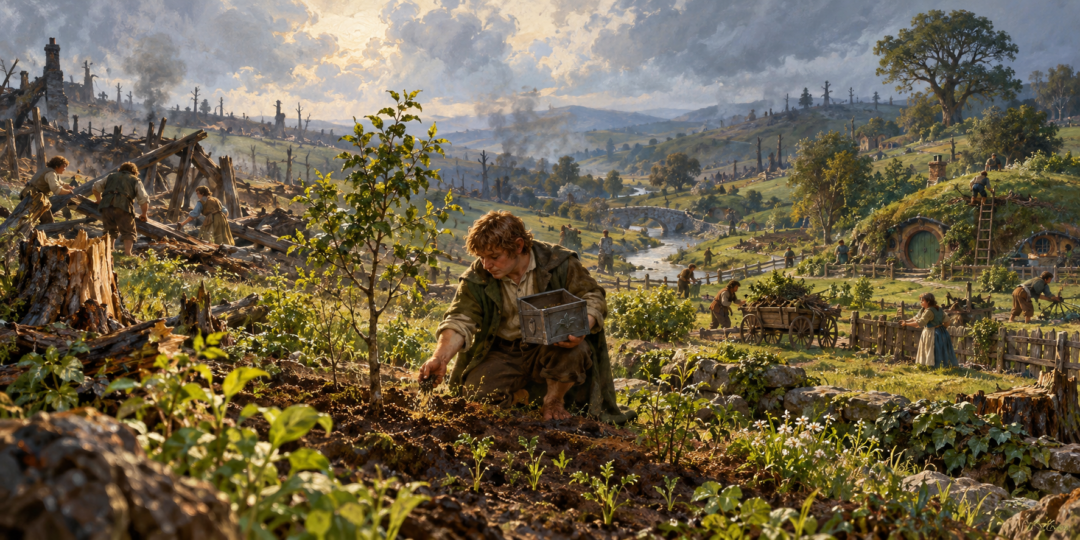
Sam does not simply use the earth on his own property. After the Scouring, he travels around the Shire repairing the damage. He plants saplings where beautiful or beloved trees have been destroyed, placing a small amount of the soil from Lothlórien near the roots.
The act is characteristically Sam-like.
He has received something extraordinarily precious, yet he distributes its benefit across his homeland.
The gift becomes communal.
The Mallorn Seed Replaces What Was Lost
Sam saves the mallorn nut for a special place.
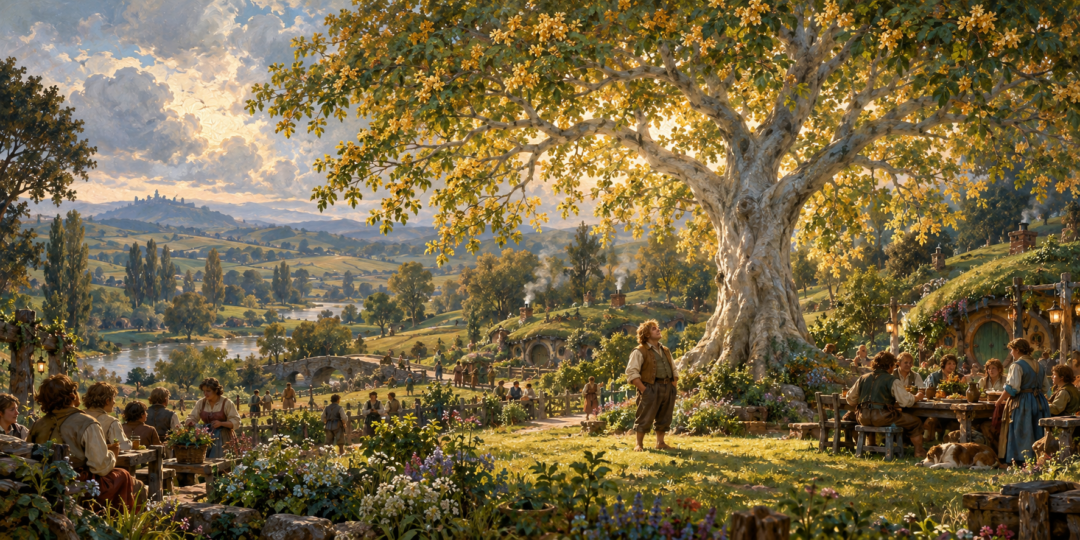
The Party Tree at the Party Field—the tree beneath which Bilbo’s great birthday celebration had taken place—has been cut down. Its destruction is one of the clearest symbols that the familiar Shire has been violated.
There Sam plants the silver-grey nut.
It grows.
The resulting mallorn becomes extraordinary within the Shire, and the following year is remembered for remarkable growth and beauty. The new tree does not simply erase what happened. The old Party Tree remains lost.
Instead, something new grows where destruction occurred.
That is a more subtle kind of restoration.
The Shire after the War is not identical to the Shire before it. Frodo, especially, cannot simply return to his old life as though his wounds never happened. The story refuses such an easy reversal.
Sam’s work follows the same principle. Healing does not make the past disappear. It creates life after damage.
Galadriel’s Gift Only Works Because Sam Does
There is another easily overlooked detail about the box: it does not do Sam’s work for him.
Sam travels throughout the Shire.
Sam plants.
Sam distributes the soil carefully.
Sam replaces trees.
This matters because it prevents the gift from becoming a convenient magical solution to the Scouring. Galadriel provides something potent and extraordinary, but restoration still depends upon ordinary labor.
That combination—grace received and work performed—is central to Sam’s story.
Again and again, he is placed in situations where great events depend upon simple actions: carrying supplies, preparing food, keeping watch, finding water, refusing to abandon Frodo, and finally carrying Frodo himself when his master can no longer walk.
Sam does not defeat Sauron in single combat.
He keeps going.
His box of earth operates on the same scale. It is small enough to carry, easy to overlook beside legendary weapons, yet capable of participating in something larger because Sam knows what to do with it.
Why a Sword Would Have Been the Wrong Gift
Sam already lives in a world full of weapons.
Weapons are necessary throughout the War of the Ring. The story does not pretend otherwise. Aragorn needs Andúril. Éowyn and Merry confront the Witch-king with weapons. Sam himself uses Sting when faced with Shelob.
But war is ultimately fought so that there can be something beyond war.
That is where the box becomes essential.
A sword can defend the Shire.
It cannot replant it.
A bow can kill an enemy threatening a tree.
It cannot make another tree grow.
Victory over Sauron removes the great external threat, but that victory alone cannot restore everything damaged along the way. Someone still has to return to the wounded places and care for them.
Sam is uniquely suited to that task.
Galadriel's gift does not transform him into something greater than a gardener.
It reveals how important a gardener already is.
Sam’s Real Ending Is About Making Things Grow
The significance of the box extends beyond the immediate restoration of the Shire.
Sam eventually marries Rosie Cotton, raises a family, becomes an important figure in his community, and remains deeply connected to the life of the Shire. His story moves away from battle and toward continuity.
That makes his farewell gift in Lothlórien look almost prophetic, though the text does not present it as a detailed prediction of everything that will happen.
Galadriel gives the future mayor, husband, father, and gardener something meant for a future that might still exist.
And Sam carries it through one of the most barren landscapes imaginable.
The contrast is remarkable. Somewhere among the ropes, blankets, food, and dwindling possessions of the journey is a little box containing fertile earth and a seed. Sam takes that possibility of growth toward Mordor and then carries it home again.
He returns from the destruction of the Ring not with a trophy taken from the Enemy, but with something preserved from Lothlórien.
Then he gives it away handful by handful.
That may be the deepest reason the box fits Sam better than any weapon could.
His greatest contribution is not that he learns how to destroy.
It is that, after witnessing destruction on an almost unimaginable scale, he still knows how to plant.
Sources & Notes
- Tolkien Gateway — Samwise Gamgee (Galadriel's gift and Sam's return to gardening) https://tolkiengateway.net/wiki/Samwise_Gamgee
- Tolkien Gateway — Galadriel (her gifts to the Fellowship in Lothlórien) https://tolkiengateway.net/wiki/Galadriel
- Tolkien Gateway — Scouring of the Shire (Sam's use of the earth in restoring the Shire) https://tolkiengateway.net/wiki/Scouring_of_the_Shire
These references document Galadriel's gift, Sam's gardening, and the restoration of the Shire. The contrast between cultivation and dominion is interpretive synthesis; Tolkien's The Fellowship of the Ring (Farewell to Lórien) and The Return of the King (The Scouring of the Shire) are the primary texts.