
When Aragorn became King Elessar, Faramir performed one of the most important acts in Gondor’s history: he surrendered the authority of the Steward to the returning King.
Yet Aragorn did not simply dismiss him.
He returned the white rod of the Steward, confirmed the office in Faramir and his heirs, and soon afterward made him Prince of Ithilien. Faramir was also commanded to dwell in the hills of Emyn Arnen, overlooking a province that had spent generations on the exposed frontier of Gondor’s war with Mordor.
At first this can look like a generous reward for a loyal captain.
It was more than that.
The settlement joined two problems that Gondor faced after Sauron’s defeat. The kingdom needed to restore a devastated eastern territory, and the restored monarchy needed a durable political order after nearly a thousand years of rule by Stewards.
Faramir stood at the meeting point of both.

Ithilien Was Beautiful, but It Was Still a Frontier
The Ithilien encountered by Frodo and Sam is one of the great contradictions of The Lord of the Rings.
It is extraordinarily beautiful.
The hobbits find woods, herbs, streams, flowers, and traces of Gondor’s older civilization. But the land is not secure. Its people have largely withdrawn, and Faramir’s Rangers operate there as soldiers in contested country.
This condition was the result of a long decline.
Ithilien lay between the Anduin and the Ephel Dúath, immediately west of Mordor. Minas Ithil, once Gondor’s eastern fortress, had fallen to the Nazgûl centuries earlier and become Minas Morgul. Pressure from Mordor eventually made Ithilien increasingly dangerous, and its surviving population retreated westward.
By the War of the Ring, Gondor still claimed Ithilien, but much of it functioned as a military frontier rather than an ordinary inhabited province.
Faramir already knew that frontier intimately.
When Frodo meets him, Faramir commands Rangers operating from Henneth Annûn. He is therefore not being given an unfamiliar territory after the war. The man who had defended Ithilien in secrecy would become its prince in peace.
That continuity matters.
The captain responsible for resisting the Enemy there becomes the lord responsible for helping restore the land after the Enemy is gone.
Aragorn Did Not Abolish the Stewardship
Faramir’s new position becomes clearer when we look at what happens at Aragorn’s coronation.
The Stewards had originally served Gondor’s kings. After King Eärnur disappeared and no new king was accepted, the House of Húrin governed Gondor as Ruling Stewards for centuries, preserving the kingdom without formally claiming kingship.
Denethor therefore possessed enormous practical authority, but he remained Steward.
After Denethor’s death, Faramir inherited the office. When Aragorn came to be crowned, Faramir surrendered his rod and declared his stewardship ended because the King had returned.
Aragorn’s response is crucial.
He gives the rod back.
The hereditary stewardship continues under the restored monarchy.
This is not merely ceremonial continuity. A later explanation in Letter 244 describes Faramir as remaining the hereditary Steward, holding a major place in the government of Gondor. The Steward was the chief counsellor of the King, while Faramir’s position in Ithilien also gave him responsibility for Gondor’s principal eastern frontier.
The old governing house was therefore not destroyed by the restoration of kingship. Its role was transformed.
Faramir ceased to be the temporary ruler awaiting a king and became one of the great officers serving an actual king.
The Prince of Ithilien Was Still the Steward of Gondor
This is the key to understanding how Ithilien remained tied to the centre of the kingdom.
Faramir did not exchange the Stewardship for the principality.
He held both.
As Prince of Ithilien, his household and territorial power were rooted east of the Anduin. As Steward, he remained bound directly to the royal government.
That combination prevented his new domain from being merely an isolated reward at the edge of Gondor.
The arrangement created a lord whose local interests and central responsibilities overlapped.
Faramir had every reason to care about rebuilding Ithilien because it was his principality and the future inheritance of his house. Yet his authority remained part of the larger structure of the Reunited Kingdom because he was also the hereditary Steward of the King.
The texts do not provide a detailed Fourth Age constitution, and it would be unsafe to imagine one. We are not given tax systems, administrative districts, councils with defined voting procedures, or a bureaucratic map of Ithilien.
But the political relationship is clear enough.
Ithilien belonged within Elessar’s restored realm, while its prince simultaneously held one of Gondor’s highest hereditary offices.
Emyn Arnen Connected Faramir’s Past and Future
Aragorn instructed Faramir to dwell in the hills of Emyn Arnen.
The choice carries an unusual historical resonance.
Emyn Arnen lay in Ithilien, across the Anduin from the region of Minas Tirith. More importantly, the House of the Stewards itself traced its ancestry to Húrin of Emyn Arnen, Steward to King Minardil and forefather of the hereditary House of Húrin.
Faramir’s establishment there therefore brought the Steward’s house back into a landscape connected with its remote origins.
That does not mean the new principality was simply a restoration of some ancient family estate; the texts do not say that. But the geographical echo is striking.
The family that had spent centuries ruling from Minas Tirith while waiting for a king would now possess its own princely seat in Ithilien while serving the king who had finally returned.
Faramir and Éowyn would make their home there.
Their marriage also gave the new beginning of Ithilien a wider significance. Faramir represented one of Gondor’s greatest houses; Éowyn came from the royal house of Rohan. Their household belonged to the postwar world in which the alliances forged against Sauron continued into peace.
Recovery Meant More Than Planting Gardens
It is tempting to imagine Ithilien’s recovery almost entirely through its beauty.
That beauty certainly returned.
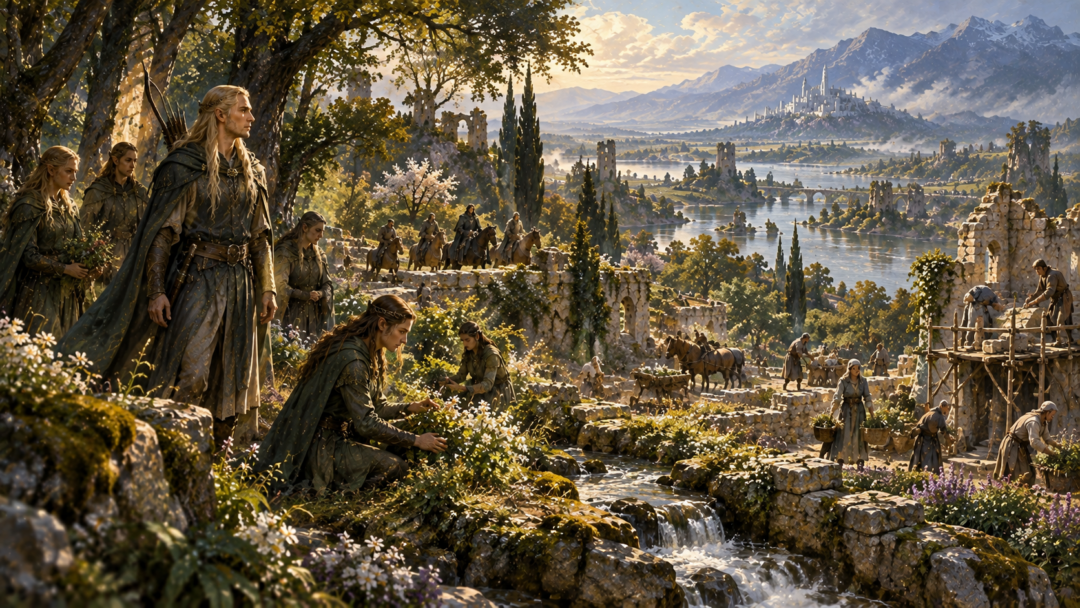
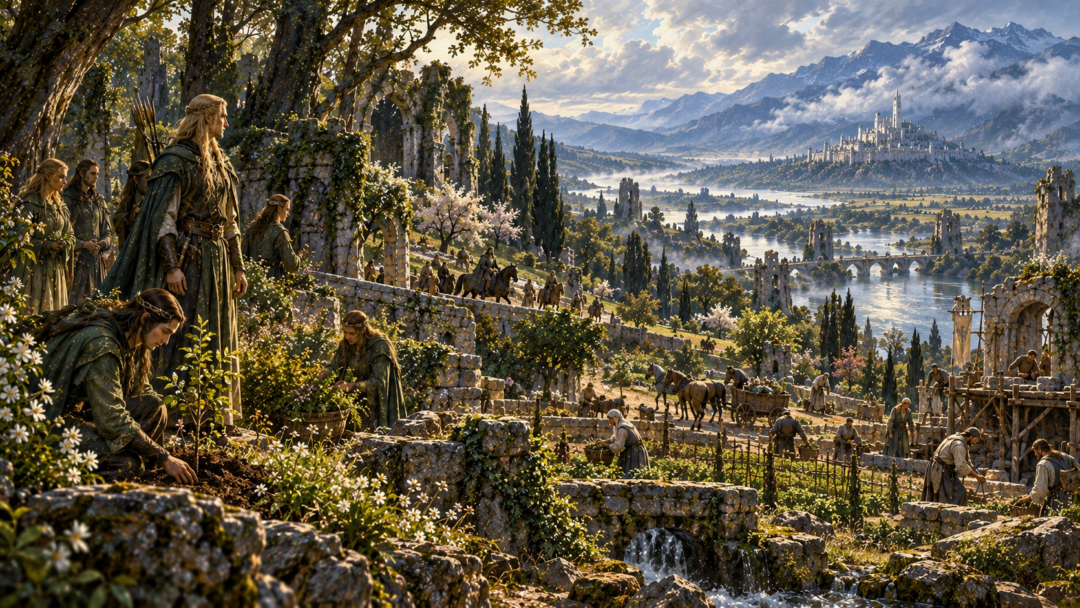
Legolas later brought Elves south from Greenwood, and they dwelt in Ithilien. Appendix A says that the land became again the fairest country in the Westlands. Legolas had already looked upon Ithilien after the war and spoken of Elves coming there.
But political recovery had a harder edge.
Letter 244 gives Faramir’s eastern office a strongly practical character. As the great lord responsible for this frontier, he had to deal with the aftermath of war, including enemies and outlaws who remained after Sauron’s overthrow, while restoring territory that had long been exposed to Mordor.
Sauron’s destruction did not magically erase every consequence of his rule.
Roads, settlements, defenses, abandoned lands, and the security of Gondor’s eastern approaches still mattered. The Morgul region in particular carried the legacy of centuries of occupation by the Nazgûl.
The Fourth Age restoration of Ithilien should therefore be understood as both beautiful and political.
Elves could help make the land fair again.
People could return.
Faramir and Éowyn could establish a household in Emyn Arnen.
But all of this occurred within a province whose security mattered to the entire kingdom.
Aragorn Turned a Potential Rival House Into a Pillar of the Realm
There is also a deeper political elegance in Aragorn’s treatment of Faramir.
The House of Húrin had governed Gondor for generations. A less secure monarch might have regarded such a family as dangerous.
Aragorn instead confirmed its dignity.
He restored the Stewardship to its proper relationship with kingship and elevated Faramir as Prince of Ithilien. Rather than reducing the old governing family until it became politically irrelevant, the restored crown gave it a permanent place within the new order.
That worked because Faramir himself accepted the King.
There is no struggle between them for legitimacy. Faramir publicly recognizes Aragorn, and Aragorn publicly honors Faramir.
The result is one of the quieter reversals at the end of The Lord of the Rings.
Denethor had feared the displacement of his house and rejected Aragorn’s claim. His surviving son experiences precisely the transition Denethor dreaded, yet Faramir is not diminished into obscurity.
He becomes Steward under the King and Prince on Gondor’s recovering eastern frontier.
The old office survives because it no longer needs to substitute for kingship.
Ithilien Became a Model of Restoration Rather Than Replacement
This pattern appears repeatedly after Sauron’s fall.
The victory does not produce a world wiped clean of everything that came before. Old loyalties, houses, peoples, and institutions continue, but their relationships change.
That is exactly what happens with Faramir.
The Ranger of Ithilien becomes its prince.
The temporary ruling house becomes a hereditary house of royal service again.
A depopulated frontier becomes a place of settlement and beauty.
And a region that had faced Mordor for centuries becomes part of the eastern strength of a reunited kingdom.
Even the presence of Legolas and his Elves fits this pattern. Ithilien’s renewal is not depicted merely as Gondorian military occupation. Its recovery includes cultivation, beauty, friendship between peoples, and the healing of a landscape long overshadowed by war.
Yet none of that makes Ithilien politically separate from Gondor.
Its prince is also the King’s Steward.
That may be the most important fact of the entire arrangement.

Faramir’s Reward Was Also a Responsibility
Calling Ithilien a reward is not wrong, but it is incomplete.
Faramir received extraordinary honor. He became Prince of Ithilien and Lord of Emyn Arnen, and his descendants inherited his standing.
But Aragorn also placed one of Gondor’s most trusted men where the kingdom had been most vulnerable.
Faramir understood Ithilien’s terrain, its military importance, and the cost of defending it. He had already commanded men there when survival required secrecy and ambush. After the war, his task changed from resistance to restoration.
His principality therefore joined personal inheritance to public duty.
That is why the settlement is more interesting than a simple distribution of lands after victory.
Ithilien needed inhabitants, security, authority, and time.
The monarchy needed experienced servants capable of governing important regions without weakening the unity of the restored kingdom.
In Faramir, those needs met.
The land he once defended from hidden refuges became the home of his house. The office his ancestors had used to preserve Gondor during the absence of kings became an office serving the returned King. And the eastern country that had symbolized Gondor’s long retreat became one of the clearest signs that retreat had finally ended.
Faramir’s principality was therefore not a kingdom beside Aragorn’s kingdom.
It was something more characteristic of Gondor’s restoration: an old house, an old land, and an old office given a new future within the reunited realm.
Sources & Notes
- https://tolkiengateway.net/wiki/Prince_of_Ithilien — Tolkien Gateway, Prince of Ithilien (Tolkien, Return of the King; Letters, no. 244)
- https://tolkiengateway.net/wiki/Stewards — Tolkien Gateway, Stewards of Gondor (hereditary office under Elessar)
- https://tolkiengateway.net/wiki/Ithilien — Tolkien Gateway, Ithilien (frontier, Rangers, and restoration)
The Return of the King, ‘The Steward and the King,’ and Tolkien’s Letter 244 underpin the hereditary stewardship, principality, and postwar frontier duties. The institutional reading is interpretation, not a detailed Fourth Age constitution.