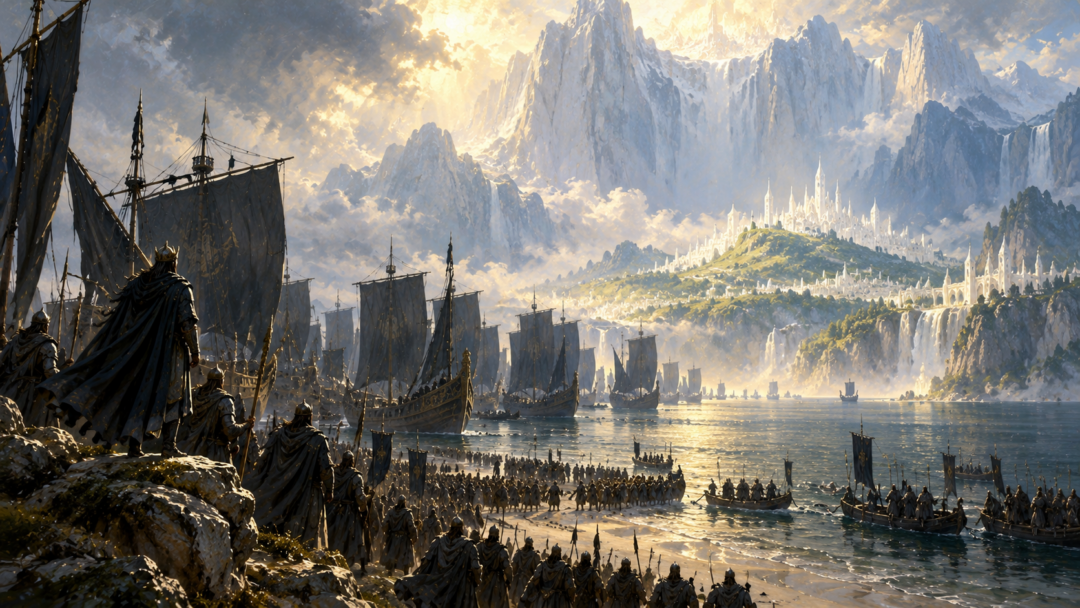
At the end of the Third Age, an Elven ship could leave the Grey Havens, sail west, and reach a destination that no ordinary mortal vessel could find by following the same compass direction.
That strange fact is one of the clearest consequences of the Changing of the World.
Before the downfall of Númenor, Aman belonged to the geography of Arda. It lay far beyond the Great Sea, separated from Middle-earth but still within the physical world. After Númenor’s rebellion and destruction, that relationship changed fundamentally. The world was made round, new lands and seas existed within its circles, and Aman was removed from the ordinary paths available to Men.
Yet Aman was not destroyed.
Valinor did not vanish because it had fallen into the sea. Nor did the Elves simply preserve a forgotten navigational technique that allowed unusually skilled sailors to locate a hidden western continent.
The deeper idea is stranger: the destination survived, while the ordinary route to it ceased to exist.
Before the World Was Bent
During the First and Second Ages, the western geography of Arda was radically different from that encountered by the peoples of the later Third Age.
Aman lay beyond Belegaer, the Great Sea. Valinor occupied part of that western continent, protected by the Valar and bounded in the east by the Pelóri. Tol Eressëa lay offshore.
Reaching those lands was never simply a matter of possessing a sufficiently seaworthy ship. After the rebellion of the Noldor, the Blessed Realm was guarded and concealed. During the First Age, the Hiding of Valinor made attempts to reach the West extraordinarily difficult. Eärendil’s successful voyage was exceptional and bound to events of enormous importance.
After the War of Wrath, however, the geopolitical and spiritual order of the world changed again. Númenor was raised from the sea for the Edain who had fought against Morgoth. It stood between Middle-earth and Aman, though much nearer to Middle-earth than to the Blessed Realm.
The Númenóreans were forbidden to sail so far west that they could no longer see the coasts of Númenor.
This Ban matters because it demonstrates something easily missed: Aman was still part of the world’s geography. The prohibition concerned where the Númenóreans were permitted to go, not whether the destination physically existed.
The problem was not that Men could not sail west.
The problem was that they had been commanded not to seek the Undying Lands.
The Fatal Confusion About Aman
Over generations, many Númenóreans came to resent the Ban.
Their grievance grew from a profound misunderstanding. They saw that the Eldar could dwell in Aman while Men remained mortal. Eventually, some began to associate the Blessed Realm itself with freedom from death.
But the land did not make its inhabitants immortal.
The Númenórean envoys were explicitly taught that the Undying Lands were not the source of the immortality of the Valar and Eldar. Mortal Men would not become deathless merely by reaching Aman.
That distinction lies at the heart of Númenor’s tragedy.
What the Númenóreans increasingly desired was not merely territory. They wanted escape from the Gift of Men—the mortality that belonged to their nature. Under Sauron’s influence, Ar-Pharazôn finally attempted to seize by force what could not be obtained through conquest.
He assembled the Great Armada and sailed west.
At that moment, navigation became rebellion.
When Ar-Pharazôn Reached the Forbidden Shore
Ar-Pharazôn’s fleet crossed the sea and came to Aman. His forces landed and encamped around Túna, while the people of Valinor withdrew.
This alone establishes an important point about the old world: before the catastrophe, mortal ships could physically reach the shores of Aman when the Ban was defied.
The impossibility came afterward.
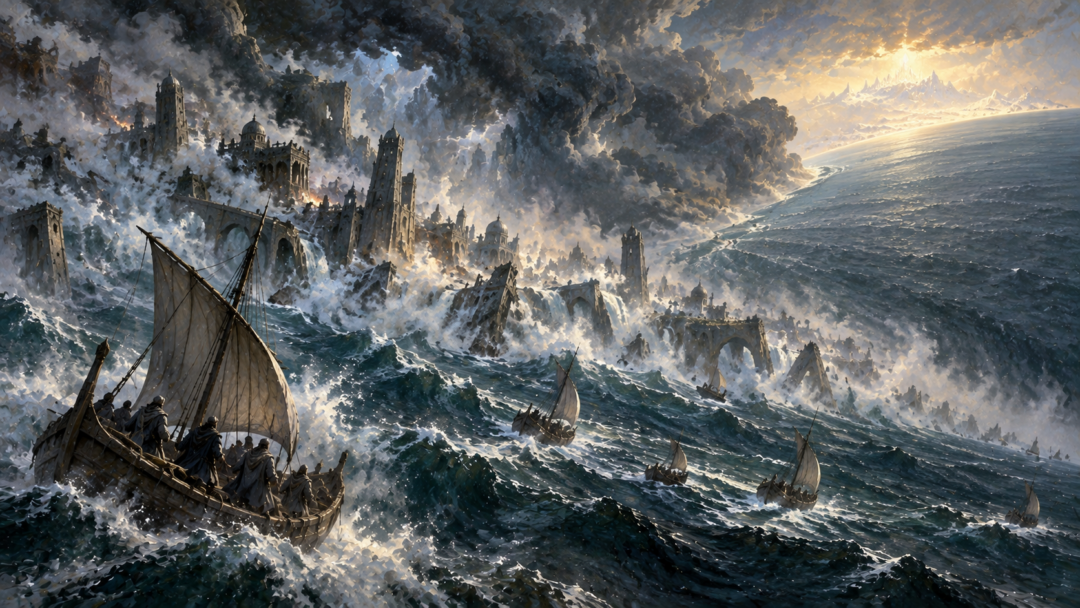
The Valar laid down their government of Arda and called upon Eru. Númenor was overwhelmed, Ar-Pharazôn and his invading host were buried, and the shape of the world was changed.
The Akallabêth describes a transformation far greater than the destruction of an island.
Aman and Eressëa were taken away from the ordinary reach of Men. New lands appeared, and the world was made round.
From then on, someone sailing west through the ordinary seas did not eventually arrive at Valinor.
That is the crucial navigational consequence of the Changing of the World.
West Still Existed, but It No Longer Led to Aman
Imagine the problem from the perspective of a later mariner.
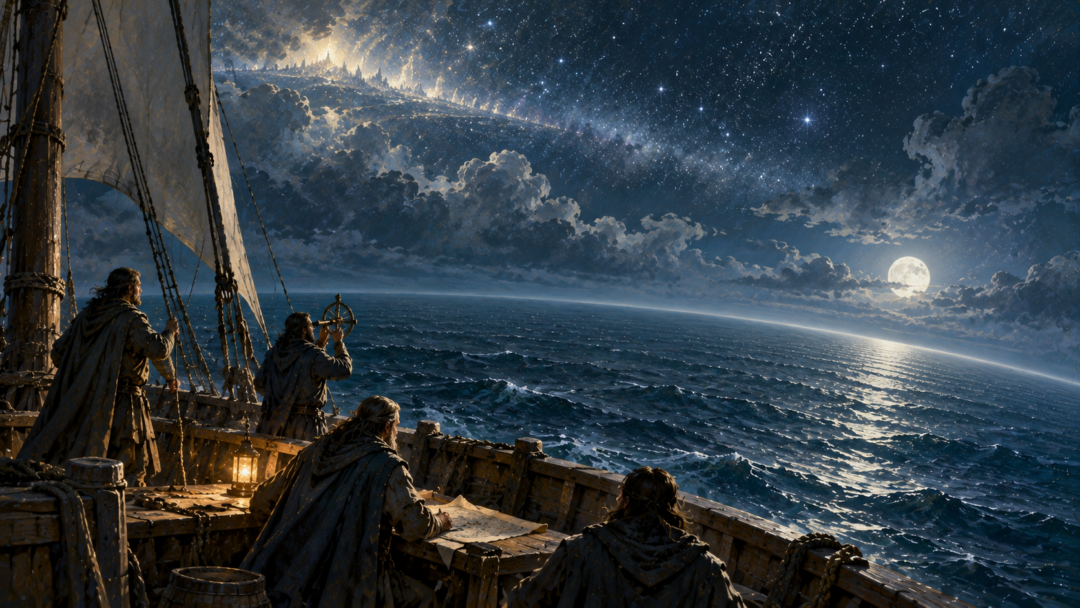
Before the catastrophe, westward sailing existed within a world in which Aman occupied the ultimate western geography. Afterward, a mortal sailor could still point a ship west. The stars, winds, coastlines, and oceans remained things that could be navigated.
But following that direction no longer produced the old destination.
The Akallabêth says that mariners afterward explored the world and discovered it to be round. Those who sailed far enough returned eventually to where they had begun.
Aman’s removal therefore did not abolish navigation. It altered the structure within which navigation operated.
Ordinary ships remained bound to the “Bent World.”
That phrase captures the paradox beautifully. The sea remained real. The west remained real. Ships could continue sailing across it.
But Aman was no longer simply the next land reached by continuing far enough.
The route had been separated from ordinary geography.
The Straight Road Was Not Just a Secret Course
This is where the idea of the Straight Road becomes important.
The Elves were still permitted to depart Middle-earth and travel into the West. Their ships could leave the Grey Havens and reach the Undying Lands even though Aman had been removed from the circles of the ordinary world.
It is tempting to imagine the Straight Road as a hidden shipping lane—a precise bearing known only to Elven navigators.
That interpretation is too mundane.
Nothing suggests that a mortal captain could reach Aman simply by acquiring an Elven chart, measuring the stars more accurately, or reproducing the correct heading.
The distinction is cosmological rather than merely technical.
Ordinary navigation follows the round world. The Straight Road somehow permits the permitted traveler to pass beyond that ordinary structure and reach the West that has been removed from it.
The texts deliberately preserve mystery around exactly how this was experienced. Turning the Straight Road into a measurable physical mechanism would go beyond what is actually explained.
What matters is the result.
Two vessels might conceptually sail westward, yet their journeys need not belong to the same geography.
Aman Survived the Catastrophe
Because Aman was removed from ordinary mortal access, readers sometimes speak as though Valinor ceased to exist after Númenor’s downfall.
That is not what the legendarium describes.
Aman endured.
So did Tol Eressëa. The Eldar continued to depart Middle-earth for the West, and the ending of The Lord of the Rings depends upon this continued reality.
When Frodo, Bilbo, Gandalf, Elrond, Galadriel, and their companions sail from the Grey Havens, they are not voyaging toward the ruins of a vanished land. Their departure belongs to the same continuing western passage by which the Eldar leave Middle-earth.
Frodo’s case also illustrates another important distinction. His voyage does not make him immortal. Permission to travel West does not change a mortal being into one of the Eldar.
The old Númenórean error therefore remains false even after the geography of the world has changed.
Aman can offer healing and peace without abolishing mortality.
Why Mortal Explorers Could Not Rediscover Valinor
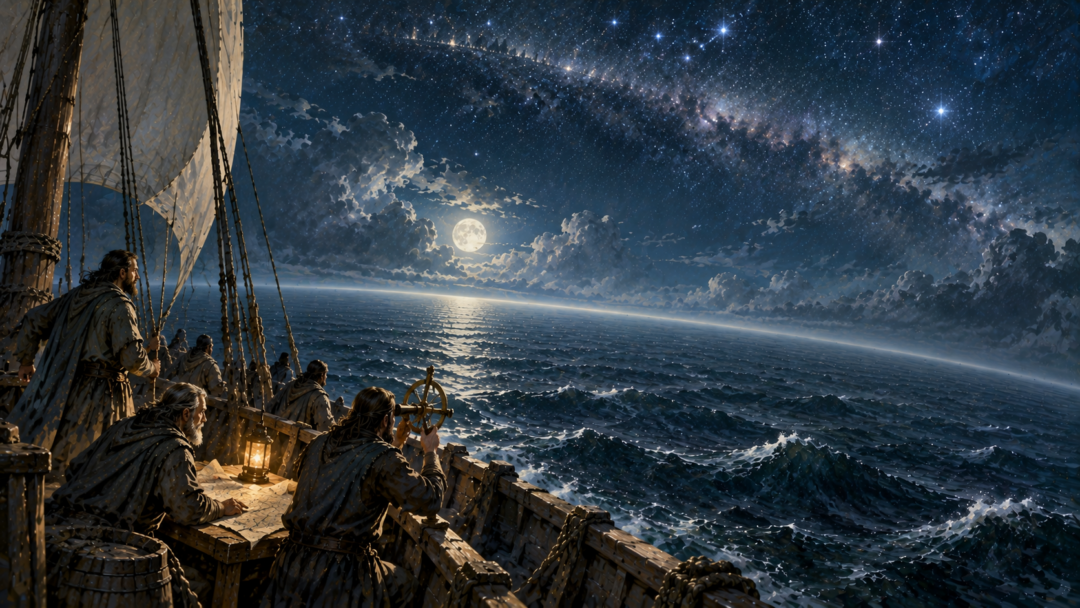
Once the world was round, increasingly ambitious exploration could map the ordinary world without recovering the lost route to Aman.
This creates one of the most fascinating consequences of the catastrophe.
Better seamanship could not solve the problem.
Neither could greater endurance.
Nor could simply sailing farther.
The Númenóreans before the Downfall had possessed extraordinary maritime power, and Ar-Pharazôn demonstrated that a mortal fleet could once cross the physical sea to Aman. After the Changing of the World, however, the obstacle was no longer the distance across Belegaer.
The structure of the world itself had changed.
Later mariners could discover lands unknown to them, cross great seas, and ultimately confirm through experience that the world was round. But those achievements remained inside the circles of the world.
Aman was elsewhere—not necessarily “elsewhere” in a modern astronomical sense, but removed from the ordinary spatial path available to mortal travelers.
The texts do not provide a scientific model for this arrangement, and imposing one would risk replacing myth with speculation.
The Exception Proves the Rule
The continued departure of Elven ships shows that the West was not annihilated.
At the same time, the exceptional nature of those voyages shows that Aman had ceased to be an ordinary geographical destination.
There are also exceptional mortals associated with voyages into the West. Frodo and Bilbo are the most famous, and tradition also places Sam’s eventual departure beyond the Sea after he had borne the Ring. Legolas is said to have built a ship after Aragorn’s death and sailed down Anduin and over Sea, with Gimli according to the tradition preserved in the appendices.
These cases should not be mistaken for evidence that the Ban had simply become irrelevant and anyone could now attempt the journey.
They are presented as extraordinary departures, not the reopening of Aman to ordinary human exploration.
The road exists.
Access to it is another matter.
The Changing of the World Was a Judgment on Possession
The geographical transformation also carries a powerful thematic consequence.
Ar-Pharazôn attempted to make the Undying Lands accessible through force. He treated Aman as territory that could be reached, occupied, and possessed.
After his assault, Aman became precisely the kind of place that worldly power could no longer seize.
No larger armada could repeat his achievement.
No later empire could build enough ships.
No navigator could defeat the separation merely by becoming more skilled.
The Númenóreans had once been restrained by a command. After their rebellion, the physical order of the world itself enforced a separation that ordinary Men could not cross.
This does not mean every detail of the Changing should be reduced to a simple moral allegory. The legendarium presents it as an actual transformation within its history. But the irony is difficult to miss.
Ar-Pharazôn sailed west because he wanted to possess what lay beyond the sea.
His rebellion helped bring about a world in which that destination could no longer be reached by conquest at all.
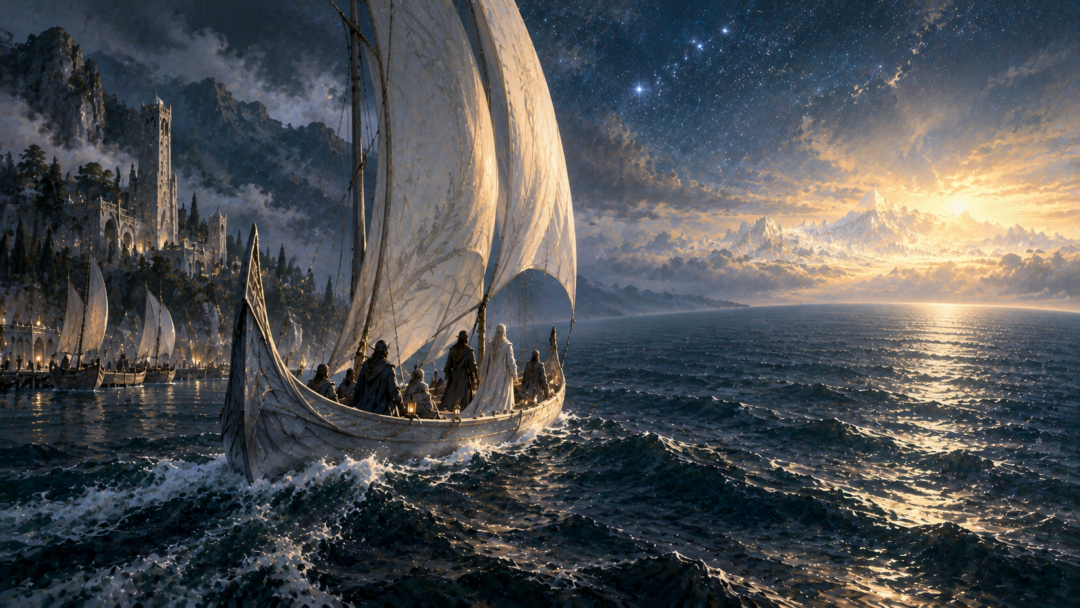
The Sea Remembered What the World Had Lost
By the Third Age, the western coast of Middle-earth therefore faced two realities at once.
For mortals, it bordered an ocean belonging to a round world. Sail far enough through ordinary geography and the journey remained within that world.
For the Eldar, the same western departure could become the beginning of the Straight Road.
That is why the final voyage from the Grey Havens carries such unusual weight.
The ship does not merely disappear beyond a distant horizon. It passes toward a realm that has been deliberately removed from the ordinary geography of Middle-earth.
The Changing of the World did not erase Aman.
It erased the assumption that every real place must be reachable simply by crossing enough miles.
After Númenor, west remained a direction—but for most inhabitants of Middle-earth, it was no longer a route to Valinor.
The Blessed Realm survived beyond the circles of the world, while ordinary ships followed the bent seas beneath them.
And so one of the greatest changes in the history of Arda was not that the West disappeared.
It was that the same sea could now lead different travelers toward fundamentally different destinations.
Sources & Notes
- https://tolkiengateway.net/wiki/Straight_Road — Tolkien Gateway, Straight Road (Tolkien primary-text references in article)
- https://tolkiengateway.net/wiki/Valinor — Tolkien Gateway, Valinor (Tolkien primary-text references in article)
- https://tolkiengateway.net/wiki/Tol_Eressea — Tolkien Gateway, Tol Eressea (Tolkien primary-text references in article)
Relevant Tolkien text and chronology are referenced by the linked Tolkien Gateway entries; interpretive conclusions remain distinguished from canon.