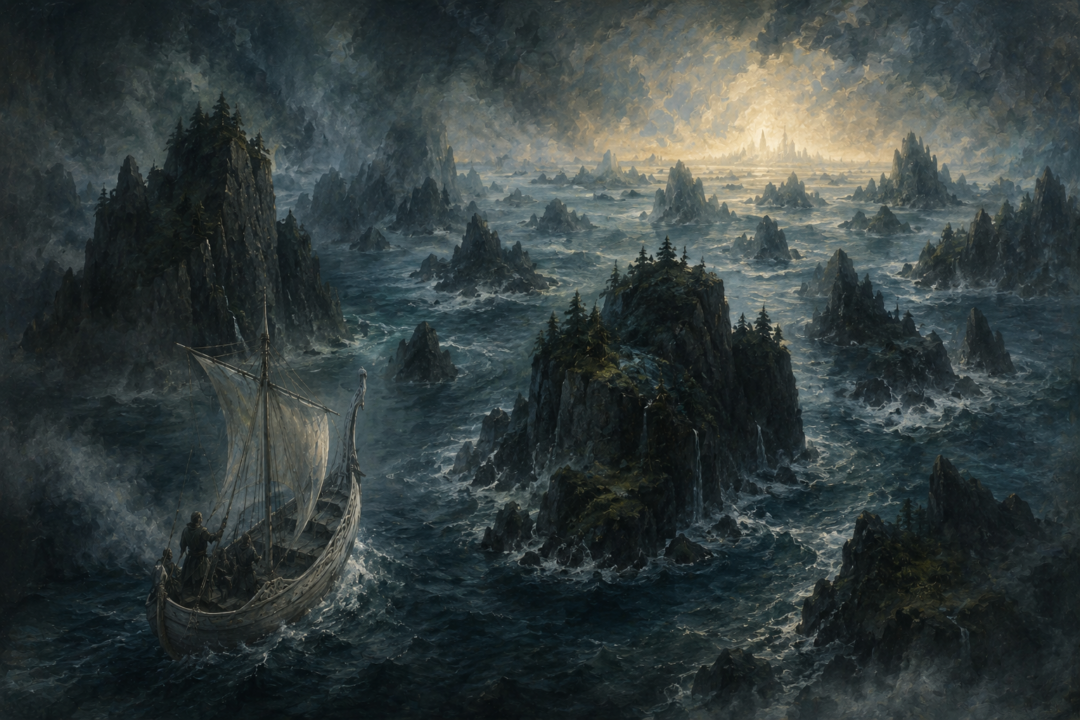
Eärendil’s ship, Vingilot, crossed the Great Sea and reached Aman. At first glance, that sounds like a problem of distance: determine where the Mouths of Sirion lay, estimate the western coastline of the Blessed Realm, measure the ocean between them, and calculate how many miles the voyage required.
But Eärendil’s journey does not work that way.
The obstacle between Middle-earth and Aman in the final centuries of the First Age was not merely a very wide sea. Valinor had been deliberately hidden. The approaches to it were wrapped in shadow, guarded by the Enchanted Isles, and made inaccessible to ordinary mariners. Ships could sail west and still fail to reach the West.
That distinction changes everything.
Eärendil’s achievement was not primarily that he sailed farther than everyone else. It was that he passed a boundary others could not pass.
Aman Was Geographically West, but Geography Was Not Enough
During the First Age, Aman still belonged to the physical world. It lay beyond Belegaer, the Great Sea, west of Middle-earth. This matters because Eärendil’s voyage should not be confused with the later Straight Road taken by Elven ships after the Downfall of Númenor.
The world had not yet been made round, and Aman had not yet been removed from the ordinary circles of the world.
So there really was a westward sea journey.
Yet this does not mean that sailing to Aman was comparable to sailing from one known coast to another.
After the rebellion and exile of the Noldor, the Valar strengthened the defenses of their realm. The Pelóri were raised higher, the approaches to Valinor were guarded, and the seas east of Aman became part of the Hiding of Valinor.
The barrier was therefore geographical and supernatural at the same time.
A mariner could correctly know that Aman lay westward and still be unable to reach it.
The Enchanted Isles Break the Logic of a Normal Map
One of the clearest reasons ordinary mileage fails is the existence of the Enchanted Isles.
They were placed in the Shadowy Seas east of Tol Eressëa as part of the defenses of the Blessed Realm. Their purpose was not simply to make navigation difficult. They prevented unauthorized passage.
The traditions preserved in The Silmarillion describe these western seas as concealed by shadows and dangerous enchantments. Mariners attempting the crossing could become lost or trapped. Those who reached the islands risked falling into an enchanted sleep from which they would not awaken until the world changed.
That is not an ordinary navigational hazard.
A reef can be charted. A storm can be waited out. A prevailing current can be studied. An archipelago can normally be mapped.
The Enchanted Isles were different because the problem was not simply finding a sufficiently clever route between fixed obstacles. The Hiding of Valinor had been established so that the way itself could not ordinarily be found.
This means that a hypothetical map showing a straight line from Beleriand to Aman would tell us surprisingly little about Eärendil’s true difficulty.
The line could be short enough in theory and impossible in practice.
Other Mariners Had Already Tried
Eärendil was not the first person in Beleriand to understand that help from the West might be necessary.
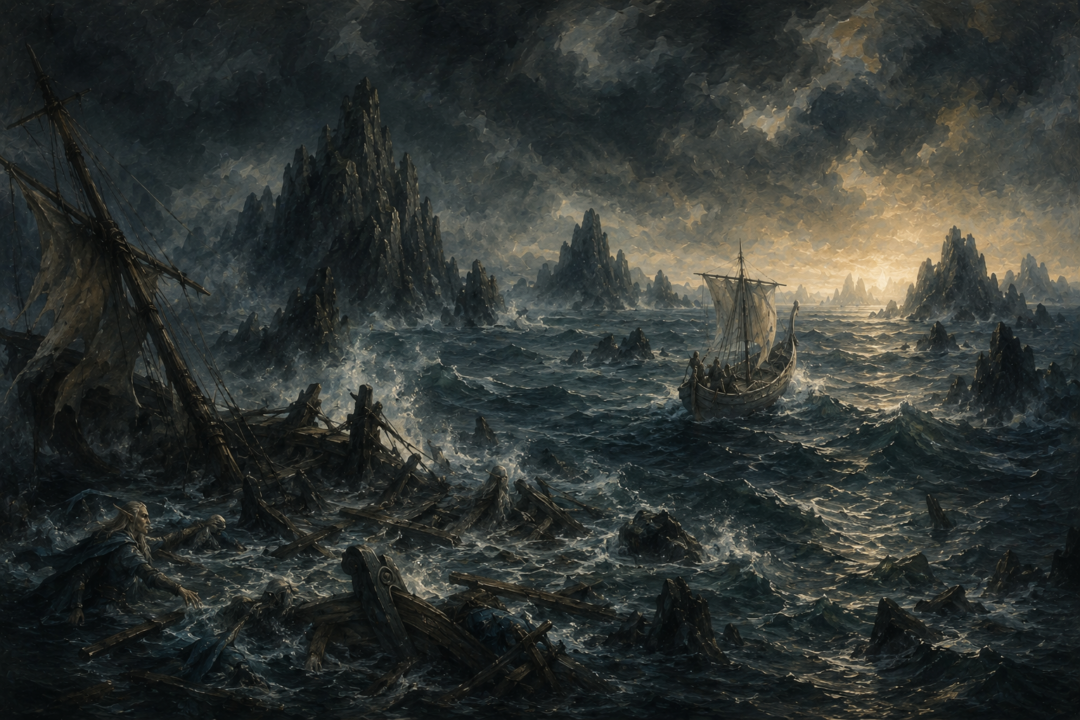
After the return of the Noldor, messengers attempted to reach Valinor. The journeys failed.
A particularly important example is Voronwë, later the guide of Tuor. He had sailed among the mariners sent west from Gondolin. Their attempt ended in disaster, and Voronwë survived only because Ulmo preserved him.
These failed voyages reveal the central problem.
The Elves of Beleriand were not ignorant of seamanship. Círdan and the Falathrim possessed a profound maritime tradition. Ships could be built. Sailors could navigate Belegaer. The western direction was known.
Still, Aman remained unreachable.
That strongly suggests that better shipbuilding, more provisions, or a longer willingness to sail would not by themselves solve the problem.
There was a prohibition embedded into the route.
Eärendil Himself Could Not Simply Sail There at First
The same point becomes even stronger when Eärendil’s own earlier voyages are considered.
Eärendil became a great mariner after the fall of Gondolin, dwelling among the survivors near the Mouths of Sirion. With the aid of Círdan he built Vingilot, and he sailed repeatedly upon the Great Sea.
His desire was connected both with the fate of his parents and with the desperate condition of Elves and Men under Morgoth.
But the early voyages did not simply end with Eärendil locating Valinor through superior navigation.
He wandered.
That is crucial.
If the problem had been ordinary mileage, repeated expeditions should at least have allowed a skilled mariner gradually to establish bearings, distances, currents, and routes.
Instead the western passage remained closed.
Vingilot was extraordinary, and Eärendil was extraordinary, but neither ship nor sailor alone was enough.
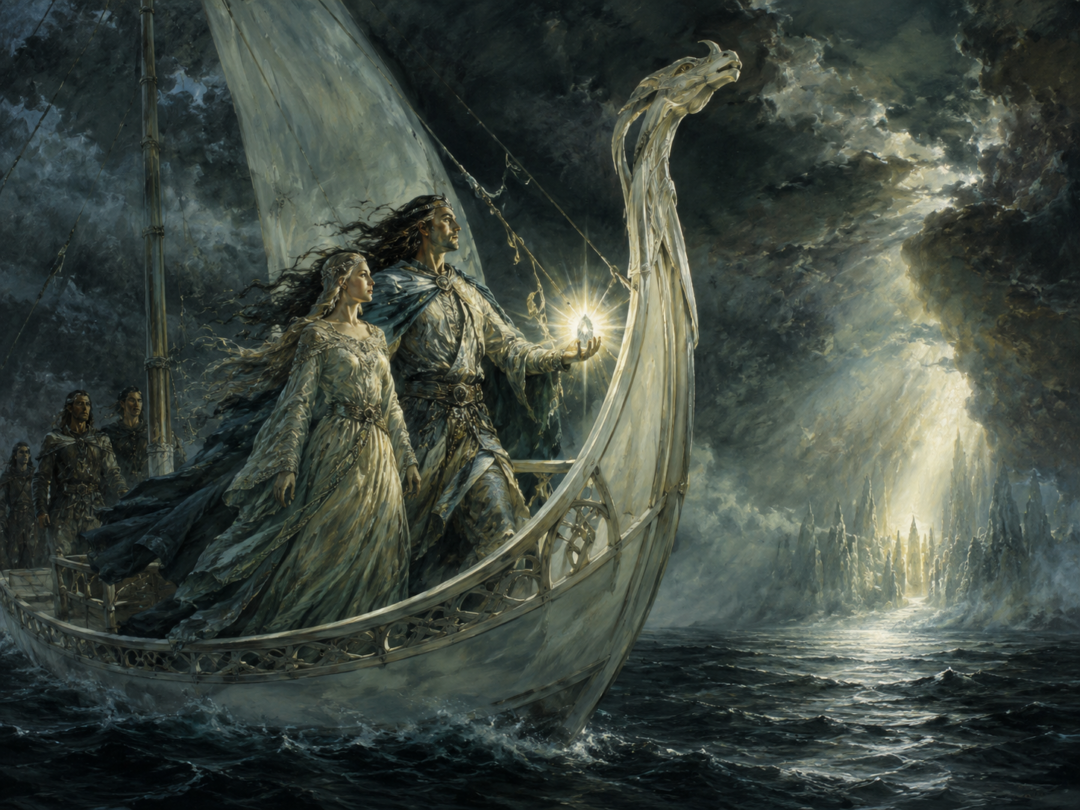
Something changed only after Elwing came to him bearing the Silmaril.
The Silmaril Changes the Nature of the Voyage
After the attack by the remaining sons of Fëanor upon the people at the Mouths of Sirion, Elwing cast herself into the sea rather than surrender the Silmaril inherited from Beren and Lúthien.
Ulmo preserved her, and she reached Eärendil upon Vingilot.
Eärendil then turned again toward the West.
This time the Silmaril was with him.
The account of the voyage associates the jewel with his passage through the Shadowy Seas and the Enchanted Isles. The text does not provide a mechanical explanation, and it would be misleading to treat the Silmaril as though it were simply a supernatural compass giving coordinates.
Its importance is deeper than that.
The Silmarils contained the unmarred light of the Two Trees of Valinor. The jewel carried by Eärendil had also passed through one of the most remarkable chains of events in the First Age: from Morgoth’s crown, through Beren and Lúthien, to Thingol, Dior, Elwing, and finally Eärendil.
When Eärendil approached Aman bearing that light, he was no longer merely another mariner attempting to defeat the western defenses by skill.
His voyage had become bound to the histories of both Elves and Men.
The texts do not explicitly define exactly how the Silmaril overcame every enchantment. What they do make clear is that Eärendil succeeded where the previous voyages had failed, and that the jewel accompanied the successful crossing.
Any calculation that reduces the achievement to ship speed therefore misses the most important variable.
The Destination Was Also Forbidden
Even reaching the coast did not make Eärendil’s journey an ordinary arrival.
Aman was not simply a foreign kingdom with closed borders. Mortals did not possess a natural right to enter the Blessed Realm, and the Exiled Noldor had lived under the consequences of rebellion against the Valar.
Eärendil himself embodied both kindreds.
He was the son of Tuor, a Man of the House of Hador, and Idril, daughter of Turgon of Gondolin. Elwing likewise descended from both Elves and Men through Beren and Lúthien.
That ancestry made his embassy uniquely significant.
He did not come west merely to escape Morgoth.
He came as a messenger.
His appeal concerned the suffering of Elves and Men together, and he sought mercy and intervention against Morgoth at a moment when resistance in Beleriand was approaching ruin.
The final barrier in Eärendil’s route was therefore not nautical at all.
It was judgment.
The True Distance Was Political, Moral, and Mythic
This is why asking how many miles Eärendil sailed can produce an answer that feels precise while explaining almost nothing.
There was certainly physical distance between Beleriand and Aman. Maps of Arda can suggest relative positions, and different reconstructions can estimate the breadth of Belegaer.
But the primary texts do not give us a reliable mileage figure for Eärendil’s successful voyage.
More importantly, they do not present mileage as the decisive obstacle.
The meaningful distance between the Mouths of Sirion and Valinor was created by the Hiding of Valinor, the rebellion of the Noldor, the judgment of the Powers, and the supernatural defenses placed upon the Western Sea.
That distance could not be overcome simply by sailing longer.
In that sense, Eärendil crossed something closer to a forbidden threshold than an oceanic measurement.
Why Later Elven Voyages Are Not a Simple Comparison
There is another common source of confusion.
By the Third Age, Elves regularly depart from the Grey Havens toward the Undying Lands. Frodo, Bilbo, Gandalf, Galadriel, and Elrond eventually sail west from Middle-earth as well.
Those voyages occur under completely different conditions.
After the Downfall of Númenor in the Second Age, the shape of the world was changed. Aman was removed from the ordinary physical world, while a special Straight Road remained available to those permitted to travel there.
Eärendil’s First Age voyage happened before that transformation.
He therefore did not sail the later Straight Road in the Third Age sense.
Yet paradoxically, his route was already more than normal geography because Valinor had been supernaturally hidden.
The distinction is subtle but important.
First Age Aman was still physically part of Arda, but access to it had been made extraordinarily difficult.
Third Age Aman was no longer reachable by simply continuing west around the curved surface of the world.
These are different cosmological situations.
Neither can be reduced safely to a modern nautical map.
Even Vingilot Eventually Ceased to Be an Ordinary Ship
What happens after Eärendil reaches Aman makes the limits of ordinary geography even clearer.
His embassy succeeds. The Valar intervene, and the War of Wrath follows.
Eärendil himself does not simply sail Vingilot back to the Mouths of Sirion and resume ordinary life.
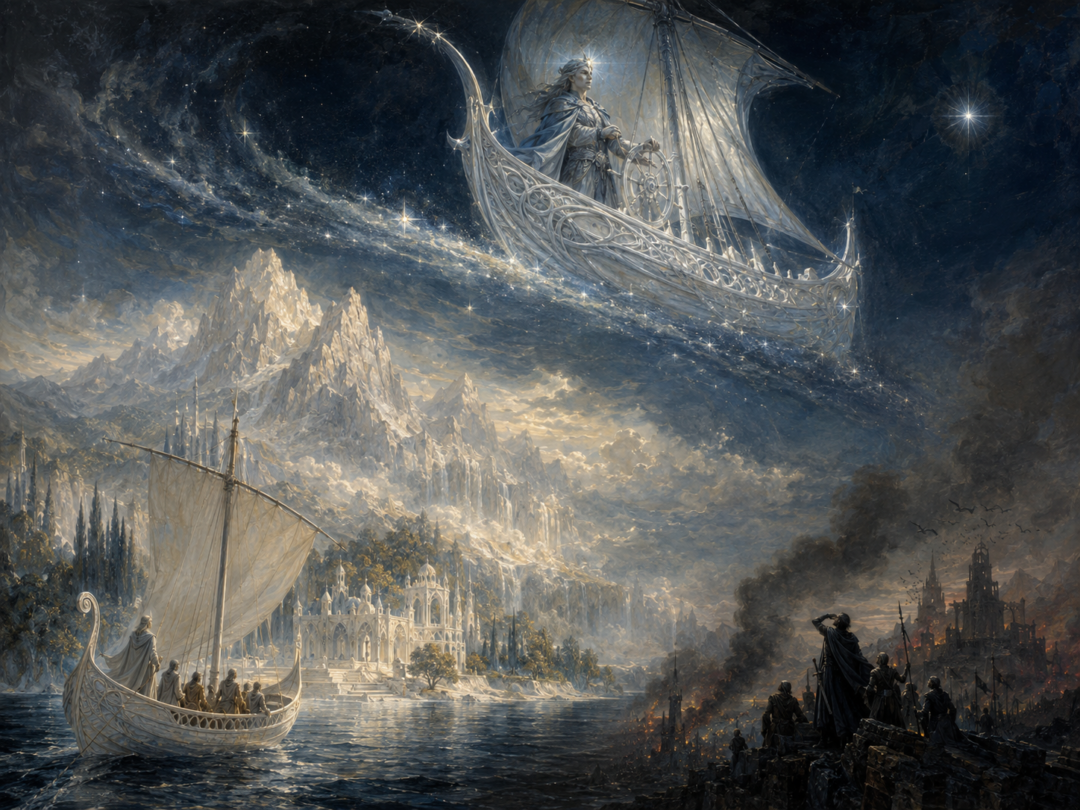
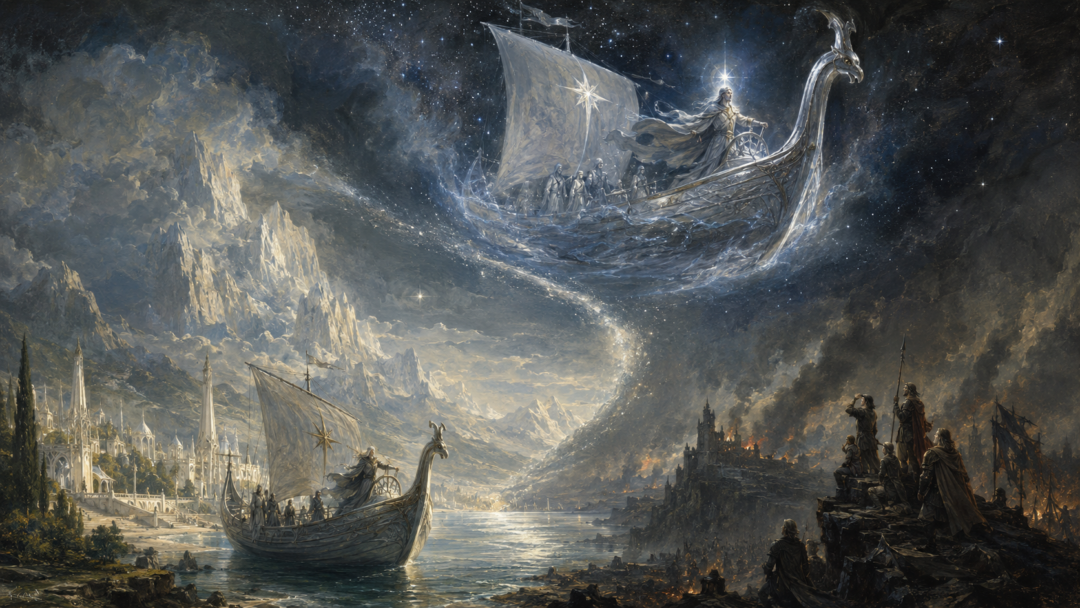
Vingilot is hallowed and transformed for a new purpose. Eärendil bears the Silmaril and sails the heavens, becoming the light that the people of Middle-earth see as the Star of High Hope.
The mariner who struggled to find the West becomes a light visible from the East.
His story begins with a ship attempting to cross an inaccessible sea and ends with that ship moving beyond the normal limits of earthly navigation altogether.
That transformation feels appropriate because Eärendil’s defining voyage was never really about mastering nautical distance.
It was about reaching what had been deliberately placed beyond ordinary reach.
The Better Question Is Not “How Far?” but “How Was Passage Possible?”
Mileage still has value when reconstructing the geography of Arda.
It can help us think about the approximate scale of Beleriand, Númenor, Belegaer, and the western lands. But Eärendil’s voyage demonstrates the danger of treating Tolkien’s world as though every journey operates under the same physical rules.
Some roads depend on geography.
Others depend on permission, fate, power, or the state of the world itself.
Eärendil’s western voyage belongs to the second category.
Aman lay across the Sea, but the Sea was only the visible part of the obstacle. Beyond it stood shadow, enchantment, exile, and prohibition.
That is why countless hypothetical miles tell us less about Eärendil’s achievement than one simple fact:
Others sailed west and could not find the way.
Eärendil, bearing the Silmaril and the hope of two kindreds, finally did.
Sources & Notes
- The Encyclopedia of Arda, “Eärendil” — https://www.glyphweb.com/arda/e/earendil.html
- The Encyclopedia of Arda, “Vingilot” — https://www.glyphweb.com/arda/v/vingilot.html
- The Encyclopedia of Arda, “Hiding of Valinor” — https://www.glyphweb.com/arda/h/hidingofvalinor.html
- The Encyclopedia of Arda, “Enchanted Isles” — https://www.glyphweb.com/arda/e/enchantedisles.html
- The Encyclopedia of Arda, “Shadowy Seas” — https://www.glyphweb.com/arda/s/shadowyseas.html
- The Encyclopedia of Arda, “Voronwë” — https://www.glyphweb.com/arda/v/voronwe.html
- Wikipedia, “Eärendil and Elwing” — https://en.wikipedia.org/wiki/E%C3%A4rendil_and_Elwing
References for Eärendil and Vingilot, the supernatural Hiding of Valinor and its maritime barriers, and Voronwë’s failed westward voyage.