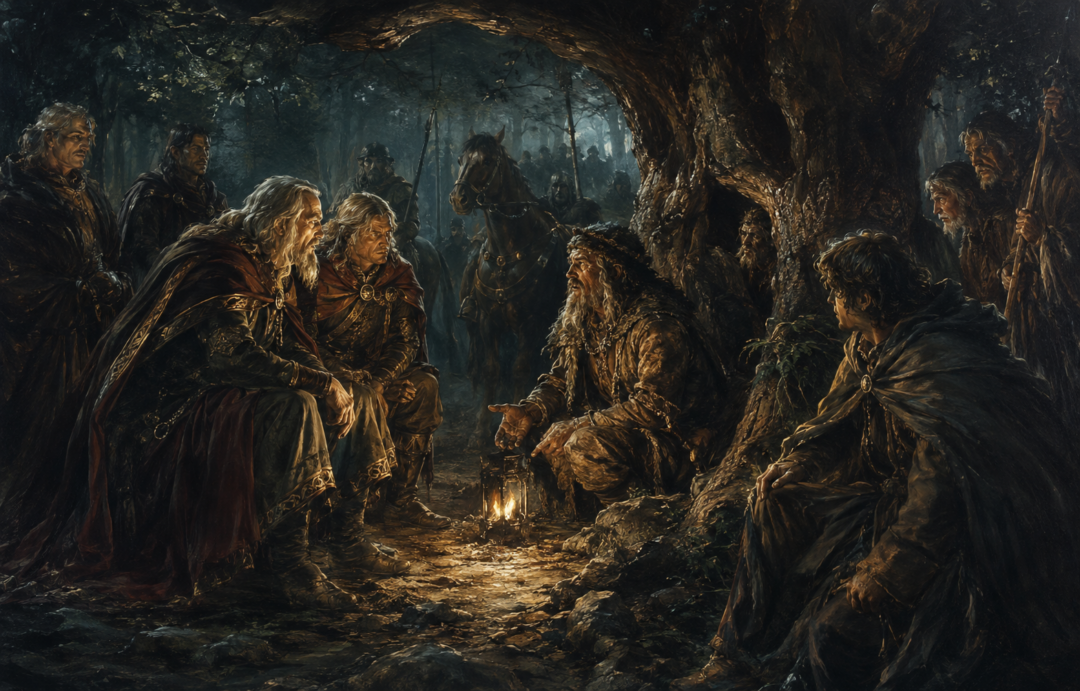
When Théoden’s Riders race toward Minas Tirith, one of the greatest armies of the West is stopped by a problem that courage cannot solve.
The road is blocked.
Enemy forces hold the main route through Anórien, time is running out, and the Rohirrim cannot simply fight every obstacle between themselves and the Pelennor Fields. Then a people almost forgotten by the kingdoms of Men step out of the forest.
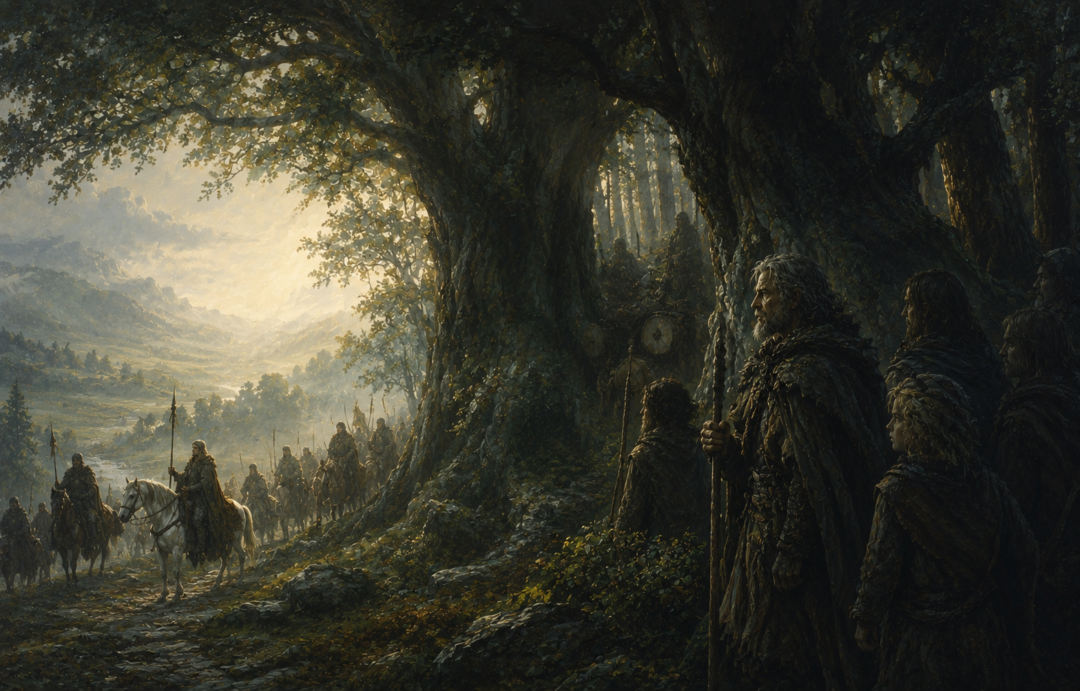
They are the Drúedain, called Woses or Wild Men by their neighbours. Their leader, Ghân-buri-Ghân, knows another way.
Théoden naturally offers him what kings offer valuable allies: reward and friendship.
Ghân-buri-Ghân effectively asks for something else.
If the Horse-men survive the coming battle, they are to stop hunting his people like animals.
That exchange is brief, but it radically changes the meaning of the Drúedain’s assistance. Ghân is not bargaining for treasure. He is forcing one of Middle-earth’s great kingdoms to acknowledge that the people it has treated as quarry are people at all.
And the road he gives Théoden is therefore more than a military shortcut. It becomes the means by which an almost invisible people make themselves impossible to ignore.
The People the Rohirrim Barely Understand
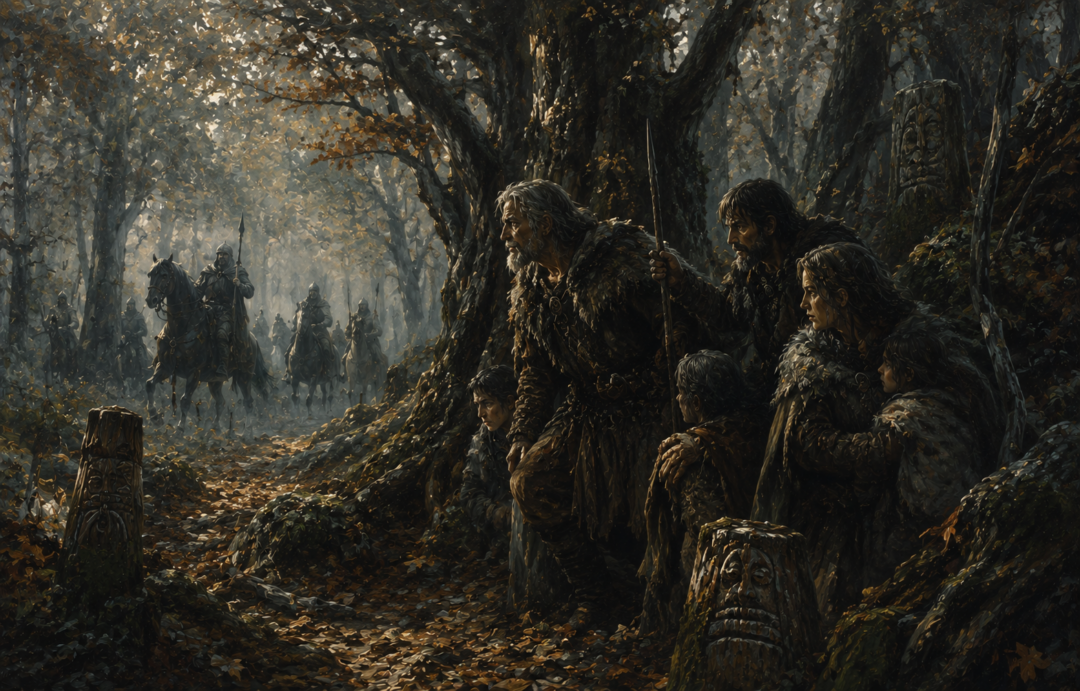
When Merry first learns about the inhabitants of Drúadan Forest in The Return of the King, they are described from the Rohirrim’s perspective as remnants of an older world.
They live secretly in the woods. They communicate across distances by drums. The Riders know them as Woses or Wild Men.
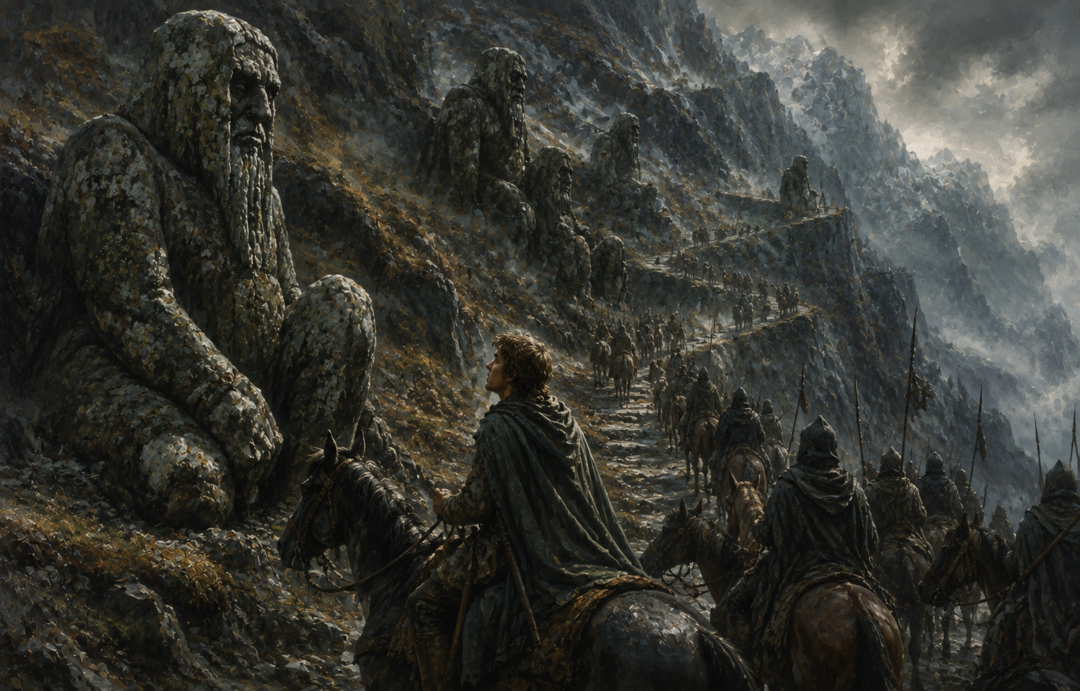
But Merry has already seen their likeness.
On the road to Dunharrow stand the ancient Púkel-men: squat, weathered stone figures beside a road whose makers have passed beyond ordinary memory. When Merry finally sees Ghân-buri-Ghân, he recognizes the resemblance.
The connection matters because it reverses the apparent relationship between “civilized” Rohan and the supposedly primitive Wild Men.
The Rohirrim are newcomers by comparison.
The Drúedain belong to a human history stretching far beyond the founding of Rohan. Material collected in Unfinished Tales places people of their kind among the Folk of Haleth in the First Age. They were known to the Eldar and counted among the enemies of Orcs.
By the late Third Age, however, the surviving Drúedain of Anórien have been pushed to the margins of the political world.
Their antiquity has not earned them honour.
It has barely earned them recognition.
That is why Ghân-buri-Ghân’s meeting with Théoden carries more weight than a simple alliance of convenience.
The Forgotten Road
Ghân’s immediate value to Théoden is practical.
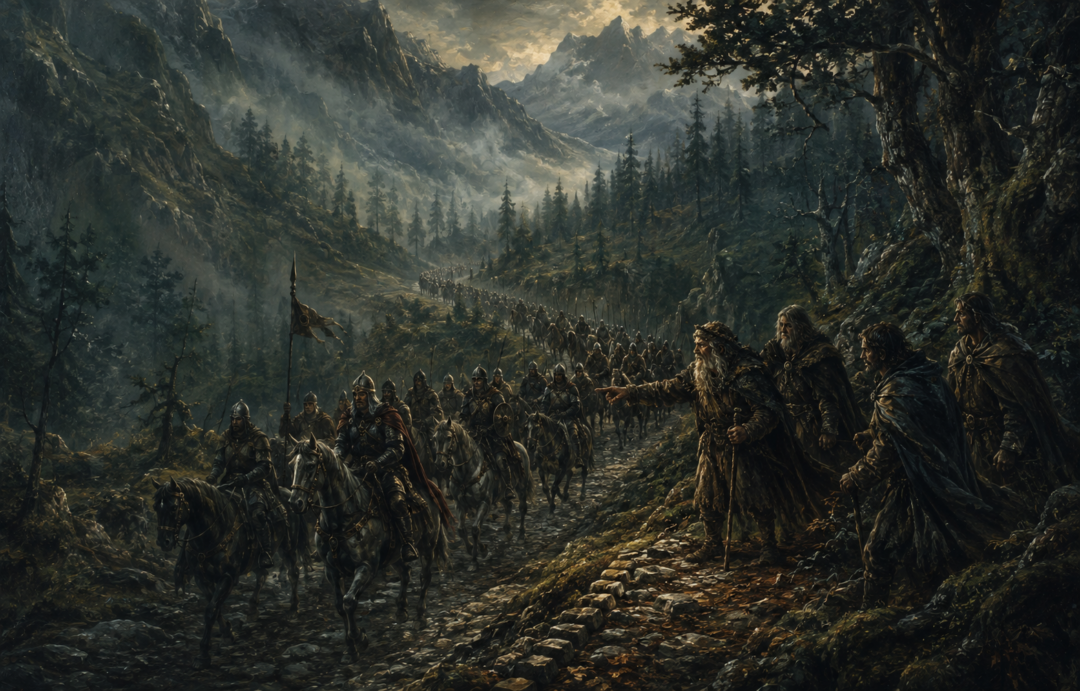
The enemy has obstructed the main road toward Minas Tirith. The Rohirrim are already desperately late, and the City may fall before they arrive.
Ghân knows that there is another passage.
The route runs through the Stonewain Valley, associated with an old road once used by the people of Gondor. By the War of the Ring it has largely passed out of ordinary use and knowledge. The Drúedain, however, have not forgotten the country.
This creates a striking reversal.
Gondor built roads, fortresses and cities on a scale the Drúedain never did. Rohan commands thousands of mounted warriors. Yet at the crucial moment, neither royal authority nor military strength can get Théoden where he needs to go.
The knowledge that matters belongs to the people living outside those systems.
Ghân knows the paths.
His people know where the enemy is.
They understand the woods and hills sufficiently well to guide a mounted host around the forces waiting on the main road.
The apparent outsiders possess the decisive information.
And Ghân understands exactly what that information is worth.
Théoden Offers Reward
Théoden treats Ghân honourably once they speak, but he initially approaches the arrangement according to the assumptions of a king.
If Ghân faithfully guides the Rohirrim, Théoden promises rich reward and the lasting friendship of the Mark.
It is a reasonable offer.
Ghân rejects its basic logic.
His answer begins with the brutal observation that gifts are meaningless if Théoden and his warriors die. But his real counter-demand concerns what will happen if they live.
The Wild Men are to be left alone.
More specifically, Ghân refers to his people having been hunted like beasts.
This is not merely his fear of something that might happen. Unfinished Tales confirms the grim background: the Rohirrim had hunted Drúedain, failing to recognize properly what sort of people they were dealing with.
Suddenly the bargain looks very different.
Théoden believes he is negotiating payment for guidance.
Ghân is negotiating an end to persecution.
Why Gold Would Be the Wrong Payment
Ghân could theoretically have requested wealth, weapons, livestock or some other material reward.
He asks for none of them.
That choice fits what the texts reveal about the Drúedain. They are a small and culturally distinct people, strongly attached to their own ways and woodlands. Their survival has depended less upon possessing great political power than upon remaining beyond the reach of stronger neighbours.
Their problem is therefore not primarily poverty.
Their problem is vulnerability.
Gold would not stop a future Rider from treating a Drúadan as an animal.
A royal gift would not necessarily erase generations of contempt or misunderstanding.
What Ghân needs from Théoden is recognition backed by royal authority: an acknowledgement that his people are not creatures inhabiting someone else’s wilderness but a community entitled to live there without being hunted.
There is also something remarkably restrained about his demand.
Ghân does not demand vengeance.
He does not require Théoden to surrender territory immediately, pay compensation, or punish those responsible for past violence.
He asks to be left in peace.
For a people who have every reason to distrust outsiders, that is an extraordinarily limited price for knowledge that may help save both Rohan’s army and Minas Tirith.
The Drúedain Could Simply Have Hidden
There is another important part of Ghân’s choice.
The Drúedain do not have to become involved.
The War of the Ring is a struggle involving powers far greater than their small woodland community. They could attempt to remain hidden while Gondor and Rohan fight Mordor.
But the Drúedain hate Orcs, and Ghân understands what the spreading Darkness means.
So they help.
Their assistance is not passive. Ghân offers information about enemy movements and personally commits himself to the guidance of Théoden. He even places his own life behind his promise: if he leads the Riders falsely, Théoden may kill him.
The supposed “Wild Man” therefore enters the agreement with an unmistakable sense of responsibility.
He asks Théoden to trust him, and offers his life as guarantee.
Théoden accepts.
For one crucial night, two cultures that have profoundly misunderstood one another cooperate because both recognize a greater enemy.
But the story does not end there.
Aragorn Gives the Promise Political Permanence
After Sauron’s defeat, the returning company passes the Drúadan Forest.
There the drums of the Wild Men are heard again.
A proclamation is made in the name of King Elessar: the Drúadan Forest is given to Ghân-buri-Ghân and his people to be theirs, and others are forbidden to enter without their permission.
This goes beyond Théoden’s battlefield agreement.
Ghân had asked that his people cease to be hunted.
The restored King recognizes their authority over the forest itself.
That distinction matters.
Being tolerated is not the same thing as possessing recognized rights.
The Drúedain are not merely told that the victorious kingdoms will graciously stop harming them. Their control of their own woodland is formally acknowledged by the new royal order.
The people who once hid from neighbouring Men now possess a boundary those neighbours are commanded to respect.
The transformation is quiet, but profound.
The Road Reverses Who Depends on Whom
The episode also overturns the usual hierarchy of power in Middle-earth.
Théoden has thousands of Riders.
Ghân has hidden paths.
Théoden has swords, horses, armour and banners.
Ghân has knowledge.
Théoden commands a kingdom.
Ghân understands the land through which that kingdom’s army must pass.
At that moment, the Rohirrim’s conventional advantages are insufficient. The king must listen to someone his people have historically dismissed.
That is one reason the Drúedain episode fits so naturally into the larger moral pattern of The Lord of the Rings. Again and again, victory depends upon people whom the powerful might overlook.
Hobbits carry the Ring.
A forgotten heir walks dangerous roads as a Ranger.
The Ents, dismissed as legend, overthrow Isengard.
And when Rohan makes its desperate ride toward the greatest battle of its age, its army reaches the Pelennor partly because the Wild Men know a road the great kingdoms have forgotten.
Power does not always belong to whoever appears strongest.
Sometimes it belongs to whoever remembers.
Ghân-buri-Ghân Wants Something Harder Than Treasure
There is a temptation to describe Ghân’s bargain as though the Drúedain simply exchange a secret road for political protection.
That is true, but incomplete.
What Ghân demands is ultimately a change in relationship.
The Rohirrim must stop seeing the Wild Men as beasts.
That cannot be measured in coins.
It requires recognition that an unfamiliar people, living according to customs outsiders may consider strange, still possess dignity, memory, loyalty and legitimate claims of their own.
Ghân does not become a Rohirrim.
His people are not absorbed into Gondor.
They do not need to become culturally similar to their powerful neighbours in order to deserve protection.
Their reward is precisely the opposite.
They are allowed to remain themselves.
And that may be the most important detail in the entire episode.
The Drúedain help save the world of Gondor and Rohan without asking for a place inside it.
They ask that their own world be allowed to survive.
The road through Stonewain Valley saves Théoden precious time. But the deeper road opened that night runs in both directions.
The Rohirrim finally see the people who have been living beside them all along.
And once they do, the old relationship cannot morally remain unchanged.
Sources & Notes
- Tolkien Gateway, “Drúedain” — https://tolkiengateway.net/wiki/Dr%C3%BAedain
- Tolkien Gateway, “Ghân-buri-Ghân” — https://tolkiengateway.net/wiki/Gh%C3%A2n-buri-Gh%C3%A2n
- Tolkien Gateway, “Stonewain Valley” — https://tolkiengateway.net/wiki/Stonewain_Valley
- The Encyclopedia of Arda, “Drúedain” — https://www.glyphweb.com/arda/d/druedain.html
- The Encyclopedia of Arda, “Ghân-buri-Ghân” — https://www.glyphweb.com/arda/g/ghanburighan.html
- The Encyclopedia of Arda, “Stonewain Valley” — https://www.glyphweb.com/arda/s/stonewainvalley.html
References for the Drúedain’s history, Ghân-buri-Ghân’s terms to Théoden, and the forgotten route through the Stonewain Valley.