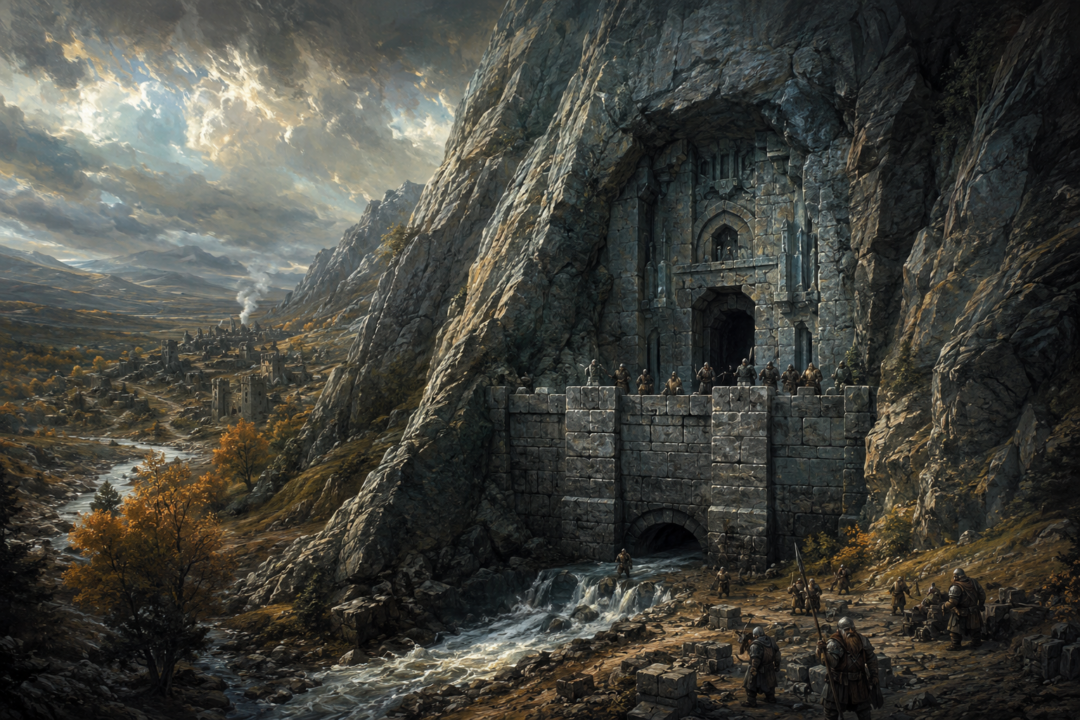
The Front Gate of Erebor looks, at first, like the perfect defensive position.
It opened from the southern face of the Lonely Mountain into the narrow valley between two great spurs. Behind it lay halls cut into living stone. An enemy approaching the restored kingdom could not simply surround a wooden town or climb an ordinary city wall. To reach the heart of Erebor, attackers had to enter the Mountain.
Yet The Hobbit reveals the uncomfortable price of that security.
By the time Thorin Oakenshield reclaimed Erebor in 2941 of the Third Age, the Front Gate was effectively the only usable entrance remaining. That made a tiny company extraordinarily difficult to attack.
It also meant that an enemy did not necessarily have to attack them at all.
Block the Gate, control the approaches, and the fortress could become a trap.
Erebor therefore illustrates one of the most interesting military contradictions in Middle-earth: the same geography that made the Mountain immensely defensible also made access to food, reinforcements, and the outside world dangerously concentrated.
Erebor Had Not Originally Been a One-Door Kingdom
It is important not to mistake Erebor’s condition after Smaug’s occupation for its original design.
When Bilbo and the Dwarves reach the Mountain, they discover evidence of a far more complex Dwarven settlement. The Front Gate had once been a magnificent entrance, connected to a broad paved road running into the Mountain. The halls behind it belonged to a functioning kingdom rather than merely a fortified cave.
There had also been other ways into Erebor.
In “The Gathering of the Clouds,” the situation after Smaug’s death is described clearly: the dragon had broken or blocked the other entrances long before. The concealed Back Door used by Bilbo and Thorin’s company remained, but it was a secret passage rather than a practical gateway for sustaining an entire kingdom.
So the military situation of 2941 was abnormal.
Thorin had recovered the Mountain, but he had not yet recovered the infrastructure of the kingdom.
That distinction explains much of what happens next.
The Front Gate Was an Extraordinary Defensive Choke Point
Once Smaug was dead, Thorin’s company returned to the Mountain and immediately began turning the Front Gate into a defensible barrier.
They built a wall across its mouth using large stones. The stream issuing from beneath the Mountain complicated the work, but they left openings through which the water could escape.
The result was formidable.
Thirteen Dwarves and Bilbo were suddenly occupying a position that a much larger force could not easily storm without severe risk.
This is the fundamental advantage of a narrow entrance.
Numbers matter less when only a limited number of attackers can reach the defenders at once. The defenders can remain behind stone while an attacking force must expose itself in the valley outside.
The Mountain itself becomes part of the fortification.
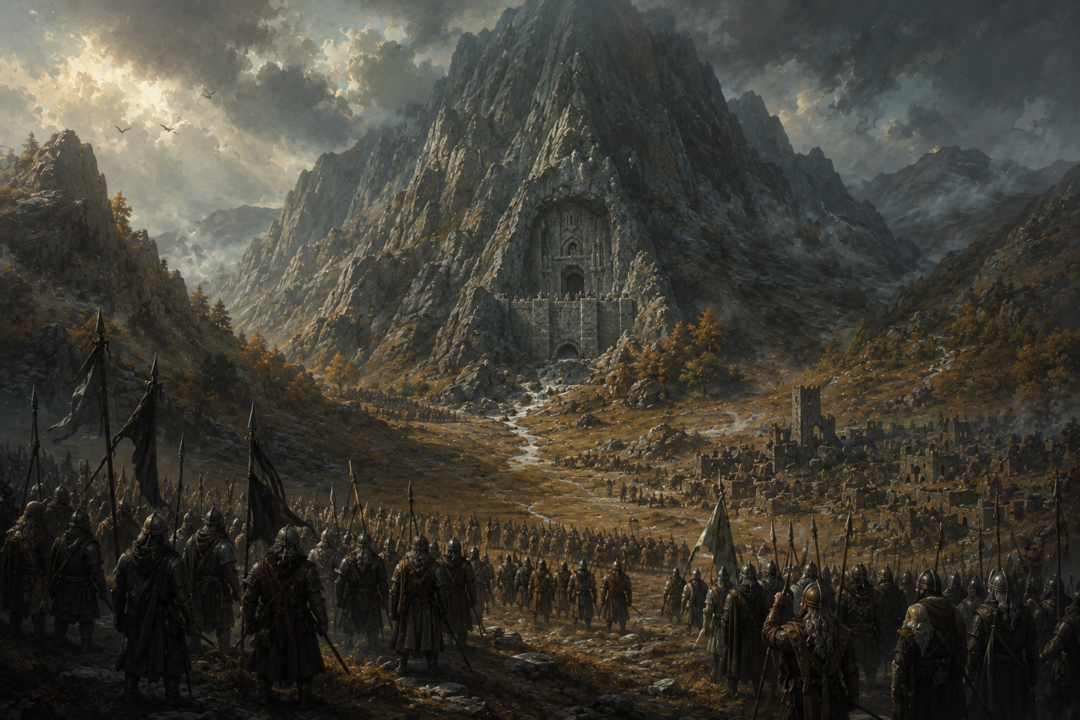
Bard and the Elvenking therefore faced a frustrating problem. They possessed far more warriors than Thorin possessed defenders, but numerical superiority did not automatically give them access to Erebor.
The Front Gate multiplied the defensive value of Thorin’s tiny company.
Yet Bard understood that he did not need to break it.
Bard Chose Hunger Instead of an Assault
After Thorin rejected Bard’s demands concerning the treasure, Bard declared the Mountain besieged.
The decision is revealing.
There is no grand attempt to batter down the Gate. No costly frontal attack is required. Instead, the Men and Elves establish themselves outside and wait.
Bilbo quickly understands the danger.
When speaking secretly with Bard and the Elvenking, he warns them that Thorin’s supplies will not last indefinitely. Bilbo’s estimate is uncertain, but his reasoning is sound: the Dwarves have treasure enough to make kings wealthy, yet treasure cannot feed them.
That is the paradox at the heart of Erebor.
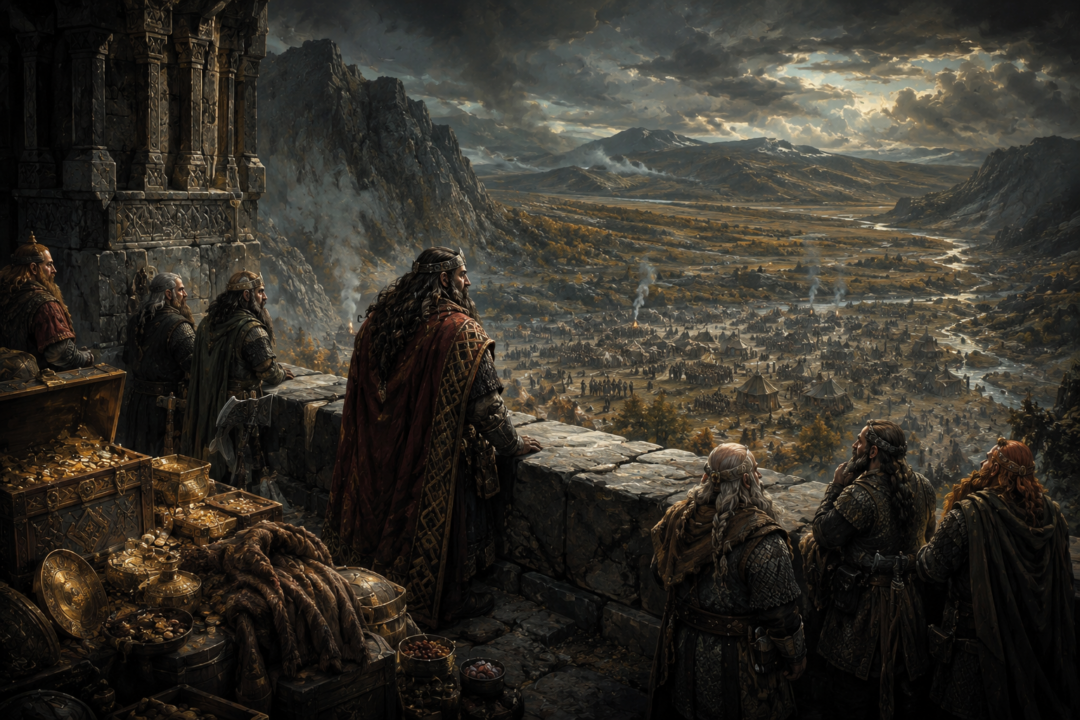
Inside the Mountain lies one of the greatest concentrations of wealth in the North.
But gold is strategically useless if the defenders cannot obtain bread.
A fortress can possess almost unlimited material wealth and still be defeated by ordinary biological needs.
The Front Gate that prevents enemies from entering also prevents the defenders from freely leaving.
The Secret Door Could Not Solve the Problem
At first glance, the Back Door seems to undermine the entire siege.
Bilbo and the Dwarves entered Erebor through it. Why not use it to bring supplies into the Mountain?
Because it was never presented as a logistical entrance capable of supporting a large population.
The passage was narrow and secret, descending toward the lower halls. Finding the door itself required knowledge from Thrór’s map and the special circumstances of Durin’s Day to reveal the keyhole.
It was ideal for infiltration.
It was not the equivalent of a functioning city gate.
There is also an important practical distinction between secretly moving a Hobbit through a tunnel and supplying a restored Dwarven kingdom with food, tools, animals, merchants, soldiers, and ordinary traffic.
The texts do not provide calculations for Erebor’s food requirements, so anything more precise would be speculation. But the strategic principle is explicit in the events: Thorin needs the siege broken, not merely a hidden path by which an individual might slip away.
The secret door helped reclaim Erebor.
It could not by itself sustain Erebor.
Dáin’s Army Reveals Thorin’s Real Solution
Thorin’s answer to the siege was not passive endurance.
It was Dáin Ironfoot.
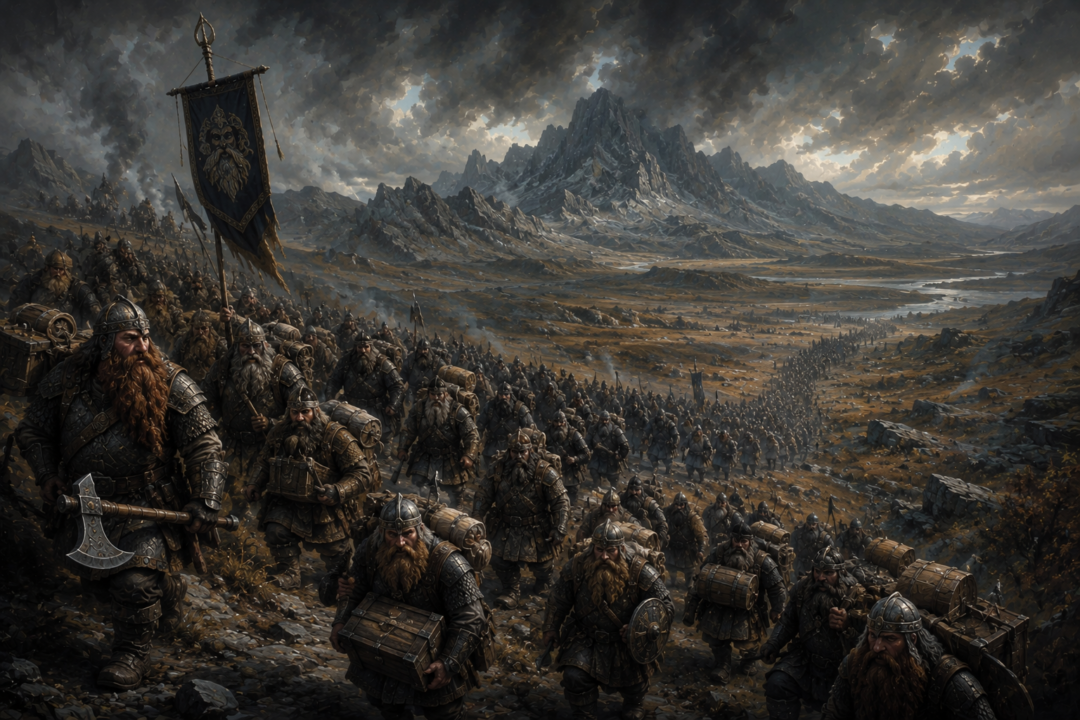
Ravens carried messages between Erebor and the Iron Hills, and Dáin marched west with more than five hundred armed Dwarves. Crucially, they did not arrive carrying weapons alone.
They brought substantial supplies.
The Hobbit specifically emphasizes the heavy packs carried by Dáin’s people despite their rapid march. Their arrival would have radically changed the siege because they could reinforce the Mountain and provision its defenders.
Bard understood this.
If Dáin reached the Gate, Thorin would no longer be a king trapped inside a fortress with thirteen companions. Erebor would contain hundreds of experienced Dwarven warriors with supplies sufficient to endure for weeks.
And there was an even greater danger for the besiegers.
The Dwarves intended eventually to reopen and defend other entrances.
At that point Bard and the Elvenking would have faced the much harder task of surrounding an entire mountain rather than watching a single gate.
This detail proves that Erebor’s one-gate vulnerability was understood by the Dwarves themselves as temporary.
Their objective was not to preserve the bottleneck forever.
It was to restore access.
One Gate Made a Tiny Garrison Powerful
There is an irony in Thorin’s predicament.
Before Dáin arrived, having only one usable gate actually helped him.
Thorin’s company was far too small to defend several widely separated entrances. Had five or six major gates remained open around Erebor, Bard could have divided his forces and threatened several points simultaneously.
Fourteen occupants could not realistically watch an entire mountain perimeter.
But one gate concentrated everything.
Thorin could place almost his entire defensive strength at the single place an enemy had to approach.
The destruction wrought by Smaug had therefore accidentally created a position well suited to a tiny garrison.
What was disastrous infrastructure for a kingdom was excellent infrastructure for a last stand.
That difference matters.
Fortresses are not simply “strong” or “weak.” Their usefulness depends on who is defending them, how many defenders exist, what supplies they possess, and how long they must hold.
For Thorin’s small company, one gate was initially an advantage.
For a permanent kingdom, it would have been a liability.
The Battle of Five Armies Shows the Gate’s Offensive Limitation
When the Goblin host arrived, the Front Gate acquired yet another meaning.
The Free Peoples arranged their defense around the valley and the Mountain’s projecting spurs. Thorin remained behind his barricade while the battle began outside.
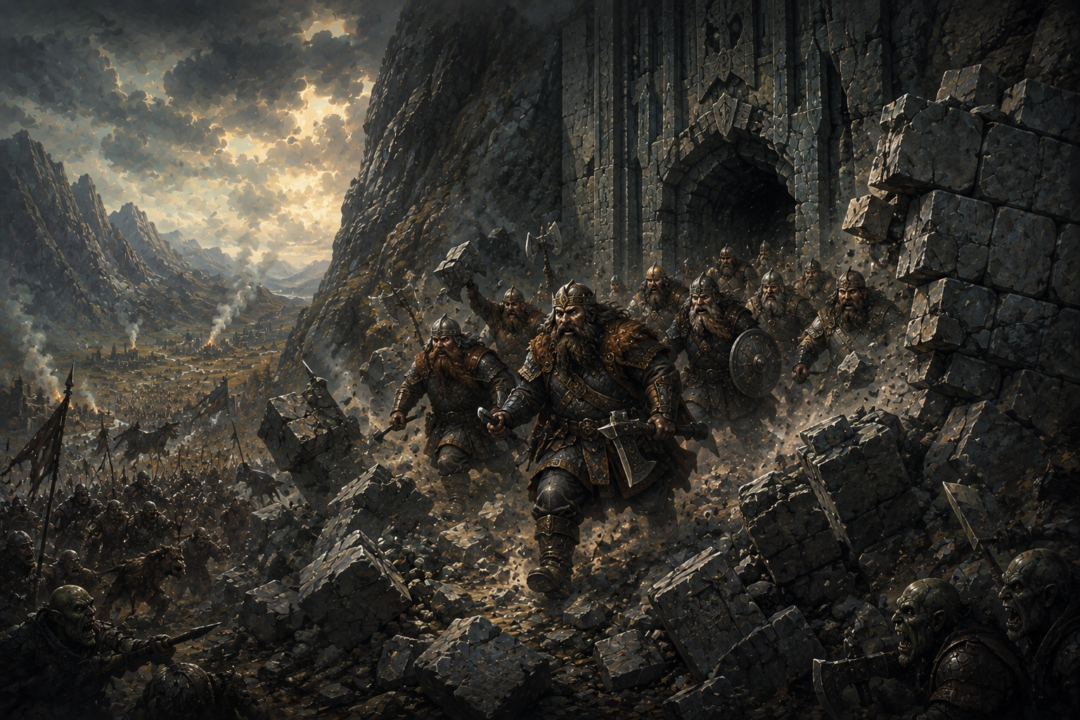
Eventually he and his companions broke down part of their own wall and charged out.
It is one of the great reversals of the episode.
The wall built to keep enemies away now had to be demolished so the defenders could join their allies.
Thorin’s charge was initially devastating, but the broader battle demonstrates the limitation of a sealed fortress: protection and freedom of movement pull in opposite directions.
A barrier strong enough to prevent an enemy entering also constrains the defenders’ ability to deploy.
Once Thorin wanted to turn defense into attack, the Gate ceased to be merely a shield.
It became something he had to pass through.
The Same Principle Appeared Again During the War of the Ring
Decades later, Erebor again faced invasion.
During the War of the Ring, forces allied with Sauron attacked Dale and the Lonely Mountain. King Brand of Dale and King Dáin II fought before Erebor, and both were slain.
The surviving Men and Dwarves retreated into the Mountain and endured a siege.
The attackers could not force their way inside.
Here the defensive strength of Erebor appears again. Against direct assault, the Mountain remained tremendously difficult to capture.
But the siege also repeated the older strategic reality: defenders behind the Gate depended on what they already possessed and on eventual relief from events outside.
They survived until news of Sauron’s fall changed the wider war and the besieging forces were defeated.
Erebor was powerful precisely because enemies could be kept outside.
It was vulnerable for exactly the same reason.
Erebor’s Greatest Wall Was Also Its Greatest Constraint
The Lonely Mountain offers a useful reminder that fortifications in Middle-earth are rarely magical guarantees of safety.
Stone can prevent an army from entering.
It cannot create food.
A narrow gate can neutralize superior numbers.
It can also allow a besieger to concentrate attention on one point.
A sealed fortress can preserve its defenders from immediate destruction.
It can also imprison them.
Thorin’s position after Smaug’s death captures that contradiction perfectly. He possessed the Mountain, the treasure, strong stone defenses, and a gate that his enemies were unwilling to storm.
Yet he still needed Dáin.
The long-term solution was not to make Erebor even more closed. The Dwarves’ plan was eventually to reopen other entrances and transform a besieged refuge back into a functioning kingdom.
That may be the most revealing detail of all.
The strongest version of Erebor was never the Mountain completely sealed against the world.
It was the Mountain secure enough to control who entered — but connected enough that its people could still live.
Sources & Notes
- Tolkien Gateway, “Front Gate” — https://tolkiengateway.net/wiki/Front_Gate
- Tolkien Gateway, “Back Door” — https://tolkiengateway.net/wiki/Back_Door
- Tolkien Gateway, “The Gathering of the Clouds” — https://tolkiengateway.net/wiki/The_Gathering_of_the_Clouds
- Tolkien Gateway, “A Thief in the Night” — https://tolkiengateway.net/wiki/A_Thief_in_the_Night
- The Encyclopedia of Arda, “Front Gate” — https://www.glyphweb.com/arda/f/frontgate.php
References for Erebor’s surviving entrances, Thorin’s gate fortification, the Men-and-Elves siege, and Dáin’s relief force.