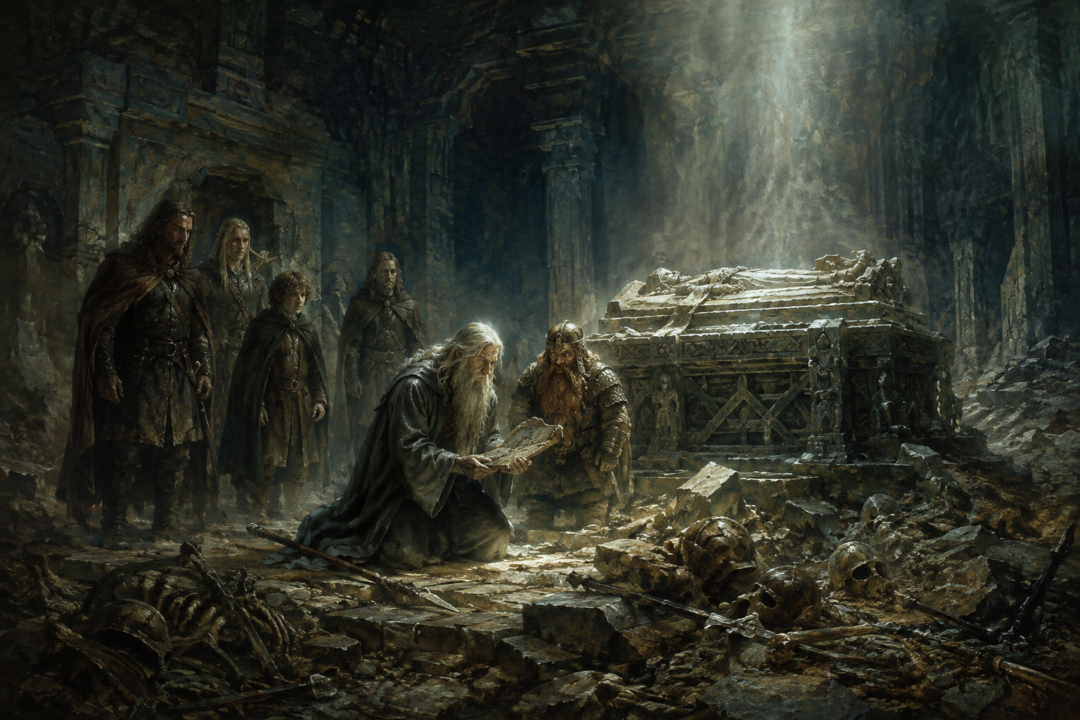
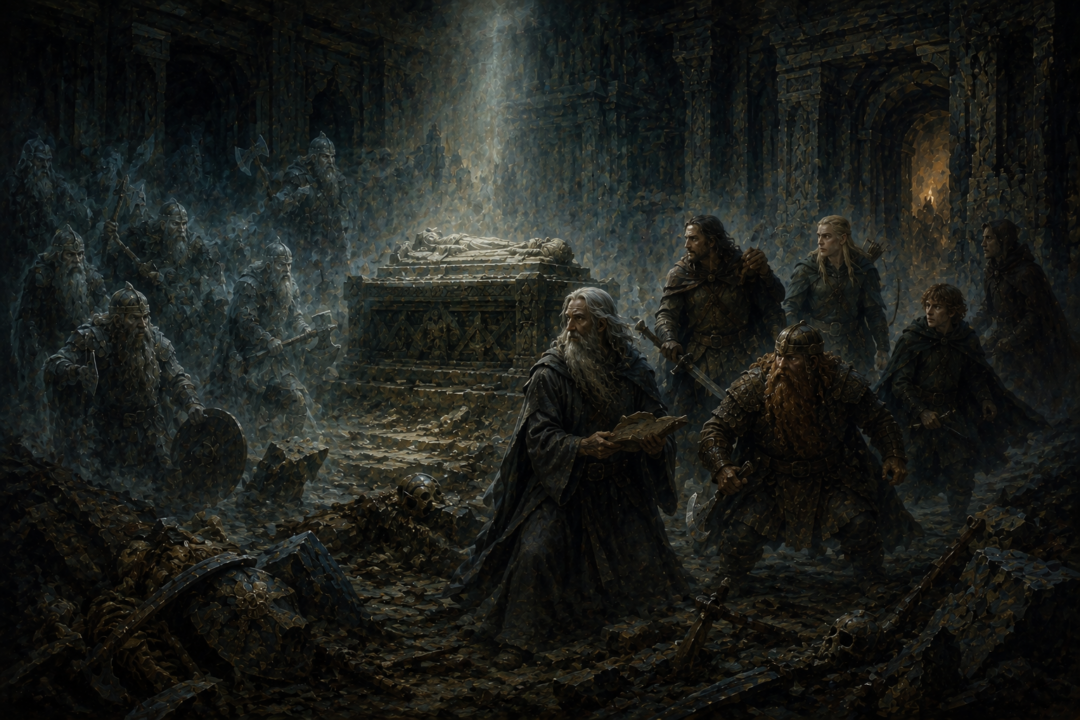
In the darkness of Moria, the Fellowship finds something almost more disturbing than Balin’s tomb: a book.
It lies among the wreckage of the Chamber of Mazarbul, battered and partly destroyed, its pages stained and damaged. Gandalf can recover only fragments. Yet those fragments tell the Fellowship exactly what they desperately need to understand.
Balin’s colony did not simply disappear.
It was trapped.
The eastern approaches were overwhelmed by Orcs. The western escape was blocked. The survivors retreated into the Chamber of Mazarbul. Then, near the end of the surviving record, the chronicler describes hearing drums in the deep and announces that the enemy is coming.
And almost immediately, the Fellowship hears drums too.
It can feel as though the Book of Mazarbul has been designed to stop at the perfect dramatic instant. In a literary sense, of course, it has. But inside the history of Middle-earth, something more interesting is happening.
The book does not end because the writer has finished explaining the disaster.
It ends because the disaster has reached the writer.
The Book Is Not a History Written After the Fall
The first important distinction is easy to miss.
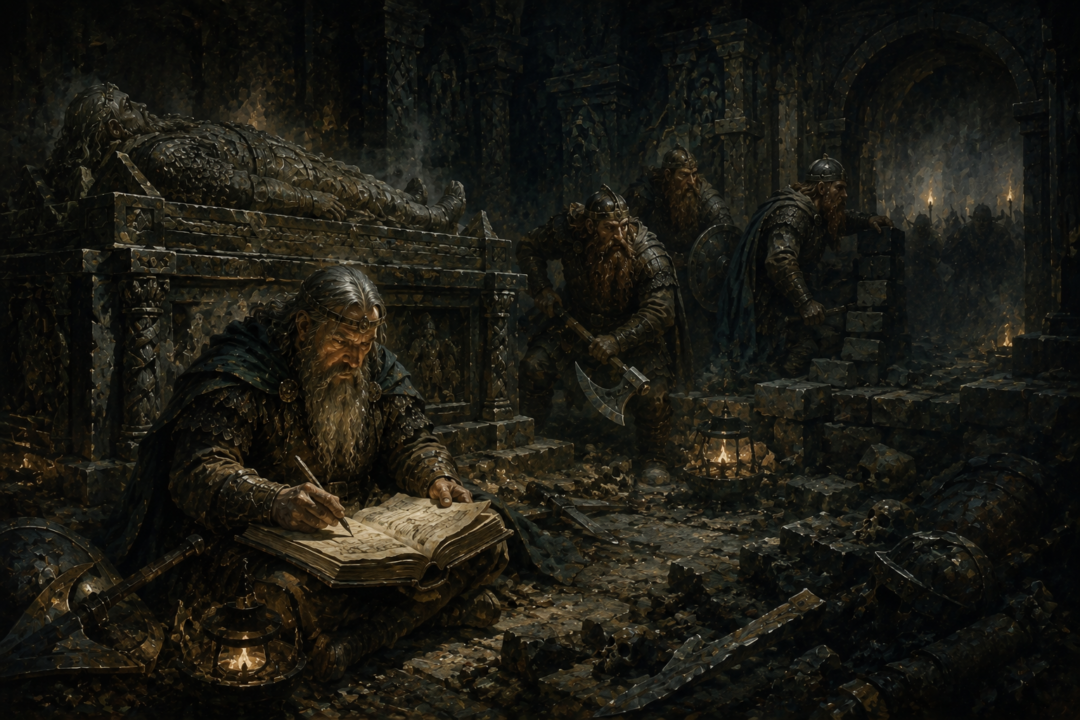
The Book of Mazarbul is not a later account written by someone who already knows how Balin’s attempt to reclaim Moria ended. It is the colony’s own record, maintained while events were happening.
The surviving fragments therefore change in character as the colony’s circumstances deteriorate.
Earlier entries preserve the optimism of the expedition. Balin and his companions entered Moria in Third Age 2989. They established themselves in the old Dwarven halls, and Balin became Lord of Moria. The record preserves evidence of their initial successes, including discoveries associated with the ancient wealth of Khazad-dûm.
For a time, their great gamble appeared to have worked.
That makes the later pages much more painful.
Five years after the colony was established, Balin was killed in Dimrill Dale. According to the damaged record Gandalf reads, Balin had gone to look into Mirrormere when an Orc shot him from concealment. More Orcs then came up from the east.
The surviving Dwarves recovered Balin’s body, but the situation rapidly became desperate.
This is not a historian summarizing their defeat.
These are people recording the collapse while they are inside it.
Moria Closes Around Them From Both Sides
The most important information in the final entries is geographical.
The Dwarves are not merely losing battles. Their exits are disappearing.
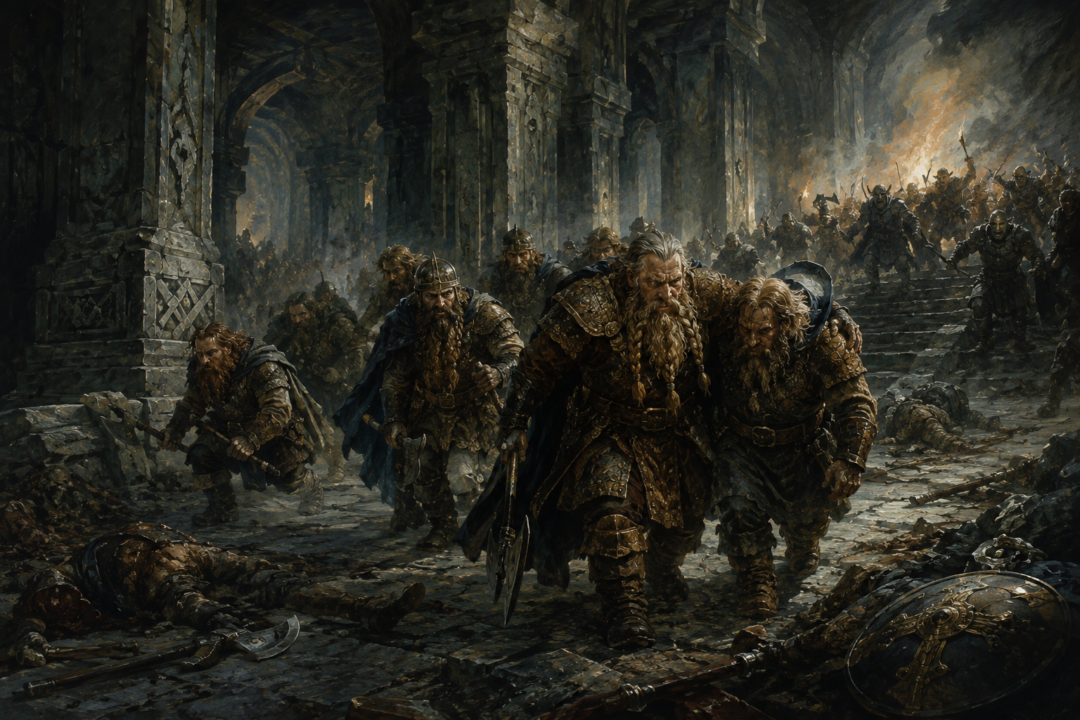
The enemy presses them from the east. Eventually the bridge and Second Hall are lost, and surviving defenders fall back toward the Chamber of Mazarbul.
But the western route is no salvation.
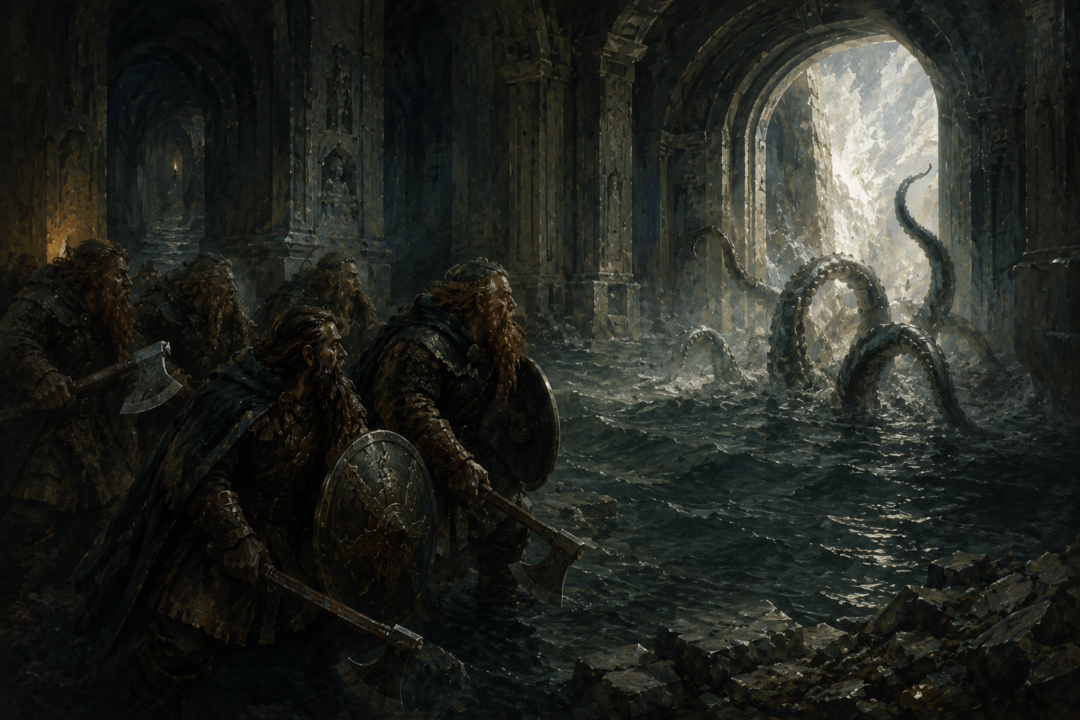
A party associated with Óin has attempted to reach the West-gate. The surviving account reports that the water has risen to the wall and that the Watcher in the Water took Óin.
That detail matters enormously because the Fellowship has already encountered the same danger.
When the Company entered Moria through the West-gate, the Watcher attacked Frodo and then blocked the entrance behind them. The Fellowship therefore knows from personal experience that the western door is no ordinary escape route.
The Book of Mazarbul suddenly gives that encounter a history.
What happened outside the West-gate was not simply an isolated obstacle encountered by Frodo’s company. The same region had already become fatal to Balin’s people years earlier.
The colony was being compressed.
Orcs controlled crucial territory toward the east. The Watcher made escape toward the west perilous or impossible. The remaining Dwarves were driven back into their own Chamber of Records.
And that is where the Fellowship is standing while Gandalf reads.
The Final Entry Is Terrifying Because It Is Immediate
The famous final portion of the record is remarkably stripped down.
The orderly purpose of a chronicle is breaking apart under pressure. The writer reports that they cannot escape, names fallen companions, describes the loss of the bridge and Second Hall, and records the disaster at the West-gate.
Then comes the sound from below.
Drums.
The final surviving warning ends with the enemy approaching.
There is no account of the battle that follows.
There could hardly be one.
The implication is brutally simple: whoever was maintaining the record no longer had the safety, time, or perhaps life required to continue it.
The absence of a conclusion therefore becomes the conclusion.
We do not need a sentence announcing that Balin’s colony has fallen. The ruined chamber, the bones, Balin’s tomb, and the unfinished record already provide the answer.
The physical state of the room completes the narrative the book cannot.
Then the Fellowship Hears the Same Sound
This is where the Book of Mazarbul becomes more than recovered history.
After Gandalf finishes reading, the past begins to repeat itself.
A deep sound is heard through Moria.
The Fellowship soon realizes that enemies are approaching, and they must defend the same chamber in which Balin’s surviving people apparently made their last stand.
That parallel is extraordinarily precise.
Balin’s people were driven into the Chamber of Mazarbul.
Now the Fellowship is there.
Balin’s people heard drums approaching.
Now the Fellowship hears them.
The Dwarves lost access to the bridge and Second Hall.
Those places are about to become crucial to the Fellowship’s own escape.
The record has not merely explained what happened years ago. It has effectively described the danger surrounding the Company in the present.
For a few moments, the Fellowship occupies the position of the dead.
That is why the scene feels so claustrophobic. The companions are not simply exploring ruins anymore. They have stepped into an unfinished event.
The Book Gives Gandalf a Map Made of Disaster
The Book of Mazarbul does not provide a convenient set of instructions for escaping Moria. Gandalf still has to navigate the halls under immense pressure.
But the record does provide strategic information.
It reveals that Balin’s colony was attacked from the east. It establishes that the bridge and Second Hall were important positions in the fighting. It confirms that the West-gate had become dangerous because of the water and the Watcher. Most importantly, it proves that hostile forces still occupied or could reach the interior of Moria.
The Fellowship cannot treat Khazad-dûm as an empty ruin.
It is inhabited territory.
That distinction matters because Gandalf had already been uncertain about the precise route through the enormous underground realm. The Company had spent days navigating darkness, old passages, and immense halls.
The Book does not solve that navigational problem.
Instead, it changes the nature of it.
They are no longer merely trying to find the eastern exit.
They are trying to reach it before the fate recorded in the book becomes their own.
There Is One Crucial Difference Between the Two Companies
The parallel between Balin’s colony and the Fellowship is powerful, but it should not be pushed too far.
Their situations are not identical.
Balin’s people came to Moria intending to remain. They attempted to reclaim Khazad-dûm and establish a lasting Dwarven settlement.
The Fellowship only needs to pass through.
That difference gives Gandalf’s company something Balin’s colony eventually lost: mobility.
When enemies attack the Chamber of Mazarbul, the Fellowship does not attempt to hold it indefinitely. They fight, withdraw, and continue toward the eastern side of Moria.
This is one of the quiet strategic lessons embedded in the sequence.
The chamber was Balin’s seat and eventually the refuge of his survivors. It contained his tomb and the record of his colony. For Gimli especially, abandoning it must carry enormous emotional weight.
But the Fellowship cannot defend the past.
They have to leave it.
Their survival depends on refusing to become another doomed garrison of Khazad-dûm.
The Book Also Changes Gimli’s Journey
For Gimli, the discovery is not an archaeological curiosity.
At Rivendell, Glóin had explained that no news had come from Balin’s colony for many years. Gimli enters Moria with uncertainty still hanging over Balin’s fate.
The Chamber of Mazarbul ends that uncertainty.
Balin is dead.
The colony is destroyed.
The Book supplies the sequence of the catastrophe, while the tomb and remains around the chamber make its outcome undeniable.
This gives the final pages another function. They transform absence into knowledge.
Before Moria, Balin’s people are missing.
After the Book of Mazarbul, they have a history.
Their names, resistance, losses, and final predicament have not vanished completely into the darkness.
That matters in a world filled with ruined kingdoms and forgotten wars. Defeat can destroy a people without entirely erasing their memory.
The battered record survives long enough to be found.
Why the Ending Feels Almost Supernaturally Perfect
Nothing in the text requires us to believe that the Book of Mazarbul possesses prophetic power or that some supernatural force preserved exactly the necessary pages.
The simpler explanation is stronger.
The book stops at the crisis because the people writing it were overtaken by that crisis.
The Fellowship then encounters comparable dangers because those dangers never truly left Moria.
The Orcs are still there.
The Watcher still haunts the western entrance.
And deeper within Khazad-dûm lies a terror greater than Balin’s surviving record explains.
Indeed, the book does not give the Fellowship a complete account of Moria’s evil. It does not neatly identify everything waiting below. Its knowledge is fragmentary because the Dwarves themselves possessed only fragmentary knowledge before they died.
That limitation is essential.
The Book of Mazarbul tells the Fellowship enough to understand that they are in terrible danger.
It does not tell them everything.
The Last Page Becomes the Fellowship’s Next Page
The most haunting thing about the Book of Mazarbul is therefore not what is written in it.
It is what happens after the writing stops.
The final chronicler hears the enemy approaching. Years later, Gandalf reads those words in the same chamber. Then another company hears the same threatening drums and must face its own attack.
For one terrible moment, the boundary between record and present almost disappears.
But the Fellowship does something Balin’s people could no longer do.
They escape the chamber.
They descend toward the Second Hall. They reach the Bridge of Khazad-dûm. And there they discover that the deepest danger in Moria is greater than the ruined book could have warned them.
The Book of Mazarbul ends exactly where the Fellowship needs it most because its unfinished ending is itself information.
It tells them what defeat in Moria looks like.
And then Moria gives them only minutes to avoid repeating it.
Sources & Notes
- https://tolkiengateway.net/wiki/Book_of_Mazarbul — Tolkien Gateway: the colony’s damaged chronicle, fragmented final pages, and Gandalf’s reading of its last entries.
- https://tolkiengateway.net/wiki/Chamber_of_Mazarbul — Tolkien Gateway: the record chamber, Balin’s tomb, entrances, and the Fellowship’s entrapment.
- https://tolkiengateway.net/wiki/Balin%27s_Colony — Tolkien Gateway: the attempt to reclaim Moria and the sequence of disasters recorded in the book.
- https://tolkiengateway.net/wiki/The_Bridge_of_Khazad-d%C3%BBm — Tolkien Gateway: the chapter context linking discovery of the record to the attack and escape.
Sources describe the damaged record, its final entries, Balin’s colony, the chamber, and the Fellowship’s immediate danger.