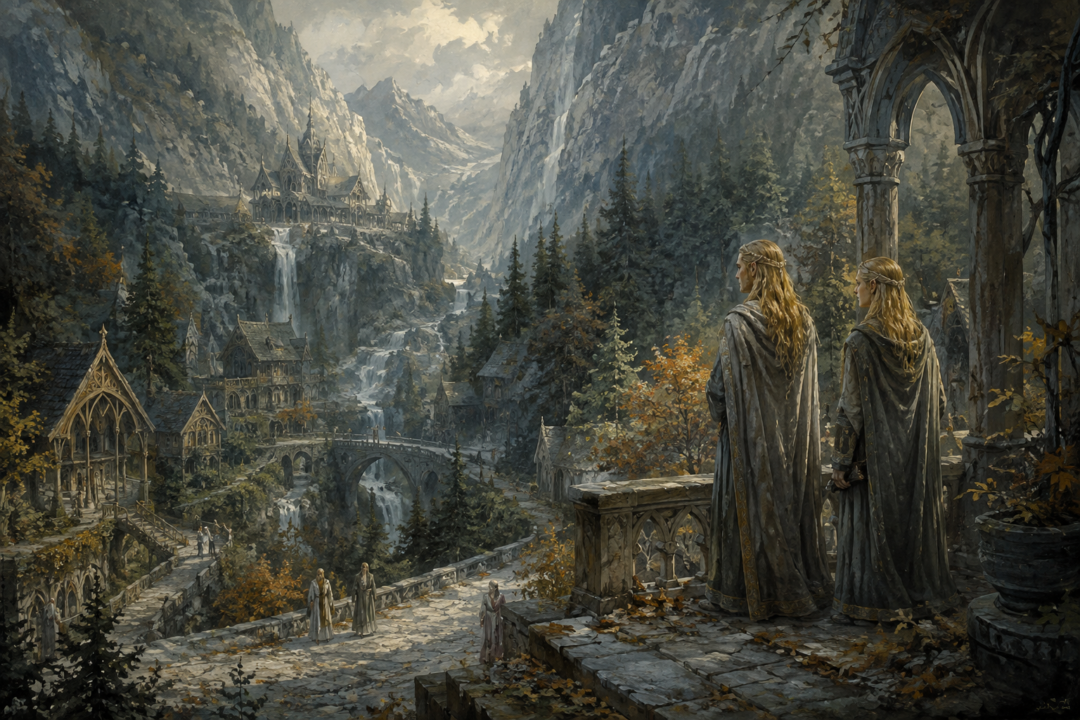
When the White Ship leaves the Grey Havens, it carries more than Frodo and Bilbo away from Middle-earth. Elrond, Galadriel, and Gandalf depart with them, and with Elrond and Galadriel go the keepers of Vilya and Nenya, two of the Three Rings of the Elves.
That seems to give Rivendell and Lothlórien the same fate. The One Ring has been destroyed. The Three have lost the power they possessed while the One endured. Their greatest keepers have sailed. The Age of the Elves is ending.
Yet the two realms do not fade in exactly the same way.
The later records in The Lord of the Rings show something easily overlooked: Elrond's departure does not immediately empty Rivendell. Elladan and Elrohir remain there, some of the High-elven folk remain with them, and eventually Celeborn himself comes to Imladris.
Lothlórien's decline is described differently. Celeborn remains in his lands for a few years after Galadriel's departure, but eventually grows weary and goes to Rivendell. Only a few of Lórien's former people linger, and Caras Galadhon loses the light and song that had defined it.
The difference is not that Vilya somehow continued working while Nenya failed. Both Rings had lost their preserving power. The deeper answer is that Rivendell could survive for a while as a household, refuge, and community even after its supernatural preservation ended, whereas the Lórien known by the Fellowship was extraordinarily bound to a condition of preservation that could no longer be maintained.
The Three Rings Could Not Preserve Either Realm Forever
The first point is crucial: Rivendell does not possess a magical loophole.
Elrond bears Vilya, the Ring of Air, while Galadriel bears Nenya, the Ring of Water. The Three were never touched by Sauron, but they were still subject to the fate of the One. Once the One Ring was destroyed, their power ended.
Galadriel had already warned Frodo of this consequence in Lothlórien. If the Quest succeeded, the power of the Three would diminish and the things maintained by them would fade. Victory over Sauron therefore contained a painful cost for the Elves: destroying the One also ended their ability to resist the ordinary changes of the world through the Three.
Rivendell therefore cannot endure because Vilya remains effective.
Elrond leaves precisely because his age in Middle-earth is finished.
The survival of Imladris after him must have another explanation.
Rivendell Was Older Than Elrond's Use of Vilya
Rivendell had already proved that it could exist as a defensible refuge before Elrond possessed Vilya.
Imladris was founded during the war between Sauron and the Elves in the Second Age, after Sauron's assault on Eregion. Elrond established a refuge there, and it became one of the great surviving centers of the Eldar in northwestern Middle-earth.
Only later did Gil-galad give Vilya to Elrond.
That chronology matters.
Vilya undoubtedly became enormously important to Elrond and his realm, and the texts associate the Three with preserving places against decay. But Rivendell was not created by Vilya. Its valley, buildings, people, traditions, and strategic position had an existence independent of the Ring.
When Vilya ceased to function, therefore, Imladris did not physically vanish.
What ended was the possibility of maintaining an Elvish refuge indefinitely against the fading and change of Middle-earth.
Rivendell could still have inhabitants tomorrow.
What it could no longer have was an endless tomorrow.
Lothlórien Had Become a Preserved World
The Fellowship experiences Lothlórien very differently.
When they enter the Golden Wood, they encounter something that feels almost removed from ordinary historical time. Frodo senses the extraordinary quality of the land, and Sam struggles to explain it afterward. Lórien seems ancient and immediate at once, as though the Elder Days have survived there instead of merely being remembered.
That impression is central to understanding its later fate.
Galadriel does not simply rule Lothlórien politically. Nenya is associated with her long resistance to change and decay, and Lórien is the clearest expression of that preservation.
This does not mean every tree or building in Lórien depended mechanically upon Nenya. The texts never establish such a simplistic rule. The Galadhrim were real inhabitants of a real woodland, and Lórien existed before Galadriel became its Lady.
But the extraordinary Lórien encountered by Frodo—the Golden Wood preserved with something of the beauty and memory of the Elder Days—could not remain what it had been once Nenya's power ended.
The War of the Ring saves Lórien from Sauron while simultaneously ending the conditions that allowed its distinctive preservation.
That is one of the quietest costs of victory.
Galadriel Leaves, but Celeborn Does Not
Another important detail complicates the idea that Lórien simply disappears in 3021.
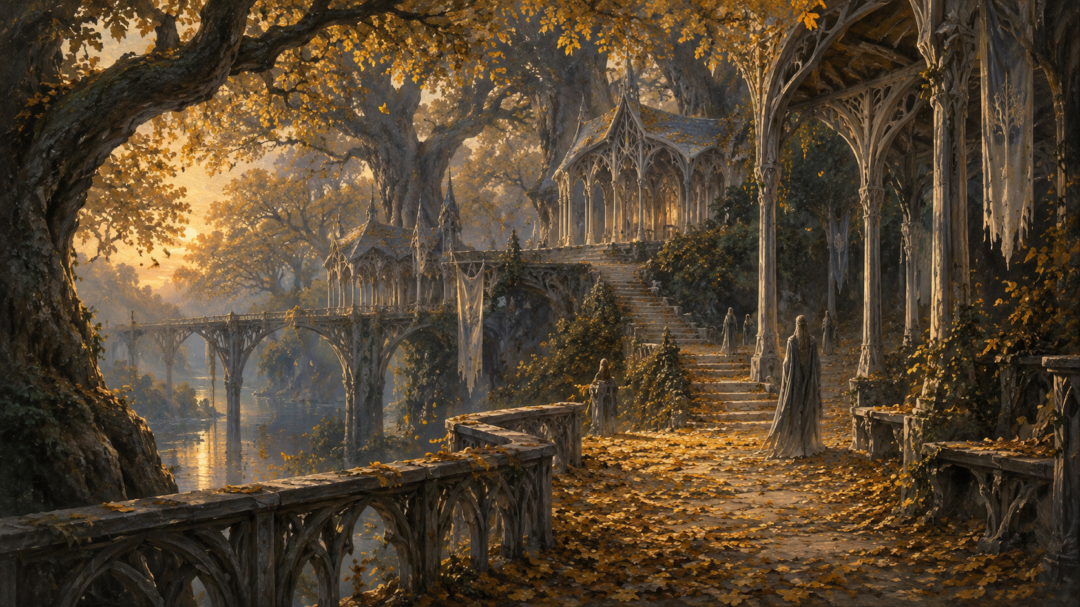
Celeborn does not sail with Galadriel.
After Sauron's defeat, Celeborn and the forces of Lórien cross the Anduin, take Dol Guldur, and cleanse the southern part of the forest from Sauron's occupation. Celeborn and Thranduil later meet and divide the renewed forest, now called Eryn Lasgalen. Celeborn takes its southern region, which is named East Lórien.
So Elvish life east of the mountains does continue.
But Appendix B gives the decisive development: after Galadriel's departure, Celeborn remains only for a few years before growing weary of his realm.
Then he goes west.
And his destination is Rivendell.
This reverses what a casual reader might expect. Elrond has departed, yet Elrond's house becomes the place where Celeborn chooses to spend part of his final period in Middle-earth.
Elrond Left Heirs Behind
The reason Rivendell remains viable becomes clearer in the later notes concerning the Shire records.
Elrond's sons, Elladan and Elrohir, do not sail with their father.
They remain in Rivendell for a long time, accompanied by some of the High-elven folk. Their ultimate choice between the fate of Elves and Men is never explicitly recorded in the published narrative, so it would be wrong to claim certainty about exactly when or how they departed.
But their continued presence matters enormously.
Elrond leaves behind adult sons who have lived in Imladris for nearly three thousand years.
They are not merely ceremonial heirs. During the War of the Ring they ride with the Grey Company, pass through the Paths of the Dead with Aragorn, fight in the southern campaign, and accompany the host to the Black Gate.
Rivendell therefore retains members of Elrond's own household capable of maintaining continuity after his departure.
The old lord is gone.
His house is not yet empty.
Rivendell Becomes a Refuge for the End of the Elven Age
Celeborn's decision makes the contrast sharper.
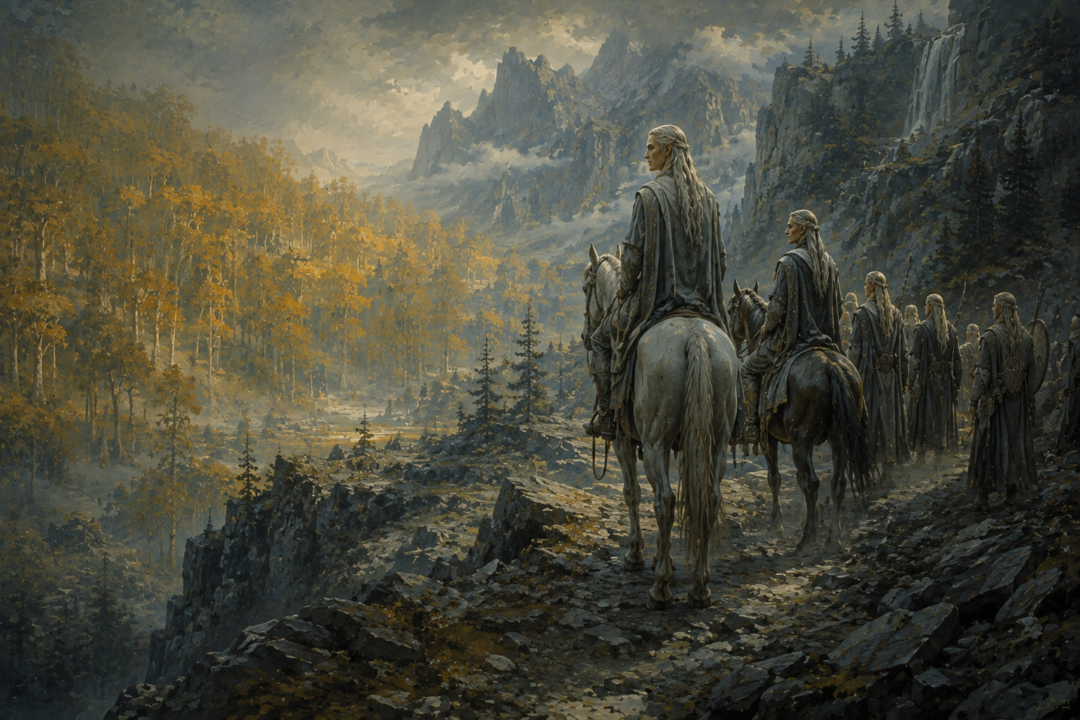
Instead of remaining indefinitely in the diminished Lórien, he goes to Imladris to dwell with his grandsons.
The surviving Rivendell therefore becomes something different from the great sanctuary seen earlier in the story.
It is no longer the protected seat of one of the Three.
It is no longer the place from which Elrond watches the long struggle against Sauron.
It is becoming a final gathering place for some of those who remain.
There is a fitting historical symmetry here. Rivendell was founded as a refuge during catastrophe in the Second Age. At the beginning of the Fourth, it again serves as a refuge—but now the danger is not an invading army.
It is departure itself.
The remaining Eldar are leaving Middle-earth, and Imladris can still shelter those who have not yet gone.
Lórien's Silence Is More Than Abandonment
The later description of Lothlórien is deliberately sorrowful.
Only a few of its former people linger, while Caras Galadhon no longer possesses its former light and song.
The significance is not necessarily that every Elf immediately leaves the entire region. The text explicitly says that some remain. Nor should the fading of Lórien be reduced entirely to the loss of Nenya, because Galadriel's departure, Celeborn's weariness, and the broader diminishing of the Eldar all belong to the same historical change.
But the center of the realm is clearly dying.
By the time Arwen returns to Lórien after Aragorn's death, the transformation is complete enough to be devastating. She goes to Cerin Amroth, the place where she and Aragorn had pledged themselves to one another, and there she dies.
The land is silent.
The living Elvish world that once surrounded that hill is gone.
Rivendell Does Not Escape the Same Fate
None of this means Rivendell survives permanently.
It does not.
Near the end of Aragorn's life, when he speaks his final words to Arwen, he refers to the garden of Elrond as a place where none now walk. Whatever exact sequence led to its abandonment, Rivendell too has ceased to be the inhabited refuge it once was.
That detail places an important boundary on the argument.
Rivendell does not defeat the fading.
It merely endures as a functioning Elvish dwelling for a time after Elrond's departure, supported by people and continuity rather than by the continuing power of Vilya.
Lothlórien also has survivors for a while, but its great center at Caras Galadhon declines rapidly after Galadriel's departure and Celeborn eventually abandons his eastern realm for Imladris.
The difference is therefore one of transition, not ultimate destiny.
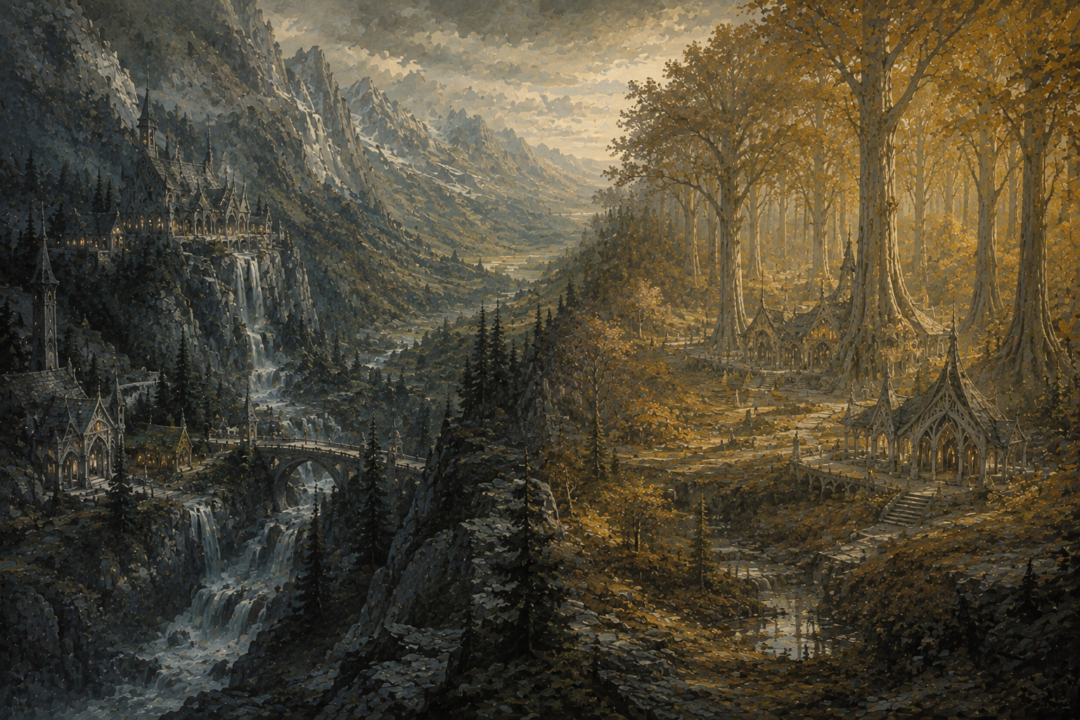
The Last Homely House Lives Up to Its Name One Final Time
There is something remarkably appropriate about Rivendell's final role.
Throughout its history, Imladris preserves things.
It shelters the heirs of Isildur. It keeps the shards of Narsil. Bilbo finds a home there. Frodo is healed there. Representatives of Elves, Dwarves, Men, and Hobbits meet there before the Quest of the Ring begins.
Even after Elrond sails, that function does not immediately disappear.
His sons remain.
Some High Elves remain.
Celeborn eventually comes.
Rivendell's last strength is therefore not that its magic survives longer than Lothlórien's. It does not.
Its strength is that the place can still serve its oldest purpose after the magic is gone.
For a little while longer, there is still a house in the hidden valley.
And in an age defined by departures, that is enough to make the Last Homely House one of the final homes of the Eldar in Middle-earth.
Sources & Notes
- Encyclopedia of Arda, “Rivendell” — history of Imladris as Elrond’s Second Age refuge, including its foundation and survival as a community: https://www.glyphweb.com/arda/r/rivendell.html
- Encyclopedia of Arda, “Lothlórien” — overview of the Golden Wood, Galadriel and Celeborn’s rule, and Lórien’s later fading and desertion: https://www.glyphweb.com/arda/l/lothlorien.html
- Encyclopedia of Arda, “Three Rings” — background on Vilya and Nenya and the loss of the Three Rings’ power after the One Ring’s destruction: https://www.glyphweb.com/arda/t/threerings.html
- Silmarillion Writers’ Guild, “Elladan and Elrohir” — sourced biography of Elrond’s sons and their continued association with Rivendell: https://www.silmarillionwritersguild.org/reference/characterofthemonth/elladan-elrohir.php
Sources cover the distinct post-Ring trajectories of Rivendell and Lothlórien, the Three Rings’ loss of power, and Elrond’s sons remaining at Imladris.